
Idioms are an integral part of the English language, adding color, depth, and nuance to our communication. Among the vast array of idioms, a specific subset focuses on expressing emphasis, highlighting the intensity or importance of a statement.
Mastering these idioms can significantly enhance your fluency and comprehension, allowing you to not only understand native speakers better but also express yourself more vividly. This guide is designed for English language learners of all levels, from beginners to advanced speakers, who wish to enrich their vocabulary and gain a deeper understanding of idiomatic expressions used for emphasis.
Table of Contents
- Definition of Idioms for Emphasis
- Structural Breakdown
- Types and Categories of Emphasis Idioms
- Examples of Idioms for Emphasis
- Usage Rules for Emphasis Idioms
- Common Mistakes with Emphasis Idioms
- Practice Exercises
- Advanced Topics
- Frequently Asked Questions
- Conclusion
Definition of Idioms for Emphasis
Idioms for emphasis are expressions whose meanings cannot be understood from the literal meanings of the individual words they comprise. Instead, they function as a unit to intensify a statement, convey a strong feeling, or underscore the significance of an event or situation.
Off to College Deals

Save up to 30% on everything you need for the semester.
Contains affiliate link
These idioms are crucial for adding emotional weight and impact to communication.
Classification
Emphasis idioms can be classified based on the type of feeling they convey, such as surprise, certainty, urgency, or importance. They can also be categorized by their structural form, such as phrasal verbs, prepositional phrases, or fixed expressions.
Function
The primary function of these idioms is to amplify the speaker’s point of view, making the message more compelling and memorable. They help convey the speaker’s attitude and emotional state, adding layers of meaning beyond the literal words used.
Contexts
Emphasis idioms are frequently used in informal settings, such as conversations with friends and family, but can also appear in more formal contexts, such as speeches and presentations, depending on the desired tone and audience. Their effectiveness lies in their ability to connect with listeners on an emotional level.
Structural Breakdown
The structure of emphasis idioms varies widely, but they often involve common grammatical elements combined in unique ways. Understanding these structures can aid in recognizing and interpreting these idioms.
Young Adults & Students:
Get 6 Months of Prime for $0

Ages 18-24 unlock exclusive perks including:
Contains affiliate link
Phrasal Verbs
Many emphasis idioms are phrasal verbs, consisting of a verb and a particle (preposition or adverb). The particle modifies the verb’s meaning, often creating a new, idiomatic sense. For example, “to drive home a point” means to emphasize a point forcefully.
Prepositional Phrases
Some emphasis idioms are prepositional phrases that add intensity to a statement. For instance, “in no uncertain terms” means to express something very clearly and forcefully.
Fixed Expressions
Other emphasis idioms are fixed expressions, meaning they have a set form and cannot be altered without losing their idiomatic meaning. An example is “without a shadow of a doubt,” which means with complete certainty.
Figurative Language
Emphasis idioms often employ figurative language, such as metaphors and similes, to create vivid and memorable images. This imagery enhances the impact of the message and engages the listener’s imagination. For example, “to move mountains” uses a metaphor to express the idea of overcoming great obstacles.
Types and Categories of Emphasis Idioms
Emphasis idioms can be categorized based on the specific emotion or intensity they convey. Here are several common categories:
Idioms of Certainty
These idioms express a strong belief or conviction about something. They leave no room for doubt or uncertainty.
Idioms of Surprise
These idioms convey a sense of astonishment or disbelief. They indicate that something is unexpected or remarkable.
Idioms of Urgency
These idioms emphasize the need for immediate action or attention. They convey a sense of importance and demand prompt response.
Idioms of Importance
These idioms highlight the significance or value of something. They indicate that something is particularly noteworthy or deserving of attention.
Idioms of Degree
These idioms emphasize the extent or intensity of something. They convey a sense of scale or magnitude.
Examples of Idioms for Emphasis
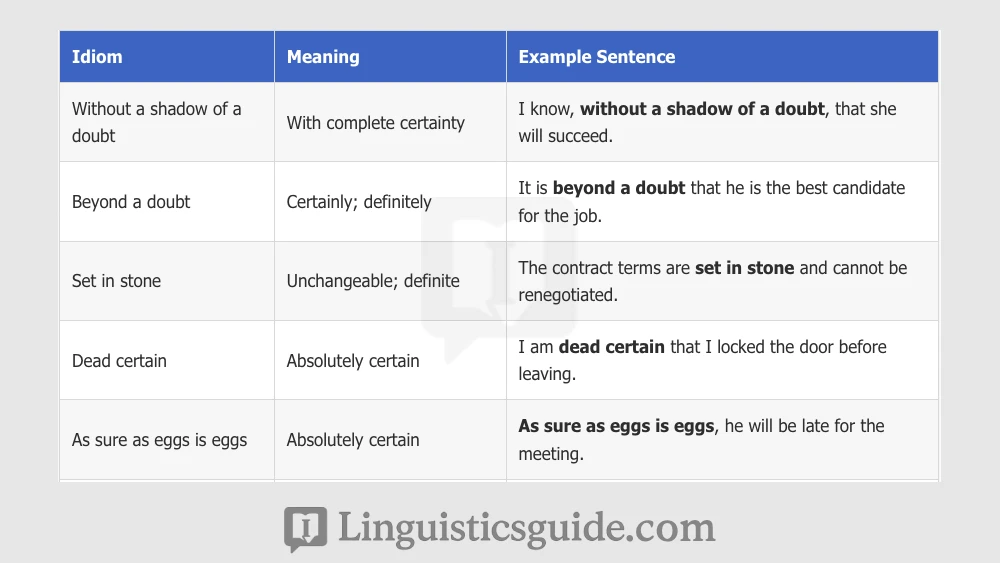
Here are some examples of idioms for emphasis, categorized by their function. Each table provides multiple examples to illustrate the usage and meaning of these idioms.
Idioms of Certainty Examples
The following table provides examples of idioms that express certainty. These idioms are used to show a strong belief or conviction about something.
| Idiom | Meaning | Example Sentence |
|---|---|---|
| Without a shadow of a doubt | With complete certainty | I know, without a shadow of a doubt, that she will succeed. |
| Beyond a doubt | Certainly; definitely | It is beyond a doubt that he is the best candidate for the job. |
| Set in stone | Unchangeable; definite | The contract terms are set in stone and cannot be renegotiated. |
| Dead certain | Absolutely certain | I am dead certain that I locked the door before leaving. |
| As sure as eggs is eggs | Absolutely certain | As sure as eggs is eggs, he will be late for the meeting. |
| Bet your bottom dollar | Absolutely certain | You can bet your bottom dollar that the sun will rise tomorrow. |
| In the bag | Assured of success | With a ten-point lead, the victory is in the bag. |
| Nailed it | To do something perfectly | She nailed the presentation; everyone was impressed. |
| For sure | Definitely | Are you coming to the party? For sure! |
| No question about it | Undoubtedly | He’s the best player on the team, no question about it. |
| Take it to the bank | Absolutely certain; guaranteed | If he promises to help, you can take it to the bank. |
| You can bet on it | Definitely | Will they win the game? You can bet on it. |
| Positively | With certainty | Are you sure you saw him? Positively! |
| Definitely | Without doubt | I will definitely be there on time. |
| Assuredly | Certainly | He will assuredly succeed with his hard work. |
| Without fail | Certainly; always | She calls her mother without fail every Sunday. |
| Undeniably | In a way that cannot be denied | His talent is undeniably impressive. |
| Indisputably | Beyond question or argument | The evidence is indisputably in his favor. |
| Undoubtedly | Without doubt; certainly | He is undoubtedly the best candidate. |
| Certainly | Without doubt; definitely | I will certainly be there to support you. |
Idioms of Surprise Examples
The following table provides examples of idioms that express surprise. These idioms are used to show astonishment or disbelief.
| Idiom | Meaning | Example Sentence |
|---|---|---|
| Knock me over with a feather | To be greatly surprised | If she actually agrees to go out with him, you could knock me over with a feather. |
| I’ll be a monkey’s uncle | An expression of surprise or disbelief | I’ll be a monkey’s uncle if he manages to finish the project on time. |
| Well, I never! | An expression of surprise or shock | Well, I never! I didn’t expect to see you here. |
| You could have knocked me down with a feather | To be extremely surprised | When I heard the news, you could have knocked me down with a feather. |
| Blow me down! | An expression of surprise or astonishment | Blow me down! I didn’t think they would actually win. |
| My jaw dropped | To be very surprised | When he proposed, my jaw dropped. |
| I was floored | To be extremely surprised or shocked | I was floored when I heard the news. |
| Out of the blue | Unexpectedly | He called me out of the blue after many years. |
| To my surprise | Unexpectedly | To my surprise, he agreed to help. |
| Fancy that! | An expression of surprise | Fancy that! I didn’t expect to see you here. |
| What a surprise! | An expression of astonishment | What a surprise! I never thought you’d come. |
| Believe it or not | Used to introduce a surprising statement | Believe it or not, he finished the marathon. |
| Get out of here! | An expression of disbelief or surprise | Get out of here! Are you serious? |
| No way! | An expression of disbelief or surprise | No way! Did you really win the lottery? |
| I can’t believe it! | An expression of disbelief or surprise | I can’t believe it! We actually won! |
| That’s a shocker! | A surprising or shocking event | His resignation was a real shocker. |
| I’m speechless! | Unable to speak due to surprise | I’m speechless! I don’t know what to say. |
| That takes the cake! | That’s the most surprising thing | His behavior takes the cake! |
| Who would have thought? | An expression of surprise | Who would have thought that he would become so successful? |
| Of all things! | An expression of surprise or annoyance | Of all things! He forgot his wallet. |
Idioms of Urgency Examples
The following table provides examples of idioms that express urgency. These idioms are used to emphasize the need for immediate action.
| Idiom | Meaning | Example Sentence |
|---|---|---|
| Time is of the essence | It is crucial to act quickly | Time is of the essence; we need to start the project immediately. |
| Hurry up | Act quickly | Hurry up, or we’ll miss the train. |
| Get a move on | Start acting more quickly | Get a move on; we don’t have all day. |
| Chop chop | Do something quickly | Chop chop, let’s get this done. |
| Shake a leg | Hurry up | Shake a leg, we’re going to be late. |
| Get cracking | Start working quickly | Let’s get cracking on this report. |
| On the double | Very quickly | I need that report on the double. |
| Make haste | Hurry | Make haste, we have to leave now. |
| Without delay | Immediately | Respond to this email without delay. |
| Right away | Immediately | I’ll do it right away. |
| Pronto | Quickly; immediately | I need that information pronto. |
| At once | Immediately | Come here at once. |
| Posthaste | With great speed or urgency | Send the message posthaste. |
| Look sharp | Be quick and alert | Look sharp, we need to finish this quickly. |
| Snap to it | Hurry up and get to work | Snap to it, we have a lot to do. |
| Get your skates on | Hurry up | Get your skates on, we’re leaving soon. |
| Step on it | Hurry up | Step on it, we’re late. |
| Pick up the pace | Increase speed | Pick up the pace, we need to finish faster. |
| Move it | Hurry up | Move it, let’s go! |
| Now or never | The present is the only opportunity | It’s now or never to seize this opportunity. |
Idioms of Degree
The following table provides examples of idioms that express degree. These idioms are used to emphasize the extent or intensity of something.
| Idiom | Meaning | Example Sentence |
|---|---|---|
| A great deal | A lot | He has learned a great deal about the subject. |
| A world of difference | A significant difference | There’s a world of difference between the two options. |
| By leaps and bounds | Rapidly; greatly | Her skills have improved by leaps and bounds. |
| Head and shoulders above | Much better than | He is head and shoulders above the other candidates. |
| In spades | To a great degree | He has talent in spades. |
| Over the top | Excessive | His reaction was a little over the top. |
| To the hilt | To the fullest extent | He supported her to the hilt. |
| Up to a point | To some extent | I agree with you up to a point. |
| In full swing | Fully active or operational | The party was in full swing by midnight. |
| All out | Using all one’s resources or efforts | They went all out to win the competition. |
| Full throttle | At maximum speed or intensity | The project is moving forward at full throttle. |
| To the max | To the maximum extent | I’m stressed to the max right now. |
| In the extreme | To a very great degree | His behavior was in the extreme unacceptable. |
| A bit much | Slightly excessive | His criticism was a bit much. |
| Quite a bit | A significant amount | He spent quite a bit of money on the trip. |
| A good deal | A considerable amount | We saved a good deal of time using the new software. |
| Tons of | A lot of | There are tons of opportunities to learn and grow here. |
| Loads of | A great amount of | He has loads of experience in this field. |
| Heaps of | A large amount of | We have heaps of work to do. |
| Oodles of | A very large quantity of | There are oodles of reasons to love this place. |
Usage Rules for Emphasis Idioms
Using emphasis idioms correctly requires understanding their specific meanings and contexts. Here are some key rules to follow:
Contextual Appropriateness
Consider the audience and setting when using emphasis idioms. Some idioms may be too informal for formal situations.
Ensure that the idiom fits the tone and purpose of your communication.
Literal vs. Idiomatic Meaning
Always remember that idioms have a figurative meaning that differs from the literal meaning of the individual words. Using the literal meaning can lead to confusion and miscommunication.
Grammatical Structure
Maintain the correct grammatical structure of the idiom. Altering the word order or substituting words can change the meaning or render the idiom nonsensical.
Cultural Sensitivity
Be aware that some idioms may have cultural connotations or origins that are not universally understood. Avoid using idioms that may be offensive or insensitive to certain groups.
Common Mistakes with Emphasis Idioms
Learners often make mistakes when using emphasis idioms due to misunderstanding their meanings or misapplying their grammatical structures. Here are some common errors to avoid:
Literal Interpretation
Incorrect: “He drove the nail into the point.” (Literal interpretation of “drive home a point”)
Correct: “He drove home the point with a strong argument.”
Misunderstanding the Meaning
Incorrect: “I’m sure there’s a shadow of a doubt about it.” (Misunderstanding “without a shadow of a doubt”)
Correct: “I’m sure there’s without a shadow of a doubt about it.”
Incorrect Word Order
Incorrect: “The essence of is time.” (Incorrect word order of “time is of the essence”)
Correct: “Time is of the essence.”
Using in Formal Contexts
Incorrect: “The CEO told the board to get cracking on the new strategy.” (Too informal for a board meeting)
Correct: “The CEO urged the board to begin working on the new strategy immediately.”
Practice Exercises
Test your understanding of emphasis idioms with these practice exercises. Choose the correct idiom to complete each sentence.
Exercise 1: Certainty Idioms
Complete the following sentences with the correct idiom of certainty.
| Question | Answer |
|---|---|
| I know, ________, that she will pass the exam. | without a shadow of a doubt |
| It is ________ that he is the right person for the job. | beyond a doubt |
| The terms of the agreement are ________ and cannot be changed. | set in stone |
| I am ________ that I locked the door. | dead certain |
| ________, he will be late. | As sure as eggs is eggs |
| You can ________ that the sun will rise tomorrow. | bet your bottom dollar |
| With a significant lead, the victory is ________. | in the bag |
| She ________ the presentation, impressing everyone. | nailed |
| Are you coming to the party? ________! | For sure |
| He’s the best candidate, ________. | no question about it |
Exercise 2: Surprise Idioms
Complete the following sentences with the correct idiom of surprise.
| Question | Answer |
|---|---|
| If he wins the lottery, you could ________. | knock me over with a feather |
| ________ if she actually agrees to go on a date with him. | I’ll be a monkey’s uncle |
| ________! I didn’t expect to see you here. | Well, I never! |
| When she told me she was pregnant, ________. | you could have knocked me down with a feather |
| ________! I didn’t think they would win. | Blow me down! |
| When he proposed, ________. | my jaw dropped |
| I ________ when I heard the news. | was floored |
| He called me ________ after many years. | out of the blue |
| ________, he agreed to help. | To my surprise |
| ________! I didn’t expect to see you. | Fancy that! |
Exercise 3: Urgency Idioms
Complete the following sentences with the correct idiom of urgency.
| Question | Answer |
|---|---|
| ________; we need to act quickly. | Time is of the essence |
| ________, or we’ll miss the bus. | Hurry up |
| ________; we don’t have all day. | Get a move on |
| ________, let’s finish this quickly. | Chop chop |
| ________, we’re going to be late. | Shake a leg |
| Let’s ________ on this project. | get cracking |
| I need that report ________. | on the double |
| ________, we have to leave now. | Make haste |
| Respond to this email ________. | without delay |
| I’ll do it ________. | right away |
Advanced Topics
For advanced learners, exploring the etymology and historical context of emphasis idioms can provide a deeper understanding of their usage and cultural significance. Additionally, analyzing how these idioms are translated and adapted in different languages can offer insights into cross-cultural communication.
Frequently Asked Questions
- What is an idiom for emphasis?
An idiom for emphasis is a phrase or expression whose meaning cannot be understood from the literal meanings of its individual words. It is used to intensify a statement, convey a strong feeling, or underscore the importance of something.
- Why are idioms for emphasis important?
These idioms add color, depth, and emotional weight to communication. They help convey the speaker’s attitude and make the message more compelling and memorable.
- How can I learn more idioms for emphasis?
Read widely, listen to native speakers, and pay attention to the context in which idioms are used. Keep a vocabulary notebook and practice using new idioms in your own speech and writing.
- Are idioms for emphasis used in formal writing?
Some idioms are appropriate for formal writing, while others are more suitable for informal contexts. Consider the audience and purpose of your writing when choosing idioms.
- Can I translate idioms for emphasis literally?
No, idioms cannot be translated literally. Their meaning is figurative and may not have a direct equivalent in other languages. It’s important to understand the intended meaning and find a corresponding expression in the target language.
- What are some common mistakes to avoid when using emphasis idioms?
Avoid interpreting idioms literally, misusing their grammatical structure, and using them in inappropriate contexts. Always double-check the meaning and usage of an idiom before using it.
- How do I know if an expression is an idiom?
If the meaning of a phrase is different from the literal meanings of the individual words, it is likely an idiom. Additionally, idioms are often fixed expressions that cannot be altered without losing their idiomatic meaning.
- Are there regional variations in the use of emphasis idioms?
Yes, many idioms are specific to certain regions or dialects. Be aware of these variations and use idioms that are appropriate for your audience and context.
- How can I improve my ability to understand idioms in spoken English?
Listen to a variety of spoken English sources, such as podcasts, movies, and TV shows. Pay attention to how native speakers use idioms in conversation and try to guess their meaning from the context. Don’t be afraid to ask for clarification if you’re unsure.
- Is it okay to use idioms in business communication?
Yes, but use them judiciously. In formal business communication, it’s best to use idioms sparingly and only when they add clarity or emphasis. Avoid using idioms that are too informal or culturally specific.
Conclusion
Mastering idioms for emphasis is a valuable step in achieving fluency and sophistication in English. These expressions add depth and color to your communication, allowing you to express yourself more vividly and connect with others on an emotional level.
By understanding the definitions, structures, and usage rules of these idioms, you can avoid common mistakes and use them effectively in a variety of contexts. Continue to practice and expand your knowledge of idioms to further enhance your language skills.

I’m James Terban, a teacher with a degree in Education and five years of experience working with students of all ages, from young kids learning their first grammar rules to adults picking up English as a second language. I started Linguistics Guide because I kept seeing good learners hit a wall due to explanations that were either too vague or too complicated. Every article here comes from a real question I have heard in a classroom or seen asked online.