
Understanding idioms is crucial for mastering English because they add color, nuance, and cultural context to communication. Idioms that describe tiredness are particularly useful in everyday conversation, allowing you to express varying degrees of exhaustion in a vivid and relatable way.
This article provides a comprehensive guide to these idioms, exploring their meanings, origins, and usage. Whether you’re an ESL student aiming for fluency or a native speaker looking to enrich your vocabulary, this guide will enhance your understanding and use of English idioms.
This article is designed for English language learners of all levels, from beginners to advanced students, as well as native English speakers who want to expand their vocabulary and improve their understanding of idiomatic expressions. By the end of this article, you will be able to recognize, understand, and appropriately use a variety of idioms related to tiredness, making your communication more effective and engaging.

Table of Contents
- Introduction
- Definition of Idioms for Tired
- Structural Breakdown of Idioms
- Types and Categories of Tired Idioms
- Examples of Idioms for Tired
- Usage Rules for Tired Idioms
- Common Mistakes with Tired Idioms
- Practice Exercises
- Advanced Topics: Nuances and Regional Variations
- FAQ: Frequently Asked Questions
- Conclusion
Definition of Idioms for Tired
An idiom is a phrase or expression whose meaning cannot be understood from the literal meanings of its individual words. Instead, an idiom has a figurative meaning that is specific to a particular language or culture.
Idioms related to tiredness are phrases that describe various states of fatigue, exhaustion, or weariness in a non-literal way. These idioms often use metaphors or similes to convey the intensity of the feeling.
These idioms can be classified based on their intensity (mildly tired to completely exhausted), their figurative source (e.g., animal metaphors, physical metaphors), or their specific connotation (e.g., physically tired, mentally tired). Understanding these classifications helps in choosing the most appropriate idiom for a given situation.
Classification of Tired Idioms
- Intensity: Ranging from slightly tired to completely drained.
- Figurative Source: Metaphors drawn from animals, objects, or physical actions.
- Connotation: Describing physical, mental, or emotional tiredness.
Function of Tired Idioms
The primary function of idioms for tired is to express the state of being tired in a more colorful and relatable way than simply saying “I am tired.” They add emphasis, emotion, and cultural context to the communication, making it more engaging for the listener or reader. Idioms can also convey the degree and type of tiredness more precisely.
Contexts for Using Tired Idioms
Tired idioms are appropriate in a wide range of contexts, from casual conversations to informal writing. They are commonly used in everyday speech, personal emails, and informal blogs or articles.
However, it’s important to consider the audience and the level of formality before using idioms, as they may not be suitable for formal or professional settings.
Structural Breakdown of Idioms
Idioms often follow unique structural patterns that deviate from standard grammatical rules. Understanding these patterns is essential for both recognizing and using idioms correctly.
Many idioms are fixed expressions, meaning that their word order and grammatical structure cannot be changed without altering their meaning or making them sound unnatural.
The structural elements may include verbs, nouns, adjectives, and prepositions, often combined in ways that create a non-literal meaning. For example, the idiom “to be dead tired” combines the verb “to be” with the adjective “dead” and “tired” to create a stronger expression of fatigue.
The structure itself contributes to the overall impact of the idiom.
Common Structural Patterns
- Verb + Adjective: To be dead tired, to feel drained
- Verb + Preposition + Noun: To run out of steam, to be at the end of one’s rope
- Similes: As tired as a dog, like a zombie
- Metaphors: To hit a wall, to be running on fumes
Rules and Constraints
While idioms are often fixed expressions, some allow for slight variations in tense or number. For example, “I am running on fumes” can be changed to “He was running on fumes” or “We are running on fumes” to reflect different subjects and tenses.
However, more significant alterations can destroy the idiom’s meaning. The key is to maintain the core words and structure while adapting the idiom to fit the specific context.
Types and Categories of Tired Idioms
Idioms for tiredness can be categorized based on the intensity of the fatigue they describe, the type of figurative language they employ, or the specific aspect of tiredness they emphasize (physical, mental, or emotional). Understanding these categories can help you choose the most appropriate idiom to express your level of exhaustion.
Intensity Levels of Tiredness
- Mildly Tired: Indicates a slight feeling of fatigue.
- Moderately Tired: Describes a noticeable level of weariness.
- Extremely Tired: Conveys a state of complete exhaustion.
Types of Figurative Language
- Similes: Use “like” or “as” to compare tiredness to something else.
- Metaphors: Directly equate tiredness to something else without using “like” or “as.”
- Hyperboles: Use exaggeration to emphasize the feeling of tiredness.
Aspects of Tiredness
- Physical Tiredness: Describes fatigue related to physical exertion.
- Mental Tiredness: Describes fatigue related to mental effort or stress.
- Emotional Tiredness: Describes fatigue related to emotional stress or trauma.
Examples of Idioms for Tired
This section provides a comprehensive list of idioms related to tiredness, categorized by their intensity level. Each example includes the idiom, its meaning, and example sentences to illustrate its usage.
By understanding these examples, you can effectively incorporate these idioms into your own speech and writing.
Mildly Tired Idioms
These idioms describe a slight feeling of fatigue, often after a long day or a period of moderate exertion. They are suitable for casual conversations and informal writing where you want to express that you are somewhat tired, but not completely exhausted.
They convey a sense of weariness without being overly dramatic.
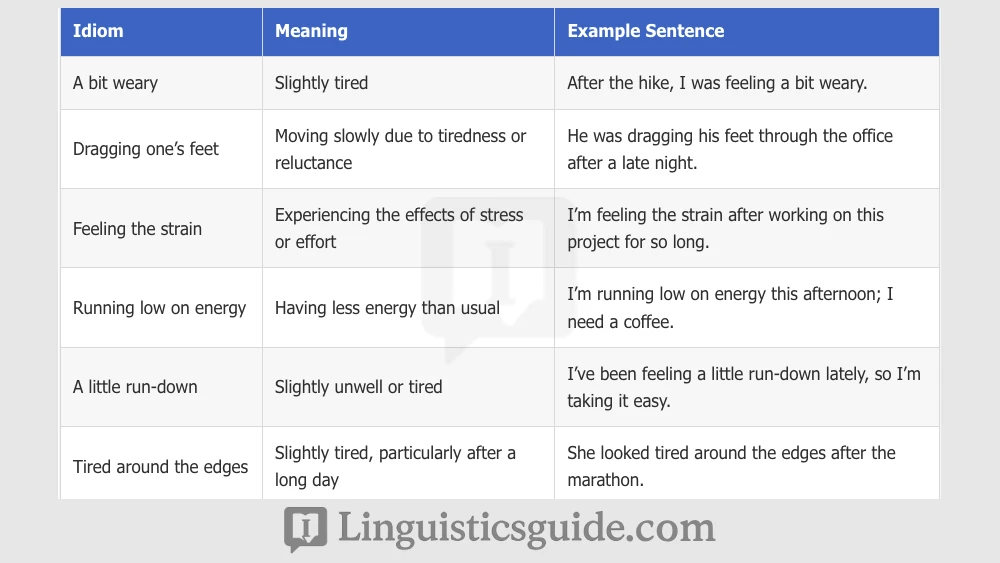
The following table provides 25 examples of idioms that describe mild tiredness, along with their meanings and example sentences:
| Idiom | Meaning | Example Sentence |
|---|---|---|
| A bit weary | Slightly tired | After the hike, I was feeling a bit weary. |
| Dragging one’s feet | Moving slowly due to tiredness or reluctance | He was dragging his feet through the office after a late night. |
| Feeling the strain | Experiencing the effects of stress or effort | I’m feeling the strain after working on this project for so long. |
| Running low on energy | Having less energy than usual | I’m running low on energy this afternoon; I need a coffee. |
| A little run-down | Slightly unwell or tired | I’ve been feeling a little run-down lately, so I’m taking it easy. |
| Tired around the edges | Slightly tired, particularly after a long day | She looked tired around the edges after the marathon. |
| Not firing on all cylinders | Not performing at one’s best due to tiredness | I’m not firing on all cylinders today because I didn’t sleep well. |
| Slightly flagging | Becoming less energetic | My energy was slightly flagging by the end of the meeting. |
| Running on empty | Continuing to function despite feeling tired | I’m running on empty, but I need to finish this report. |
| Feeling a bit drained | Experiencing a slight loss of energy | I’m feeling a bit drained after that presentation. |
| Feeling the weight of the day | Feeling tired after the day’s activities | I’m feeling the weight of the day; I need to relax. |
| Knackered | Very tired (British English) | After the football match, I was absolutely knackered. |
| Pooped | Tired (informal) | I’m pooped after all that cleaning. |
| Worn out | Tired from use or activity | The kids were worn out after playing in the park. |
| Feeling beat | Feeling tired or exhausted | I’m feeling beat after working overtime. |
| A little fatigued | Slightly tired or lacking energy | I’m a little fatigued after my workout. |
| Out of gas | Lacking energy or motivation | I’m out of gas; I need a break. |
| Running on fumes | Continuing to function with very little energy | I’m running on fumes but I have to finish this. |
| Tired but happy | Tired but content | I’m tired but happy after our hiking trip. |
| A bit tuckered out | Slightly tired (informal) | I’m a bit tuckered out after the long drive. |
| Low on juice | Lacking energy (informal) | I’m low on juice; let’s get some coffee. |
| Feeling sluggish | Feeling slow and lacking energy | I’m feeling sluggish today; I need to exercise. |
| A little weary | Slightly tired | I’m a little weary after all that walking. |
| Spent | Having no energy left | I’m spent after the marathon. |
| Drained | Feeling emptied of energy | I’m drained after my work day. |
Moderately Tired Idioms
These idioms describe a noticeable level of weariness, often after a significant amount of physical or mental exertion. They are suitable for situations where you want to express that you are quite tired and need to rest.
These idioms convey a stronger sense of fatigue compared to the mildly tired idioms.
The following table provides 25 examples of idioms that describe moderate tiredness, along with their meanings and example sentences:
| Idiom | Meaning | Example Sentence |
|---|---|---|
| Beat | Very tired | I’m beat after working all day. |
| Dragging | Feeling tired and slow | I’m dragging today because I didn’t get enough sleep. |
| Dog-tired | Extremely tired | I’m dog-tired after the hike. |
| Feeling it | Feeling the effects of exertion | I’m really feeling it after that workout. |
| Fried | Exhausted | My brain is fried after studying all night. |
| Knocked out | Extremely tired | I was knocked out after the long flight. |
| Out on one’s feet | Extremely tired and unable to stand | I was out on my feet by the end of the day. |
| Pooped out | Very tired | I’m pooped out after the gardening. |
| Shattered | Extremely tired (British English) | I’m shattered after the journey. |
| Wiped out | Completely exhausted | I’m wiped out after the marathon. |
| Run ragged | Exhausted from being overworked | The kids have run me ragged all day. |
| Ready to drop | Extremely tired and about to collapse | I’m ready to drop after all this work. |
| Feeling the pinch | Feeling the strain or pressure | I’m feeling the pinch of working two jobs. |
| Burning the candle at both ends | Working very hard and not getting enough rest | He’s been burning the candle at both ends to finish the project. |
| Running on fumes | Operating with very little energy | I’m running on fumes, but I need to complete this task. |
| Hit the wall | Reached a point where one can’t continue due to exhaustion | I hit the wall during the marathon. |
| Feeling the weight of the world | Feeling overwhelmed and exhausted | I’m feeling the weight of the world on my shoulders. |
| Running out of steam | Losing energy or motivation | I’m running out of steam on this project. |
| Tired to the bone | Extremely tired | I’m tired to the bone after working the fields. |
| Drained of energy | Completely lacking energy | I’m drained of energy after my workout. |
| Burnt out | Exhausted from prolonged stress | I’m burnt out from my job. |
| Feeling zapped | Feeling drained of energy | I’m feeling zapped after the presentation. |
| Like death warmed over | Looking and feeling very unwell or tired | I feel like death warmed over after staying up all night. |
| On one’s last legs | Close to collapse due to tiredness | I’m on my last legs after this long day. |
| Running on empty | Operating with very little energy | I’m running on empty, but I need to finish this. |
Extremely Tired Idioms
These idioms describe a state of complete exhaustion, often after extreme physical or mental exertion. They are suitable for situations where you want to emphasize just how tired you are.
These idioms convey the strongest sense of fatigue and are often used for dramatic effect.
The following table provides 25 examples of idioms that describe extreme tiredness, along with their meanings and example sentences:
| Idiom | Meaning | Example Sentence |
|---|---|---|
| Dead tired | Extremely tired | I’m dead tired after the marathon. |
| Flat out | Completely exhausted | I was flat out after the race. |
| Knackered | Extremely tired (British English) | After the football match, I was absolutely knackered. |
| Shattered | Extremely tired (British English) | I’m shattered after the journey. |
| Wiped out | Completely exhausted | I’m wiped out after the marathon. |
| Absolutely cream crackered | Extremely tired (British slang) | I’m absolutely cream crackered after all that work! |
| Bushed | Extremely tired (Australian/New Zealand slang) | I’m completely bushed after the hike. |
| All in | Completely exhausted | I’m all in after the long day at work. |
| Fagged out | Extremely tired (offensive in some contexts) | I’m fagged out after all that gardening. |
| Kaput | Finished, broken down, or exhausted | I’m kaput after the intense training session. |
| Like a zombie | Moving slowly and lifelessly due to tiredness | I feel like a zombie after staying up all night. |
| Out for the count | Completely exhausted and asleep | I was out for the count as soon as my head hit the pillow. |
| Run into the ground | Exhausted from overwork | They’ve run me into the ground at this job. |
| Totally zonked | Extremely tired | I’m totally zonked after the all-nighter. |
| At the end of one’s tether | Having no strength or patience left | I’m at the end of my tether with this project. |
| Drained beyond measure | Completely emptied of energy | I’m drained beyond measure after the ordeal. |
| Feeling like a wrung-out dishrag | Feeling completely exhausted and limp | I feel like a wrung-out dishrag after that performance. |
| Running on fumes | Operating with very little energy left | I’m running on fumes, just trying to get through the day. |
| Sapped of all energy | Completely devoid of energy | I’m sapped of all energy after the illness. |
| Tired as a log | Extremely tired | I’m as tired as a log after that long hike. |
| In need of some ZZZs | In need of sleep | After such a hard day at work, I’m in need of some ZZZs. |
| Burnt to a crisp | Completely exhausted and burnt out | I feel burnt to a crisp after working all night. |
| Completely frazzled | Extremely tired and stressed | I am completely frazzled after dealing with all those customers. |
| Done for the day | Completely exhausted and finished working | I am done for the day; I can’t do any more. |
| Like a bear with a sore head | Irritable and tired | After not getting enough sleep, I feel like a bear with a sore head. |
Usage Rules for Tired Idioms
Using idioms correctly requires an understanding of their specific meanings, contexts, and grammatical structures. While most idioms are relatively fixed, some allow for slight variations in tense or number.
It’s crucial to use idioms in appropriate situations to avoid sounding unnatural or confusing your audience.
Context and Appropriateness
Consider the formality of the situation and the audience when using idioms. Avoid using overly casual or slangy idioms in formal settings, such as business meetings or academic papers.
Choose idioms that are appropriate for the age, background, and cultural understanding of your audience.
Grammatical Accuracy
Ensure that you use the correct tense, number, and word order when using idioms. While some idioms can be adapted to fit different grammatical contexts, others are fixed expressions that must be used exactly as they are.
Pay close attention to the grammatical structure of each idiom to avoid making errors.
Regional Variations
Be aware of regional variations in idiom usage. Some idioms are more common in certain English-speaking countries or regions than others.
Using an idiom that is unfamiliar to your audience can lead to confusion or misunderstanding. If you are unsure about the regional appropriateness of an idiom, it’s best to avoid using it.
Common Mistakes with Tired Idioms
One common mistake is misinterpreting the meaning of an idiom and using it in an inappropriate context. Another common error is altering the structure of an idiom, which can change its meaning or make it sound unnatural.
Additionally, using idioms that are not widely understood by your audience can lead to confusion.
Here are some examples of common mistakes and their corrections:
| Incorrect | Correct | Explanation |
|---|---|---|
| I’m feeling like a dead horse. | I’m feeling as tired as a horse. | The correct idiom is “as tired as a horse,” not “like a dead horse.” |
| He is running of steam. | He is running out of steam. | The correct idiom is “running out of steam,” not “running of steam.” |
| She was wiped from the marathon. | She was wiped out after the marathon. | The correct idiom is “wiped out,” not “wiped from.” |
| I’m feeling the world’s weight. | I’m feeling the weight of the world. | The correct idiom is “the weight of the world,” not “the world’s weight.” |
| He burned the candle from both edges. | He burned the candle at both ends. | The correct idiom is “at both ends,” not “from both edges.” |
Practice Exercises
These exercises will help you practice using idioms for tired correctly. Complete the sentences using the most appropriate idiom from the list provided.
These exercises are designed to reinforce your understanding of the meanings and contexts of the idioms discussed in this article.
Instructions: Choose the correct idiom from the word bank to complete each sentence.
Word Bank: dead tired, running on fumes, a bit weary, feeling the strain, wiped out, dog-tired, ready to drop, burning the candle at both ends, tired to the bone, out of gas
| Question | Answer |
|---|---|
| 1. After working two jobs and taking care of the kids, she’s always __________. | burning the candle at both ends |
| 2. I’m _________ after that intense workout; I need to sit down. | ready to drop |
| 3. He’s been _________ lately, so he’s taking a vacation. | feeling the strain |
| 4. I’m _________ after that long hike; I can barely move. | dog-tired |
| 5. After studying all night, I’m _________ and can barely think straight. | dead tired |
| 6. I’m just _________ trying to finish this project before the deadline. | running on fumes |
| 7. After a full day of meetings, I’m _________. | a bit weary |
| 8. She was _________ after the marathon and could barely walk. | wiped out |
| 9. I’m _________ after working in the fields all day. | tired to the bone |
| 10. I’m _________ and need to recharge before I can do anything else. | out of gas |
Instructions: Rewrite the following sentences using idioms for tired.
| Question | Answer |
|---|---|
| 1. I am very tired after the long journey. | I am shattered after the long journey. |
| 2. She is exhausted from working too hard. | She is burning the candle at both ends. |
| 3. I have no energy left after the workout. | I am completely out of gas after the workout. |
| 4. He feels worn out after taking care of the children all day. | He feels run ragged after taking care of the children all day. |
| 5. I am extremely tired after staying up all night. | I feel like a zombie after staying up all night. |
| 6. She’s slightly tired after the meeting. | She’s a bit weary after the meeting. |
| 7. He is extremely exhausted after the race. | He is wiped out after the race. |
| 8. I’m really feeling the effects of that tough class. | I’m really feeling it after that tough class. |
| 9. I can’t go on with this job due to so much stress. | I’m at the end of my tether with this job. |
| 10. I am very tired after working all night. | I am dead tired after working all night. |
Advanced Topics: Nuances and Regional Variations
For advanced learners, understanding the subtle nuances and regional variations of idioms for tired can significantly enhance their command of the English language. This involves recognizing the emotional undertones, cultural contexts, and geographical differences that influence the use of these idioms.
Emotional Undertones
Idioms can carry different emotional undertones depending on the context and the speaker’s intention. Some idioms convey a sense of humor or lightheartedness, while others express frustration or despair.
Recognizing these emotional nuances is crucial for using idioms appropriately and effectively.
Cultural Contexts
The cultural context in which an idiom is used can also affect its meaning and appropriateness. Some idioms may be more common or acceptable in certain cultural settings than others.
Understanding these cultural contexts is essential for avoiding misunderstandings and communicating effectively across cultures.
Regional Differences
English idioms can vary significantly from one region to another. For example, some idioms are more common in British English than in American English, and vice versa.
Being aware of these regional differences can help you avoid using idioms that are unfamiliar or confusing to your audience.
FAQ: Frequently Asked Questions
This section answers common questions about idioms for tired. These questions address the definitions, usage, and common pitfalls associated with using these idioms, providing clear and concise explanations to enhance your understanding.
- What is an idiom?
An idiom is a phrase or expression whose meaning cannot be understood from the literal meanings of its individual words. It has a figurative meaning that is specific to a particular language or culture.
- Why is it important to learn idioms?
Learning idioms is crucial for understanding and communicating effectively in English. Idioms add color, nuance, and cultural context to the language, making your communication more engaging and natural.
- How can I improve my understanding of idioms?
You can improve your understanding of idioms by reading widely, listening to native speakers, and practicing using idioms in your own speech and writing. Pay attention to the context in which idioms are used and try to understand their figurative meanings.
- Are idioms the same in all English-speaking countries?
No, idioms can vary significantly from one English-speaking country or region to another. Some idioms are more common in certain areas than others, and some may not be understood at all in other regions.
- Can I change the words in an idiom?
In most cases, no. Idioms are usually fixed expressions, and changing the words can alter their meaning or make them sound unnatural. However, some idioms allow for slight variations in tense or number.
- Is it okay to use idioms in formal writing?
It depends on the context and the audience. In general, it’s best to avoid using overly casual or slangy idioms in formal writing, such as academic papers or business reports. Choose idioms that are appropriate for the level of formality.
- What should I do if I don’t understand an idiom?
If you don’t understand an idiom, try to look it up in a dictionary or online resource. Pay attention to the context in which the idiom is used and try to infer its meaning from the surrounding words. You can also ask a native speaker for clarification.
- How can I practice using idioms in my own speech and writing?
You can practice using idioms by incorporating them into your everyday conversations and writing exercises. Try to use idioms that you have recently learned and pay attention to how native speakers use them. You can also ask for feedback from a teacher or language partner.
- What’s the difference between “tired” and “exhausted”?
While both describe a lack of energy, “tired” generally indicates a moderate level of fatigue that can be resolved with rest. “Exhausted,” on the other hand, implies a state of extreme fatigue, often resulting from prolonged physical or mental exertion. The idioms you choose should reflect this difference in intensity.
- How can I tell if an idiom is appropriate for the audience?
Consider the audience’s age, background, and level of English proficiency. Avoid using slang or culturally specific idioms that they may not understand. If in doubt, opt for more neutral language or explain the idiom’s meaning to ensure clear communication.
Conclusion
Mastering idioms for tired is an essential step in enhancing your English language skills. By understanding the meanings, structures, and usage rules of these idioms, you can express your feelings of fatigue more accurately and vividly.
Remember to consider the context, audience, and regional variations when using idioms to ensure effective and appropriate communication.
Continue to practice using idioms in your everyday conversations and writing exercises to reinforce your understanding and improve your fluency. With consistent effort and attention to detail, you can confidently incorporate idioms into your English and communicate more effectively and engagingly.
Keep exploring, learning, and practicing, and you’ll soon find yourself using idioms like a native speaker.

I’m James Terban, a teacher with a degree in Education and five years of experience working with students of all ages, from young kids learning their first grammar rules to adults picking up English as a second language. I started Linguistics Guide because I kept seeing good learners hit a wall due to explanations that were either too vague or too complicated. Every article here comes from a real question I have heard in a classroom or seen asked online.