
Understanding metaphors for writing can significantly enhance your ability to craft compelling and effective prose. By conceptualizing writing through different lenses, such as sculpting, building, or weaving, you can gain new perspectives on the writing process, overcome writer’s block, and refine your work with greater precision.
This article delves into several powerful metaphors for writing, exploring their nuances and providing practical examples to help you elevate your writing skills. Whether you’re a student, a professional writer, or simply someone who wants to improve their communication, this guide offers valuable insights and techniques to transform your approach to writing.
This comprehensive exploration will benefit anyone looking to improve their writing by providing new ways to think about the craft. It is particularly useful for students learning composition, professional writers seeking inspiration, and educators looking for innovative teaching methods.
Table of Contents
- Definition of Metaphors for Writing
- Structural Breakdown: How Metaphors Shape Writing
- Types of Metaphors for Writing
- Examples of Metaphors in Writing
- Usage Rules: Applying Metaphors Effectively
- Common Mistakes When Using Metaphors
- Practice Exercises
- Advanced Topics: Complex Metaphorical Structures
- Frequently Asked Questions
- Conclusion
Definition of Metaphors for Writing
Metaphors for writing are conceptual frameworks that use an analogy to explain the writing process. They involve comparing writing to something seemingly unrelated to gain a fresh perspective, unlock creativity, and refine the craft.
These metaphors aren’t just stylistic devices; they provide a structured way to approach tasks, from brainstorming to editing. They offer writers a new lens through which to view their work, fostering deeper understanding and more effective communication.
The function of these metaphors extends beyond mere description. They serve as cognitive tools, helping writers to visualize and manage the complexities of composition.
By understanding writing as a process akin to building, sculpting, or even gardening, writers can break down overwhelming tasks into manageable steps, identify areas for improvement, and ultimately produce more polished and impactful work.
Metaphors for writing can be applied in various contexts, from academic essays to creative fiction, business reports to personal journals. Their versatility makes them invaluable for writers of all levels, providing a flexible and adaptable framework for tackling any writing challenge.
By understanding and utilizing these metaphors, writers can unlock their full potential and communicate their ideas with clarity, precision, and artistry.
Structural Breakdown: How Metaphors Shape Writing
The structure of a writing metaphor involves several key elements. First, there’s the source domain – the concept to which writing is being compared (e.g., sculpting, building). Second, the target domain is the writing process itself. The metaphor works by mapping attributes and relationships from the source domain onto the target domain.
For example, in the “writing as sculpting” metaphor, the source domain (sculpting) provides concepts like “shaping,” “chiseling,” and “refining.” These concepts are then mapped onto the target domain (writing), suggesting that writers should focus on shaping their ideas, chiseling away unnecessary words, and refining their prose for clarity and impact. The success of a writing metaphor depends on the relevance and resonance of the source domain, as well as the writer’s ability to effectively apply its principles to their own work.
The structural elements also include identifying the core actions and elements within the source domain that can be translated to writing. A sculptor starts with a raw material, then progressively refines it; a writer starts with initial ideas, then revises and edits.
Understanding this parallel structure allows writers to apply the metaphor effectively.
Types of Metaphors for Writing
Writing as Sculpting
This metaphor emphasizes the iterative process of shaping and refining ideas. A sculptor starts with a block of raw material and gradually chips away at it to reveal the final form.
Similarly, a writer begins with a rough draft and progressively refines it through revision and editing. This metaphor highlights the importance of precision, attention to detail, and the willingness to discard unnecessary elements.
It suggests that writing is not about creating something from nothing, but rather about uncovering the inherent potential within the initial idea.
Writing as Building
This metaphor focuses on structure and organization. A building requires a solid foundation, a well-defined framework, and careful attention to detail.
Similarly, a piece of writing needs a clear thesis statement, a logical structure, and well-supported arguments. This metaphor encourages writers to think about the architecture of their work, ensuring that each element is strong and contributes to the overall stability and coherence of the final product.
The planning stage becomes critical, just as blueprints are essential for a building.
Writing as Weaving
This metaphor emphasizes the interconnectedness of ideas and the importance of creating a cohesive and flowing narrative. A weaver carefully interlaces threads to create a fabric, and a writer similarly interweaves ideas, arguments, and evidence to create a compelling text.
This metaphor highlights the importance of transitions, connections, and the overall texture of the writing. It suggests that writing is not just about presenting individual points, but about creating a seamless and harmonious whole.
Writing as Gardening
This metaphor focuses on nurturing and growth. A gardener plants seeds, tends to the soil, and cultivates the plants over time.
Similarly, a writer plants ideas, researches and develops them, and nurtures them through revision and editing. This metaphor highlights the importance of patience, perseverance, and the willingness to let ideas evolve and mature.
It suggests that writing is not a linear process, but rather a cyclical one of planting, growing, and harvesting.
Writing as Painting
This metaphor emphasizes the use of imagery, detail, and stylistic flair to create a vivid and engaging experience for the reader. A painter uses colors, textures, and techniques to create a visual representation, and a writer uses words, phrases, and literary devices to create a mental picture.
This metaphor highlights the importance of sensory details, descriptive language, and the overall aesthetic appeal of the writing. It suggests that writing is not just about conveying information, but about creating an immersive and memorable experience.
Writing as Journey
This metaphor frames the writing process as an exploration or quest. The writer embarks on a journey of discovery, gathering information, developing ideas, and ultimately arriving at a destination (the finished piece).
This metaphor highlights the importance of planning, research, and the willingness to adapt to unexpected challenges along the way. It suggests that writing is not just about reaching a predetermined conclusion, but about the transformative experience of the journey itself.
The writer, like a traveler, learns and grows through the process.
Examples of Metaphors in Writing
The following tables provide examples of how different metaphors can be applied to various aspects of writing, from brainstorming to editing.
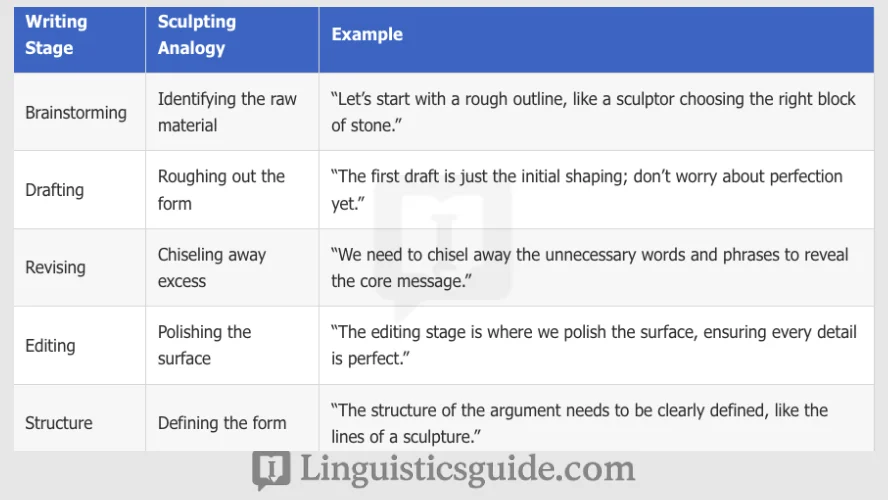
Table 1: Writing as Sculpting – Examples
This table showcases how the “writing as sculpting” metaphor can be applied to different stages of the writing process, focusing on refinement and precision.
| Writing Stage | Sculpting Analogy | Example |
|---|---|---|
| Brainstorming | Identifying the raw material | “Let’s start with a rough outline, like a sculptor choosing the right block of stone.” |
| Drafting | Roughing out the form | “The first draft is just the initial shaping; don’t worry about perfection yet.” |
| Revising | Chiseling away excess | “We need to chisel away the unnecessary words and phrases to reveal the core message.” |
| Editing | Polishing the surface | “The editing stage is where we polish the surface, ensuring every detail is perfect.” |
| Structure | Defining the form | “The structure of the argument needs to be clearly defined, like the lines of a sculpture.” |
| Word Choice | Selecting the right tools | “Choose your words carefully, like a sculptor selecting the right chisel for the job.” |
| Clarity | Removing the imperfections | “Ensure the clarity of your writing by removing any imperfections, just like a sculptor smoothing out rough edges.” |
| Conciseness | Reducing the bulk | “Make your writing concise by reducing the bulk, similar to a sculptor removing excess material.” |
| Precision | Fine-tuning the details | “Achieve precision in your writing by fine-tuning the details, like a sculptor perfecting the features of a statue.” |
| Impact | Revealing the essence | “Create impact by revealing the essence of your message, just as a sculptor reveals the beauty hidden within the stone.” |
| Rewriting | Reforming | “If the initial form isn’t right, rewrite it, just as a sculptor might reform the clay.” |
| Critique | Inspecting for flaws | “Critique your work by inspecting for flaws, like a sculptor examining their piece for imperfections.” |
| Flow | Smooth Transitions | “Ensure a smooth flow by creating seamless transitions, similar to how a sculptor blends different parts of their work.” |
| Emphasis | Highlighting key areas | “Emphasize key areas by highlighting them, like a sculptor accentuating certain features to draw attention.” |
| Revision | Refining the Shape | “The revision process is about refining the shape of your argument, just as a sculptor refines the form of their sculpture.” |
| Title | The finishing touch | “The title is the finishing touch, like the final polish on a sculpture.” |
| Introduction | The base | “The introduction is like the base of a sculpture, providing a solid foundation for the rest of the piece.” |
| Conclusion | The presentation | “The conclusion is the presentation, like how a sculptor displays their finished work.” |
| Abstract | The miniature | “The abstract is a miniature version of the whole work, like a small model of a large sculpture.” |
| Research | Gathering Materials | “Research is like gathering the materials needed for the sculpture, ensuring you have everything you need to create your masterpiece.” |
| Audience | The Viewer | “Consider your audience, like a sculptor considers the viewer of their art.” |
| Purpose | The Sculptor’s Vision | “Define your purpose, like a sculptor defines their vision for their finished work.” |
| Voice | The Artist’s Style | “Develop your voice, like a sculptor develops their unique style.” |
| Style | The Artist’s Signature | “Your writing style is your signature, like the unique mark of a sculptor.” |
| Structure | The Skeleton | “The structure of your writing is like the skeleton of a sculpture, providing a framework for the rest of the piece.” |
Table 2: Writing as Building – Examples
This table illustrates how the “writing as building” metaphor can be used to think about the structure, foundation, and organization of a piece of writing.
| Writing Stage | Building Analogy | Example |
|---|---|---|
| Brainstorming | Laying the Foundation | “Let’s lay the foundation by brainstorming all possible ideas.” |
| Thesis Statement | The Cornerstone | “The thesis statement is the cornerstone of your argument, the most important element.” |
| Paragraphs | The Bricks | “Each paragraph should be a solid brick, supporting the overall structure.” |
| Arguments | The Pillars | “Your arguments are the pillars that hold up your main point.” |
| Evidence | The Reinforcement | “Use evidence to reinforce your arguments, like steel reinforcing concrete.” |
| Structure | The Blueprint | “Follow the structure like a blueprint to ensure a coherent and logical flow.” |
| Introduction | The Entrance | “The introduction is the entrance to your writing, welcoming the reader into your world.” |
| Conclusion | The Roof | “The conclusion is the roof, providing a sense of completion and closure.” |
| Transitions | The Hallways | “Transitions are the hallways, connecting the different rooms of your argument.” |
| Clarity | The Windows | “Clarity is like the windows, letting light into your writing and making it easy to understand.” |
| Organization | The Floor Plan | “Organization is the floor plan, ensuring that everything is in its proper place.” |
| Coherence | The Walls | “Coherence is like the walls, holding everything together and providing a sense of unity.” |
| Support | The Support Beams | “Support each claim with evidence, like support beams holding up a structure.” |
| Logic | The Architecture | “The logic of your argument is the architecture of your building, ensuring a sound and stable structure.” |
| Purpose | The Design | “Define your purpose, like an architect defines the design of a building.” |
| Thesis | The Foundation | “The thesis is the foundation, the base upon which everything else is built.” |
| Revision | The Renovation | “Revise your work like renovating a building, improving its structure and appearance.” |
| Editing | The Finishing Touches | “Editing is the finishing touches, like painting and decorating a building.” |
| Audience | The Occupants | “Consider your audience, like an architect considers the occupants of a building.” |
| Style | The Aesthetics | “Develop your style, like an architect develops the aesthetics of a building.” |
| Details | The Fixtures | “Pay attention to details, like the fixtures and fittings in a building.” |
| Flow | The Circulation | “Ensure a smooth flow, like the circulation of people through a building.” |
| Conciseness | The Efficient Design | “Be concise, like an architect designing an efficient and functional building.” |
| Impact | The Grandeur | “Create impact, like the grandeur of a well-designed building.” |
| Planning | The Site Preparation | “Planning is like site preparation, making sure everything is ready before you start building.” |
Table 3: Writing as Weaving – Examples
This table showcases how the “writing as weaving” metaphor can be applied, focusing on the interconnectedness of ideas and creating a cohesive narrative.
| Writing Stage | Weaving Analogy | Example |
|---|---|---|
| Brainstorming | Gathering Threads | “Let’s gather all the threads of our ideas before we begin to weave them together.” |
| Drafting | Loom Setup | “Setting up the loom is like drafting your outline – preparing the structure.” |
| Sentences | Individual Threads | “Each sentence is a thread that contributes to the overall fabric of the text.” |
| Paragraphs | Woven Sections | “The paragraphs are woven sections, each contributing to the larger pattern.” |
| Transitions | Interlacing | “Use transitions to interlace ideas, creating a seamless flow.” |
| Coherence | Tight Weave | “Achieve coherence by creating a tight weave, where all elements are interconnected.” |
| Revision | Mending | “Revise your work by mending any loose threads or weak spots in the weave.” |
| Editing | Trimming Excess | “Edit by trimming any excess threads that detract from the overall design.” |
| Introduction | The Starting Knot | “The introduction is the starting knot, securing the beginning of your narrative.” |
| Conclusion | The Finishing Knot | “The conclusion is the finishing knot, tying up all loose ends and completing the weave.” |
| Arguments | The Warp Threads | “Your arguments are the warp threads, the foundation upon which your narrative is built.” |
| Evidence | The Weft Threads | “Use evidence as the weft threads, weaving in support for your claims.” |
| Style | The Pattern | “Develop your style, like choosing a unique pattern for your weave.” |
| Voice | The Weaver’s Touch | “Your voice is the weaver’s touch, adding a personal element to the fabric.” |
| Details | The Intricate Design | “Pay attention to details, like the intricate design of a complex weave.” |
| Purpose | The Intended Fabric | “Define your purpose, like deciding what kind of fabric you want to create.” |
| Audience | The End User | “Consider your audience, like a weaver considers the end user of their fabric.” |
| Flow | The Smooth Texture | “Ensure a smooth flow, like the smooth texture of a well-woven fabric.” |
| Conciseness | The Efficient Use of Thread | “Be concise, like a weaver using thread efficiently to create a strong fabric.” |
| Impact | The Stunning Design | “Create impact, like the stunning design of a masterfully woven tapestry.” |
| Research | Sourcing Fine Yarns | “Research is like sourcing fine yarns, ensuring you have the best materials for your weave.” |
| Clarity | A Clear Pattern | “Clarity is achieved by creating a clear and understandable pattern.” |
| Complexity | An Intricate Pattern | “Complexity is achieved by weaving an intricate and multi-layered pattern.” |
| Simplicity | A Basic Weave | “Simplicity is achieved by using a basic and straightforward weave.” |
| Theme | The Central Motif | “The theme is the central motif woven throughout the fabric.” |
Usage Rules: Applying Metaphors Effectively
Using metaphors effectively in writing requires careful consideration and adherence to certain guidelines. First, ensure the metaphor is relevant and appropriate for your topic and audience. A metaphor that is too obscure or unrelated will only confuse readers. Second, maintain consistency within the metaphor. Avoid mixing metaphors or switching between different analogies without a clear purpose. Third, use metaphors sparingly and strategically. Overusing metaphors can make your writing seem contrived and distracting. Fourth, be mindful of the cultural context of your metaphors. Some metaphors may have different connotations or meanings in different cultures, so choose your analogies carefully. Finally, ensure the metaphor enhances clarity and understanding rather than obscuring the message. If a metaphor complicates rather than clarifies, it’s best to revise or abandon it.
Exceptions to these rules exist, particularly in creative writing where experimentation and unconventional expression are encouraged. However, even in these contexts, it’s important to be aware of the potential impact of your metaphorical choices on the reader’s understanding and experience.
Common Mistakes When Using Metaphors
One common mistake is using mixed metaphors, which occur when two or more incompatible metaphors are combined. For example: “We need to nip this problem in the bud before it snowballs into a full-blown crisis.” (Mixing gardening and snowball metaphors). A better version would be: “We need to address this problem quickly before it escalates into a serious crisis.”
Another frequent error is using clichéd metaphors, which are overused and lack originality. For example: “He was as brave as a lion.” Instead, try a fresh and unique comparison: “His courage was a shield against the onslaught of criticism.”
Incorrect Example: “The project was a rollercoaster of emotions that sailed smoothly.” (Incompatible metaphors)
Correct Example: “The project was a rollercoaster of emotions, with exhilarating highs and terrifying lows.”
Incorrect Example: “She was like a fish out of water.” (Clichéd metaphor)
Correct Example: “She felt adrift in the new environment, like a lone ship lost at sea.”
Practice Exercises
The following exercises will help you practice applying metaphors to your writing.
Exercise 1: Identifying Metaphors
Identify the dominant metaphor in each of the following sentences:
| Question | Answer |
|---|---|
| 1. The company’s strategy was a house of cards, destined to collapse at the slightest breeze. | Building |
| 2. His words were a soothing balm to her wounded spirit. | Healing |
| 3. The debate was a battlefield, with arguments flying like bullets. | Warfare |
| 4. The artist sculpted his novel with meticulous care, shaping each sentence like a piece of clay. | Sculpting |
| 5. Life is a journey, filled with unexpected twists and turns. | Journey |
| 6. The internet is a vast ocean of information, waiting to be explored. | Ocean |
| 7. Her voice was a melody, enchanting everyone in the room. | Music |
| 8. The project was a tangled web, difficult to unravel. | Weaving |
| 9. His mind was a fertile garden, where ideas blossomed and grew. | Gardening |
| 10. Time is a river, constantly flowing and carrying us along. | River |
Exercise 2: Completing Metaphors
Complete the following sentences by adding a metaphor that fits the context:
| Question | Answer |
|---|---|
| 1. The evidence presented was _____, clearly demonstrating his guilt. | a smoking gun |
| 2. Her determination was _____, never wavering despite the challenges. | an iron wall |
| 3. The city at night was _____, glittering with lights and energy. | a jewel box |
| 4. His speech was _____, captivating the audience with its eloquence. | a symphony |
| 5. The relationship was _____, constantly tested by external pressures. | a tightrope walk |
| 6. Learning a new language is _____, requiring patience and dedication. | climbing a mountain |
| 7. The project’s success was _____, rewarding the team’s hard work. | the fruit of their labor |
| 8. His anger was _____, threatening to consume everything in its path. | a raging fire |
| 9. The truth was _____, hidden beneath layers of deception. | a buried treasure |
| 10. The future is _____, full of possibilities and uncertainties. | an open book |
Exercise 3: Writing with Metaphors
Write a short paragraph (5-7 sentences) describing a difficult challenge you faced, using the metaphor of “climbing a mountain.”
Example Answer:
The project loomed before me, a daunting mountain range against the horizon. Each task was a steep incline, testing my endurance and resolve.
There were moments when I wanted to turn back, to descend into the comfort of familiarity. But the summit beckoned, promising a breathtaking view of accomplishment.
With each step, I grew stronger, more resilient. Finally, after what felt like an eternity, I reached the peak, breathless but triumphant.
The panoramic view of success made every struggle worthwhile, a testament to the power of perseverance.
Advanced Topics: Complex Metaphorical Structures
At an advanced level, writers can explore more complex metaphorical structures, such as extended metaphors and allegories. An extended metaphor is a metaphor that is sustained throughout a longer passage or even an entire work. It involves developing the initial comparison in greater detail, exploring multiple aspects of the source and target domains. Allegories are narratives that function as extended metaphors, where characters, events, and settings represent abstract ideas or moral principles. Mastering these techniques requires a deep understanding of metaphorical reasoning and the ability to create intricate and meaningful connections between seemingly disparate concepts.
Another advanced technique involves using multiple metaphors within a single piece of writing to create a richer and more nuanced effect. However, this requires careful planning and execution to avoid confusion and maintain coherence. The different metaphors should complement each other and contribute to a unified overall message.
Frequently Asked Questions
Q1: What is the difference between a metaphor and a simile?
A metaphor directly equates two unlike things, while a simile uses “like” or “as” to make a comparison. For example, “He is a lion” (metaphor) vs.
“He is as brave as a lion” (simile). Metaphors are generally considered stronger and more impactful because they create a more direct and vivid connection.
Q2: How can I avoid using clichéd metaphors in my writing?
To avoid clichés, focus on creating original and specific comparisons. Think about the unique qualities of the thing you are describing and try to find an analogy that captures those qualities in a fresh and unexpected way.
Read widely and pay attention to the metaphors used by other writers to get inspiration, but always strive to create your own distinctive expressions.
Q3: Can I use more than one metaphor in a single sentence?
While it is possible to use multiple metaphors in a sentence, it is generally best to avoid doing so, as it can lead to confusion and mixed metaphors. If you do choose to use multiple metaphors, make sure they are compatible and contribute to a unified overall message.
Q4: How do I know if a metaphor is appropriate for my audience?
Consider your audience’s background, knowledge, and cultural context. Choose metaphors that are relevant and accessible to them.
Avoid metaphors that are too obscure, technical, or culturally specific, as they may not be understood or appreciated.
Q5: What is the role of metaphors in persuasive writing?
Metaphors can be powerful tools in persuasive writing, as they can help to make abstract ideas more concrete and relatable. By framing an issue in terms of a familiar and emotionally resonant analogy, you can influence your audience’s perceptions and attitudes.
Q6: How can metaphors help with writer’s block?
Thinking about writing through a metaphorical lens can help you break free from rigid thinking and explore new perspectives. If you’re stuck, try applying a different metaphor to your writing process.
For example, if you’re struggling with structure, try thinking of your writing as building a house or weaving a tapestry.
Q7: Are there any types of writing where metaphors should be avoided?
While metaphors can be used effectively in many types of writing, they should be used sparingly in contexts where clarity and precision are paramount, such as scientific reports or technical manuals. In these cases, it’s generally best to rely on literal language and avoid figurative expressions that could introduce ambiguity.
Q8: How do I analyze the effectiveness of a metaphor?
To analyze the effectiveness of a metaphor, consider its relevance, originality, clarity, and impact. Does it effectively illuminate the concept being described?
Is it fresh and engaging, or clichéd and predictable? Does it enhance understanding, or does it create confusion?
Does it resonate emotionally with the reader?
Q9: Can metaphors be used in non-fiction writing?
Absolutely! Metaphors are a powerful tool in non-fiction to make complex ideas more accessible and engaging.
They can illustrate abstract concepts, simplify complicated processes, and add depth to your writing.
Q10: How do I develop my ability to create effective metaphors?
Practice is key! Start by observing the world around you and looking for connections between seemingly unrelated things.
Read widely and pay attention to the metaphors used by skilled writers. Experiment with different analogies and ask for feedback on your work.
The more you practice, the better you will become at crafting compelling and insightful metaphors.
Conclusion
In conclusion, metaphors for writing provide a valuable framework for understanding and improving your writing skills. By viewing writing through different metaphorical lenses, such as sculpting, building, or weaving, you can gain new perspectives, break through writer’s block, and refine your work with greater precision.
Remember to choose relevant and appropriate metaphors, maintain consistency, and use them sparingly and strategically. Avoid common mistakes like mixed metaphors and clichéd expressions, and always strive for clarity and originality.
The key takeaway is that understanding and applying these metaphors can transform your approach to writing, making it more creative, effective, and enjoyable. Continue to explore different metaphorical frameworks and experiment with their application to your own writing.
With practice and dedication, you can unlock your full potential as a writer and communicate your ideas with clarity, precision, and artistry.