
Metaphors are powerful tools that help us understand abstract concepts by relating them to more concrete ideas. When we talk about community, metaphors often provide a richer, more nuanced understanding of its complexities.
This article explores how metaphors shape our perception of community, delving into their grammatical structures, types, and usage. Whether you’re an English language learner, a writer, or simply someone interested in the power of language, this guide will equip you with the knowledge to recognize, analyze, and effectively use metaphors for community.
Table of Contents
- Introduction
- Definition of Metaphor for Community
- Structural Breakdown
- Types and Categories of Community Metaphors
- Examples of Metaphors for Community
- Usage Rules for Metaphors of Community
- Common Mistakes
- Practice Exercises
- Advanced Topics
- FAQ
- Conclusion
Definition of Metaphor for Community
A metaphor for community is a figure of speech that describes a community by comparing it to something else, highlighting shared qualities or characteristics. Instead of a literal description, a metaphor offers an imaginative way to understand the complex dynamics, relationships, and values within a group of people.
Metaphors are not merely decorative; they shape our understanding and influence our actions towards the community.
The function of a community metaphor goes beyond simple description. It serves to evoke emotions, create shared understanding, and even inspire action.
By framing a community as a “garden,” for instance, we emphasize the need for nurturing, growth, and collaboration. This framing can influence how community members perceive their roles and responsibilities.
Community metaphors appear in various contexts, including political discourse, social commentary, literature, and everyday conversations. They are used to promote unity, critique social structures, or simply express the speaker’s perception of the community.
The specific context often determines the effectiveness and impact of the metaphor.
Structural Breakdown
A metaphor consists of two main elements: the tenor and the vehicle. The tenor is the subject being described (in this case, the community), and the vehicle is the object or concept to which the subject is compared. The connection between the tenor and vehicle is not arbitrary; it is based on shared characteristics or qualities that are highlighted in the metaphor.
For example, in the metaphor “The community is a well-oiled machine,” the tenor is “community,” and the vehicle is “well-oiled machine.” The shared characteristics are efficiency, smooth functioning, and interdependence of parts. The metaphor suggests that the community operates effectively because its members work together seamlessly.
The effectiveness of a metaphor depends on the audience’s understanding of both the tenor and the vehicle. If the audience is unfamiliar with the concept of a “well-oiled machine,” the metaphor may not resonate or convey the intended meaning.
Therefore, choosing appropriate and relatable vehicles is crucial for successful communication.
Furthermore, the grammatical structure of a metaphor can vary. It can be expressed as a simple equation (“Community is family”), a more elaborate comparison (“The community functions like a beehive”), or even implied through descriptive language (“The roots of the community run deep”).
Recognizing these different structures is essential for interpreting and analyzing metaphors effectively.
Types and Categories of Community Metaphors
Community metaphors can be categorized based on the type of vehicle used and the qualities they emphasize. Here are some common categories:
Community as Organism
This metaphor portrays the community as a living entity with interconnected parts, emphasizing growth, health, and interdependence. Examples include:
- “The community is a living, breathing organism.”
- “The community’s roots run deep.”
- “The community is a garden that needs tending.”
- “A healthy community fosters growth and prosperity.”
Community as Machine
This metaphor emphasizes efficiency, functionality, and the interdependence of parts, often highlighting the importance of each member’s contribution. Examples include:
- “The community is a well-oiled machine.”
- “Every member is a cog in the community’s engine.”
- “The community functions like a complex clock.”
- “If one part fails, the whole community suffers.”
Community as Fabric
This metaphor focuses on the interconnectedness and interwoven nature of community relationships, highlighting strength, resilience, and the importance of individual threads. Examples include:
- “The community is a tightly woven fabric.”
- “Each member is a thread in the community’s tapestry.”
- “The community’s strength lies in its interwoven relationships.”
- “A tear in the fabric weakens the entire community.”
Community as Family
This metaphor emphasizes kinship, support, and shared responsibility, highlighting the emotional bonds and sense of belonging within the community. Examples include:
- “The community is a family.”
- “We are all brothers and sisters in this community.”
- “The community provides a sense of belonging and support.”
- “We look out for each other like family.”
Community as Journey
This metaphor portrays the community as a group traveling together towards a common goal, emphasizing progress, challenges, and shared experiences. Examples include:
- “The community is on a journey together.”
- “We are all travelers on this road of community development.”
- “The community faces challenges and obstacles along the way.”
- “Together, we can reach our destination.”
Community as Building
This metaphor illustrates the process of creation, construction, and stability within a community. It highlights the need for strong foundations, careful planning, and collaborative effort.
Examples include:
- “The community is a building under construction.”
- “We are building a stronger community together.”
- “The foundation of our community is based on trust and respect.”
- “Every contribution is a brick in the wall of community progress.”
Examples of Metaphors for Community
The following tables provide a wide range of examples of community metaphors, categorized by type, to illustrate their diverse applications and meanings.
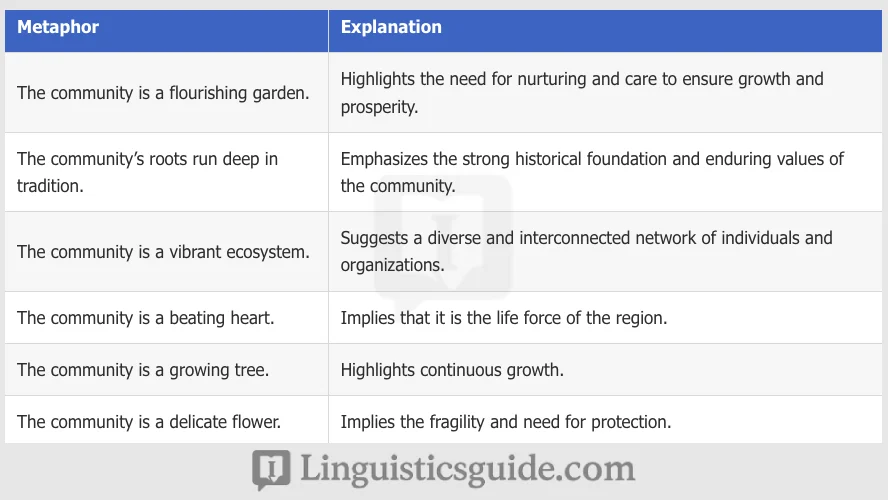
Community as Organism Examples
This table provides examples of metaphors that depict a community as a living organism, emphasizing growth, health, and interdependence.
| Metaphor | Explanation |
|---|---|
| The community is a flourishing garden. | Highlights the need for nurturing and care to ensure growth and prosperity. |
| The community’s roots run deep in tradition. | Emphasizes the strong historical foundation and enduring values of the community. |
| The community is a vibrant ecosystem. | Suggests a diverse and interconnected network of individuals and organizations. |
| The community is a beating heart. | Implies that it is the life force of the region. |
| The community is a growing tree. | Highlights continuous growth. |
| The community is a delicate flower. | Implies the fragility and need for protection. |
| The community is a thriving forest. | Highlights the strength in numbers. |
| The community is a spreading vine. | Implies organic growth and expansion. |
| The community is a healing body. | Emphasizes the resilience and recovery from challenges. |
| The community is a nurturing womb. | Highlights the caring and supportive environment. |
| The community is a sprouting seed. | Implies potential and future growth. |
| The community is a budding flower. | Highlights the beauty and potential. |
| The community is a ripening fruit. | Emphasizes the rewards of hard work and dedication. |
| The community is a living cell. | Implies that it’s a fundamental unit of a larger system. |
| The community is a growing organism. | Highlights the continuous development. |
| The community is a fertile ground. | Suggests potential for new ideas and growth. |
| The community is a healthy plant. | Implies good health and well-being. |
| The community is a resilient tree. | Highlights the ability to withstand challenges. |
| The community is a symbiotic relationship. | Highlights the mutually beneficial interactions. |
| The community is a complex network of roots. | Emphasizes the interconnectedness of the community. |
| The community is a fragile ecosystem. | Suggests vulnerability. |
| The community is a self-sustaining garden. | Highlights the ability to thrive independently. |
Community as Machine Examples
This table provides examples of metaphors that depict a community as a machine, emphasizing efficiency, functionality, and the interdependence of parts.
| Metaphor | Explanation |
|---|---|
| The community is a well-oiled machine. | Highlights efficiency and smooth functioning. |
| Every member is a cog in the community’s engine. | Emphasizes the importance of each individual’s contribution. |
| The community functions like a complex clock. | Suggests precision and coordinated effort. |
| The community is a finely tuned instrument. | Highlights the need for precision. |
| The community is a powerful locomotive. | Implies forward momentum and progress. |
| The community is a sophisticated network. | Highlights the complexity. |
| The community is a synchronized machine. | Emphasizes the coordinated effort. |
| The community is a well-designed system. | Implies efficiency. |
| The community is a powerful engine. | Highlights the driving force. |
| The community is a streamlined process. | Emphasizes efficiency. |
| The community is a complex mechanism. | Highlights the inner workings. |
| The community is a finely calibrated device. | Implies precision. |
| The community is a well-maintained structure. | Highlights the need for upkeep. |
| The community is a powerful generator. | Emphasizes the energy output. |
| The community is a sophisticated apparatus. | Highlights the intricate design. |
| The community is a finely engineered system. | Implies precision and efficiency. |
| The community is a well-coordinated effort. | Emphasizes teamwork. |
| The community is a powerful infrastructure. | Highlights the support. |
| The community is a finely tuned orchestra. | Highlights how precision and teamwork are needed for success. |
| The community is a well-oiled bicycle. | Emphasizes how each part must work together for success. |
| The community is a robotic arm. | Highlights the precision and efficiency of the community. |
| The community is a highly automated machine. | Implies a community that is very efficient and does not require much input. |
Community as Fabric Examples
This table provides examples of metaphors that depict a community as a fabric, emphasizing interconnectedness and interwoven relationships.
| Metaphor | Explanation |
|---|---|
| The community is a tightly woven fabric. | Highlights the strength and interconnectedness of relationships. |
| Each member is a thread in the community’s tapestry. | Emphasizes the unique contribution of each individual. |
| The community’s strength lies in its interwoven relationships. | Suggests that unity and collaboration are essential. |
| The community is a patchwork quilt. | Highlights the diversity. |
| The community is a delicate lace. | Implies the fragility. |
| The community is a strong cable. | Highlights the resilience. |
| The community is a complex weave. | Emphasizes the intricate connections. |
| The community is a vibrant textile. | Highlights the richness and diversity. |
| The community is a resilient fiber. | Implies strength. |
| The community is a unified cloth. | Emphasizes the unity. |
| The community is a colorful yarn. | Highlights the diversity. |
| The community is a sturdy canvas. | Implies the strength. |
| The community is a flexible material. | Highlights adaptability. |
| The community is a seamless garment. | Emphasizes the unity. |
| The community is a textured tapestry. | Highlights the diversity. |
| The community is a durable fabric. | Implies strength. |
| The community is a resilient weave. | Highlights ability to withstand challenges. |
| The community is a vibrant pattern. | Emphasizes the diversity. |
| The community is a complex quilt of cultures. | Highlights how different cultures makeup a vibrant community. |
| The community is a tapestry of dreams and aspirations. | Emphasizes how each individual has a unique dream for the community. |
| The community is a knit blanket. | Highlights the warmth and comfort of a community. |
| The community is a delicate spider web. | Implies a strong, but fragile community. |
Community as Family Examples
This table provides examples of metaphors that depict a community as a family, emphasizing kinship, support, and shared responsibility.
| Metaphor | Explanation |
|---|---|
| The community is a family. | Highlights the sense of belonging and mutual support. |
| We are all brothers and sisters in this community. | Emphasizes kinship and shared responsibility. |
| The community provides a sense of belonging and support. | Suggests a caring and inclusive environment. |
| The community is our second home. | Highlights the comfort. |
| The community is our extended family. | Implies a close relationship. |
| The community is our support system. | Highlights the assistance. |
| The community is our safe haven. | Emphasizes the security. |
| The community is our shared heritage. | Highlights the common history. |
| The community is our common ground. | Implies shared values. |
| The community is our collective identity. | Highlights the shared sense of self. |
| The community is our united front. | Emphasizes the solidarity. |
| The community is our mutual aid. | Highlights the assistance. |
| The community is our common bond. | Implies a strong connection. |
| The community is our shared destiny. | Highlights the common future. |
| The community is our collective strength. | Emphasizes the power in unity. |
| The community is our mutual trust. | Highlights the reliability. |
| The community is our common goal. | Implies a shared purpose. |
| The community is our shared vision. | Highlights the common aspiration. |
| The community is a family reunion. | Highlights the comfort and joy of a community. |
| The community is a group of siblings always looking out for each other. | Emphasizes how each member of the community is always there to help. |
| The community is a family dinner. | Highlights how all members of the community share a common bond. |
| The community is a group of parents raising children. | Implies that the community is there to support and raise the next generation. |
Usage Rules for Metaphors of Community
Using metaphors effectively requires careful consideration of several factors. First, ensure that the vehicle is appropriate for the tenor.
The shared characteristics between the community and the metaphorical object should be clear and relevant. Avoid using metaphors that are too abstract or obscure, as they may confuse the audience.
Second, be mindful of the connotations associated with the vehicle. Metaphors can evoke positive or negative emotions, so choose a vehicle that aligns with the intended message.
For example, comparing a community to a “battleground” may create a sense of conflict and division, while comparing it to a “garden” may evoke feelings of peace and harmony.
Third, avoid overusing metaphors. While metaphors can enhance communication, excessive use can make your writing or speech sound artificial and contrived.
Use metaphors sparingly and strategically to maximize their impact.
Fourth, be consistent with your metaphors. Mixing metaphors can create confusion and undermine the clarity of your message.
If you start by comparing the community to a “garden,” avoid switching to a different metaphor, such as a “machine,” unless you have a clear and deliberate reason for doing so.
Finally, consider your audience. The effectiveness of a metaphor depends on the audience’s understanding of both the tenor and the vehicle.
Choose metaphors that are relatable and meaningful to your target audience. A metaphor that resonates with one group of people may not be effective with another.
Common Mistakes
One common mistake is using clichéd metaphors that have lost their impact through overuse. For example, “the community is a melting pot” is a common metaphor, but it may not convey a fresh or insightful perspective. Instead, try to create original metaphors that offer a unique and compelling way to understand the community.
Another mistake is using mixed metaphors, which combine incompatible images or ideas. For example, “The community is a well-oiled machine that needs to plant seeds of change” combines the metaphor of a machine with the metaphor of a garden, creating a confusing and illogical image.
A further error is using inappropriate metaphors that convey unintended or negative connotations. For example, comparing a community to a “prison” may suggest that it is restrictive and oppressive, which may not be the intended message.
Here are some examples of common mistakes:
| Incorrect | Correct | Explanation |
|---|---|---|
| The community is a melting pot, firing on all cylinders. | The community is a vibrant mosaic. | Avoid mixing metaphors (melting pot and firing on all cylinders). Choose a single, consistent image. |
| The community is a jungle, but we’re all in the same boat. | The community is a ship sailing through stormy seas. | “Jungle” and “same boat” are unrelated. A consistent metaphor (ship) is more effective. |
| The community is a war zone, planting seeds of peace. | The community is a garden, cultivating peace. | War zone has negative connotations. Replace with a metaphor that has positive connotations. |
Practice Exercises
Test your understanding of metaphors for community with these practice exercises.
Exercise 1: Identifying Metaphors
Identify the metaphor in each sentence and explain what it means.
| Question | Answer |
|---|---|
| 1. The community is a tapestry woven with diverse cultures. | Metaphor: Tapestry. Explanation: The community is made up of many different cultures that all come together to make the community. |
| 2. Every citizen is a brick in the foundation of our community. | Metaphor: Brick. Explanation: Each citizen is an important part of the community. |
| 3. The community is a symphony, with each voice contributing to the harmony. | Metaphor: Symphony. Explanation: Each person in the community has something to offer which makes the community better. |
| 4. The community is a family, supporting each other through thick and thin. | Metaphor: Family. Explanation: The community will always be there for one another. |
| 5. Our community is a lighthouse, guiding those in need. | Metaphor: Lighthouse. Explanation: The community provides guidance to people in need. |
| 6. The community is a lifeboat, keeping everyone afloat during tough times. | Metaphor: Lifeboat. Explanation: The community keeps everyone safe. |
| 7. The community is a playground, where everyone can come together to have fun. | Metaphor: Playground. Explanation: The community is a safe place for everyone to enjoy. |
| 8. The community is a classroom, where everyone can learn from each other. | Metaphor: Classroom. Explanation: The community is a place where everyone can share useful information. |
| 9. The community is a forest, where everyone can grow together. | Metaphor: Forest. Explanation: The community is a place where everyone can learn and grow together. |
| 10. The community is a garden, where everyone can nurture each other to help them grow. | Metaphor: Garden. Explanation: The community is a place where people can nurture each other. |
Exercise 2: Creating Metaphors
Complete the following sentences by adding an appropriate metaphor for community.
| Question | Answer |
|---|---|
| 1. The community is like a ______, where everyone has a role to play. | Answer: The community is like a beehive, where everyone has a role to play. |
| 2. Building a strong community is like ______. | Answer: Building a strong community is like laying the foundation of a house. |
| 3. The community is a ______, bringing people together from different backgrounds. | Answer: The community is a bridge, bringing people together from different backgrounds. |
| 4. The community is a ______, where everyone can share their unique talents. | Answer: The community is a stage, where everyone can share their unique talents. |
| 5. The community is a ______, always ready to lend a helping hand. | Answer: The community is a team, always ready to lend a helping hand. |
| 6. The community is a ______, always there with open arms. | Answer: The community is a hug, always there with open arms. |
| 7. The community is a ______, always there to support each other. | Answer: The community is a crutch, always there to support each other. |
| 8. The community is a ______, always shining bright for those in need. | Answer: The community is a candle, always shining bright for those in need. |
| 9. The community is a ______, always there to provide aid. | Answer: The community is a hospital, always there to provide aid. |
| 10. The community is a ______, always there to protect each other. | Answer: The community is a shield, always there to protect each other. |
Exercise 3: Correcting Mistaken Metaphors
Identify and correct the mistaken or mixed metaphors in the following sentences.
| Question | Answer |
|---|---|
| 1. The community is a melting pot, but we need to nip it in the bud. | Answer: The community is a garden, and we need to nurture it. (Corrected metaphor) |
| 2. The community is a well-oiled machine that needs to branch out. | Answer: The community is a tree that needs to branch out. (Corrected metaphor) |
| 3. The community is a war zone, and we need to build bridges. | Answer: The community is a construction site, and we need to build bridges. (Corrected metaphor) |
| 4. The community is a rollercoaster, but we need to get on the same page. | Answer: The community is a team, and we need to get on the same page. (Corrected metaphor) |
| 5. The community is a jungle, and we need to turn over a new leaf. | Answer: The community is a forest, and we need to turn over a new leaf. (Corrected metaphor) |
| 6. The community is a raging storm, and we need to get on the same wavelength. | Answer: The community is an orchestra, and we need to get on the same wavelength. (Corrected metaphor) |
| 7. The community is a circus, and we all need to take a step back. | Answer: The community is a team, and we all need to take a step back. (Corrected metaphor) |
| 8. The community is a zoo, and we all need to pull ourselves up by our bootstraps. | Answer: The community is a family, and we all need to pull ourselves up by our bootstraps. (Corrected metaphor) |
| 9. The community is a battlefield, and we all need to get on the same page. | Answer: The community is a book, and we all need to get on the same page. (Corrected metaphor) |
| 10. The community is a rollercoaster, and we all need to start singing from the same hymn sheet. | Answer: The community is a choir, and we all need to start singing from the same hymn sheet. (Corrected metaphor) |
Advanced Topics
For advanced learners, exploring the theoretical underpinnings of metaphor can provide a deeper understanding of their power and impact. Consider researching conceptual metaphor theory, which argues that metaphors are not merely linguistic devices but fundamental structures of thought. This theory suggests that our understanding of abstract concepts is largely based on metaphorical mappings from more concrete domains.
Another advanced topic is the role of metaphor in framing and persuasion. Metaphors can be used to frame issues in a particular way, influencing how people perceive and respond to them. Understanding how metaphors are used to shape public opinion is essential for critical thinking and effective communication.
Additionally, explore the use of metaphor in different cultural contexts. Metaphors are often culturally specific, and a metaphor that resonates in one culture may not be effective in another. Studying cross-cultural metaphors can provide insights into different worldviews and values.
FAQ
Here are some frequently asked questions about metaphors for community:
- What is the difference between a metaphor and a simile?
A metaphor directly equates two things, while a simile uses “like” or “as” to make a comparison. For example, “The community is a family” (metaphor) versus “The community is like a family” (simile).
- Why are metaphors important in understanding community?
Metaphors provide a powerful way to understand complex and abstract concepts like community by relating them to more concrete and familiar ideas. They can evoke emotions, create shared understanding, and inspire action.
- How can I identify a metaphor in a sentence?
Look for statements that describe something by comparing it to something else without using “like” or “as.” The comparison should not be literal but rather suggestive of shared qualities or characteristics.
- What are some common categories of metaphors for community?
Common categories include community as organism, machine, fabric, family, journey, and building. Each category emphasizes different aspects of community dynamics and relationships.
- How can I avoid using clichéd metaphors?
Strive to create original metaphors that offer a fresh and insightful perspective. Think about the specific qualities you want to highlight and choose vehicles that are less common and more evocative.
- What should I do if I accidentally mix metaphors?
Revise the sentence or passage to use a consistent metaphor. Choose a single image or idea and stick with it throughout the description.
- How do I know if a metaphor is appropriate for my audience?
Consider your audience’s background, knowledge, and values. Choose metaphors that are relatable and meaningful to them. If you’re unsure, test your metaphors with a small group before using them more widely.
- Can a metaphor be interpreted in different ways?
Yes, metaphors are inherently open to interpretation. Different people may focus on different aspects of the comparison or bring their own experiences and perspectives to the reading. Be aware of this potential for multiple interpretations and choose metaphors that are likely to resonate with your intended audience.
- Is it possible to overuse metaphors?
Yes, excessive use of metaphors can make your writing or speech sound artificial and contrived. Use metaphors sparingly and strategically to maximize their impact.
- How can I improve my ability to create effective metaphors?
Practice observing the world around you and identifying connections between seemingly unrelated things. Read widely and pay attention to how other writers use metaphors. Experiment with different vehicles and see which ones resonate most effectively.
Conclusion
Metaphors are essential tools for understanding and communicating the complex concept of community. By comparing communities to organisms, machines, fabrics, families, journeys, or buildings, we can highlight different aspects of their dynamics, relationships, and values.
Understanding the structure, types, and usage rules of community metaphors allows us to use them effectively in our writing, speech, and critical thinking.
Remember to choose appropriate and relatable vehicles, avoid clichéd and mixed metaphors, and be mindful of your audience. By mastering the art of using metaphors for community, you can enhance your communication skills, deepen your understanding of social dynamics, and contribute to building stronger and more connected communities.