
Understanding how we use metaphors to talk about cancer is crucial because it shapes our perceptions, emotions, and actions related to the disease. Metaphors influence how patients, healthcare professionals, and the wider public understand cancer, impacting treatment decisions, emotional coping strategies, and societal attitudes.
This exploration of metaphors for cancer falls under the study of figurative language, a core component of English grammar and rhetoric. This article is beneficial for anyone interested in language, healthcare communication, or understanding the psychological impact of language.
Students, medical professionals, and those affected by cancer will find valuable insights into the power of metaphorical language.
Off to College Deals

Save up to 30% on everything you need for the semester.
Contains affiliate link
Table of Contents
- Introduction
- Definition of Metaphor and its Role in Describing Cancer
- Structural Breakdown: How Metaphors are Constructed
- Types of Metaphors Used for Cancer
- Examples of Cancer Metaphors
- Usage Rules and Considerations
- Common Mistakes in Using Cancer Metaphors
- Practice Exercises
- Advanced Topics: The Impact of Metaphors
- Frequently Asked Questions
- Conclusion
Definition of Metaphor and its Role in Describing Cancer
A metaphor is a figure of speech that directly compares two unrelated things, asserting that one thing is another, for rhetorical effect. Unlike similes, which use “like” or “as” to make a comparison, metaphors create a more implicit and powerful connection. The essence of a metaphor lies in transferring qualities from one concept (the source domain) to another (the target domain). This transfer allows us to understand abstract or complex ideas in more concrete and relatable terms.
When discussing cancer, a disease often shrouded in fear and uncertainty, metaphors become especially significant. They provide a framework for patients, caregivers, and healthcare providers to conceptualize the illness, its progression, and the treatment process.
Metaphors can shape emotional responses, influence decision-making, and even affect the perceived quality of life. The choice of metaphor is not neutral; it carries inherent connotations that can either empower or dishearten those affected by cancer.
For example, war metaphors might inspire a fighting spirit, while journey metaphors can offer a sense of purpose and direction.
Structural Breakdown: How Metaphors are Constructed
Metaphors are built on a foundation of semantic relationships and cognitive processes. Understanding their structure involves identifying the key components and how they interact to create meaning.
Young Adults & Students:
Get 6 Months of Prime for $0

Ages 18-24 unlock exclusive perks including:
Contains affiliate link
The basic structure of a metaphor involves two primary elements: the tenor and the vehicle. The tenor is the subject to which metaphorical attributes are ascribed (in this case, cancer). The vehicle is the object whose attributes are borrowed to describe the tenor (e.g., a battle, a journey, a machine). The ground is the shared characteristic or commonality between the tenor and the vehicle that makes the comparison meaningful.
For example, in the metaphor “Cancer is a battle,” cancer (the tenor) is being described as a battle (the vehicle). The ground, or shared characteristic, is the idea of struggle, conflict, and the need to overcome an opposing force.
The metaphor works because both cancer and battles involve challenges, strategies, and potential victory or defeat. The effectiveness of a metaphor depends on the strength and relevance of this shared ground.
The implied comparison enhances understanding. By using metaphors, abstract concepts, such as the progression of cancer, become more tangible and easier to comprehend.
This simplifies complex information and makes it more accessible, especially for those without a medical background.
Types of Metaphors Used for Cancer
Various types of metaphors are commonly used when discussing cancer, each framing the disease in a unique light. These metaphors can be categorized based on the source domain from which they draw their imagery.
War Metaphors
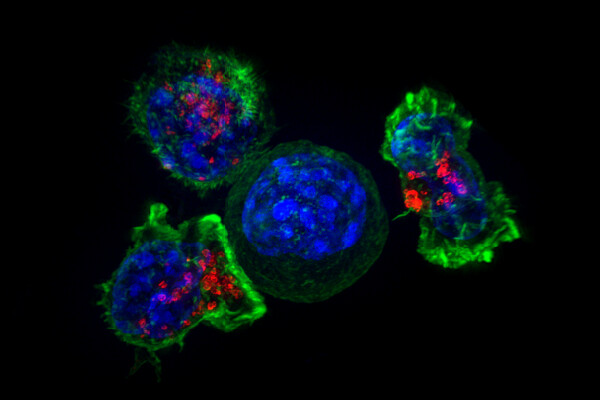
War metaphors are among the most prevalent ways of describing cancer. They frame the disease as an enemy to be fought, treatments as weapons, and patients as warriors.
These metaphors emphasize aggression, resistance, and the pursuit of victory.
Common expressions include “fighting cancer,” “battling the disease,” “winning the war,” and “attacking the tumor.” This framing encourages a proactive and combative approach, but it can also create pressure and guilt if the patient does not “win” the battle.
Journey Metaphors
Journey metaphors depict cancer as a path or voyage, with its own challenges, obstacles, and milestones. These metaphors emphasize the process of dealing with the disease, the changes it brings, and the potential for growth and transformation.
Phrases like “cancer journey,” “navigating treatment,” “being on a difficult road,” and “finding your way through” are typical examples. Journey metaphors can provide a sense of purpose and direction, but they can also be overwhelming if the path seems endless or uncertain.
Mechanical Metaphors
Mechanical metaphors compare the body to a machine, with cancer representing a malfunction or breakdown. These metaphors focus on the biological aspects of the disease and the need for repair or maintenance.
Examples include “the body breaking down,” “the system malfunctioning,” “fixing the problem,” and “repairing the damage.” Mechanical metaphors can be useful for explaining the physical processes involved in cancer, but they can also dehumanize the patient and reduce them to a collection of parts.
Natural Disaster Metaphors
Natural disaster metaphors portray cancer as a destructive force, like a storm, earthquake, or flood. These metaphors highlight the overwhelming and unpredictable nature of the disease.
Expressions such as “a tsunami of emotions,” “the storm of cancer,” “being swept away,” and “devastated by the diagnosis” capture the sense of chaos and loss associated with cancer. These metaphors can be helpful for expressing the intensity of the experience, but they can also be frightening and disempowering.
Animal Metaphors
Animal metaphors often compare cancer cells to invasive or predatory creatures. These metaphors can reflect feelings of fear, disgust, and the sense of being invaded by a foreign entity.
Examples include “cancer cells spreading like weeds,” “a parasitic growth,” “the tumor as a beast,” and “cancer lurking in the shadows.” Animal metaphors can evoke strong emotional responses, but they can also be stigmatizing and reinforce negative perceptions of the disease.
Examples of Cancer Metaphors
The following tables provide examples of cancer metaphors, categorized by type. Each example illustrates how the metaphor is used and its potential impact.
War Metaphor Examples
War metaphors are commonly used to describe the fight against cancer. These metaphors can be empowering but may also create unrealistic expectations.
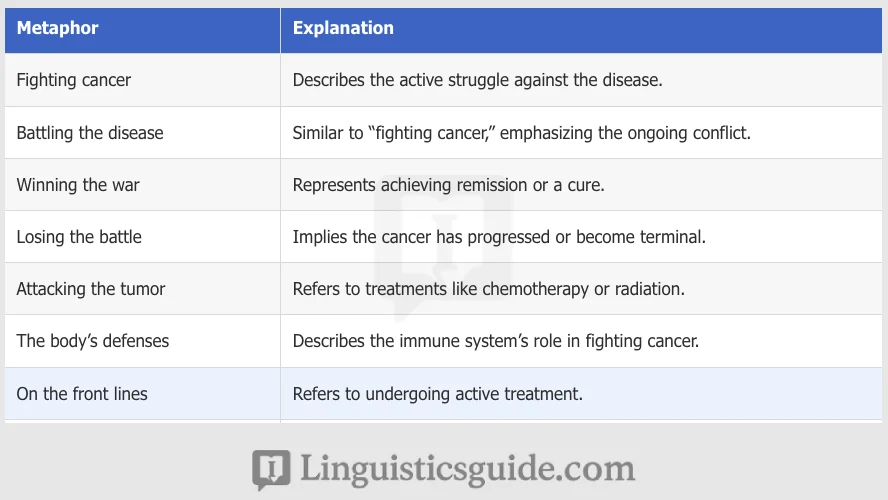
The table below lists various examples of war metaphors used in the context of cancer, demonstrating how the disease is often framed as a battle to be won.
| Metaphor | Explanation |
|---|---|
| Fighting cancer | Describes the active struggle against the disease. |
| Battling the disease | Similar to “fighting cancer,” emphasizing the ongoing conflict. |
| Winning the war | Represents achieving remission or a cure. |
| Losing the battle | Implies the cancer has progressed or become terminal. |
| Attacking the tumor | Refers to treatments like chemotherapy or radiation. |
| The body’s defenses | Describes the immune system’s role in fighting cancer. |
| On the front lines | Refers to undergoing active treatment. |
| Weapons against cancer | Represents treatments used to combat the disease. |
| A cancer survivor | Someone who has “won” the battle against cancer. |
| Targeting cancer cells | Describes the precision of certain treatments. |
| The enemy within | Cancer as an internal threat to the body. |
| A strategic approach | Planning and coordinating treatment. |
| The fight for life | Emphasizes the high stakes of cancer treatment. |
| Holding the line | Preventing the cancer from spreading. |
| Undergoing bombardment | Describes the intense effects of chemotherapy. |
| A relentless enemy | Describing the aggressive nature of cancer. |
| The war room | Referring to the medical team planning treatment. |
| A hard-fought victory | Achieving remission after a difficult treatment. |
| Cancer’s stronghold | The location of the primary tumor. |
| The offensive strategy | The plan to attack and eliminate the cancer. |
| Scorched earth | Aggressive treatments that damage healthy cells. |
| Collateral damage | Side effects of cancer treatment. |
| Winning the skirmish | Successfully managing a particular symptom or side effect. |
| Behind enemy lines | Describes the cancer spreading to new areas. |
| Medical arsenal | The range of treatments available. |
| The battle plan | The overall treatment strategy. |
| Frontline treatment | The initial treatment approach. |
Journey Metaphor Examples
Journey metaphors frame cancer as a path or voyage, often emphasizing personal growth and resilience. These metaphors can provide a sense of direction and purpose.
The table below illustrates how journey metaphors are applied to the cancer experience, highlighting the various stages, challenges, and transformations along the way.
| Metaphor | Explanation |
|---|---|
| Cancer journey | Describes the overall experience of living with cancer. |
| Navigating treatment | Implies finding one’s way through the complexities of treatment. |
| Being on a difficult road | Emphasizes the challenges and hardships of the experience. |
| Finding your way through | Suggests resilience and the ability to overcome obstacles. |
| A long and winding road | Represents the extended duration and unpredictability of cancer treatment. |
| Hitting a roadblock | Experiencing setbacks or complications. |
| Reaching a milestone | Achieving a significant step in treatment or recovery. |
| The path to recovery | Focuses on the journey towards healing and wellness. |
| Lost in the woods | Feeling confused and uncertain about the future. |
| The ups and downs | Describes the fluctuating nature of the experience. |
| A fork in the road | Making difficult decisions about treatment options. |
| The road ahead | Looking towards the future after treatment. |
| Climbing a mountain | Overcoming significant challenges and obstacles. |
| Sailing through treatment | Experiencing a relatively smooth and uncomplicated course. |
| Charting a course | Planning and managing the treatment process. |
| The final stretch | Approaching the end of treatment or life. |
| A scenic route | Finding moments of beauty and joy amidst the challenges. |
| A bumpy ride | Experiencing difficult side effects or complications. |
| The road less traveled | Choosing unconventional or alternative treatments. |
| A pilgrimage of healing | Seeking physical, emotional, and spiritual recovery. |
| The summit of survival | Reaching a point of long-term remission. |
| A crossroads | A point where significant decisions must be made. |
| The map of treatment | The structured plan and timeline for medical interventions. |
| A detour in life | Cancer causing a significant change in life’s direction. |
| The horizon of hope | Looking forward to a future beyond cancer. |
| Navigating uncharted waters | Dealing with rare or complex cases of cancer. |
| Picking up the pieces | Rebuilding life after cancer treatment. |
Mechanical Metaphor Examples
Mechanical metaphors frame the body as a machine, with cancer representing a malfunction or breakdown. These metaphors can be useful for explaining the biological aspects of the disease.
The table below provides examples of how mechanical metaphors are used in the context of cancer, focusing on the body’s functions and the disruptions caused by the disease.
| Metaphor | Explanation |
|---|---|
| The body breaking down | Describes the physical deterioration caused by cancer. |
| The system malfunctioning | Implies a disruption in the body’s normal processes. |
| Fixing the problem | Refers to treatments aimed at correcting the malfunction. |
| Repairing the damage | Focuses on restoring the body’s normal functions after treatment. |
| A cog in the machine | Describes a specific organ or body part affected by cancer. |
| The engine failing | Represents the body’s vital functions weakening. |
| A glitch in the system | Implies a minor disruption that can be corrected. |
| Rebooting the body | Refers to treatments that aim to restore normal function. |
| A worn-out part | Describes an organ or tissue damaged by cancer. |
| The machine needs maintenance | Emphasizes the need for ongoing care and monitoring. |
| A short circuit | Implies a sudden and unexpected malfunction. |
| Tuning up the body | Refers to treatments that optimize bodily functions. |
| The body’s wiring | Describes the nervous system’s role in cancer. |
| A faulty component | Represents a specific gene or cell that is malfunctioning. |
| The machine is running hot | Describes the body’s inflammatory response to cancer. |
| Overhauling the system | Refers to extensive treatments that aim to restore overall function. |
| A broken mechanism | Implies a fundamental disruption in the body’s processes. |
| The machine is sputtering | Describes the body’s weakened state during treatment. |
| Calibrating the treatment | Adjusting the dosage and frequency of medical interventions. |
| A mechanical breakdown | The failure of a critical bodily function due to cancer. |
| Replacing the parts | Surgical removal and replacement of affected tissues. |
| The body’s internal clock | Disruption of the body’s natural rhythms and processes. |
| Fine-tuning the system | Optimizing bodily functions through medication and therapy. |
| The machine’s regulator | Hormonal imbalances and their effect on cancer progression. |
| A jammed mechanism | Blockages and obstructions caused by tumors. |
| The body’s circuit board | The complex network of cells and signals affected by cancer. |
| Resetting the system | Immunotherapy to reprogram the body’s defenses. |
Natural Disaster Metaphor Examples
Natural disaster metaphors depict cancer as a destructive force, like a storm, earthquake, or flood. These metaphors highlight the overwhelming and unpredictable nature of the disease.
The table below illustrates how natural disaster metaphors are used to describe the emotional and physical impact of cancer, emphasizing the sense of chaos and destruction.
| Metaphor | Explanation |
|---|---|
| A tsunami of emotions | Describes the overwhelming feelings experienced after diagnosis. |
| The storm of cancer | Emphasizes the turbulent and unpredictable nature of the disease. |
| Being swept away | Implies a loss of control and being overwhelmed by the experience. |
| Devastated by the diagnosis | Captures the sense of destruction and loss associated with cancer. |
| An earthquake in the body | Represents the sudden and disruptive impact of cancer. |
| The flood of treatment | Describes the overwhelming intensity of medical interventions. |
| A wildfire spreading | Represents the rapid growth and spread of cancer cells. |
| The aftershocks of cancer | Describes the long-term effects and challenges after treatment. |
| A volcanic eruption | Implies a sudden and explosive manifestation of the disease. |
| The hurricane of emotions | Emphasizes the intense and chaotic feelings experienced during treatment. |
| A landslide of changes | Represents the significant life alterations caused by cancer. |
| The drought of hope | Describes a period of despair and hopelessness. |
| A blizzard of confusion | Implies feeling lost and disoriented in the face of cancer. |
| The erosion of health | Represents the gradual deterioration of physical well-being. |
| A tidal wave of fear | Emphasizes the overwhelming anxiety associated with cancer. |
| The tremors of uncertainty | Describes the lingering doubts and anxieties about the future. |
| A forest fire of inflammation | Represents the body’s inflammatory response to cancer. |
| The fallout of treatment | Describes the negative side effects and consequences of medical interventions. |
| A deluge of information | Feeling overwhelmed by the amount of medical data and advice. |
| The eye of the storm | Finding moments of calm and clarity amidst the chaos of cancer. |
| Weathering the storm | Enduring the challenges and hardships of cancer treatment. |
| A dust storm of symptoms | Experiencing a range of uncomfortable physical symptoms. |
| The tectonic shift of perspective | A fundamental change in outlook and priorities after cancer. |
| A flash flood of panic | Sudden and intense episodes of anxiety and fear. |
Animal Metaphor Examples
Animal metaphors often compare cancer cells to invasive or predatory creatures. These metaphors can reflect feelings of fear, disgust, and the sense of being invaded by a foreign entity.
The table below illustrates how animal metaphors are used to describe cancer, emphasizing its invasive and destructive nature.
| Metaphor | Explanation |
|---|---|
| Cancer cells spreading like weeds | Describes the uncontrolled growth and spread of cancer. |
| A parasitic growth | Implies that cancer is feeding off the body’s resources. |
| The tumor as a beast | Represents cancer as a menacing and destructive entity. |
| Cancer lurking in the shadows | Emphasizes the hidden and insidious nature of the disease. |
| A snake in the grass | Implies that cancer is a deceptive and dangerous threat. |
| Cancer cells multiplying like rabbits | Describes the rapid and uncontrolled proliferation of cancer cells. |
| A swarm of cancer cells | Represents a large and invasive group of cancer cells. |
| The cancer is a predator | Implies that cancer is actively hunting and destroying healthy cells. |
| Cancer cells are like piranhas | Describes the aggressive and voracious nature of cancer cells. |
| A spider web of cancer | Represents the complex and interconnected network of cancer cells. |
| The cancer is a leech | Implies that cancer is draining the body of its vitality. |
| Cancer cells are like locusts | Describes the destructive and overwhelming impact of cancer. |
| A nest of cancer cells | Represents a localized and contained group of cancer cells. |
| The cancer is a vulture | Implies that cancer is feeding off the body’s weakened state. |
| Cancer cells are like termites | Describes the gradual and insidious destruction caused by cancer. |
| A pack of cancer cells | Represents a coordinated and aggressive group of cancer cells. |
| The cancer is a wolf in sheep’s clothing | Implies that cancer is a deceptive and dangerous threat. |
| Cancer cells are like ants | Describes the relentless and persistent nature of cancer cells. |
| A plague of cancer | An overwhelming and widespread occurrence of the disease. |
| The cancer is a silent killer | A slow-progressing, difficult to detect form of cancer. |
| Cancer cells are like parasites | Cells that live in or on another organism (host) and benefit by deriving nutrients at the host’s expense. |
| The cancer is a creeping vine | Spreading slowly and insidiously, often unnoticed until it has taken hold. |
| Cancer cells are like scavengers | Cancer cells consume dead or decaying tissue. |
Usage Rules and Considerations
While metaphors can be powerful tools for understanding and communicating about cancer, it’s essential to use them thoughtfully and sensitively. The choice of metaphor can significantly impact how individuals perceive and cope with the disease.
Therefore, it is critical to be aware of the potential effects of different metaphors and to choose those that are most helpful and empowering.
Consider the audience: Tailor your language to the specific needs and preferences of the people you are communicating with. Some individuals may find war metaphors motivating, while others may prefer journey metaphors or more neutral language. Always be respectful of individual differences and sensitivities.
Avoid overused or clichéd metaphors: Overused metaphors can lose their impact and become meaningless. Try to find fresh and original ways to describe cancer that resonate with your audience.
Be mindful of the connotations: Every metaphor carries inherent connotations that can influence how people feel about cancer. Avoid metaphors that are overly negative, frightening, or disempowering. Instead, choose metaphors that promote hope, resilience, and a sense of agency.
Use metaphors sparingly: While metaphors can be helpful, it’s important not to overuse them. Too many metaphors can be confusing and distracting. Use them strategically to highlight key points and enhance understanding.
Balance metaphors with factual information: Metaphors should complement, not replace, factual information about cancer. Ensure that your communication is accurate and informative, and use metaphors to help people understand complex concepts.
Common Mistakes in Using Cancer Metaphors
Several common mistakes can occur when using metaphors to describe cancer. Being aware of these pitfalls can help ensure that your language is clear, sensitive, and effective.
Overusing war metaphors: While war metaphors can be empowering, they can also create pressure and guilt if the patient does not “win” the battle. Avoid framing cancer solely as a fight to be won, and acknowledge the complexities of the experience.
Incorrect: “You have to fight harder to beat this cancer!”
Correct: “Let’s focus on managing your symptoms and improving your quality of life.”
Using dehumanizing metaphors: Mechanical metaphors can reduce the patient to a collection of parts, neglecting their emotional and psychological needs. Avoid language that objectifies or dehumanizes the individual.
Incorrect: “We need to fix the malfunctioning system.”
Correct: “We need to support your body’s natural healing processes.”
Ignoring individual preferences: Not everyone responds well to the same metaphors. Be sensitive to individual preferences and avoid imposing your own metaphorical framework on others.
Incorrect: “You’re a warrior, and you’ll conquer this!” (when the patient prefers a more gentle approach)
Correct: “We’ll work together to navigate this journey at your own pace.”
Mixing metaphors: Combining incompatible metaphors can create confusion and undermine your message. Ensure that your metaphors are consistent and coherent.
Incorrect: “This cancer journey is a battle against a broken machine.”
Correct: “This cancer journey is a challenging path, but we’ll navigate it together.”
Practice Exercises
Test your understanding of cancer metaphors with these practice exercises. Identify the type of metaphor used in each sentence and explain its potential impact.
| Question | Answer |
|---|---|
| 1. She is battling cancer with all her might. | War metaphor: Emphasizes the struggle and fight against the disease. |
| 2. The cancer journey has been a long and winding road. | Journey metaphor: Highlights the duration and challenges of the experience. |
| 3. His body started breaking down due to the disease. | Mechanical metaphor: Focuses on the physical deterioration caused by cancer. |
| 4. A tsunami of emotions washed over her after the diagnosis. | Natural disaster metaphor: Captures the overwhelming feelings associated with cancer. |
| 5. The cancer cells spread like weeds throughout his body. | Animal metaphor: Describes the uncontrolled growth and spread of cancer. |
| 6. The treatment plan is our weapon against the tumor. | War metaphor: Frames treatment as a means to combat the disease. |
| 7. He is navigating the complexities of chemotherapy. | Journey metaphor: Implies finding one’s way through the challenges of treatment. |
| 8. The cancer created a glitch in her system. | Mechanical metaphor: Suggests a disruption in the body’s normal processes. |
| 9. She felt devastated by the diagnosis. | Natural disaster metaphor: Captures the sense of destruction and loss. |
| 10. The tumor was a beast that needed to be tamed. | Animal metaphor: Represents cancer as a menacing and destructive entity. |
Exercise 2: Rewrite the following sentences using a different type of metaphor.
| Question | Answer |
|---|---|
| 1. The patient is fighting a tough battle against cancer. (Rewrite using a journey metaphor) | The patient is navigating a challenging journey through cancer treatment. |
| 2. The body’s system is malfunctioning due to the tumor. (Rewrite using a natural disaster metaphor) | The body experienced an earthquake due to the tumor. |
| 3. The cancer journey is a long and winding road. (Rewrite using a war metaphor) | The fight against cancer is a long and arduous campaign. |
| 4. Cancer cells spread like weeds throughout the body. (Rewrite using a mechanical metaphor) | The body’s system experienced a breakdown as the cancer cells multiplied. |
| 5. The diagnosis brought a tsunami of emotions. (Rewrite using a journey metaphor) | The diagnosis started a difficult journey filled with intense emotions. |
| 6. He is arming himself with knowledge to combat the disease. (Rewrite using a mechanical metaphor) | He is tuning up his understanding to fix the problem. |
| 7. She is lost in the woods of treatment options. (Rewrite using a natural disaster metaphor) | A blizzard of information surrounds her regarding treatment options. |
| 8. The cancer is a parasitic growth, feeding off his strength. (Rewrite using a war metaphor) | The cancer is an enemy sapping his strength in an ongoing battle. |
| 9. The chemo felt like a relentless bombardment. (Rewrite using a journey metaphor) | The chemo felt like a grueling stretch of road on the cancer journey. |
| 10. Cancer is lurking in the shadows, waiting to strike. (Rewrite using a mechanical metaphor) | There is a hidden malfunction in the system, posing a threat. |
Advanced Topics: The Impact of Metaphors
The impact of metaphors on the perception and experience of cancer is a complex and multifaceted area of study. Advanced learners can explore the following topics to gain a deeper understanding of the role of metaphorical language in healthcare.
Cultural variations in cancer metaphors: Different cultures may use different metaphors to describe cancer, reflecting their unique beliefs and values. Research how cultural factors influence the choice and interpretation of cancer metaphors.
The ethical implications of cancer metaphors: Consider the ethical implications of using certain metaphors, particularly those that may be stigmatizing or disempowering. Discuss the responsibility of healthcare professionals to use language that is sensitive and supportive.
The role of metaphors in cancer advocacy: Explore how metaphors are used in cancer advocacy campaigns to raise awareness, promote research, and support patients. Analyze the effectiveness of different metaphorical strategies in achieving these goals.
The psychological impact of cancer metaphors: Investigate the psychological effects of different metaphors on patients, caregivers, and healthcare providers. Consider how metaphors can influence emotional well-being, coping strategies, and treatment adherence.
Critical analysis of cancer narratives: Analyze personal narratives of cancer experiences, focusing on the use of metaphors and their impact on the reader. Discuss how metaphorical language shapes our understanding of the disease and its effects.
Frequently Asked Questions
Here are some frequently asked questions about cancer metaphors, along with detailed answers to help clarify common points of confusion.
1. Why are metaphors so commonly used to describe cancer?
Metaphors provide a way to understand the complex and often frightening reality of cancer by relating it to more familiar concepts. Cancer is an abstract idea for many people, so using metaphors helps make it more tangible and relatable.
The emotional impact of a cancer diagnosis is immense, and metaphors offer a way to articulate these intense feelings. Metaphors also help simplify complex medical information, making the disease more understandable for
patients and their families.
2. Are some metaphors better than others when talking about cancer?
The “best” metaphor depends on the individual and the context. War metaphors can be empowering for some, while others might find them stressful or guilt-inducing if they feel they are “losing the battle.” Journey metaphors can offer a sense of purpose, but might feel overwhelming if the path seems endless.
It’s crucial to be sensitive to the individual’s preferences, cultural background, and emotional state. A good metaphor is one that resonates with the person and helps them understand and cope with the situation.
3. Can metaphors negatively impact how someone copes with cancer?
Yes, metaphors can have negative effects. Overusing war metaphors can lead to feelings of failure if treatment isn’t successful.
Dehumanizing metaphors can make patients feel like they are merely a collection of malfunctioning parts, neglecting their emotional and psychological needs. Frightening metaphors, like those involving natural disasters or predatory animals, can increase anxiety and fear.
It’s essential to use metaphors thoughtfully and be aware of their potential impact.
4. How can healthcare professionals use metaphors effectively when communicating with patients?
Healthcare professionals should first assess the patient’s preferences and emotional state. Use metaphors that are empowering and hopeful, but avoid clichés.
Be sensitive to the connotations of different metaphors and how they might be interpreted. Balance metaphors with clear, factual information, and use them to complement, not replace, medical explanations.
Always prioritize the patient’s understanding and emotional well-being.
5. What should I do if I find a particular cancer metaphor unhelpful or offensive?
It’s important to communicate your feelings to the person using the metaphor. Explain why you find it unhelpful or offensive, and suggest alternative ways of describing the situation.
If it’s a healthcare professional, they should be receptive to your feedback and adjust their language accordingly. Remember that you have the right to express your preferences and needs.
Conclusion
Metaphors are powerful tools that shape our understanding and experience of cancer. By recognizing the different types of metaphors used, their potential impacts, and the importance of thoughtful usage, we can communicate about cancer in ways that are more sensitive, empowering, and effective.
Understanding the nuances of metaphorical language allows us to better support those affected by cancer and promote a more informed and compassionate dialogue about this complex disease. Whether you are a patient, caregiver, healthcare professional, or simply interested in language, a deeper awareness of cancer metaphors can lead to more meaningful and supportive interactions.

I’m James Terban, a teacher with a degree in Education and five years of experience working with students of all ages, from young kids learning their first grammar rules to adults picking up English as a second language. I started Linguistics Guide because I kept seeing good learners hit a wall due to explanations that were either too vague or too complicated. Every article here comes from a real question I have heard in a classroom or seen asked online.