

Understanding the nuances of English spelling can sometimes feel like navigating a minefield. One common point of confusion lies in words that have variations based on regional dialects.
The words “behavior” and “behaviour” are prime examples of this phenomenon. While they both refer to the same concept – the way a person or animal acts – their spelling depends on whether you’re using American or British English. Mastering this distinction is crucial for clear and effective communication, especially in professional or academic contexts.
This article will comprehensively explore the differences between “behavior” and “behaviour,” providing you with the knowledge and tools to use them correctly. This guide is designed for English language learners, writers, editors, and anyone who wants to ensure their writing is accurate and polished.

Table of Contents
- Introduction
- Definition of Behavior and Behaviour
- Structural Breakdown
- Types and Categories of Behavior
- Examples of Behavior and Behaviour in Sentences
- Usage Rules
- Common Mistakes
- Practice Exercises
- Advanced Topics
- Frequently Asked Questions
- Conclusion
Definition of Behavior and Behaviour
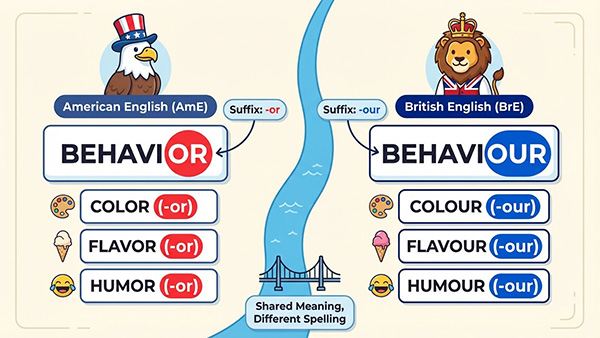
The words “behavior” and “behaviour” are nouns that describe the way a person or animal acts or conducts themselves, especially towards others. It encompasses a wide range of actions, reactions, and mannerisms. The key difference lies solely in the spelling: “behavior” is the standard spelling in American English, while “behaviour” is the standard spelling in British English and other Commonwealth countries.
Behavior (American English): The way in which one acts or conducts oneself, especially towards others.
Behaviour (British English): The same definition as above, but with a different spelling convention.
The term can refer to both voluntary and involuntary actions, as well as conscious and unconscious responses to stimuli. It’s a broad term that can be applied to individuals, groups, systems, and even inanimate objects in certain contexts (e.g., “the behavior of the stock market”).
Writers often search for “behavior vs behaviour” or “behavior or behaviour which is correct.” The answer depends entirely on the regional standard: American English uses “behavior,” while British English prefers “behaviour.” Understanding the “behaviour spelling” conventions and knowing the “american spelling of behaviour” versus “behaviour british spelling” ensures consistency and clarity in your writing.
Structural Breakdown
The difference between “behavior” and “behaviour” is a simple matter of spelling. Both words share the same root and pronunciation. The variation stems from historical differences in spelling conventions between Noah Webster’s American English dictionary and British English standards.
The base word is “behave,” a verb meaning to act in a specific way. The suffix “-ior” (American English) or “-iour” (British English) is added to form the noun. This pattern extends to other related words like “savior” (US) and “saviour” (UK), “color” (US) and “colour” (UK), and “flavor” (US) and “flavour” (UK). The British English spellings generally retain the “u” from the original French or Latin roots of these words.
Here’s a breakdown:
- Verb: Behave (same in both American and British English)
- Noun (American English): Behavior
- Noun (British English): Behaviour
Types and Categories of Behavior
Behavior can be categorized in various ways, depending on the context and the field of study. Here are a few common classifications:
1. Voluntary vs. Involuntary Behavior
Voluntary behavior is intentional and conscious, such as deciding to study for an exam or choosing to help someone. Involuntary behavior is automatic and unconscious, like blinking or shivering when cold. These are physical responses to external stimuli.
2. Innate vs. Learned Behavior
Innate behavior is instinctive and genetically determined, such as a baby’s reflex to suckle. Learned behavior is acquired through experience and observation, such as learning to ride a bike or speak a language.
3. Individual vs. Social Behavior
Individual behavior is actions performed by a person alone, such as reading a book or going for a run. Social behavior involves interactions with others, such as participating in a group project or attending a party. Social behavior can be influenced by social norms.
4. Adaptive vs. Maladaptive Behavior
Adaptive behavior helps an individual adjust to their environment and meet their needs, such as studying hard to achieve good grades. Maladaptive behavior hinders an individual’s ability to function effectively and may be harmful, such as substance abuse or aggression.
5. Normal vs. Abnormal Behavior
Normal behavior is considered typical and acceptable within a given cultural context. Abnormal behavior deviates from these norms and may indicate an underlying psychological or medical condition. What is considered normal can vary greatly across cultures.
Examples of Behavior and Behaviour in Sentences
The following tables provide examples of “behavior” and “behaviour” in sentences, categorized by different contexts to illustrate their proper usage.
Table 1: General Examples
This table illustrates the use of “behavior” and “behaviour” in general contexts, highlighting the difference in spelling based on regional English.
| American English (Behavior) | British English (Behaviour) |
|---|---|
| His behavior was unacceptable. | His behaviour was unacceptable. |
| The dog’s behavior changed after the training. | The dog’s behaviour changed after the training. |
| Good behavior is expected in the classroom. | Good behaviour is expected in the classroom. |
| The study examined the behavior of consumers. | The study examined the behaviour of consumers. |
| The child’s behavior improved with positive reinforcement. | The child’s behaviour improved with positive reinforcement. |
| The company has a code of behavior for all employees. | The company has a code of behaviour for all employees. |
| Animal behavior is a fascinating field of study. | Animal behaviour is a fascinating field of study. |
| Her behavior at the party was quite erratic. | Her behaviour at the party was quite erratic. |
| The teacher addressed the disruptive behavior in class. | The teacher addressed the disruptive behaviour in class. |
| Understanding human behavior is crucial for effective communication. | Understanding human behaviour is crucial for effective communication. |
| The politician’s behavior was under scrutiny. | The politician’s behaviour was under scrutiny. |
| The software’s behavior was unpredictable. | The software’s behaviour was unpredictable. |
| The experiment analyzed the behavior of the chemicals. | The experiment analyzed the behaviour of the chemicals. |
| The robot’s behavior is programmed in advance. | The robot’s behaviour is programmed in advance. |
| His erratic behavior worried his family. | His erratic behaviour worried his family. |
| The bird’s mating behavior is quite complex. | The bird’s mating behaviour is quite complex. |
| The crowd’s behavior became increasingly agitated. | The crowd’s behaviour became increasingly agitated. |
| The manager addressed the behavior of the team. | The manager addressed the behaviour of the team. |
| The study focused on the behavior of children under stress. | The study focused on the behaviour of children under stress. |
| The company’s ethical behavior is commendable. | The company’s ethical behaviour is commendable. |
Table 2: Examples in Psychological Contexts
This table provides examples of “behavior” and “behaviour” used in psychological contexts, such as describing mental health or therapeutic interventions.
| American English (Behavior) | British English (Behaviour) |
|---|---|
| Cognitive behavior therapy can be very effective. | Cognitive behaviour therapy can be very effective. |
| The therapist analyzed the patient’s behavior patterns. | The therapist analyzed the patient’s behaviour patterns. |
| The child exhibited challenging behavior at school. | The child exhibited challenging behaviour at school. |
| Understanding behavior disorders is crucial in mental health. | Understanding behaviour disorders is crucial in mental health. |
| Applied behavior analysis is used to treat autism. | Applied behaviour analysis is used to treat autism. |
| His behavior suggested underlying anxiety. | His behaviour suggested underlying anxiety. |
| The study investigated the behavior of individuals with depression. | The study investigated the behaviour of individuals with depression. |
| The patient’s behavior improved after medication. | The patient’s behaviour improved after medication. |
| The psychologist specializes in child behavior. | The psychologist specializes in child behaviour. |
| The research explored the link between stress and behavior. | The research explored the link between stress and behaviour. |
| The behavior modification program was successful. | The behaviour modification program was successful. |
| The doctor assessed his aggressive behavior. | The doctor assessed his aggressive behaviour. |
| The study examined the behavior of patients with PTSD. | The study examined the behaviour of patients with PTSD. |
| Her compulsive behavior was a sign of a deeper issue. | Her compulsive behaviour was a sign of a deeper issue. |
| The treatment focused on changing maladaptive behavior. | The treatment focused on changing maladaptive behaviour. |
| Understanding group behavior is important in social psychology. | Understanding group behaviour is important in social psychology. |
| The experiment explored the behavior of subjects under pressure. | The experiment explored the behaviour of subjects under pressure. |
| His defiant behavior was a cry for help. | His defiant behaviour was a cry for help. |
| The research analyzed the behavior of individuals with social anxiety. | The research analyzed the behaviour of individuals with social anxiety. |
| The counselor addressed the student’s disruptive behavior. | The counselor addressed the student’s disruptive behaviour. |
Table 3: Examples in Scientific and Technical Contexts
This table illustrates the use of “behavior” and “behaviour” in scientific and technical writing, demonstrating the importance of adhering to the correct spelling based on the intended audience.
| American English (Behavior) | British English (Behaviour) |
|---|---|
| The study examined the behavior of the particles. | The study examined the behaviour of the particles. |
| The system’s behavior was unpredictable under those conditions. | The system’s behaviour was unpredictable under those conditions. |
| The engineer analyzed the structural behavior of the bridge. | The engineer analyzed the structural behaviour of the bridge. |
| The software’s behavior is determined by its code. | The software’s behaviour is determined by its code. |
| The experiment investigated the behavior of the chemical reaction. | The experiment investigated the behaviour of the chemical reaction. |
| The robot’s behavior is controlled by artificial intelligence. | The robot’s behaviour is controlled by artificial intelligence. |
| The material’s behavior under stress was tested. | The material’s behaviour under stress was tested. |
| The model simulates the behavior of the ecosystem. | The model simulates the behaviour of the ecosystem. |
| The algorithm predicts user behavior on the website. | The algorithm predicts user behaviour on the website. |
| The sensor monitors the behavior of the machine. | The sensor monitors the behaviour of the machine. |
| The research focused on the behavior of the quantum particles. | The research focused on the behaviour of the quantum particles. |
| The analysis revealed the complex behavior of the network. | The analysis revealed the complex behaviour of the network. |
| The study modeled the behavior of fluid dynamics. | The study modeled the behaviour of fluid dynamics. |
| The system’s adaptive behavior allowed it to optimize performance. | The system’s adaptive behaviour allowed it to optimize performance. |
| The simulation examines the behavior of the climate system. | The simulation examines the behaviour of the climate system. |
| The experiment measured the behavior of light waves. | The experiment measured the behaviour of light waves. |
| The study analyzed the behavior of the stock market. | The study analyzed the behaviour of the stock market. |
| The software predicts the behavior of traffic patterns. | The software predicts the behaviour of traffic patterns. |
| The research investigates the behavior of cancerous cells. | The research investigates the behaviour of cancerous cells. |
| The system monitors the behavior of the power grid. | The system monitors the behaviour of the power grid. |
Some learners wonder, “is it behaviour or behavior?” Both forms are correct, but the proper choice is dictated by the English variant being used. Selecting the correct version avoids mistakes and ensures your text aligns with either American or British spelling norms.
Usage Rules
The rule of thumb is straightforward: use “behavior” in American English and “behaviour” in British English. However, there are some additional points to consider:
- Consistency: Within any given document or piece of writing, maintain consistency. Do not switch between “behavior” and “behaviour.” Choose the spelling appropriate for your target audience and stick with it.
- Context: Consider the context in which you are writing. If you are writing for an international audience, you may need to choose one spelling and indicate your choice (e.g., “using American English spelling”).
- Style Guides: Adhere to the style guide required by your publisher, institution, or organization. Style guides often specify preferred spellings for certain words.
- Software Settings: Be mindful of your word processing software’s language settings. These settings can automatically correct your spelling to match the selected dialect.
Common Mistakes
The most common mistake is using the incorrect spelling for the intended audience. Here are some examples of incorrect and corrected sentences:
| Incorrect | Correct (American English) | Correct (British English) |
|---|---|---|
| His behaviour was excellent in America. | His behavior was excellent in America. | His behaviour was excellent. |
| The dog’s behavior is well-regarded in the UK. | The dog’s behavior is well-regarded. | The dog’s behaviour is well-regarded in the UK. |
| The child’s behaviour needs improvement in the US. | The child’s behavior needs improvement in the US. | The child’s behaviour needs improvement. |
| The consumer behavior is the same globally. | The consumer behavior is the same globally. | The consumer behaviour is the same globally. |
| The ethical behaviour is always important. | The ethical behavior is always important. | The ethical behaviour is always important. |
| Cognitive behavior therapy is helpful. | Cognitive behavior therapy is helpful. | Cognitive behaviour therapy is helpful. |
| The scientist studied the particle behaviour. | The scientist studied the particle behavior. | The scientist studied the particle behaviour. |
| The software’s behavior is easy to use in Europe. | The software’s behavior is easy to use. | The software’s behaviour is easy to use in Europe. |
Practice Exercises
Test your understanding of “behavior” and “behaviour” with these practice exercises. Choose the correct spelling based on the context provided.
Exercise 1: Fill in the Blanks (American English)
Fill in the blanks with the correct form of “behavior” for American English.
| Question | Answer |
|---|---|
| 1. The study of animal ______ is fascinating. | behavior |
| 2. His ______ at the meeting was inappropriate. | behavior |
| 3. The company has a strict code of ______. | behavior |
| 4. Understanding consumer ______ is crucial for marketing. | behavior |
| 5. The child’s ______ improved after the intervention. | behavior |
| 6. The software’s ______ is unpredictable. | behavior |
| 7. The robot’s ______ is programmed in advance. | behavior |
| 8. Ethical ______ is essential for business success. | behavior |
| 9. The patient’s ______ was assessed by the doctor. | behavior |
| 10. The research analyzed the ______ of the system. | behavior |
Exercise 2: Fill in the Blanks (British English)
Fill in the blanks with the correct form of “behaviour” for British English.
| Question | Answer |
|---|---|
| 1. The study of animal ______ is fascinating. | behaviour |
| 2. His ______ at the meeting was inappropriate. | behaviour |
| 3. The company has a strict code of ______. | behaviour |
| 4. Understanding consumer ______ is crucial for marketing. | behaviour |
| 5. The child’s ______ improved after the intervention. | behaviour |
| 6. The software’s ______ is unpredictable. | behaviour |
| 7. The robot’s ______ is programmed in advance. | behaviour |
| 8. Ethical ______ is essential for business success. | behaviour |
| 9. The patient’s ______ was assessed by the doctor. | behaviour |
| 10. The research analyzed the ______ of the system. | behaviour |
Exercise 3: Choose the Correct Spelling
Choose the correct spelling (“behavior” or “behaviour”) based on the context.
| Question | Answer |
|---|---|
| 1. The psychologist studied the patient’s ______. (Writing for a US audience) | behavior |
| 2. The school has a policy on student ______. (Writing for a UK audience) | behaviour |
| 3. The research on animal ______ was published in a US journal. | behavior |
| 4. The analysis of consumer ______ was conducted in London. | behaviour |
| 5. The company’s code of ______ is based on American standards. | behavior |
| 6. The software’s ______ was tested in a British laboratory. | behaviour |
| 7. The study of group ______ was presented at a conference in New York. | behavior |
| 8. The investigation into ethical ______ was conducted by a UK firm. | behaviour |
| 9. The assessment of the child’s ______ was performed by an American specialist. | behavior |
| 10. The report on the system’s ______ was written for a British audience. | behaviour |
While this article focuses on English spelling, it’s helpful to understand that language differences are not unique to English. Many people ask, “what is the difference between spanish and english?” The two languages differ in spelling, grammar, and pronunciation conventions.
Just as “behavior” and “behaviour” follow distinct rules depending on the English variant, Spanish has its own standardized forms that must be respected in writing. Recognizing these distinctions improves clarity and prevents misunderstandings, especially in international or bilingual contexts.
Advanced Topics
For advanced learners, it’s helpful to understand the historical context and linguistic reasons behind the spelling differences between American and British English. Noah Webster, an American lexicographer, advocated for simplified spellings in American English to distinguish it from British English and promote a sense of national identity. This is why many words that end in “-our” in British English end in “-or” in American English.
Furthermore, understanding the nuances of register and formality can also be important. While “behavior” and “behaviour” are generally interchangeable in most contexts, some may perceive one spelling as slightly more formal than the other, depending on their regional dialect. However, this is a subtle distinction and should not be a primary concern.
Frequently Asked Questions
Here are some frequently asked questions about “behavior” and “behaviour”:
Is there any difference in meaning between “behavior” and “behaviour”?
No, there is absolutely no difference in meaning. The only difference is the spelling, which depends on whether you are using American or British English.
Which spelling should I use if I am writing for an international audience?
If you are writing for a truly international audience, it is generally recommended to choose one spelling (either American or British) and be consistent throughout your document. You could also include a note at the beginning stating which spelling convention you are using. Alternatively, you could use a style guide that specifies a preferred spelling for international communication.
Will my word processor automatically correct the spelling?
Yes, most word processors have language settings that will automatically correct your spelling based on the selected dialect. Make sure your language settings are set to the appropriate English dialect (American or British) to ensure accurate spelling.
Are there any other words with similar spelling differences?
Yes, there are many other words with similar spelling differences between American and British English. Some common examples include “color/colour,” “flavor/flavour,” “honor/honour,” “labor/labour,” and “neighbor/neighbour.” The same rule applies: the “-or” spelling is generally used in American English, while the “-our” spelling is generally used in British English.
Is it acceptable to mix American and British spellings in the same document?
No, it is generally not acceptable to mix American and British spellings in the same document. This is considered inconsistent and can be distracting to the reader. Choose one spelling convention and stick with it throughout your writing.
What if I am unsure which spelling to use?
If you are unsure which spelling to use, consider your target audience and the context in which you are writing. If you are writing for an American audience, use American English spellings. If you are writing for a British audience, use British English spellings. If you are writing for an international audience, choose one spelling and be consistent.
Does the spelling difference affect pronunciation?
No, the spelling difference does not affect pronunciation. Both “behavior” and “behaviour” are pronounced the same way.
Are there any regional variations within American or British English?
While American and British English are the two main dialects with these spelling differences, there may be some regional variations within each dialect. However, the “behavior/behaviour” distinction is generally consistent across all regions within the United States and the United Kingdom, respectively.
Conclusion
The difference between “behavior” and “behaviour” is a simple matter of spelling convention tied to regional dialects of English. “Behavior” is the standard spelling in American English, while “behaviour” is the standard spelling in British English. Understanding this distinction is crucial for effective communication and ensuring your writing is appropriate for your intended audience. By consistently applying the correct spelling and being mindful of your word processor’s language settings, you can avoid common mistakes and present yourself as a skilled and attentive writer.
Remember to always consider your audience and the context in which you are writing. By mastering this simple yet important difference, you can enhance the clarity and professionalism of your written communication. Keep practicing, and don’t hesitate to consult style guides or dictionaries when in doubt. Happy writing!

I’m James Terban, a teacher with a degree in Education and five years of experience working with students of all ages, from young kids learning their first grammar rules to adults picking up English as a second language. I started Linguistics Guide because I kept seeing good learners hit a wall due to explanations that were either too vague or too complicated. Every article here comes from a real question I have heard in a classroom or seen asked online.