
Mastering the placement of punctuation marks, especially periods, in relation to quotation marks is crucial for clear and accurate writing. This seemingly small detail can significantly impact the readability and professionalism of your work. Whether you’re a student, a professional writer, or simply someone who wants to improve their grammar skills, understanding this rule is essential.
This article provides a comprehensive guide to the rules governing period placement with quotation marks, offering detailed explanations, numerous examples, and helpful practice exercises.
Table of Contents
- Introduction
- Definition: Quotation Marks and Periods
- Structural Breakdown
- Types of Quotations
- Examples
- Usage Rules
- Common Mistakes
- Practice Exercises
- Advanced Topics
- Frequently Asked Questions (FAQ)
- Conclusion
Definition: Quotation Marks and Periods
Off to College Deals

Save up to 30% on everything you need for the semester.
Contains affiliate link
Quotation marks are punctuation marks used in pairs to set off direct speech, a quotation, or a phrase. They indicate that the enclosed words are not the writer’s original words but are being borrowed from another source. There are two main types of quotation marks: double quotation marks (“) and single quotation marks (‘).
A period is a punctuation mark (.) used to indicate the end of a declarative sentence. It signals a complete thought and a pause in the flow of writing. Understanding how to correctly place a period in relation to quotation marks is a foundational element of grammatical correctness.
The primary function of quotation marks is to attribute words accurately, while the period serves to punctuate the entire sentence. Therefore, the placement of the period often depends on the context and the style guide being followed.
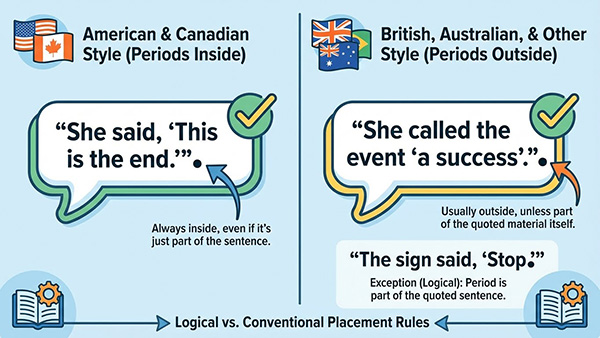
Understanding whether a period goes inside or outside quotation marks can be confusing, especially for writers navigating both American and British English conventions. In American English, periods almost always go inside quotation marks, even if the quoted material is a single word or phrase. British English, by contrast, places the period outside unless the quotation forms a complete sentence.
This distinction is crucial at the end of a sentence, as misplacement can subtly alter readability and may affect the perceived professionalism of your writing. Clear application of this rule ensures your punctuation aligns with the intended style and avoids ambiguity.
Young Adults & Students:
Get 6 Months of Prime for $0

Ages 18-24 unlock exclusive perks including:
Contains affiliate link
Structural Breakdown
The structure involving periods and quotation marks can be broken down into a simple rule, primarily applicable in American English: The period usually goes inside the quotation marks. To put it simply, the period in American English comes before the closing quotation mark. Writers often wonder, “should quotation marks be before period?”—the answer is yes for standard statements, but style guides may vary for specialized formats. This convention aims to improve readability and visual clarity.
However, this rule is not universally applied. British English, for instance, often places the period outside the quotation mark unless the quotation itself is a complete sentence. Understanding these differences is crucial for writing that is appropriate for the intended audience.
The structure also depends on the type of quotation. Direct quotations, which are exact reproductions of someone’s words, typically adhere to the “period inside” rule in American English. Indirect quotations, which report what someone said without using their exact words, do not use quotation marks at all and therefore are punctuated as normal sentences.
Types of Quotations
Direct Quotations
A direct quotation represents the exact words spoken or written by someone. It is enclosed in quotation marks to indicate that these are not the author’s original words but are being reproduced verbatim. Direct quotations are essential for providing evidence, adding credibility, and capturing the speaker’s tone and style.
Example: She said, “I will be there at five o’clock.”
Indirect Quotations
An indirect quotation, also known as reported speech, reports what someone said or wrote without using their exact words. It is typically introduced by a reporting verb such as “said,” “stated,” or “mentioned,” and it does not require quotation marks. Instead, the information is conveyed in the writer’s own words, often with changes in tense and pronouns.
Example: She said that she would be there at five o’clock.
Quotations Within Quotations
When a quotation appears within another quotation, it is necessary to use single quotation marks to distinguish it from the main quotation. This helps to avoid confusion and clearly indicate the different layers of speech or text being cited.
Example: He said, “She told me, ‘I can’t believe it’s already Friday!'”
Examples
Direct Quotations
The following table illustrates the use of periods with direct quotations. Note that in American English, the period typically goes inside the quotation marks.
| Example | Explanation |
|---|---|
| She exclaimed, “I love this song.” | The period is placed inside the quotation mark because the quoted material is the end of the sentence. |
| He whispered, “It’s a secret.” | Again, the period goes inside the quotation mark. |
| “I’m so tired,” she complained. | Even when the quotation comes first, the period stays inside. |
| The sign read, “No trespassing.” | Short, complete sentences still follow the rule. |
| He asked, “Are you coming?” | Note that question marks and exclamation points have their own rules. |
| She said, “The book was amazing.” | Simple statement with period inside. |
| He replied, “I don’t think so.” | Negative statement with period inside. |
| “Let’s go,” she urged. | Imperative sentence with period inside. |
| The note said, “Call me later.” | Instruction with period inside. |
| “I’m not sure,” he admitted. | Uncertainty expressed with period inside. |
| The teacher announced, “Class is dismissed.” | Announcement with period inside. |
| He muttered, “This is ridiculous.” | Grumbling with period inside. |
| “I agree,” she said firmly. | Agreement with period inside. |
| The email stated, “Meeting is postponed.” | Formal statement with period inside. |
| “I understand,” he nodded. | Understanding expressed with period inside. |
| She confessed, “I made a mistake.” | Confession with period inside. |
| He joked, “I’m always right.” | Joke with period inside. |
| “I’m ready,” she declared. | Declaration with period inside. |
| The report concluded, “Further research is needed.” | Conclusion with period inside. |
| “I’m impressed,” he admitted. | Admission with period inside. |
| The instructions read, “Open carefully.” | Instruction with period inside. |
| “I’m disappointed,” she sighed. | Disappointment expressed with period inside. |
| He added, “It’s worth a try.” | Addition with period inside. |
| “I’m optimistic,” she smiled. | Optimism expressed with period inside. |
Indirect Quotations
Indirect quotations do not use quotation marks. The period is placed at the end of the sentence, as with any regular statement.
| Example | Explanation |
|---|---|
| She said that she loved the song. | No quotation marks are used, and the period ends the sentence. |
| He whispered that it was a secret. | Again, no quotation marks are needed. |
| She complained that she was so tired. | The period ends the reported statement. |
| The sign indicated that there was no trespassing. | Paraphrased information doesn’t require quotes. |
| He asked if I was coming. | Indirect questions also don’t use quotation marks. |
| She mentioned that she would call later. | Reported action, no quotation marks. |
| He explained that he needed more time. | Explanation reported, no quotation marks. |
| They confirmed that the meeting was on Tuesday. | Confirmation reported, no quotation marks. |
| She believed that honesty was the best policy. | Belief reported, no quotation marks. |
| He suggested that we should leave early. | Suggestion reported, no quotation marks. |
| They announced that the event was cancelled. | Announcement reported, no quotation marks. |
| She demonstrated that the technique was effective. | Demonstration reported, no quotation marks. |
| He reminded us that the deadline was approaching. | Reminder reported, no quotation marks. |
| They emphasized that teamwork was essential. | Emphasis reported, no quotation marks. |
| She noticed that the room was unusually quiet. | Observation reported, no quotation marks. |
| He realized that he had made a mistake. | Realization reported, no quotation marks. |
| They suspected that something was wrong. | Suspicion reported, no quotation marks. |
| She hoped that everything would be alright. | Hope reported, no quotation marks. |
| He predicted that the weather would improve. | Prediction reported, no quotation marks. |
| They determined that the cause was unknown. | Determination reported, no quotation marks. |
| She advised us that caution was necessary. | Advice reported, no quotation marks. |
| He warned them that danger was imminent. | Warning reported, no quotation marks. |
| They informed us that changes were coming. | Information reported, no quotation marks. |
| She assured him that everything would be fine. | Assurance reported, no quotation marks. |
Single Quotation Marks
Single quotation marks are typically used for quotations within quotations. The placement of the period depends on whether the single-quoted material ends the sentence and whether you’re following American or British English conventions.
| Example | Explanation |
|---|---|
| He said, “She mentioned, ‘I’m ready.'” | In American English, the period goes inside both sets of quotation marks. |
| The teacher asked, “Did she say, ‘I don’t know’?” | The question mark takes precedence here, but the period for “I don’t know” would still be inside in American English if a statement. |
| She explained, “He said, ‘It’s complicated.'” | Again, the period goes inside both sets. |
| The author wrote, “In her poem, she uses the word ‘serendipity’.” | Single quotes can also emphasize a word. |
| He recalled, “She yelled, ‘Hurry up!'” | Exclamation point takes precedence, but period would be inside if a statement. |
| The witness stated, “He claimed, ‘I didn’t do it.'” | Denial quoted within a statement, period inside. |
| She recounted, “He whispered, ‘Meet me there.'” | Arrangement quoted within a statement, period inside. |
| The report noted, “The suspect muttered, ‘I’ll get you.'” | Threat quoted within a statement, period inside. |
| He remembered, “She sang, ‘Silent Night.'” | Song title quoted within a statement, period inside. |
| The article mentioned, “He defined ‘ubiquitous’ as ‘everywhere present.'” | Definition quoted within a statement, period inside. |
| She clarified, “He implied, ‘It’s your fault.'” | Implication quoted within a statement, period inside. |
| He elaborated, “She hinted, ‘Look closer.'” | Hint quoted within a statement, period inside. |
| The document stated, “The clause defined ‘negligence’ as ‘failure to use reasonable care.'” | Legal definition quoted within a statement, period inside. |
| She added, “He joked, ‘I’m always right.'” | Joke quoted within a statement, period inside. |
| He responded, “She questioned, ‘Are you sure?'” | Question quoted within a statement. |
| She emphasized, “He insisted, ‘Trust me.'” | Insistence quoted within a statement, period inside. |
| He revealed, “She confessed, ‘I lied.'” | Confession quoted within a statement, period inside. |
| She explained, “He clarified, ‘It’s not that simple.'” | Clarification quoted within a statement, period inside. |
| The professor noted, “The student argued, ‘That’s not fair.'” | Argument quoted within a statement, period inside. |
| He confirmed, “She agreed, ‘Absolutely.'” | Agreement quoted within a statement, period inside. |
| She suggested, “He proposed, ‘Let’s collaborate.'” | Proposal quoted within a statement, period inside. |
| He observed, “She remarked, ‘How interesting.'” | Remark quoted within a statement, period inside. |
| She analyzed, “He concluded, ‘The data is inconclusive.'” | Conclusion quoted within a statement, period inside. |
| He interpreted, “She suggested, ‘Consider the alternatives.'” | Suggestion quoted within a statement, period inside. |
Dialogue
When writing dialogue, the placement of the period is crucial for clarity. Each speaker’s words are enclosed in quotation marks, and the period is placed inside the quotation mark in American English.
| Example | Explanation |
|---|---|
| “Hello,” she said. “How are you today?” | Each sentence is a separate quotation, with the period inside. |
| “I’m fine, thank you,” he replied. “And you?” | Again, each speaker’s words are punctuated accordingly. |
| “I’m doing well,” she said. “Let’s go for a walk.” | A conversation continues with proper punctuation. |
| “That sounds great,” he agreed. “Where should we go?” | Agreement and a question, properly punctuated. |
| “Let’s go to the park,” she suggested. “It’s beautiful this time of year.” | Suggestion with a reason, each punctuated correctly. |
| “Are you ready?” he asked. “We should leave now.” | Question and statement in dialogue. |
| “Yes, I’m ready,” she confirmed. “Let’s get going.” | Confirmation and action in dialogue. |
| “Did you bring your keys?” he inquired. “I can’t find mine.” | Inquiry and explanation in dialogue. |
| “Yes, I have them,” she reassured. “Don’t worry.” | Reassurance and comfort in dialogue. |
| “This is a great day,” he observed. “I’m glad we came.” | Observation and gratitude in dialogue. |
| “I agree completely,” she responded. “It’s so peaceful here.” | Agreement and description in dialogue. |
| “What should we do next?” he wondered. “Any ideas?” | Question and invitation in dialogue. |
| “Let’s sit by the lake,” she suggested. “We can relax there.” | Suggestion and reason in dialogue. |
| “That sounds perfect,” he approved. “I need a break.” | Approval and need in dialogue. |
| “Do you want some water?” she offered. “I brought a bottle.” | Offer and explanation in dialogue. |
| “Yes, please,” he accepted. “I’m quite thirsty.” | Acceptance and reason in dialogue. |
| “Here you go,” she said. “Enjoy.” | Offering and well-wishing in dialogue. |
| “Thank you so much,” he appreciated. “You’re very kind.” | Appreciation and compliment in dialogue. |
| “What time is it?” he inquired. “I have to be home by five.” | Inquiry and constraint in dialogue. |
| “It’s almost four,” she informed. “We have plenty of time.” | Information and reassurance in dialogue. |
| “That’s good to know,” he relieved. “I was getting worried.” | Relief and worry in dialogue. |
| “Let’s head back soon,” she proposed. “We don’t want to be late.” | Proposal and reason in dialogue. |
| “Agreed,” he confirmed. “Let’s start walking now.” | Agreement and action in dialogue. |
| “This was lovely,” she concluded. “We should do this again.” | Conclusion and suggestion in dialogue. |
Usage Rules
American English
In American English, the general rule is that periods and commas are placed inside the quotation marks, regardless of whether the quoted material is a complete sentence. This rule is primarily for aesthetic reasons and aims to improve readability.
Example: She said, “I will be there.”
British English
British English follows a more logical approach. The period is placed inside the quotation mark only if the quotation is a complete sentence. If the quotation is just a fragment or a word, the period goes outside the quotation mark.
Example: She said, “I will be there”. (Complete sentence)
Example: The word “serendipity”. (Fragment)
Exceptions to the Rule
There are exceptions to these rules, particularly when dealing with other punctuation marks such as question marks and exclamation points. If the question mark or exclamation point is part of the quoted material, it goes inside the quotation mark. If it punctuates the entire sentence, it goes outside.
Example: She asked, “Are you coming?” (Question mark is part of the quote)
Did she say, “I’m not sure”? (Question mark punctuates the entire sentence)
Common Mistakes
One of the most common mistakes is placing the period outside the quotation mark in American English. This is often influenced by British English conventions or simply a lack of awareness of the rule.
Incorrect: She said, “I love it”.
Correct: She said, “I love it.”
Another mistake is confusing the placement of other punctuation marks like question marks and exclamation points. Remember that these marks go inside the quotation mark if they are part of the quoted material, and outside if they punctuate the entire sentence.
Incorrect: Did she say, “I’m ready?”.
Correct: Did she say, “I’m ready?”
Practice Exercises
When punctuation appears at the end of a sentence, always consider whether the quotation marks contain a full sentence or just a fragment. This distinction helps writers determine when using quotations does period go inside or outside, reinforcing proper grammar in both American and British styles.
Exercise 1: Basic Period Placement
Instructions: Place the period correctly in the following sentences.
| Question | Answer |
|---|---|
| He said, “I’m going to the store” | He said, “I’m going to the store.” |
| She replied, “That sounds great” | She replied, “That sounds great.” |
| “I don’t know,” he admitted | “I don’t know,” he admitted. |
| The sign read, “Beware of dog” | The sign read, “Beware of dog.” |
| She whispered, “It’s a secret” | She whispered, “It’s a secret.” |
| He announced, “The meeting is cancelled” | He announced, “The meeting is cancelled.” |
| She explained, “I need more time” | She explained, “I need more time.” |
| “Let’s begin,” he urged | “Let’s begin,” he urged. |
| The note said, “Please call me” | The note said, “Please call me.” |
| “I understand,” she nodded | “I understand,” she nodded. |
Exercise 2: Dialogue and Quotations
Instructions: Correctly punctuate the following dialogue excerpts.
| Question | Answer |
|---|---|
| “Hello” she said “How are you?” | “Hello,” she said. “How are you?” |
| “I’m fine thank you” he replied “And you?” | “I’m fine, thank you,” he replied. “And you?” |
| “I’m doing well” she said “Let’s go for a walk” | “I’m doing well,” she said. “Let’s go for a walk.” |
| “That sounds great” he agreed “Where should we go?” | “That sounds great,” he agreed. “Where should we go?” |
| “Let’s go to the park” she suggested “It’s beautiful there” | “Let’s go to the park,” she suggested. “It’s beautiful there.” |
| “Are you ready” he asked “We should leave now” | “Are you ready?” he asked. “We should leave now.” |
| “Yes I’m ready” she confirmed “Let’s get going” | “Yes, I’m ready,” she confirmed. “Let’s get going.” |
| “Did you bring your keys” he inquired “I can’t find mine” | “Did you bring your keys?” he inquired. “I can’t find mine.” |
| “Yes I have them” she reassured “Don’t worry” | “Yes, I have them,” she reassured. “Don’t worry.” |
| “This is a great day” he observed “I’m glad we came” | “This is a great day,” he observed. “I’m glad we came.” |
Exercise 3: Correcting Errors
Instructions: Identify and correct the errors in period placement in the following sentences.
| Question | Answer |
|---|---|
| She said, “I’m not sure”. | She said, “I’m not sure.” |
| He asked, “Is it raining”? | He asked, “Is it raining?” |
| “I’ll be there”, she promised. | “I’ll be there,” she promised. |
| The sign warned, “Danger!”. | The sign warned, “Danger!” |
| He muttered, “This is ridiculous”. | He muttered, “This is ridiculous.” |
| She exclaimed, “What a surprise!”. | She exclaimed, “What a surprise!” |
| “I need help”, he pleaded. | “I need help,” he pleaded. |
| The email stated, “Meeting postponed”. | The email stated, “Meeting postponed.” |
| “I understand”, he nodded. | “I understand,” he nodded. |
| She confessed, “I was wrong”. | She confessed, “I was wrong.” |
Advanced Topics
Block Quotations
Block quotations are long quotations (typically longer than four lines) that are set off from the main text by indenting them. In block quotations, quotation marks are usually not used unless the quoted material itself contains quotations. The period is placed before the citation, which usually follows the quotation.
Example:
In his book, “The Elements of Style,” Strunk and White state:
“Omit needless words. Vigorous writing is concise. A sentence should contain no unnecessary words, a paragraph no unnecessary sentences, for the same reason that a drawing should have no unnecessary lines and a machine no unnecessary parts.” (Strunk & White, 1959, p. 23)
Punctuating with Other Marks
When a quotation ends with a question mark or an exclamation point, the placement depends on the context. If the question mark or exclamation point belongs to the quoted material, it replaces the period and goes inside the quotation mark. If the entire sentence is a question or exclamation, the question mark or exclamation point goes outside the quotation mark.
Example: She asked, “Are you coming?”
Did she say, “I’m ready!”?
Frequently Asked Questions (FAQ)
Does the rule about period placement apply to all types of writing?
The rule primarily applies to academic and formal writing. In informal writing, such as text messages or social media posts, the rules may be more relaxed. However, for professional and academic purposes, adhering to the standard conventions is crucial.
What if the quotation is a question? Where does the question mark go?
If the quotation is a question, the question mark replaces the period and goes inside the quotation mark: She asked, “Are you coming?” If the entire sentence is a question about what was said, the question mark goes outside: Did she say, “I’m ready”?
What if I’m quoting something that already has a period in it?
If the quoted material already ends with a period and it’s a complete sentence, simply include the period within the quotation marks. No additional period is needed.
How does this rule apply to citations in academic papers?
In academic papers, the citation usually follows the quotation, and the period is placed after the citation. Example: “The quick brown fox jumps over the lazy dog” (Smith, 2020, p. 45).
What if the quotation is at the beginning of the sentence?
Even if the quotation starts the sentence, the period still goes inside the quotation mark in American English: “I’m ready,” she said.
Does the length of the quotation affect the placement of the period?
The length of the quotation doesn’t change the rule. Whether it’s a short phrase or a complete sentence, the period goes inside the quotation mark in American English. For block quotations, quotation marks are often omitted, and the period is placed before the citation.
What about other punctuation marks like commas, semicolons, and colons?
In American English, commas and periods always go inside the quotation marks. Semicolons and colons, however, are typically placed outside the quotation marks.
Is there a specific style guide that dictates these rules?
Yes, style guides like the Chicago Manual of Style (CMOS) and the Associated Press (AP) style guide provide detailed rules on punctuation, including the placement of periods with quotation marks. The CMOS generally favors placing periods and commas inside quotation marks, while the AP style also follows this convention. Always refer to the specific style guide required for your writing context.
Conclusion
Mastering the placement of periods inside or outside quotation marks is a fundamental aspect of English grammar that ensures clarity and professionalism in writing. While the rules may seem simple, they require careful attention to detail and an understanding of the conventions of American and British English. By following the guidelines and examples provided in this article, you can confidently punctuate your writing and avoid common errors.
Remember, in American English, the period generally goes inside the quotation mark, while British English places it outside unless the quotation is a complete sentence. Practice these rules regularly, and consult style guides when in doubt. With consistent application, you’ll enhance the readability and credibility of your written work. Good luck!

I’m James Terban, a teacher with a degree in Education and five years of experience working with students of all ages, from young kids learning their first grammar rules to adults picking up English as a second language. I started Linguistics Guide because I kept seeing good learners hit a wall due to explanations that were either too vague or too complicated. Every article here comes from a real question I have heard in a classroom or seen asked online.