
Idioms add color and depth to the English language, making communication more engaging and nuanced. Mastering idioms related to success is crucial for understanding native speakers and expressing yourself effectively.
This guide explores a wide range of idioms associated with success, providing definitions, examples, and practical exercises to help you incorporate them into your everyday language. Whether you’re a student, professional, or language enthusiast, this article will equip you with the knowledge and skills to confidently use idioms in various contexts.
Introduction
Understanding and using idioms effectively can significantly enhance your English proficiency. Idioms related to success are particularly useful in professional and academic settings, allowing you to express complex ideas in a concise and impactful way.

This article serves as a comprehensive guide, offering clear explanations, numerous examples, and practical exercises to help you master these essential expressions. By the end of this guide, you’ll be able to confidently incorporate idioms for success into your vocabulary and communication.
Definition of Idioms for Success
An idiom is a phrase or expression whose meaning cannot be understood from the literal meanings of its individual words. Instead, the phrase has a figurative meaning that is known through common usage.
Idioms related to “success” are phrases that describe achieving goals, overcoming challenges, or possessing qualities that lead to favorable outcomes. These idioms often add color and depth to conversations, making them more engaging and relatable.
The function of idioms for success is to convey complex ideas about accomplishment and achievement in a concise and memorable way. They allow speakers and writers to express nuanced emotions and judgments about successful endeavors.
For example, instead of saying “He worked very hard and achieved his goals,” you might say “He burned the midnight oil and hit it out of the park.”
Idioms are highly context-dependent, making it essential to understand the situation in which they are used. The same idiom can have different connotations or implications depending on the speaker’s tone and the audience’s background.
Therefore, careful consideration of context is crucial for accurate interpretation and effective use of idioms.
Structural Breakdown
Idioms, by definition, defy straightforward structural analysis because their meaning isn’t directly derived from their components. However, we can observe some common patterns. Many idioms consist of a verb and a prepositional phrase (e.g., ‘get ahead’), while others involve metaphorical comparisons (e.g., ‘smooth sailing’). Still others use vivid imagery (e.g., ‘reach for the stars’). Understanding these general patterns can help in recognizing and interpreting unfamiliar idioms.
One common structure involves verbs of action combined with adverbs or prepositions to create a new meaning. For example, “climb the ladder” uses the verb “climb” and the noun “ladder” to represent advancement in a career or social status.
The literal action of climbing a ladder is not relevant; instead, the idiom symbolizes progress and achievement.
Another pattern involves using concrete nouns to represent abstract concepts. For instance, “a foot in the door” uses the image of partially entering a space to symbolize gaining an initial opportunity.
The physical act of placing a foot in a doorway is not the primary meaning; rather, it signifies making a first step toward a larger goal.
Types and Categories of Success Idioms
Idioms related to success can be categorized based on the specific aspect of success they describe. Here are several key categories:
Idioms Related to Effort and Hard Work
These idioms describe the dedication and perseverance required to achieve success. They often highlight the intensity and duration of the effort involved.
Idioms Related to Achievement
These idioms emphasize the accomplishment of goals and the attainment of desired outcomes. They often convey a sense of satisfaction and triumph.
Idioms Related to Opportunity
These idioms refer to recognizing and seizing chances that lead to success. They often highlight the importance of being proactive and opportunistic.
Idioms Related to Qualities Leading to Success
These idioms describe the character traits and skills that contribute to successful outcomes. They often emphasize the importance of qualities like determination, resilience, and creativity.
Idioms Related to Overcoming Obstacles
These idioms describe the ability to navigate challenges and setbacks on the path to success. They often highlight the importance of perseverance and adaptability.
Examples of Idioms for Success
Here are some examples of idioms related to success, organized by category. Each table provides the idiom, its meaning, and example sentences to illustrate its usage.
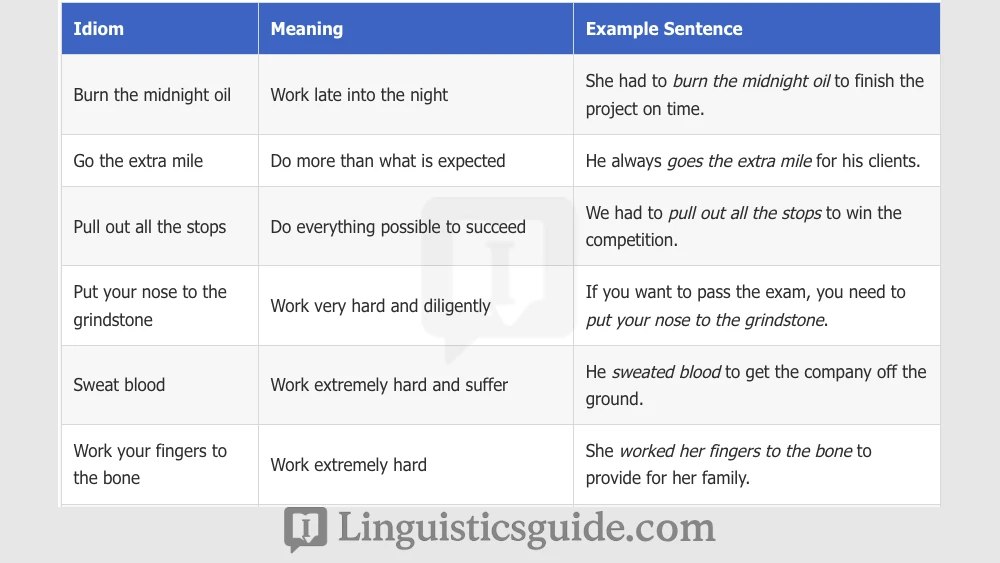
Table 1: Idioms Related to Effort and Hard Work
This table showcases idioms that emphasize the hard work and dedication required for success. Understanding these idioms can help you describe the effort someone puts into achieving their goals.
| Idiom | Meaning | Example Sentence |
|---|---|---|
| Burn the midnight oil | Work late into the night | She had to burn the midnight oil to finish the project on time. |
| Go the extra mile | Do more than what is expected | He always goes the extra mile for his clients. |
| Pull out all the stops | Do everything possible to succeed | We had to pull out all the stops to win the competition. |
| Put your nose to the grindstone | Work very hard and diligently | If you want to pass the exam, you need to put your nose to the grindstone. |
| Sweat blood | Work extremely hard and suffer | He sweated blood to get the company off the ground. |
| Work your fingers to the bone | Work extremely hard | She worked her fingers to the bone to provide for her family. |
| Go the whole nine yards | Do something as completely as possible | When he decorates for Christmas, he goes the whole nine yards. |
| Leave no stone unturned | Try every possible course of action | The detectives left no stone unturned in their investigation. |
| Plough through | To continue doing something even though it is difficult or boring | I had to plough through a mountain of paperwork to get the deal done. |
| Keep at it | To continue working hard at something | It’s a difficult task, but if you keep at it, you’ll eventually succeed. |
| Plug away | To work steadily and persistently | He’s been plugging away at his novel for years. |
| Hit the books | To study hard | I need to hit the books if I want to pass this exam. |
| Be chained to your desk | To be forced to spend a lot of time at your desk working | I’ve been chained to my desk all week trying to meet this deadline. |
| Hammer away at something | Work persistently at something | He hammered away at the problem until he found a solution. |
| Slave away | Work very hard with little or no rest | She slaved away in the kitchen all day preparing for the party. |
| Be up to your ears (in something) | To be very busy or deeply involved in something | I’m up to my ears in work right now. |
| Be snowed under | To have too much work to do | I’m completely snowed under with paperwork. |
| Go all out | To put all your energy into something | They went all out to make the event a success. |
| Be at it hammer and tongs | To work at something with great energy. | They were at it hammer and tongs trying to get the project finished. |
| Dig in | To start eating or working hard | We need to dig in if we want to finish this project on time. |
| Keep your shoulder to the wheel | To continue working hard | If we keep our shoulder to the wheel, we will surely succeed. |
| Get cracking | To start doing something quickly | Let’s get cracking on this project. |
| Be knee deep in something | To be very involved in something | I’m knee deep in research for my thesis. |
| Get your head down | To start working hard and not pay attention to anything else | I need to get my head down and focus on this project. |
Table 2: Idioms Related to Achievement
This table includes idioms that describe the successful completion of goals and the attainment of desired outcomes. These idioms are useful for expressing satisfaction and accomplishment.
| Idiom | Meaning | Example Sentence |
|---|---|---|
| Hit it out of the park | Achieve great success | She hit it out of the park with her presentation. |
| Make a breakthrough | Achieve a significant discovery or advancement | The scientists made a breakthrough in cancer research. |
| Reach the top | Achieve the highest level of success | He worked hard to reach the top of his profession. |
| Come out on top | Emerge as the winner or most successful | Despite the challenges, they came out on top. |
| Go places | Be successful in the future | He is a talented young man; he’s going to go places. |
| Make it big | Become very successful or famous | She dreamed of making it big as a singer. |
| Be a success story | A person, thing or event that has achieved success | Her business is a real success story. |
| Be on the right track | To be doing things in a way that will lead to success | If you follow this advice, you’ll be on the right track. |
| Be home and dry | To have succeeded in doing something | Once we signed the contract, we were home and dry. |
| Get over the hump | To get past the most difficult part of something | Once we got over the hump, the project became much easier. |
| Carry the day | To win or be successful | The team carried the day with their impressive performance. |
| Make a killing | To make a lot of money quickly | He made a killing on the stock market. |
| Reap the rewards | To get something good as a result of your actions | After years of hard work, she is finally reaping the rewards. |
| Strike gold | To discover something valuable or successful | They struck gold with their new product. |
| Get the nod | To receive approval or acceptance | He got the nod for the promotion. |
| Make headway | To make progress | We are making headway on the project. |
| Get somewhere | To make progress or achieve something | We are finally getting somewhere with this project. |
| Land on your feet | To succeed after a difficult situation | Despite losing his job, he landed on his feet. |
| Go down a storm | To be very successful | The new show went down a storm with the audience. |
| Smash hit | Something very successful | The play was a smash hit. |
| Be quids in | To be in a good financial situation | We’re quids in after that deal. |
| Be sitting pretty | To be in a good situation | They’re sitting pretty after their success. |
| Be in clover | To live comfortably because you have a lot of money | Since the company went public, they’ve been in clover. |
| On a roll | Experiencing a period of success | The team is on a roll after winning three games in a row. |
Table 3: Idioms Related to Opportunity
This table lists idioms that describe the recognition and utilization of opportunities that lead to success. Understanding these idioms can help you discuss the importance of seizing chances.
| Idiom | Meaning | Example Sentence |
|---|---|---|
| A foot in the door | An initial opportunity to advance | Getting an internship was a foot in the door for her career. |
| Strike while the iron is hot | Take advantage of an opportunity immediately | They decided to strike while the iron is hot and launch the product now. |
| Seize the day | Make the most of the present opportunity | Seize the day and pursue your dreams. |
| Take the bull by the horns | Face a challenge directly and decisively | He decided to take the bull by the horns and confront the problem. |
| Capitalize on | To take advantage of something | The company capitalized on the new market trends. |
| Jump on the bandwagon | Join a popular activity or trend | Many companies jumped on the bandwagon and started offering online services. |
| Make hay while the sun shines | Take advantage of a good situation while it lasts | We need to make hay while the sun shines and sell as much as possible. |
| Leave the door open | Allow for future possibilities | We decided to leave the door open for future collaborations. |
| Have a golden opportunity | To have a wonderful chance | This is a golden opportunity to invest in the company. |
| Cash in on something | To gain an advantage from a situation, often in a way that is considered morally wrong | The company tried to cash in on the disaster by raising prices. |
| Be in the right place at the right time | To be present when an opportunity arises | He was in the right place at the right time and got the job. |
| Get in on the ground floor | To join something at the beginning | He got in on the ground floor of the company and became very successful. |
| Not look a gift horse in the mouth | To not be critical or unappreciative when someone offers you something | They were offered a free upgrade and decided not to look a gift horse in the mouth. |
| Grab the chance/opportunity | To accept an opportunity quickly | She decided to grab the chance to study abroad. |
| Lose out | To not get something because someone else gets it instead | They lost out on the contract because they were too slow to respond. |
| Miss the boat | To miss an opportunity | If you don’t apply now, you’ll miss the boat. |
| Let something slip throught your fingers | To lose an opportunity | He let the opportunity slip through his fingers by hesitating. |
| Be a missed opportunity | Something that could have been done but wasn’t | The company’s failure to invest in new technology was a missed opportunity. |
| Get into the act | To become involved in an activity, often one that is already successful | Other companies are now getting into the act of producing electric cars. |
| Seize the moment | To take an opportunity immediately it presents itself | She decided to seize the moment and ask him out. |
| Have your work cut out for you | To have something difficult to do | They have their work cut out for them if they want to finish the project on time. |
| Make the most of something | To use a good situation to your advantage | They decided to make the most of their vacation and explore the city. |
| Open the floodgates | To release something that causes a lot of activity or problems | The success of the product opened the floodgates to new opportunities. |
| Be ripe for the picking | To be in a condition that makes something easy to take advantage of | The market is ripe for the picking for new investors. |
Table 4: Idioms Related to Qualities Leading to Success
This table presents idioms that describe the personal attributes and skills that contribute to achieving success. These idioms are useful for discussing the importance of having the right qualities.
| Idiom | Meaning | Example Sentence |
|---|---|---|
| Have what it takes | Possess the necessary qualities or skills | She has what it takes to be a successful leader. |
| Keep your eye on the ball | Stay focused on the goal | To succeed in this project, you need to keep your eye on the ball. |
| Think outside the box | Be creative and innovative | We need to think outside the box to find a solution. |
| Have your head screwed on | To be practical and wise | He has his head screwed on and makes good decisions. |
| Be a safe pair of hands | To be reliable and capable | She’s a safe pair of hands and can handle any task. |
| Be a team player | To work well with others | He is a team player and always helps his colleagues. |
| Be on the ball | To be alert and competent | She’s on the ball and always knows what’s going on. |
| Be a self-starter | To be able to work effectively without needing to be told what to do | He’s a self-starter and doesn’t need constant supervision. |
| Have a can-do attitude | To be positive and willing to try new things | She has a can-do attitude and is always up for a challenge. |
| Be a people person | To be good at dealing with people | He’s a people person and gets along well with everyone. |
| Have a thick skin | To be able to withstand criticism | You need to have a thick skin to succeed in this industry. |
| Be a quick study | To learn quickly | He’s a quick study and picks things up easily. |
| Have a good head for something | To be naturally good at something | She has a good head for numbers. |
| Be streets ahead | To be much better than other people | Their product is streets ahead of the competition. |
| Have the gift of the gab | To be good at talking | He has the gift of the gab and can persuade anyone. |
| Be a smooth operator | Someone who is good at dealing with difficult situations | She’s a smooth operator and always gets what she wants. |
| Be a high-flier | Someone who is very ambitious and successful | He’s a high-flier and is destined for great things. |
| Be a mover and shaker | A person who has a lot of influence and gets things done | She’s a mover and shaker in the industry. |
| Be a go-getter | Someone who is very energetic and determined to succeed | He’s a go-getter and always achieves his goals. |
| Know your stuff | To be knowledgeable about something | She knows her stuff when it comes to marketing. |
| Have a nose for something | To have a natural ability to find or recognize something | He has a nose for a good investment. |
| Keep your wits about you | To stay alert and think clearly in a difficult situation | You need to keep your wits about you in this business. |
| Have your finger on the pulse | To be aware of the most recent developments | She has her finger on the pulse of the industry. |
| Be one step ahead | To be better prepared than other people | They are always one step ahead of the competition. |
Table 5: Idioms Related to Overcoming Obstacles
This table presents idioms that describe the ability to overcome challenges and setbacks on the path to success. These idioms are useful for emphasizing the importance of resilience and adaptability.
| Idiom | Meaning | Example Sentence |
|---|---|---|
| Get back on your feet | Recover from a setback | After losing his job, it took him a while to get back on his feet. |
| Turn the tide | Reverse a negative situation | The new strategy helped turn the tide for the company. |
| Weather the storm | Survive a difficult period | The company managed to weather the storm despite the economic crisis. |
| Rise above | Overcome a difficult situation | She managed to rise above her difficult childhood and become successful. |
| Get over something | To begin to forget something or feel better after something bad | It took her a long time to get over the disappointment of not getting the job. |
| Keep your chin up | To stay positive during a difficult time | Keep your chin up, things will get better. |
| Bounce back | To recover quickly from a setback | The economy bounced back after the recession. |
| Turn something around | To improve a bad situation | They managed to turn the company around and make it profitable. |
| Get through to someone | To make someone understand something | It’s hard to get through to him when he’s angry. |
| Cross that bridge when you come to it | To deal with a problem when it happens rather than worrying about it in advance | We’ll cross that bridge when we come to it. |
| Make the best of a bad situation | To try to be as positive as possible in a bad situation | They decided to make the best of a bad situation and enjoy their vacation despite the rain. |
| Come through with flying colors | To succeed in something despite difficulties | They came through with flying colors despite the challenges. |
| Ride out the storm | To survive a difficult situation | The company managed to ride out the storm and remain profitable. |
| Pull through | To recover from a serious illness or difficult situation | He pulled through after a long illness. |
| Come up smelling of roses | To emerge from a difficult situation with your reputation unharmed | Despite the scandal, he came up smelling of roses. |
| Get out of the woods | To escape from a difficult situation | They are out of the woods now that the crisis is over. |
| Be back in the saddle | To be active again after a period of absence or difficulty | He’s back in the saddle after his injury. |
| Turn over a new leaf | To change your behavior and start to live in a better way | He decided to turn over a new leaf and quit smoking. |
| Be a glutton for punishment | To enjoy doing something difficult or unpleasant | He must be a glutton for punishment to take on that job. |
| Keep going | To continue despite difficulties | Keep going, you’re almost there. |
| Pick yourself up | To recover from a fall or setback | You just have to pick yourself up and try again. |
| Hang in there | To persevere through difficulties | Hang in there, things will get better. |
| Shake something off | To recover from something | She shook off the disappointment and focused on her next goal. |
| Come up trumps | To do something successfully, especially when it was not expected | They came up trumps and delivered the project on time. |
Usage Rules for Idioms for Success
Using idioms correctly requires attention to several key rules. First, it’s crucial to understand the idiom’s meaning accurately.
Misinterpreting an idiom can lead to confusion or miscommunication. Second, consider the context in which you’re using the idiom.
Some idioms are appropriate for formal settings, while others are better suited for informal conversations. Third, pay attention to the grammatical structure of the idiom.
Some idioms have fixed structures that cannot be altered without changing their meaning.
For instance, the idiom “hit the nail on the head” means to state something accurately. It would be incorrect to say “hit the hammer on the head,” as this changes the idiom’s meaning.
Similarly, the idiom “burn the midnight oil” should not be altered to “burn the evening oil,” as this disrupts the established expression.
Furthermore, be aware of the audience’s familiarity with the idiom. Using obscure or uncommon idioms can confuse listeners or readers who are not familiar with them.
It’s generally best to stick to well-known idioms unless you have a specific reason to use a less common expression.
Common Mistakes with Idioms for Success
One common mistake is misinterpreting the meaning of an idiom. For example, some learners might think “break a leg” means to cause harm, when it actually means “good luck.” Another frequent error is using the wrong form of the idiom.
For instance, saying “put your head to the grindstone” instead of “put your nose to the grindstone” changes the idiom and its meaning.
Another common mistake is using idioms inappropriately in formal contexts. While idioms can add color to your language, they may not be suitable for academic writing or professional presentations.
In such situations, it’s often better to use more direct and literal language.
Here are some examples of common mistakes and their corrections:
| Incorrect | Correct | Explanation |
|---|---|---|
| Break a foot! | Break a leg! | “Break a leg” is an idiom that means “good luck,” especially before a performance. |
| Put your head to the grindstone. | Put your nose to the grindstone. | The correct idiom is “put your nose to the grindstone,” which means to work very hard. |
| He reached the moon. | He reached the top. | “Reach the top” is the idiom that means to achieve the highest level of success. |
| She striked while the iron was hot. | She struck while the iron was hot. | The correct verb tense is “struck.” |
| They made it largely. | They made it big. | The correct idiom is “make it big,” which means to become very successful. |
Practice Exercises
Test your understanding of idioms for success with these exercises. Choose the correct idiom to complete each sentence.
Exercise 1: Fill in the Blanks
Choose the correct idiom from the list to complete each sentence:
- After years of hard work, she finally began to __________ the rewards. (reap, sow, harvest)
- He had to __________ the midnight oil to finish the report on time. (burn, light, ignite)
- She decided to __________ the bull by the horns and confront her fears. (take, grab, seize)
- The company managed to __________ the storm despite the economic downturn. (weather, sail, float)
- He always __________ the extra mile for his clients. (goes, walks, runs)
- They __________ a breakthrough in their research. (did, made, had)
- He’s determined to __________ the top of his profession. (reach, arrive, get)
- She’s a talented young artist; she’s going to __________
the places. (go, walk, run) - It’s important to __________ your eye on the ball to succeed in this project. (keep, hold, watch)
- They managed to __________ the company around and make it profitable. (turn, twist, flip)
Answers:
- reap
- burn
- take
- weather
- goes
- made
- reach
- go
- keep
- turn
Exercise 2: Correct the Mistakes
Identify and correct the mistakes in the following sentences:
- She breaked a leg before her performance.
- He putted his head to the grindstone to pass the exam.
- They reached the moon in their careers.
- She striked when the iron is hot.
- He made it largely as a businessman.
Answers:
- Incorrect: She breaked a leg before her performance. Correct: She broke a leg before her performance.
- Incorrect: He putted his head to the grindstone to pass the exam. Correct: He put his nose to the grindstone to pass the exam.
- Incorrect: They reached the moon in their careers. Correct: They reached the top in their careers.
- Incorrect: She striked when the iron is hot. Correct: She struck while the iron was hot.
- Incorrect: He made it largely as a businessman. Correct: He made it big as a businessman.
Advanced Topics
For advanced learners, exploring the origins and cultural contexts of idioms can provide a deeper understanding of their meanings and usage. Many idioms have historical roots that explain their figurative meanings.
For example, the idiom “strike while the iron is hot” comes from the blacksmithing tradition, where it’s easier to shape metal when it’s hot. Understanding this origin can enrich your appreciation of the idiom’s meaning.
Additionally, idioms can vary in usage across different English-speaking regions. Some idioms are more common in American English, while others are more prevalent in British English.
Being aware of these regional differences can help you communicate more effectively with diverse audiences.
Finally, consider the emotional and rhetorical impact of using idioms. Idioms can add emphasis, humor, or irony to your language, making it more engaging and persuasive.
However, it’s important to use idioms judiciously, as overuse can make your language sound cliché or insincere.
Frequently Asked Questions
What is the difference between an idiom and a proverb?
An idiom is a phrase whose meaning is different from the literal meanings of its individual words, while a proverb is a short, well-known saying that expresses a general truth or piece of advice.
How can I improve my understanding of idioms?
Read widely, listen to native speakers, and practice using idioms in your own speech and writing. Pay attention to the context in which idioms are used and look up any unfamiliar expressions.
Are idioms important for learning English?
Yes, idioms are an essential part of the English language. Understanding and using idioms will help you communicate more effectively and understand native speakers better.
Can I use idioms in formal writing?
It depends on the context. In general, it’s best to avoid idioms in formal academic or professional writing, as they can sound informal or cliché.
However, idioms may be appropriate in certain types of creative writing or persuasive communication.
How can I avoid making mistakes with idioms?
Pay attention to the meaning and structure of idioms, and practice using them in context. If you’re unsure about an idiom’s meaning or usage, look it up in a dictionary or ask a native speaker.
Conclusion
Mastering idioms for success can significantly enhance your English language skills and improve your ability to communicate effectively in various contexts. By understanding the definitions, usage rules, and common mistakes associated with these idioms, you can confidently incorporate them into your vocabulary and express complex ideas with clarity and nuance.
Whether you’re striving for academic achievement, professional success, or personal growth, these idioms will help you articulate your goals, celebrate your accomplishments, and navigate the challenges along the way. Keep practicing and exploring new idioms to continue expanding your linguistic repertoire and achieving your full potential.

I’m James Terban, a teacher with a degree in Education and five years of experience working with students of all ages, from young kids learning their first grammar rules to adults picking up English as a second language. I started Linguistics Guide because I kept seeing good learners hit a wall due to explanations that were either too vague or too complicated. Every article here comes from a real question I have heard in a classroom or seen asked online.