
Understanding idioms is crucial for mastering English, especially when expressing nuanced relationships. This article focuses on idioms related to “best friend,” enriching your vocabulary and enhancing your ability to communicate affection and camaraderie.
From casual expressions to more profound descriptions, these idioms provide colorful alternatives to simple words. This guide is perfect for English language learners, writers, and anyone wishing to deepen their understanding of idiomatic expressions.
Idioms are a fundamental part of English grammar. They add color and depth to communication, providing a means to express complex emotions and ideas in concise and memorable ways.
Off to College Deals

Save up to 30% on everything you need for the semester.
Contains affiliate link
For English language learners, mastering idioms enhances comprehension and fluency. Understanding and using idioms correctly can make your English sound more natural and expressive.
This article aims to equip you with the knowledge and practice needed to confidently use idioms for “best friend” in various contexts.
Table of Contents
- Definition of Idioms for Best Friend
- Structural Breakdown of Idioms
- Types and Categories of Idioms for Best Friend
- Examples of Idioms for Best Friend
- Usage Rules for Idioms
- Common Mistakes When Using Idioms
- Practice Exercises
- Advanced Topics in Idiom Usage
- Frequently Asked Questions
- Conclusion
Definition of Idioms for Best Friend
An idiom is a phrase or expression whose meaning cannot be understood from the literal meanings of its individual words. Instead, an idiom has a figurative meaning that is known through common usage.
Idioms for “best friend” are phrases that describe the close, supportive, and often long-lasting relationship between close friends. These idioms capture the emotional bond, shared experiences, and mutual understanding that characterize such relationships.
In the context of grammar, idioms are considered fixed expressions. This means that the words within the idiom cannot be changed or rearranged without altering or losing the intended meaning.
Young Adults & Students:
Get 6 Months of Prime for $0

Ages 18-24 unlock exclusive perks including:
Contains affiliate link
For example, the idiom “thick as thieves” describes people who are very close and share secrets. Changing it to “thick like thieves” or replacing “thick” with another word would not convey the same meaning.
Idioms are essential for understanding and using English fluently because they are frequently used in everyday conversation, literature, and media.
Classification of Idioms
Idioms can be classified based on their grammatical structure and the type of figurative language they employ. Some common classifications include:
- Phrasal Verbs: Idioms that combine a verb with a preposition or adverb, such as “stick by” (to support someone).
- Metaphorical Idioms: Idioms that use a metaphor to convey their meaning, such as “a shoulder to cry on” (someone who offers comfort).
- Similes: Idioms that use “like” or “as” to make a comparison, such as “thick as thieves” (very close and secretive).
- Binomial Idioms: Idioms that consist of two words joined by a conjunction, such as “through thick and thin” (during good times and bad times).
Function of Idioms
The primary function of idioms is to add color, depth, and expressiveness to language. They allow speakers and writers to convey emotions, attitudes, and experiences in a vivid and memorable way.
Idioms related to “best friend” serve to emphasize the strength, loyalty, and importance of the friendship. They can also be used to describe the specific qualities or characteristics of the friendship, such as its longevity, intensity, or mutual support.
Contexts for Using Idioms
Idioms for “best friend” can be used in a variety of contexts, including:
- Casual Conversations: Describing your friendship to others in everyday conversations.
- Writing: Enhancing the emotional impact of stories, poems, or personal essays.
- Speeches: Adding a personal touch to speeches or presentations about friendship.
- Social Media: Expressing your appreciation for your best friend on social media platforms.
Structural Breakdown of Idioms
Understanding the structural elements of idioms helps in recognizing and using them correctly. Idioms, although fixed, often follow grammatical structures that can be analyzed.
Elements of Idioms
Idioms typically consist of several key elements:
- Words: The individual words that make up the idiom.
- Structure: The grammatical arrangement of the words, which can follow various patterns (e.g., verb + preposition, noun + adjective).
- Figurative Meaning: The non-literal meaning that the idiom conveys.
Common Idiomatic Patterns
Several patterns are commonly found in idioms related to friendship:
- Similes: Using “like” or “as” to compare the friendship to something else (e.g., “like two peas in a pod”).
- Metaphors: Describing the friendship in terms of something else (e.g., “a shoulder to cry on”).
- Phrasal Verbs: Using a verb and a preposition to describe the actions or qualities of the friendship (e.g., “stick by”).
Rules Governing Idiom Structure
While idioms are fixed expressions, there are some general rules to keep in mind:
- Word Order: The word order in an idiom is typically fixed and cannot be changed.
- Verb Tense: The verb tense in an idiom can be adjusted to fit the context (e.g., “He has always stuck by me”).
- Pronouns: Pronouns in an idiom can be changed to refer to different people (e.g., “I’ll always be there for her”).
Types and Categories of Idioms for Best Friend
Idioms for “best friend” can be categorized based on the specific aspects of the friendship they describe. Here are some common categories:
Idioms Describing Loyalty
These idioms emphasize the unwavering support and commitment between best friends. Loyalty is a cornerstone of strong friendships, and these idioms capture that essence.
Idioms Describing Closeness
These idioms highlight the deep connection and understanding between best friends. Closeness involves sharing personal thoughts, feelings, and experiences.
Idioms Describing Shared Experiences
These idioms refer to the common memories and adventures that best friends have together. Shared experiences create lasting bonds and inside jokes.
Idioms Describing Support
These idioms emphasize the role of best friends as sources of comfort and encouragement. Support involves being there for each other during both good times and bad times.
Idioms Describing Understanding
These idioms highlight the mutual comprehension and empathy between best friends. Understanding involves knowing each other’s thoughts and feelings without needing to explain them.
Examples of Idioms for Best Friend
This section provides a comprehensive list of idioms related to “best friend,” categorized for clarity. Each idiom is accompanied by a definition and example sentence.
Examples of Idioms Describing Loyalty
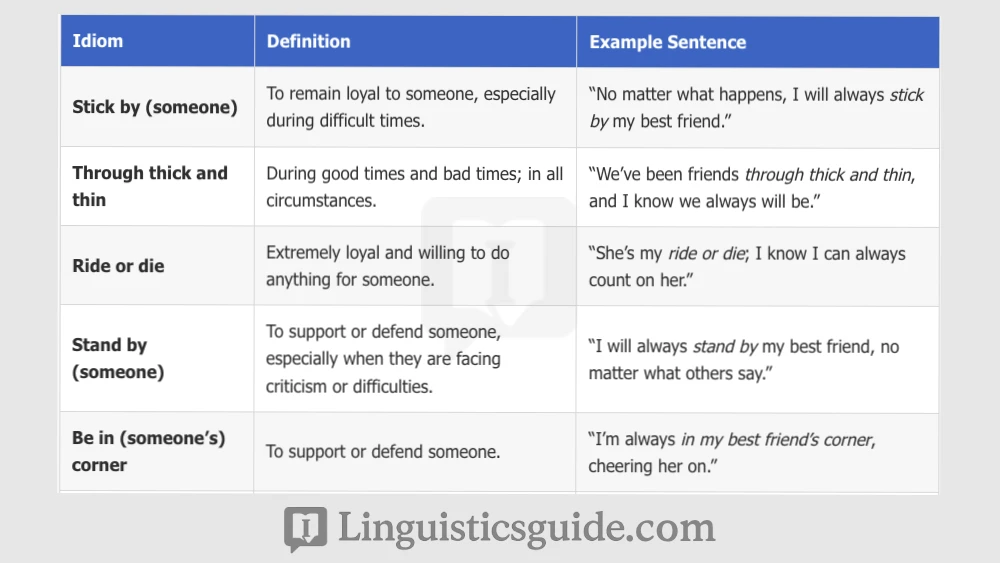
The following table provides examples of idioms that describe loyalty in a best friend relationship. These idioms emphasize the unwavering support and commitment between best friends.
| Idiom | Definition | Example Sentence |
|---|---|---|
| Stick by (someone) | To remain loyal to someone, especially during difficult times. | “No matter what happens, I will always stick by my best friend.” |
| Through thick and thin | During good times and bad times; in all circumstances. | “We’ve been friends through thick and thin, and I know we always will be.” |
| Ride or die | Extremely loyal and willing to do anything for someone. | “She’s my ride or die; I know I can always count on her.” |
| Stand by (someone) | To support or defend someone, especially when they are facing criticism or difficulties. | “I will always stand by my best friend, no matter what others say.” |
| Be in (someone’s) corner | To support or defend someone. | “I’m always in my best friend’s corner, cheering her on.” |
| Have (someone’s) back | To support and protect someone. | “I know my best friend always has my back, and I have hers.” |
| Be there for (someone) | To be available to support and help someone. | “I will always be there for my best friend, no matter what she needs.” |
| Stand up for (someone) | To defend or support someone who is being criticized or attacked. | “She always stands up for me when others are being unfair.” |
| Come hell or high water | No matter what difficulties or obstacles arise. | “Come hell or high water, we’ll always be there for each other.” |
| Never leave (someone’s) side | To always be present and supportive. | “I promised I would never leave my best friend’s side during her surgery.” |
| A friend in need is a friend indeed | A true friend is someone who helps you when you are in trouble. | “When I lost my job, my best friend was there to help me, proving that a friend in need is a friend indeed.” |
| Through fire and water | Through all kinds of dangers and difficulties. | “We’ve been through fire and water together, and our friendship has only grown stronger.” |
| Shoulder to shoulder | Standing together in support and solidarity. | “We faced the challenge shoulder to shoulder, supporting each other every step of the way.” |
| To the end of the line | Until the very end; forever. | “I’ll be your friend to the end of the line, no matter what happens.” |
| Be a rock for (someone) | To be a source of stability and support for someone. | “During the crisis, she was a rock for her best friend, providing unwavering support.” |
| Go to bat for (someone) | To defend or support someone, especially when they are in trouble. | “He always goes to bat for his best friend when others criticize him.” |
| Back (someone) up | To support or assist someone. | “She always backs me up in meetings, which I really appreciate.” |
| Defend (someone) to the death | To protect or support someone fiercely, even if it means risking oneself. | “He would defend his best friend to the death, their bond is that strong.” |
| Be (someone’s) shield | To protect someone from harm or criticism. | “She has always been my shield, protecting me from negativity and judgment.” |
| Be a staunch supporter | To be a strong and unwavering supporter. | “He has always been a staunch supporter of his best friend’s dreams.” |
Examples of Idioms Describing Closeness
The following table provides examples of idioms that describe the closeness in a best friend relationship. These idioms highlight the deep connection and understanding between best friends.
| Idiom | Definition | Example Sentence |
|---|---|---|
| Like two peas in a pod | Very similar or close. | “They’re like two peas in a pod; they do everything together.” |
| Thick as thieves | Very close and secretive. | “Those two are thick as thieves; I wouldn’t be surprised if they knew each other’s deepest secrets.” |
| Attached at the hip | Always together; inseparable. | “They’ve been attached at the hip since they were kids.” |
| Inseparable | Unable to be separated. | “The two friends are inseparable; they can’t stand being apart.” |
| Birds of a feather | People who are similar and like to spend time together. | “Birds of a feather flock together; it’s no surprise they became best friends.” |
| Kindred spirits | People who have similar interests and feelings. | “They’re kindred spirits; they understand each other perfectly.” |
| Two of a kind | Very similar in personality or behavior. | “They’re two of a kind; they’re always getting into trouble together.” |
| Bosom buddies | Very close friends. | “They’ve been bosom buddies since elementary school.” |
| Soulmates | People who are deeply connected and share a strong bond. | “They’re not romantically involved, but they’re definitely soulmates.” |
| Partners in crime | Friends who often do mischievous things together. | “Those two are partners in crime; they’re always up to something.” |
| Cut from the same cloth | Very similar in character or behavior. | “They’re cut from the same cloth; they have the same values and beliefs.” |
| Two sides of the same coin | Very similar despite appearing different. | “They might seem different, but they’re really two sides of the same coin.” |
| Like brother and sister | Having a very close and familial relationship. | “They fight sometimes, but they’re like brother and sister at heart.” |
| Close-knit | Having strong relationships and being very connected. | “They have a very close-knit friendship; they’re always there for each other.” |
| Joined at the hip | To be constantly together. | “Ever since they met, they’ve been joined at the hip.” |
| In each other’s pockets | Spending a lot of time together; very close. | “They’re always in each other’s pockets; you rarely see them apart.” |
| Like two magnets | Attracted to each other and always together. | “They’re like two magnets; they just naturally gravitate towards each other.” |
| Of one mind | Having the same thoughts or opinions. | “They’re always of one mind when it comes to important decisions.” |
| On the same wavelength | Understanding each other without needing to explain much. | “They’re always on the same wavelength; they just get each other.” |
| Sharing an unspoken bond | Having a deep connection that doesn’t need words. | “They’re sharing an unspoken bond; they understand each other without saying a word.” |
Examples of Idioms Describing Shared Experiences
The following table provides examples of idioms that describe shared experiences in a best friend relationship. These idioms refer to the common memories and adventures that best friends have together.
| Idiom | Definition | Example Sentence |
|---|---|---|
| Walk down memory lane | To reminisce about past experiences. | “We love to walk down memory lane, remembering all our crazy adventures together.” |
| Have history together | To have a shared past and experiences. | “They have history together; they’ve known each other since kindergarten.” |
| Share a common ground | To have similar interests or experiences. | “They share a common ground in their love for music and art.” |
| Been there, done that | To have experienced something before. | “They can relate to each other because they’ve both been there, done that.” |
| Relive old times | To remember and enjoy past experiences. | “We often relive old times by looking at old photos and reminiscing.” |
| Share inside jokes | To have jokes that only you and your friend understand. | “They share inside jokes that no one else gets.” |
| A trip down memory lane | A nostalgic recollection of past events. | “Looking through old photo albums was a trip down memory lane for the two friends.” |
| Rehash old memories | To talk about past events repeatedly. | “During their reunion, they rehashed old memories and laughed about their youthful escapades.” |
| Bond over (something) | To develop a close relationship through shared experiences. | “They bonded over their shared love for hiking and the outdoors.” |
| Weather the storm together | To go through difficult times together and emerge stronger. | “They weathered the storm together when they both lost their jobs.” |
| Share a laugh | To laugh together about something. | “They always share a laugh whenever they reminisce about their college days.” |
| Go way back | To have known each other for a long time. | “They go way back; they’ve been friends since childhood.” |
| Been through the mill | To have experienced many difficulties or hardships. | “They’ve been through the mill together, which has made their friendship stronger.” |
| Have seen (someone) at their best and worst | To have witnessed someone’s good and bad times. | “They’ve seen each other at their best and worst, and still remain close friends.” |
| Have shared ups and downs | To have experienced both good and bad times together. | “They’ve shared ups and downs throughout their friendship, which has deepened their bond.” |
| Have a lot in common | To have similar interests or characteristics. | “They have a lot in common, from their love of books to their passion for travel.” |
| Share a past | To have a history of shared experiences. | “They share a past filled with adventures and unforgettable moments.” |
| Have been through thick and thin together | To have supported each other during both good and bad times. | “They’ve been through thick and thin together, which has made their friendship unshakable.” |
| Know each other inside out | To know each other very well. | “They know each other inside out; they can anticipate each other’s thoughts and feelings.” |
| Share a special bond | To have a unique and strong connection. | “They share a special bond that is unlike any other friendship.” |
Examples of Idioms Describing Support
The following table provides examples of idioms that describe support in a best friend relationship. These idioms emphasize the role of best friends as sources of comfort and encouragement.
| Idiom | Definition | Example Sentence |
|---|---|---|
| A shoulder to cry on | Someone who offers comfort and support in times of distress. | “She’s always been a shoulder to cry on whenever I’m feeling down.” |
| Lean on (someone) | To rely on someone for support or help. | “You can always lean on me when you need someone to talk to.” |
| Be a crutch for (someone) | To provide support or assistance to someone who needs it. | “He was a crutch for his friend during her recovery after the accident.” |
| Lift (someone) up | To encourage or support someone. | “She always knows how to lift me up when I’m feeling discouraged.” |
| Give (someone) a boost | To help someone improve or succeed. | “My best friend always gives me a boost when I’m trying to achieve my goals.” |
| Be (someone’s) cheerleader | To support and encourage someone enthusiastically. | “She’s always been my cheerleader, believing in me even when I doubt myself.” |
| Be a pillar of strength | To provide strong support and stability. | “During the crisis, she was a pillar of strength for her family and friends.” |
| Offer a helping hand | To provide assistance or support. | “He always offers a helping hand to those in need.” |
| Be there to pick up the pieces | To help someone recover after a difficult experience. | “After the breakup, her best friend was there to pick up the pieces.” |
| Be a sounding board | Someone who listens and provides feedback. | “She’s always been a sounding board for my ideas and concerns.” |
| Be an anchor | To provide stability and security. | “In times of uncertainty, my best friend has always been an anchor for me.” |
| Hold (someone) up | To support or sustain someone. | “His friends helped hold him up during the difficult times.” |
| Be a port in the storm | To provide a safe and comforting place during difficult times. | “She’s always been a port in the storm for me when things get tough.” |
| Be a beacon of hope | To provide inspiration and optimism. | “During the dark days, she was a beacon of hope for her friends.” |
| Be a lifeline | To provide essential support or help. | “Her best friend was a lifeline when she was struggling with depression.” |
| Be a cushion | To soften the impact of a difficult situation. | “Her friends served as a cushion when she received bad news.” |
| Be a guide | To provide direction and advice. | “He’s always been a guide for me, helping me navigate through life’s challenges.” |
| Be a mentor | To provide guidance and support, especially in professional development. | “She’s been a mentor to me, helping me grow in my career.” |
| Be an advocate | To support or defend someone’s cause. | “He’s always been an advocate for his best friend, standing up for her rights.” |
| Be a confidant | Someone to whom one can confide secrets or personal matters. | “She’s my confidant; I trust her with my deepest secrets.” |
Examples of Idioms Describing Understanding
The following table provides examples of idioms that describe understanding in a best friend relationship. These idioms highlight the mutual comprehension and empathy between best friends.
| Idiom | Definition | Example Sentence |
|---|---|---|
| Know where (someone) is coming from | To understand someone’s perspective or point of view. | “I know where she’s coming from; I understand why she made that decision.” |
| Read (someone’s) mind | To know what someone is thinking without being told. | “Sometimes I feel like my best friend can read my mind.” |
| Be on the same page | To have the same understanding or agreement about something. | “We’re always on the same page when it comes to our goals and priorities.” |
| See eye to eye | To agree with someone. | “We don’t always see eye to eye, but we respect each other’s opinions.” |
| Get (someone) | To understand someone’s personality or feelings. | “My best friend really gets me; she understands my quirks and eccentricities.” |
| Be on the same wavelength | To understand each other without needing to explain much. | “We’re always on the same wavelength; we just intuitively understand each other.” |
| Click with (someone) | To immediately feel a connection with someone. | “We clicked instantly when we first met.” |
| Vibe with (someone) | To feel a connection or compatibility with someone. | “I really vibe with my best friend; we have a great connection.” |
| Be in sync | To be in harmony or agreement. | “We’re always in sync; we anticipate each other’s actions and thoughts.” |
| Understand where (someone) is coming from | To comprehend someone’s perspective or viewpoint. | “I understand where she is coming from, given her past experiences.” |
| Know (someone) like the back of (one’s) hand | To know someone very well. | “I know my best friend like the back of my hand; I know her strengths and weaknesses.” |
| Be attuned to (someone’s) feelings | To be sensitive to someone’s emotions. | “She’s always attuned to my feelings; she knows when I’m upset even if I don’t say anything.” |
| Have a mutual understanding | To share a common comprehension. | “We have a mutual understanding; we know we can always count on each other.” |
| Be empathetic | To understand and share the feelings of another. | “She’s very empathetic; she always understands how I’m feeling.” |
| Get each other’s sense of humor | To understand and appreciate each other’s jokes and comedic style. | “We get each other’s sense of humor; we’re always laughing together.” |
| Know what makes (someone) tick | To understand what motivates or annoys someone. | “I know what makes my best friend tick; I know how to encourage her and how to avoid upsetting her.” |
| Be on the same mental plane | To have a similar level of intellectual understanding. | “We’re on the same mental plane; we can discuss complex topics and understand each other’s perspectives.” |
| Be soul sisters/brothers | To have a deep spiritual connection. | “We’re soul sisters; we have a connection that goes beyond words.” |
| Share a silent language | To understand each other without needing to speak. | “We share a silent language; we communicate through glances and gestures.” |
| Read between the lines | To understand the hidden meaning behind words or actions. | “She can always read between the lines; she understands what I’m really trying to say.” |
Usage Rules for Idioms
Using idioms correctly requires understanding their specific meanings and contexts. Here are some key usage rules to keep in mind:
Literal vs. Figurative Meaning
Always remember that idioms have a figurative meaning that is different from the literal meaning of their individual words. Using the literal meaning will often result in confusion or miscommunication.
Contextual Appropriateness
Consider the context in which you are using an idiom. Some idioms are more appropriate for casual conversations, while others are suitable for formal writing or speeches.
Understanding Your Audience
Be mindful of your audience’s familiarity with idioms. If you are speaking to non-native English speakers, it may be best to avoid using idioms or to explain their meanings.
Flexibility and Variation
While idioms are generally fixed expressions, some idioms allow for slight variations in word order or tense. However, it’s important to be cautious and avoid making changes that could alter the meaning of the idiom.
Common Mistakes When Using Idioms
Even advanced English learners can make mistakes when using idioms. Here are some common errors to avoid:
- Literal Interpretation: Interpreting the idiom literally instead of understanding its figurative meaning.
- Incorrect Word Order: Changing the word order of the idiom, which can alter or lose its meaning.
- Misusing Prepositions: Using the wrong preposition in a phrasal verb idiom.
- Overusing Idioms: Using too many idioms in a single conversation or piece of writing, which can sound unnatural or forced.
Example of a Common Mistake:
| Incorrect | Correct | Explanation |
|---|---|---|
| “They are like two apples in a basket.” | “They are like two peas in a pod.” | The correct idiom is “like two peas in a pod,” not “like two apples in a basket.” |
Practice Exercises
Test your understanding of idioms for “best friend” with these practice exercises.
Exercise 1: Fill in the Blanks
Complete the following sentences with the correct idiom from the list below.
Idiom List:
through thick and thin, a shoulder to cry on, like two peas in a pod, partners in crime, stick by
- They have been friends ________, always supporting each other no matter what.
- She is always ________ when I need someone to talk to.
- Those two are ________; they are always getting into trouble together.
- We are ________; we enjoy doing everything together.
- I will always ________ you, no matter what happens.
Answers:
- They have been friends through thick and thin, always supporting each other no matter what.
- She is always a shoulder to cry on when I need someone to talk to.
- Those two are partners in crime; they are always getting into trouble together.
- We are like two peas in a pod; we enjoy doing everything together.
- I will always stick by you, no matter what happens.
Exercise 2: Matching
Match the idiom with its correct definition.
- Ride or die
- Kindred spirits
- Have someone’s back
- Go way back
- Be a rock
Definitions:
- To support and protect someone
- To be a source of stability and support
- People who have similar interests and feelings
- Extremely loyal and willing to do anything for someone
- To have known each other for a long time
Answers:
- Ride or die – D. Extremely loyal and willing to do anything for someone
- Kindred spirits – C. People who have similar interests and feelings
- Have someone’s back – A. To support and protect someone
- Go way back – E. To have known each other for a long time
- Be a rock – B. To be a source of stability and support
Exercise 3: Correct the Sentence
Identify and correct the mistake in the following sentences.
- They are like two oranges in a tree.
- She always has my front.
- We’ve been friends through thin and thick.
- He is my crutch to lean on.
- They are cut from the same material.
Answers:
- Incorrect: They are like two oranges in a tree. Correct: They are like two peas in a pod.
- Incorrect: She always has my front. Correct: She always has my back.
- Incorrect: We’ve been friends through thin and thick. Correct: We’ve been friends through thick and thin.
- Incorrect: He is my crutch to lean on. Correct: He is a shoulder to cry on.
- Incorrect: They are cut from the same material. Correct: They are cut from the same cloth.
Advanced Topics in Idiom Usage
For advanced learners, understanding the nuances of idiom usage can further enhance their language skills. Here are some advanced topics to explore:
Cultural Context of Idioms
Idioms are often deeply rooted in culture and history. Understanding the cultural context of an idiom can provide deeper insights into its meaning and usage.
For example, idioms related to weather or seasons may reflect the values and experiences of a particular culture.
Regional Variations in Idioms
Idioms can vary from one region to another, even within the same country. Being aware of these regional variations can help you avoid misunderstandings and communicate more effectively with people from different areas.
For instance, an idiom commonly used in the United States may not be familiar to someone from the United Kingdom.
Historical Evolution of Idioms
Idioms can evolve over time, with their meanings and usages changing as language and culture evolve. Studying the historical evolution of idioms can provide a fascinating glimpse into the history of the English language and the societies that have shaped it.
Idioms in Literature and Media
Analyzing how idioms are used in literature and media can provide valuable insights into their stylistic and rhetorical effects. Writers and speakers often use idioms to add color, humor, or emotional impact to their work.
Frequently Asked Questions
What is the difference between an idiom and a proverb?
An idiom is a phrase with a figurative meaning, while a proverb is a short, well-known saying that expresses a general truth or piece of advice. Idioms are more about expression, whereas proverbs are about imparting wisdom.
How can I improve my understanding of idioms?
Immerse yourself in the English language by reading books, watching movies, and listening to podcasts. Pay attention to how native speakers use idioms in conversation and try to use them yourself.
Also, use idiom dictionaries and online resources to look up the meanings of unfamiliar idioms.
Are idioms universal across all languages?
No, idioms are not universal. Each language has its own unique set of idiomatic expressions that reflect its culture and history.
While some idioms may have equivalents in other languages, their literal translations often do not make sense.
Is it okay to use idioms in formal writing?
It depends on the context and the specific idiom. Some idioms are more appropriate for casual writing, while others can be used in formal writing to add a touch of personality or emphasis.
However, it’s generally best to avoid using overly colloquial or informal idioms in formal writing.
How can I avoid misusing idioms?
Pay close attention to the context in which you are using the idiom and make sure you understand its meaning correctly. If you are unsure about the meaning or usage of an idiom, look it up in a dictionary or ask a native speaker for clarification.
Also, be mindful of your audience and avoid using idioms that they may not be familiar with.
Conclusion
Mastering idioms for “best friend” can significantly enhance your ability to communicate affection, loyalty, and camaraderie in English. By understanding the definitions, structures, and usage rules of these idioms, you can express yourself more vividly and connect with others on a deeper level.
Keep practicing, and soon you’ll be using these colorful expressions with confidence and flair. Embrace the richness of the English language and continue to explore the fascinating world of idioms!

I’m James Terban, a teacher with a degree in Education and five years of experience working with students of all ages, from young kids learning their first grammar rules to adults picking up English as a second language. I started Linguistics Guide because I kept seeing good learners hit a wall due to explanations that were either too vague or too complicated. Every article here comes from a real question I have heard in a classroom or seen asked online.