
Understanding idioms is crucial for mastering English, especially when describing personality. Idioms add color and nuance to your language, allowing you to express character traits in a vivid and memorable way.
This article provides a comprehensive guide to idioms used to describe personality, covering their definitions, structural breakdown, usage rules, common mistakes, and practice exercises. This guide is perfect for English language learners of all levels, from beginners looking to expand their vocabulary to advanced speakers aiming to refine their expressive abilities.
By the end of this article, you’ll be equipped with the knowledge and tools to confidently use personality idioms in your everyday conversations and writing.
Off to College Deals

Save up to 30% on everything you need for the semester.
Contains affiliate link
Table of Contents
- Introduction
- Definition of Idioms for Personality
- Structural Breakdown
- Types and Categories of Personality Idioms
- Examples of Personality Idioms
- Usage Rules for Personality Idioms
- Common Mistakes with Personality Idioms
- Practice Exercises
- Advanced Topics
- FAQ
- Conclusion
Definition of Idioms for Personality
Idioms for personality are phrases or expressions whose meaning cannot be understood from the literal meanings of the individual words they contain. Instead, these idioms convey specific character traits, behaviors, or qualities of a person.
They are a figurative way of describing someone’s personality, adding depth and color to communication. These idioms are an essential part of the English language, enriching conversations and writing with vivid imagery and cultural understanding.
Understanding these idioms can significantly improve your comprehension and fluency in English.
The function of personality idioms is to provide a concise and expressive way to describe someone’s character. Instead of listing individual traits, an idiom can capture the essence of a person’s personality in a single phrase.
They are used in various contexts, from casual conversations to formal writing, to add a layer of meaning and understanding. In literature, they bring characters to life, making them more relatable and memorable.
Young Adults & Students:
Get 6 Months of Prime for $0

Ages 18-24 unlock exclusive perks including:
Contains affiliate link
In everyday speech, they help to convey nuances and subtleties that might be lost in a literal description.
Structural Breakdown
Personality idioms can be broken down into several structural categories. These can include phrasal verbs, prepositional phrases, and compound expressions.
Understanding these structures can help you recognize and interpret new idioms more easily.
Phrasal Verbs: Many personality idioms are based on phrasal verbs, which consist of a verb and a preposition or adverb. The combination creates a new meaning that is different from the individual words. For example, “to clam up” (to become silent or uncommunicative) is a phrasal verb idiom describing someone’s behavior. The verb “clam” and the adverb “up” together create a distinct meaning. These types of idioms often describe a specific action or mannerism that reflects someone’s personality.
Prepositional Phrases: Other idioms use prepositional phrases to convey personality traits. These phrases often use prepositions like “with,” “in,” or “of” to connect a noun or adjective to a descriptive element. An example is “a heart of gold,” which describes someone who is kind and generous. The preposition “of” links the noun “heart” with the quality “gold,” creating a figurative description of the person’s nature. This structure is common in idioms that emphasize a particular attribute or characteristic.
Compound Expressions: Some personality idioms are compound expressions, which are fixed phrases that have a specific meaning. These expressions are often metaphorical and do not follow standard grammatical rules. For instance, “a couch potato” (someone who spends a lot of time sitting and watching television) is a compound expression. The combination of “couch” and “potato” creates a humorous and descriptive term for a lazy person. These idioms rely on cultural understanding and figurative language to convey their meaning.
Types and Categories of Personality Idioms
Personality idioms can be categorized based on the types of traits they describe. These categories include positive, negative, neutral, and behavioral traits.
Understanding these categories can help you choose the right idiom to accurately describe someone’s personality.
Idioms for Positive Traits
These idioms describe admirable qualities and characteristics. They are used to praise or highlight someone’s positive attributes.
Examples include being kind-hearted, generous, or intelligent. These idioms can add warmth and appreciation to your descriptions.
Idioms for Negative Traits
These idioms describe undesirable qualities and characteristics. They are used to criticize or point out someone’s flaws.
Examples include being lazy, stubborn, or dishonest. These idioms should be used carefully to avoid being offensive.
Idioms for Neutral Traits
These idioms describe qualities that are neither particularly positive nor negative. They are used to describe someone’s personality in a more objective way.
Examples include being quiet, reserved, or unconventional. These idioms can provide a balanced perspective on someone’s character.
Idioms for Behavioral Traits
These idioms describe specific behaviors or habits that reflect someone’s personality. They are used to describe how someone acts in certain situations.
Examples include being a workaholic, a chatterbox, or a people pleaser. These idioms can provide insight into someone’s typical patterns of behavior.
Examples of Personality Idioms
The following sections provide examples of personality idioms organized by category. Each table includes the idiom, its meaning, and example sentences to illustrate its usage.
These examples will help you understand how to use these idioms in context.
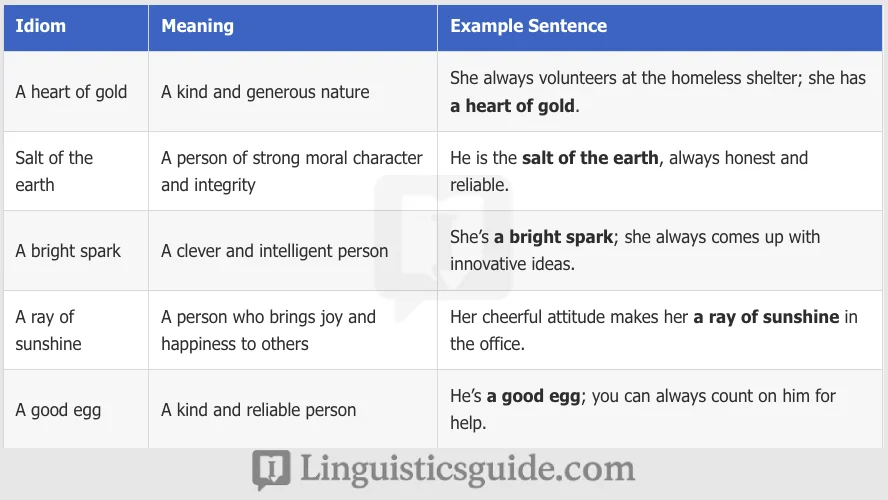
Positive Personality Idioms Examples
This table presents idioms that describe positive personality traits. Each idiom is defined, and example sentences are provided to show how to use them in context.
Understanding these idioms will help you express admiration and appreciation when describing someone.
| Idiom | Meaning | Example Sentence |
|---|---|---|
| A heart of gold | A kind and generous nature | She always volunteers at the homeless shelter; she has a heart of gold. |
| Salt of the earth | A person of strong moral character and integrity | He is the salt of the earth, always honest and reliable. |
| A bright spark | A clever and intelligent person | She’s a bright spark; she always comes up with innovative ideas. |
| A ray of sunshine | A person who brings joy and happiness to others | Her cheerful attitude makes her a ray of sunshine in the office. |
| A good egg | A kind and reliable person | He’s a good egg; you can always count on him for help. |
| Down-to-earth | Practical and realistic | Despite her success, she remains down-to-earth and approachable. |
| Level-headed | Calm and sensible | In a crisis, it’s important to have a level-headed person in charge. |
| On the ball | Alert and competent | Our new project manager is really on the ball; she anticipates every problem. |
| Sharp as a tack | Very intelligent | Even at 90, she’s as sharp as a tack and remembers everything. |
| Golden-hearted | Extremely kind and generous | The volunteer was known for his golden-hearted nature and willingness to help anyone. |
| A shoulder to cry on | Someone who offers comfort and support | Whenever I’m upset, she’s always a shoulder to cry on. |
| A pillar of strength | Someone who provides unwavering support and stability | During difficult times, he was a pillar of strength for his family. |
| Always there | Reliable and supportive | You know you can count on her; she’s always there for her friends. |
| True blue | Loyal and faithful | He’s a true blue friend; he’ll never let you down. |
| Good Samaritan | Someone who helps others in need | The Good Samaritan stopped to help the stranded motorist. |
| Angel | A kind and selfless person | The nurse was an angel, always caring for her patients with compassion. |
| Life of the party | Someone who is fun and energetic | He’s always the life of the party, entertaining everyone with his stories. |
| Full of beans | Energetic and lively | The children were full of beans after their nap. |
| A breath of fresh air | Someone who brings new ideas and energy | Her innovative approach was a breath of fresh air to the company. |
| Good sport | Someone who is gracious in winning or losing | Even though he lost the game, he was a good sport about it. |
| Diamond in the rough | Someone with hidden potential | Although he lacked formal education, he was a diamond in the rough with incredible talent. |
| Gentle giant | A large person with a kind personality | Despite his size, he was a gentle giant, loved by all the children. |
| An old soul | Someone who seems wise beyond their years | She always gave thoughtful advice; she seemed like an old soul. |
| Creative genius | An exceptionally creative person | He was a creative genius, constantly coming up with groundbreaking ideas. |
Negative Personality Idioms Examples
This table presents idioms that describe negative personality traits. Using these idioms requires caution to avoid causing offense.
Each idiom is defined, and example sentences are provided to illustrate its usage.
| Idiom | Meaning | Example Sentence |
|---|---|---|
| A couch potato | A lazy person who spends a lot of time sitting and watching television | He’s such a couch potato; he never wants to go out or do anything active. |
| A wet blanket | A person who spoils the fun of others | Don’t invite him; he’s such a wet blanket and always complains. |
| A pain in the neck | Someone who is annoying or troublesome | Dealing with that customer is a pain in the neck. |
| A backseat driver | Someone who constantly gives unwanted advice | My mother is such a backseat driver whenever I’m driving. |
| A control freak | Someone who tries to control everything | She’s such a control freak; she always has to be in charge. |
| A drama queen | Someone who overreacts to situations | She’s such a drama queen; she makes a big deal out of everything. |
| A know-it-all | Someone who acts as if they know everything | He’s such a know-it-all; he always has to correct everyone. |
| A rolling stone | Someone who doesn’t settle down in one place | He’s a rolling stone; he never stays in one job for long. |
| A wolf in sheep’s clothing | Someone who appears harmless but is actually dangerous | Beware of him; he’s a wolf in sheep’s clothing. |
| A cold fish | Someone who is unemotional and aloof | She’s such a cold fish; she never shows any emotion. |
| A bad egg | A dishonest or unreliable person | He’s a bad egg; I wouldn’t trust him with anything. |
| A loose cannon | Someone who is unpredictable and uncontrolled | He’s a loose cannon; you never know what he’s going to do next. |
| A busybody | Someone who interferes in other people’s affairs | The neighbor is such a busybody, always gossiping about everyone. |
| A chatterbox | Someone who talks excessively | She’s such a chatterbox; she never stops talking. |
| A penny pincher | Someone who is excessively thrifty | He’s such a penny pincher; he never spends any money. |
| A Scrooge | A miserly person | He’s a real Scrooge, especially around Christmas. |
| A killjoy | Someone who spoils other people’s fun | Don’t be such a killjoy; let’s enjoy the party. |
| A complainer | Someone who constantly complains | She’s such a complainer; she’s never happy with anything. |
| A stick-in-the-mud | Someone who is unwilling to try new things | He’s such a stick-in-the-mud; he never wants to do anything different. |
| A wet blanket | Someone who spoils the fun of others | He’s such a wet blanket; he always ruins the party. |
| Black sheep | The odd or disreputable member of a family or group | He was always considered the black sheep of the family. |
| A yes-man | A person who always agrees with their superiors | He’s just a yes-man, agreeing with everything the boss says. |
| Prima donna | A person who thinks they are very important and are difficult to please | She’s such a prima donna, demanding special treatment all the time. |
| Hard nut to crack | A person who is difficult to get to know | He’s a hard nut to crack, never revealing much about himself. |
Neutral Personality Idioms Examples
This table presents idioms that describe neutral personality traits. These idioms offer a balanced perspective on someone’s character without being overly positive or negative.
Each idiom is defined, and example sentences are provided to illustrate its usage.
| Idiom | Meaning | Example Sentence |
|---|---|---|
| A creature of habit | Someone who follows a routine | He’s a creature of habit; he always has the same breakfast every morning. |
| A lone wolf | Someone who prefers to be alone | She’s a lone wolf; she prefers working independently. |
| A night owl | Someone who stays up late | He’s a night owl; he does his best work late at night. |
| An early bird | Someone who wakes up early | She’s an early bird; she’s always up before sunrise. |
| A social butterfly | Someone who is very social and outgoing | She’s a social butterfly; she flits from party to party. |
| A workaholic | Someone who is addicted to work | He’s a workaholic; he’s always at the office. |
| A daydreamer | Someone who spends time imagining things | She’s such a daydreamer; she’s always lost in her thoughts. |
| Set in their ways | Unwilling to change their habits or opinions | He’s very set in his ways and doesn’t like trying new things. |
| A man of few words | Someone who doesn’t talk much | He’s a man of few words, but when he speaks, people listen. |
| An open book | Someone who is easy to know and understand | She’s an open book; she doesn’t hide anything. |
| A homebody | Someone who enjoys spending time at home | He’s a homebody; he prefers staying in to going out. |
| A free spirit | Someone who is independent and unconventional | She’s a free spirit; she lives life on her own terms. |
| A people person | Someone who enjoys being around people | She’s a people person; she loves working with the public. |
| A deep thinker | Someone who thinks seriously about things | He’s a deep thinker; he’s always pondering complex issues. |
| A trendsetter | Someone who starts new trends | She’s a trendsetter; everyone copies her style. |
| A follower | Someone who follows trends rather than starting them | He’s a follower; he always does what everyone else is doing. |
| A creature of comfort | Someone who enjoys comfort and luxury | He’s a creature of comfort; he always stays in the best hotels. |
| A rolling stone gathers no moss | Someone who is always moving doesn’t accumulate possessions or responsibilities | He lives by the saying “a rolling stone gathers no moss” and enjoys traveling the world. |
| A jack-of-all-trades | Someone who can do many different things | He’s a jack-of-all-trades; he can fix anything around the house. |
| A Renaissance man | Someone with many talents and interests | He’s a true Renaissance man, excelling in both arts and sciences. |
| A late bloomer | Someone who develops their talents or abilities later in life | He was a late bloomer, only finding success in his forties. |
| A go-getter | Someone who is ambitious and proactive | She’s a real go-getter, always striving to achieve her goals. |
| A self-starter | Someone who can start tasks independently | He’s a self-starter, requiring little supervision. |
Behavioral Personality Idioms Examples
This table presents idioms that describe specific behaviors or habits that reflect someone’s personality. These idioms provide insight into how someone typically acts in certain situations.
Each idiom is defined, and example sentences are provided to illustrate its usage.
| Idiom | Meaning | Example Sentence |
|---|---|---|
| Wear their heart on their sleeve | To openly show their emotions | She wears her heart on her sleeve; everyone knows how she’s feeling. |
| Clam up | To become silent or uncommunicative | He tends to clam up when he’s nervous. |
| Butter someone up | To flatter someone to get something | He tried to butter her up to get a promotion. |
| Rub someone the wrong way | To annoy someone unintentionally | He often rubs people the wrong way with his blunt comments. |
| Go with the flow | To accept things as they are | She prefers to go with the flow rather than making plans. |
| Keep their cards close to their chest | To keep their intentions secret | He keeps his cards close to his chest, never revealing his plans. |
| Bend over backwards | To try very hard to please someone | She always bends over backwards to help her friends. |
| Call a spade a spade | To speak frankly and honestly | He calls a spade a spade, even if it’s not what people want to hear. |
| Cry over spilt milk | To dwell on past mistakes | There’s no point in crying over spilt milk; let’s focus on the future. |
| Cut to the chase | To get to the point quickly | Let’s cut to the chase; what do you want to talk about? |
| Beat around the bush | To avoid talking directly about something | Stop beating around the bush and tell me what’s going on. |
| Get a kick out of | To enjoy something very much | He gets a kick out of playing practical jokes. |
| Have a short fuse | To get angry easily | He has a short fuse; it doesn’t take much to make him angry. |
| Have a thick skin | To not be easily offended | You need to have a thick skin to work in this industry. |
| Jump the gun | To act too soon | He jumped the gun and announced the news before it was official. |
| Keep their head above water | To manage to survive despite difficulties | He’s just trying to keep his head above water after losing his job. |
| Let sleeping dogs lie | To avoid stirring up trouble | It’s best to let sleeping dogs lie and not bring up the past. |
| Make a mountain out of a molehill | To exaggerate a problem | She always makes a mountain out of a molehill; it’s not that serious. |
| Miss the forest for the trees | To focus on details and lose sight of the big picture | He missed the forest for the trees and focused on minor issues. |
| Play devil’s advocate | To argue against something for the sake of discussion | I’m just playing devil’s advocate to see things from a different perspective. |
| Take the bull by the horns | To face a challenge directly | She decided to take the bull by the horns and confront the problem. |
| Walk on eggshells | To be very careful not to offend someone | Everyone walks on eggshells around him because he’s so sensitive. |
| See the glass half full | To be optimistic | She always sees the glass half full, even in difficult situations. |
| See the glass half empty | To be pessimistic | He always sees the glass half empty, focusing on the negative aspects. |
Usage Rules for Personality Idioms
Using personality idioms correctly requires understanding their specific meanings and contexts. Idioms should be used appropriately to avoid misunderstandings or misinterpretations.
Here are some guidelines to follow:
Context is Key: Pay attention to the context in which you use an idiom. Consider the situation, the audience, and the overall tone of your communication. Some idioms may be appropriate in casual conversations but not in formal settings. For instance, saying someone is “a pain in the neck” might be fine among friends, but not suitable in a business meeting.
Know the Meaning: Be sure you fully understand the meaning of an idiom before using it. Misusing an idiom can lead to confusion or even embarrassment. If you are unsure of an idiom’s meaning, look it up in a dictionary or ask a native speaker.
Cultural Sensitivity: Be aware that some idioms may be culturally specific and not easily understood by people from different backgrounds. Avoid using idioms that might be offensive or insensitive. For example, idioms that rely on stereotypes should be avoided.
Avoid Overuse: While idioms can add color to your language, using too many can make your speech sound unnatural or forced. Use idioms sparingly and only when they enhance your message.
Grammatical Considerations: Ensure that the idiom fits grammatically into your sentence. Some idioms have fixed structures and cannot be altered. Pay attention to verb tenses, subject-verb agreement, and other grammatical rules.
Common Mistakes with Personality Idioms
Learners often make mistakes when using personality idioms. Recognizing these common errors can help you avoid them and improve your accuracy.
Literal Interpretation: One of the most common mistakes is interpreting idioms literally. Remember that idioms have figurative meanings that are different from the literal meanings of their individual words. For example, “a heart of gold” does not refer to a literal heart made of gold but to a kind and generous nature.
Incorrect Word Order: Some idioms have a fixed word order that cannot be changed. Altering the word order can change the meaning or make the idiom nonsensical. For example, it’s “salt of the earth,” not “earth of the salt.”
Misusing Prepositions: Prepositions are often an integral part of idioms, and using the wrong preposition can change the meaning. For example, it’s “on the ball,” not “in the ball.”
Overgeneralization: Assuming that all idioms can be used interchangeably is a mistake. Each idiom has a specific meaning and context. For example, you can’t use “a bright spark” and “a good egg” in the same way, even though they both describe positive qualities.
The following table illustrates some common mistakes and provides correct examples:
| Incorrect | Correct | Explanation |
|---|---|---|
| He is earth of the salt. | He is the salt of the earth. | The word order is fixed; “salt of the earth” is the correct idiom. |
| She has a heart from gold. | She has a heart of gold. | The correct preposition is “of,” not “from.” |
| He is in the ball. | He is on the ball. | The correct preposition is “on,” not “in.” |
| She is a rain blanket. | She is a wet blanket. | The correct adjective is “wet,” not “rain.” |
| He is a pain in the head. | He is a pain in the neck. | The correct body part is “neck,” not “head.” |
Practice Exercises
Test your understanding of personality idioms with these practice exercises. Each exercise includes multiple questions with solutions provided below.
Exercise 1: Fill in the Blanks
Complete the following sentences with the correct idiom from the list below:
Idiom List: a heart of gold, salt of the earth, a bright spark, a couch potato, a wet blanket
- She always helps others; she has __________.
- He’s always honest and reliable; he’s __________.
- She’s very clever; she’s __________.
- He spends all day watching TV; he’s __________.
- He always spoils the fun; he’s __________.
Exercise 2: Matching
Match the idiom with its meaning:
| Idiom | Meaning |
|---|---|
| 1. A control freak | A. Someone who is very social and outgoing |
| 2. A social butterfly | B. Someone who is addicted to work |
| 3. A workaholic | C. Someone who tries to control everything |
Exercise 3: Multiple Choice
Choose the correct meaning of the idiom in the sentence:
- He’s always barking up the wrong tree. What does this mean?
- He’s always climbing trees.
- He’s always pursuing the wrong course of action.
- He’s always making noise.
- She is on cloud nine. What does this mean?
- She is very sad.
- She is very happy.
- She is very tired.
Exercise 4: Sentence Completion
Complete the following sentences with an appropriate personality idiom.
- Even though he appears intimidating, he’s actually a __________ and wouldn’t hurt a fly.
- She’s such a __________, always gossiping and interfering in other people’s affairs.
Solutions:
Exercise 1:
- a heart of gold
- salt of the earth
- a bright spark
- a couch potato
- a wet blanket
Exercise 2:
| Idiom | Meaning |
|---|---|
| 1. A control freak | C. Someone who tries to control everything |
| 2. A social butterfly | A. Someone who is very social and outgoing |
| 3. A workaholic | B. Someone who is addicted to work |
Exercise 3:
- b. He’s always pursuing the wrong course of action.
- b. She is very happy.
Exercise 4:
- Even though he appears intimidating, he’s actually a gentle giant and wouldn’t hurt a fly.
- She’s such a busybody, always gossiping and interfering in other people’s affairs.
Advanced Topics
For advanced learners, exploring the nuances and cultural contexts of personality idioms can further enhance their understanding
can further enhance their understanding and usage. This section delves into the origins of some idioms, their evolution over time, and their variations across different English-speaking regions.
Origins and Etymology: Many personality idioms have fascinating origins that reflect historical events, cultural practices, or literary references. Understanding these origins can provide deeper insights into the meanings and connotations of the idioms. For example, the idiom “salt of the earth” comes from the Bible (Matthew 5:13), where it is used to describe people who are morally upright and valuable. Knowing this origin adds a layer of significance to the idiom, emphasizing its connection to traditional values and integrity.
Evolution Over Time: Idioms are not static; they evolve over time as language and culture change. Some idioms may become more or less common, while others may acquire new meanings or variations. For instance, the idiom “couch potato” is a relatively recent addition to the English language, reflecting the rise of television and sedentary lifestyles. Tracking these changes can help you stay current with contemporary usage.
Regional Variations: English is spoken in many different countries and regions, each with its own unique dialects and idioms. Some personality idioms may be more common in certain regions than others, or they may have slightly different meanings. For example, an idiom used in British English might not be familiar to speakers of American English, and vice versa. Being aware of these regional variations can help you communicate more effectively with people from different backgrounds.
Literary and Cultural References: Personality idioms are often used in literature, movies, and other forms of media to create vivid characters and convey complex ideas. Recognizing these references can enhance your appreciation of the works and improve your understanding of the idioms. For example, a character described as “a rolling stone” might evoke images of freedom, restlessness, and a lack of commitment, depending on the context.
FAQ
This section addresses some frequently asked questions about personality idioms to clarify any remaining doubts or concerns.
Why is it important to learn personality idioms?
Learning personality idioms is important because it enhances your ability to express yourself in a more nuanced and colorful way. Idioms add depth to your descriptions and make your language more engaging and relatable.
They also help you understand native speakers better, as idioms are commonly used in everyday conversations and media.
How can I effectively memorize personality idioms?
Effective memorization involves using the idioms in context, creating flashcards with definitions and examples, and practicing regularly. Try to incorporate the idioms into your writing and speaking to reinforce your learning.
Also, pay attention to how native speakers use idioms in their conversations and media.
Are there any resources for learning more idioms?
Yes, there are many resources available, including dictionaries of idioms, online language learning platforms, and textbooks. Some popular resources include the Oxford Dictionary of Idioms, Merriam-Webster’s Idiom Dictionary, and various language learning apps and websites that offer idiom lessons and exercises.
Can I create my own idioms?
While it’s possible to create new expressions, they won’t be considered true idioms until they are widely adopted and understood by native speakers. Idioms typically evolve organically over time through cultural usage.
However, you can certainly play with language and create your own metaphors and expressions for creative purposes.
How do I know if an idiom is appropriate to use in a formal setting?
When in doubt, it’s best to avoid using idioms in formal settings. Opt for more direct and literal language to ensure clarity and professionalism.
If you’re unsure whether an idiom is appropriate, consider your audience, the context, and the overall tone of the communication. If the idiom seems too casual or informal, it’s best to choose a different way to express yourself.
Conclusion
Mastering idioms for personality is a valuable skill for anyone learning the English language. These expressions add color, depth, and nuance to your communication, allowing you to describe people’s characters in a vivid and memorable way.
By understanding the definitions, structures, usage rules, and common mistakes associated with personality idioms, you can confidently incorporate them into your everyday conversations and writing.
Continue to practice and explore new idioms to expand your vocabulary and enhance your fluency. The more you immerse yourself in the language and culture, the more natural and effortless your use of idioms will become.
With dedication and practice, you can master the art of describing personality using idioms and communicate with greater precision and expressiveness.

I’m James Terban, a teacher with a degree in Education and five years of experience working with students of all ages, from young kids learning their first grammar rules to adults picking up English as a second language. I started Linguistics Guide because I kept seeing good learners hit a wall due to explanations that were either too vague or too complicated. Every article here comes from a real question I have heard in a classroom or seen asked online.