
Understanding and using idioms related to clarity is crucial for effective communication in English. These idioms add color and nuance to your language, making it more engaging and understandable.
This article delves into various idioms that convey the concept of clarity, providing definitions, examples, and practical exercises to help you master their usage. Whether you’re an English language learner or a native speaker looking to enhance your communication skills, this guide will equip you with the tools to express yourself with precision and flair.
Table of Contents
- Introduction
- Definition of Idioms for Clarity
- Structural Breakdown
- Types and Categories of Clarity Idioms
- Examples of Idioms for Clarity
- Usage Rules
- Common Mistakes
- Practice Exercises
- Advanced Topics
- FAQ
- Conclusion
Introduction
Idioms are phrases or expressions whose meanings cannot be understood from the literal definitions of the words themselves. They are a vital part of the English language, adding richness and depth to communication.
When it comes to expressing the concept of clarity – being easily understood, transparent, or unambiguous – English offers a variety of colorful idioms. Mastering these idioms can significantly improve your ability to communicate effectively and understand nuanced conversations.
This comprehensive guide explores the most common and useful idioms for clarity, providing you with the knowledge and practice to use them confidently.
Definition of Idioms for Clarity
Idioms for clarity are expressions that convey the idea of something being easily understood, unambiguous, or transparent. These idioms go beyond literal meanings and provide a more vivid and often metaphorical way to describe clarity in various contexts. They can be used to describe ideas, instructions, explanations, or even people who are straightforward and honest. Understanding these idioms involves recognizing that their combined meaning differs from the individual meanings of the words they contain. These idioms often rely on cultural context and figurative language to communicate effectively.
Classification
Idioms for clarity can be classified based on the specific aspect of clarity they emphasize. Some focus on ease of understanding, others on transparency, and still others on the absence of ambiguity.
For instance, an idiom like “clear as a bell” emphasizes the distinctness and audibility of something, while “crystal clear” highlights the transparency and lack of doubt. “In plain English” focuses on simplifying complex information to make it accessible to everyone.
By recognizing these nuances, you can choose the most appropriate idiom to convey your intended meaning.
Function
The primary function of idioms for clarity is to enhance communication by providing a more expressive and engaging way to describe something that is easily understood. They add color and personality to your language, making it more memorable and impactful.
Additionally, using these idioms demonstrates a strong command of the English language, which can enhance your credibility and rapport with native speakers. These idioms help to avoid the monotony of using the same words and phrases repeatedly, enriching your vocabulary and communication style.
Contexts
Idioms for clarity are used in a wide range of contexts, from everyday conversations to professional settings. In casual conversations, idioms like “get the picture” or “see the light” are common ways to indicate understanding.
In business or academic contexts, idioms such as “in a nutshell” or “lay it out clearly” are used to summarize information or provide clear explanations. The appropriate use of these idioms depends on the audience and the level of formality required.
Being mindful of the context ensures that your communication is both clear and appropriate.
Structural Breakdown
The structure of idioms for clarity varies depending on the specific expression. Some idioms are simple phrases, while others are more complex sentences.
Understanding the structural elements of these idioms can help you use them correctly and confidently. Many idioms use similes (comparisons using “like” or “as”) to create vivid images of clarity.
Others use metaphors, where a word or phrase is applied to an object or action to which it is not literally applicable. Recognizing these patterns can aid in both understanding and using idioms effectively.
Simile Structure
Similes are a common structural element in idioms for clarity. These idioms often use “as” or “like” to compare something to a clear or transparent object or concept.
For example, “clear as crystal” compares the clarity of something to the transparency of crystal. The structure typically involves a subject, a verb, “as” or “like,” and a clear object or concept.
Understanding this structure helps in recognizing and using simile-based idioms correctly.
Metaphor Structure
Metaphors involve using a word or phrase to represent something else, creating an implied comparison. In idioms for clarity, metaphors often involve using terms related to light, vision, or simplicity to describe understanding.
For instance, “shed light on” uses the metaphor of light illuminating a subject to represent clarifying information. Recognizing the metaphorical relationship between the words and their intended meaning is crucial for understanding and using these idioms effectively.
Phrasal Verb Structure
Some idioms for clarity involve phrasal verbs, which are verbs combined with prepositions or adverbs to create a new meaning. For example, “spell out” means to explain something in detail, leaving no room for misunderstanding.
The structure involves a verb (e.g., spell) and a particle (e.g., out). Understanding the combined meaning of the verb and particle is essential for using these phrasal verb idioms correctly.
Types and Categories of Clarity Idioms
Idioms for clarity can be categorized based on the specific aspect of clarity they emphasize. These categories include idioms that focus on ease of understanding, transparency, lack of ambiguity, and directness.
Each category offers a unique way to express the concept of clarity in different contexts. By understanding these categories, you can choose the most appropriate idiom to convey your intended meaning.
Ease of Understanding
These idioms emphasize how easily something can be understood. They often involve metaphors related to simplicity and accessibility.
Examples include “in plain English,” “easy to grasp,” and “a piece of cake.” These idioms are useful when describing information or explanations that are straightforward and require little effort to comprehend.
Transparency
Idioms in this category highlight the transparency and lack of hidden information. They often use metaphors related to light, glass, or openness.
Examples include “clear as glass,” “crystal clear,” and “open and shut case.” These idioms are useful when describing situations or explanations that are straightforward and leave no room for doubt.
Lack of Ambiguity
These idioms emphasize the absence of ambiguity or confusion. They often involve metaphors related to precision and certainty.
Examples include “cut and dried,” “black and white,” and “no gray areas.” These idioms are useful when describing situations or explanations that are definite and leave no room for interpretation.
Directness
Idioms in this category focus on being direct and straightforward in communication. They often involve metaphors related to honesty and lack of pretense.
Examples include “call a spade a spade,” “straight from the shoulder,” and “get to the point.” These idioms are useful when describing communication that is honest, direct, and avoids unnecessary complexity.
Examples of Idioms for Clarity
The following tables provide examples of idioms for clarity, categorized by their specific meaning. Each example is accompanied by a definition and a sample sentence to illustrate its usage.
By studying these examples, you can gain a better understanding of how to use these idioms in your own communication.
Ease of Understanding Examples
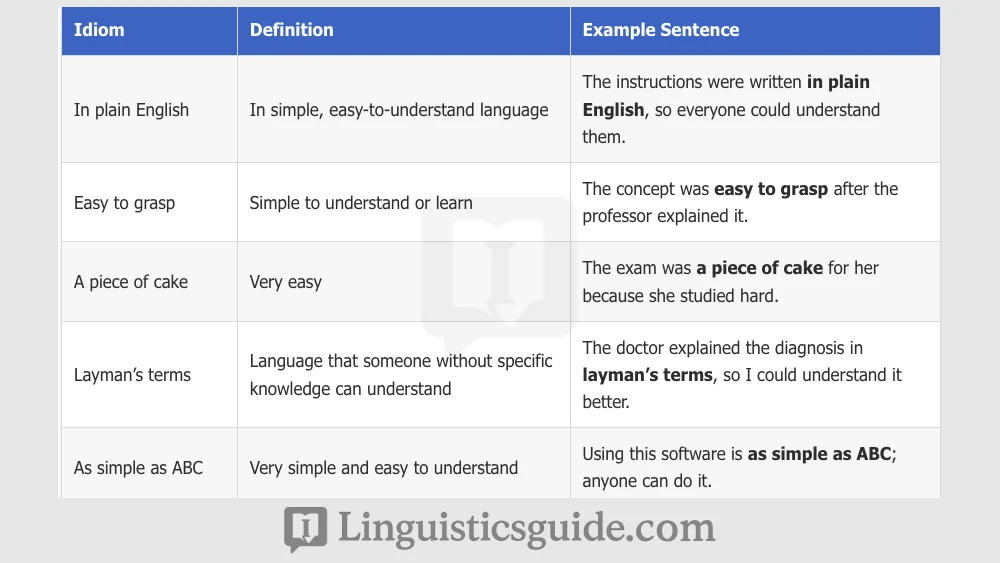
The following table lists examples of idioms that describe content that is easy to understand. These idioms are useful when emphasizing how straightforward and accessible information is.
| Idiom | Definition | Example Sentence |
|---|---|---|
| In plain English | In simple, easy-to-understand language | The instructions were written in plain English, so everyone could understand them. |
| Easy to grasp | Simple to understand or learn | The concept was easy to grasp after the professor explained it. |
| A piece of cake | Very easy | The exam was a piece of cake for her because she studied hard. |
| Layman’s terms | Language that someone without specific knowledge can understand | The doctor explained the diagnosis in layman’s terms, so I could understand it better. |
| As simple as ABC | Very simple and easy to understand | Using this software is as simple as ABC; anyone can do it. |
| Crystal clear | Extremely clear and easy to understand | The instructions were crystal clear, leaving no room for confusion. |
| Get the picture | Understand the situation | After the explanation, I got the picture and knew what to do. |
| See the light | Understand something after a period of confusion | He finally saw the light and realized the importance of his actions. |
| Sink in | Be fully understood or realized | It took a while for the news to sink in, but eventually, I understood the implications. |
| Get it | Understand | Did you get it? I can explain it again if you need. |
| Click into place | Become clear or understandable | Once she saw the diagram, everything clicked into place. |
| Make head or tail of something | Understand something (often used in the negative) | I couldn’t make head or tail of the instructions. |
| Dumb it down | Simplify something to make it easier to understand (often used informally) | Could you dumb it down for me? I’m not a technical expert. |
| Watered down | Made simpler or less forceful | The report was watered down to make it more accessible to the public. |
| In a nutshell | In a few words; concisely | In a nutshell, the project was a success. |
| Boiled down | Reduced to the essentials | The argument boiled down to a disagreement over money. |
| Plain sailing | Easy and without problems | Once we got the initial setup done, it was plain sailing from there. |
| Elementary, my dear Watson | Obviously simple (humorous reference to Sherlock Holmes) | The solution is elementary, my dear Watson! |
| Intuitively obvious | Easy to understand without needing explanation | The answer was intuitively obvious to anyone with basic knowledge. |
| In black and white | Clearly stated in writing | The rules are in black and white, so there’s no room for interpretation. |
| The long and short of it | The essence of something | The long and short of it is that we need to cut costs. |
| See through someone | Understand someone’s true intentions | I could see through his lies from the start. |
| As clear as mud | Not clear at all (ironic) | His explanation was as clear as mud. |
Transparency Examples
The following table lists idioms that highlight the transparency and lack of hidden information. These idioms are useful when emphasizing openness and honesty.
| Idiom | Definition | Example Sentence |
|---|---|---|
| Clear as glass | Very transparent and easy to see through | The water was clear as glass, allowing us to see the fish swimming below. |
| Open and shut case | A case or situation that is easy to prove or decide | The evidence was so strong that it was an open and shut case. |
| Above board | Legitimate, honest, and transparent | The company’s dealings were always above board, ensuring trust with its clients. |
| On the up and up | Honest and legitimate | You can trust him; he’s on the up and up. |
| Straight shooter | A person who is honest and direct | She’s a straight shooter, so you can always trust her to tell you the truth. |
| No hidden agenda | No secret or ulterior motives | He approached the negotiation with no hidden agenda, seeking a fair agreement. |
| Face value | The literal or apparent meaning of something | We took his statement at face value, assuming he was telling the truth. |
| Transparent | Easy to perceive or detect | The reasons for their decision were transparent. |
| Come clean | Confess or admit something | He decided to come clean about his past mistakes. |
| Lay all your cards on the table | Be completely open and honest about your intentions | In order to build trust, we need to lay all our cards on the table. |
| See through | Understand the true nature of someone or something | I can see through his false charm. |
| An open book | Someone or something that is easy to understand | She’s an open book; you always know what she’s thinking. |
| Glass ceiling | An invisible barrier preventing someone from rising higher | Women still face a glass ceiling in many corporate environments. |
| In broad daylight | Openly and without hiding | The crime occurred in broad daylight. |
| Show your true colors | Reveal your real character | He finally showed his true colors during the crisis. |
| Clean slate | A fresh start | He wanted to start with a clean slate after the scandal. |
| Nothing up one’s sleeve | Having no hidden tricks or plans | He assured us that he had nothing up his sleeve. |
| A level playing field | A fair and equal situation | We need to create a level playing field for all competitors. |
| On the level | Honest and genuine | You can trust him; he’s on the level. |
| Full disclosure | Complete and honest revelation of information | The company provided full disclosure of all relevant financial details. |
| Bare one’s soul | Reveal one’s innermost thoughts and feelings | She bared her soul to her therapist. |
| In the open | Publicly and transparently | The negotiations were conducted in the open. |
| Keep nothing back | Reveal everything | She promised to keep nothing back during her testimony. |
Lack of Ambiguity Examples
This table provides idioms that emphasize the absence of ambiguity or confusion. These idioms are useful when describing situations or explanations that are definite and leave no room for interpretation.
| Idiom | Definition | Example Sentence |
|---|---|---|
| Cut and dried | Completely settled or decided | The decision was cut and dried; there was no room for further discussion. |
| Black and white | Clear and unambiguous; easily distinguishable | The rules were black and white, leaving no room for interpretation. |
| No gray areas | No ambiguity or uncertainty | The policy had no gray areas; it was very clear about what was allowed. |
| Set in stone | Unchangeable or firmly established | The deadline is set in stone, so we must meet it. |
| Written in stone | Permanent and unchangeable | Some believe that the laws of nature are written in stone. |
| Nailed down | Settled or finalized | We finally nailed down the details of the contract. |
| Clear-cut | Clearly defined or easy to recognize | It was a clear-cut case of theft. |
| Definitive | Final and authoritative | The study provided a definitive answer to the question. |
| Beyond a shadow of a doubt | With complete certainty | He proved his innocence beyond a shadow of a doubt. |
| In no uncertain terms | Very clearly and directly | He told her in no uncertain terms that he was not interested. |
| Leave no room for doubt | Make something completely clear | The evidence left no room for doubt about his guilt. |
| Point blank | Directly and without hesitation | She asked him point blank if he was lying. |
| Straightforward | Easy to understand or deal with | The instructions were straightforward and easy to follow. |
| Unequivocal | Clear, definite, and leaving no doubt | The president issued an unequivocal statement condemning the violence. |
| Without a doubt | Certainly; definitely | Without a doubt, she is the best candidate for the job. |
| Conclusive | Serving to settle an issue definitively | The evidence was conclusive, proving his guilt. |
| Dead certain | Absolutely certain | I’m dead certain that I saw him yesterday. |
| For sure | Definitely; certainly | I’ll be there for sure. |
| No ifs, ands, or buts | No excuses or objections | You need to finish this project, no ifs, ands, or buts. |
| Set the record straight | Correct a false or inaccurate account | He wanted to set the record straight about what really happened. |
| Put to bed | Resolve or settle something definitively | We finally put to bed the rumors about the company’s financial troubles. |
| Iron out | Resolve or settle | We need to iron out the details before we sign the contract. |
| Leave no stone unturned | Search thoroughly and exhaustively | The detectives left no stone unturned in their investigation. |
Usage Rules
Using idioms correctly requires understanding their specific meanings and contexts. While idioms add color and nuance to your language, using them inappropriately can lead to confusion or miscommunication.
It’s important to consider the audience, the level of formality, and the overall tone of the conversation. Pay attention to how native speakers use these idioms and practice incorporating them into your own speech and writing.
Contextual Appropriateness
The appropriateness of using an idiom depends on the context of the conversation or writing. Informal idioms, such as “a piece of cake,” may be suitable for casual conversations but not for formal presentations or academic papers.
Consider the audience and the level of formality required. When in doubt, it’s best to err on the side of caution and use more straightforward language.
Audience Awareness
Be mindful of your audience when using idioms. If you’re speaking to non-native English speakers, it’s best to avoid using too many idioms or to explain them when you do use them.
Even among native speakers, some idioms may be more familiar to certain age groups or regions. Tailor your language to your audience to ensure effective communication.
Literal vs. Idiomatic Meaning
It’s crucial to understand the difference between the literal and idiomatic meaning of a phrase. Idioms have a figurative meaning that differs from the literal meaning of the individual words.
Misunderstanding this difference can lead to confusion and miscommunication. Always consider the context to determine whether a phrase is being used literally or idiomatically.
Common Mistakes
One common mistake is using idioms out of context, leading to misunderstandings. Another is misunderstanding the idiom’s meaning and using it incorrectly.
Non-native speakers sometimes attempt to translate idioms directly from their native language, resulting in nonsensical phrases. It’s important to learn the correct usage of each idiom and practice using them in appropriate contexts.
Incorrect Idiom Usage
Using an idiom incorrectly can significantly alter the meaning of your sentence. For example, saying “The instructions were as clear as mud” when you mean they were easy to understand is incorrect.
Always double-check the meaning of an idiom before using it to ensure that it accurately conveys your intended message.
Literal Translation Errors
Attempting to translate idioms directly from another language can result in nonsensical phrases. Idioms are often culturally specific and do not have direct equivalents in other languages.
It’s important to learn the English idiom as a whole phrase rather than trying to translate it word-for-word.
Mixing Idioms
Mixing two or more idioms together can create confusing and nonsensical sentences. For example, saying “Let’s cut to the chase and call a spade a spade in a nutshell” combines elements of multiple idioms and doesn’t make sense.
Avoid mixing idioms and stick to using them in their complete and correct form.
| Incorrect | Correct |
|---|---|
| The instructions were as clear as mud, so I understood everything. | The instructions were crystal clear, so I understood everything. |
| He wanted to set the record straight from the shoulder. | He wanted to set the record straight. / He spoke straight from the shoulder. |
| Let’s cut to the chase in a nutshell. | In a nutshell, let’s cut to the chase. / Let’s get straight to the point. |
Practice Exercises
Test your understanding of idioms for clarity with these practice exercises. Each exercise includes multiple-choice questions to help you identify the correct usage of idioms in different contexts.
Answers are provided at the end of each exercise to help you check your progress.
Exercise 1: Fill in the Blanks
Choose the correct idiom to complete each sentence.
| Question | Options | Answer |
|---|---|---|
| The explanation was so simple; it was ____________. | a) a hard nut to crack, b) a piece of cake, c) a storm in a teacup | b) a piece of cake |
| He explained the complex topic ____________, so everyone could understand. | a) in rocket science, b) in plain English, c) in Greek | b) in plain English |
| After hours of confusion, I finally ____________ and understood the solution. | a) saw the light, b) missed the boat, c) beat around the bush | a) saw the light |
| The evidence was so clear that it was an ____________. | a) open and shut case, b) uphill battle, c) wild goose chase | a) open and shut case |
| She’s a ____________, so you can always trust her to tell you the truth. | a) rolling stone, b) straight shooter, c) fair-weather friend | b) straight shooter |
| The rules are ____________, leaving no room for interpretation. | a) black and white, b) touch and go, c) here and there | a) black and white |
| We need to ____________ the details of the contract before signing. | a) iron out, b) call it a day, c) add fuel to the fire | a) iron out |
| He proved his innocence ____________. | a) beyond a shadow of a doubt, b) once in a blue moon, c) on cloud nine | a) beyond a shadow of a doubt |
| ____________, the project was a success. | a) In a nutshell, b) In the long run, c) Once upon a time | a) In a nutshell |
| The water was ____________, allowing us to see the fish. | a) clear as glass, b) like a fish out of water, c) a drop in the bucket | a) clear as glass |
Exercise 2: Multiple Choice
Choose the sentence that correctly uses the idiom.
| Question | Options | Answer |
|---|---|---|
| Which sentence correctly uses “come clean”? | a) He decided to come clean the house. b) He decided to come clean about his mistakes. c) He decided to come clean the dishes. | b) He decided to come clean about his mistakes. |
| Which sentence correctly uses “lay all your cards on the table”? | a) We need to lay all our cards on the table for the poker game. b) We need to lay all our cards on the table to hide our intentions. c) We need to lay all our cards on the table to build trust. | c) We need to lay all our cards on the table to build trust. |
| Which sentence correctly uses “see through”? | a) I can see through the window very well. b) I can see through his false charm. c) I can see through the telescope. | b) I can see through his false charm. |
| Which sentence correctly uses “an open book”? | a) She’s an open book; you can write anything in her. b) She’s an open book; you always know what she’s thinking. c) She’s an open book; she loves to read. | b) She’s an open book; you always know what she’s thinking. |
| Which sentence correctly uses “in broad daylight”? | a) The crime occurred in broad daylight, making it hard to see. b) The crime occurred in broad daylight, openly and without hiding. c) The crime occurred in broad daylight, during the night. | b) The crime occurred in broad daylight, openly and without hiding. |
| Which sentence correctly uses “show your true colors”? | a) He finally showed his true colors by wearing a colorful outfit. b) He finally showed his true colors during the crisis. c) He finally showed his true colors by painting the house. | b) He finally showed his true colors during the crisis. |
| Which sentence correctly uses “nothing up one’s sleeve”? | a) He had nothing up his sleeve, so he couldn’t perform the magic trick. b) He assured us that he had nothing up his sleeve, meaning he had no hidden tricks. c) He had nothing up his sleeve because it was too hot. | b) He assured us that he had nothing up his sleeve, meaning he had no hidden tricks. |
| Which sentence correctly uses “a level playing field”? | a) We need a level playing field for the construction site. b) We need a level playing field for the soccer game. c) We need to create a level playing field for all competitors. | c) We need to create a level playing field for all competitors. |
| Which sentence correctly uses “on the level”? | a) The building was not on the level; it was crooked. b) You can trust him; he’s on the level. c) The water level was on the level. | b) You can trust him; he’s on the level. |
| Which sentence correctly uses “full disclosure”? | a) The company provided full disclosure of all financial details. b) The company provided full disclosure by keeping secrets. c) The company provided full disclosure by hiding information. | a) The company provided full disclosure of all financial details. |
Advanced Topics
For advanced learners, exploring the origins and etymology of idioms can provide a deeper understanding of their meanings and usage. Researching the cultural context in which idioms originated can also enhance your ability to use them appropriately.
Additionally, analyzing how idioms are used in literature and other forms of media can provide valuable insights into their expressive power.
Idiom Origins
Many idioms have interesting origins that shed light on their meanings. For example, the idiom “call a spade a spade” dates back to ancient Greece and originally referred to being direct and honest, even if it’s impolite.
Understanding these origins can help you appreciate the nuances of idioms and use them more effectively.
Cultural Context
Idioms are often deeply rooted in cultural context, reflecting the values, beliefs, and experiences of a particular society. Understanding this context is crucial for using idioms appropriately and avoiding misunderstandings.
Some idioms may be specific to certain regions or social groups, so it’s important to be aware of these variations.
Idioms in Literature
Analyzing how idioms are used in literature can provide valuable insights into their expressive power. Writers often use idioms to add color, depth, and authenticity to their writing.
By studying these examples, you can learn how to use idioms more creatively and effectively in your own communication.
FAQ
Here are some frequently asked questions about idioms for clarity.
- What are idioms for clarity?
Idioms for clarity are expressions that convey the idea of something being easily understood, unambiguous, or transparent. They add color and nuance to your language, making it more engaging and understandable.
- Why is it important to learn idioms for clarity?
Learning idioms for clarity enhances your communication skills, allowing you to express yourself more effectively and understand nuanced conversations. It also demonstrates a strong command of the English language.
- How can I improve my understanding of idioms?
You can improve your understanding of idioms by studying examples, practicing their usage, and paying attention to how native speakers use them in different contexts. Reading books, watching movies, and listening to podcasts can also help.
- Are idioms the same in all English-speaking countries?
No, idioms can vary between different English-speaking countries. Some idioms may be more common in the United States, while others may be more prevalent in the United Kingdom or Australia. Be aware of these regional variations when using idioms.
- Is it okay to use idioms in formal writing?
It depends on the context and the audience. While idioms can add color and personality to your writing, they may not be appropriate for formal academic papers or business reports. Consider the level of formality required and choose your language accordingly.
- What should I do if I don’t understand an idiom?
If you don’t understand an idiom, ask for clarification. You can ask the speaker to explain the
explanation or look it up in a dictionary or online resource. Don’t be afraid to admit that you don’t understand an idiom; it’s better to ask than to misunderstand the message. - How can I practice using idioms in my daily conversations?
Start by identifying a few idioms that you want to incorporate into your vocabulary. Practice using them in different contexts and pay attention to how native speakers use them. Don’t be afraid to make mistakes; it’s a natural part of the learning process.
- Are there any resources that can help me learn more about idioms?
Yes, there are many resources available to help you learn more about idioms. Dictionaries, online resources, and language learning apps can provide definitions, examples, and practice exercises. Additionally, reading books and watching movies can expose you to idioms in context.
- How do I avoid making mistakes when using idioms?
To avoid making mistakes when using idioms, double-check their meanings and contexts before using them. Pay attention to how native speakers use idioms and practice incorporating them into your own speech and writing. If you’re unsure about the correct usage of an idiom, it’s best to err on the side of caution and use more straightforward language.
- Can idioms be translated directly into other languages?
No, idioms cannot typically be translated directly into other languages. Idioms are often culturally specific and do not have direct equivalents in other languages. It’s important to learn the English idiom as a whole phrase rather than trying to translate it word-for-word.
Conclusion
Mastering idioms for clarity is an essential step in becoming a proficient English speaker. These idioms add richness and depth to your language, allowing you to express yourself more effectively and understand nuanced conversations.
By understanding the definitions, structures, and usage rules of these idioms, you can confidently incorporate them into your daily communication. Remember to practice regularly, pay attention to context, and be mindful of your audience.
With dedication and effort, you can unlock the power of idioms and elevate your English language skills to new heights. Whether you’re aiming for clearer communication in professional settings, academic discussions, or casual conversations, the knowledge and skills you’ve gained from this guide will undoubtedly serve you well.
Keep exploring, keep practicing, and enjoy the journey of mastering the art of clear communication in English.