

Understanding the difference between “whose” and “who’s” is crucial for clear and effective communication in English. These two words, though similar in appearance and pronunciation, have distinct grammatical functions. Confusing them can lead to awkward sentences and misinterpretations.
This article provides a comprehensive guide to mastering the correct usage of “whose” and “who’s,” suitable for English learners of all levels, from beginners to advanced.
Whether you’re writing an academic paper, a business email, or simply engaging in casual conversation, knowing when to use “whose” and “who’s” correctly will enhance your writing and speaking skills. This guide will break down the definitions, structural rules, common mistakes, and provide ample examples and practice exercises to solidify your understanding.
Table of Contents
- Introduction
- Definitions: Whose vs. Who’s
- Structural Breakdown
- Usage Contexts
- Examples
- Usage Rules
- Common Mistakes
- Practice Exercises
- Advanced Topics
- Frequently Asked Questions (FAQ)
- Conclusion
Definitions: Whose vs. Who’s
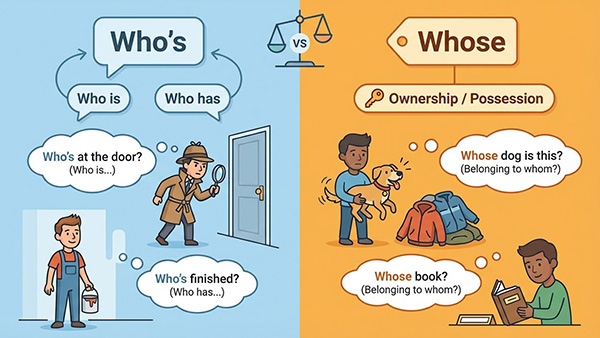
Understanding the core definitions of “whose” and “who’s” is the first step toward mastering their correct usage. These words serve different grammatical functions and should not be used interchangeably.
Difference Between Whose and Who’s at a Glance
The difference between whose and who’s lies in grammar and meaning, not pronunciation. Whose functions as a possessive pronoun and answers questions about ownership or association.
It modifies a noun directly and does not involve a verb. Who’s, on the other hand, is a contraction that always contains a verb—either is or has. Confusion arises because both sound identical when spoken, but their written roles are entirely different. Recognizing whether a sentence needs possession or a verb phrase instantly clarifies which form is correct.
Whose: The Possessive Pronoun
“Whose” is a possessive pronoun that indicates ownership or belonging. It is used to ask or state who owns something or to whom something belongs. “Whose” can refer to both people and things. It is important to remember that “whose” does not require an apostrophe.
For example, in the question “Whose book is this?”, “whose” asks who the book belongs to. Similarly, in the sentence “The student whose essay won the prize was very happy,” “whose” indicates that the essay belongs to the student.
Who’s: The Contraction
“Who’s” is a contraction of “who is” or “who has.” The apostrophe in “who’s” signifies that letters have been omitted. It is crucial to recognize that “who’s” is always a shortened form of one of these two phrases.
For instance, “Who’s going to the party?” is a contraction of “Who is going to the party?”. Another example is “Who’s been eating my porridge?” which is a contraction of “Who has been eating my porridge?”. Always remember to expand the contraction to “who is” or “who has” to check if “who’s” is the correct choice.
Structural Breakdown
Analyzing the structure of sentences using “whose” and “who’s” can further clarify their roles and correct usage. Understanding the patterns in which these words appear will help you identify them more easily in different contexts.
Structure of ‘Whose’ Sentences
“Whose” typically appears at the beginning of a question or within a clause to indicate possession. It is often followed by the noun that is being possessed. The basic structure is usually: “Whose + noun + verb + subject?”. In relative clauses, “whose” connects a noun to a related possessive idea.
For example: “Whose car is parked outside?” Here, “whose” is followed by the noun “car.” In the sentence, “The artist whose paintings are displayed in the gallery is famous,” “whose paintings” acts as a possessive relative clause, modifying “artist.”
Structure of ‘Who’s’ Sentences
“Who’s” appears as a subject followed by a verb, due to its nature as a contraction of “who is” or “who has.” The structure is simple: “Who’s + verb + rest of the sentence?”. It functions like “who is” or “who has” would in a sentence.
For example: “Who’s coming to the meeting?” This is equivalent to “Who is coming to the meeting?”. In the sentence, “Who’s been working on this project?”, “who’s” is a contraction of “who has,” and the sentence is equivalent to “Who has been working on this project?”.
Usage Contexts
Knowing the appropriate contexts for using “whose” and “who’s” is essential for avoiding errors. Each word has specific situations where its use is grammatically correct.
When to Use Whose and Who’s in Real Sentences
Understanding when to use whose versus when to use whose and who’s depends on identifying the role each word plays in a sentence. Use whose whenever possession or ownership is being expressed, whether in a direct question or a relative clause. It points to who something belongs to and never contains an apostrophe.
In contrast, who’s should only appear when it can be expanded to who is or who has. If neither expansion fits naturally, who’s is incorrect. Pausing briefly to test this substitution often prevents errors, especially in fast-paced writing or editing situations.
When to Use ‘Whose’
Use “whose” when you need to indicate possession or ownership. It can be used in questions, statements, and relative clauses. It’s versatile in that it can refer to people, animals, or inanimate objects possessing something.
For example, “Whose idea was it to start this project?” asks about the originator of the idea. In the sentence “The company whose profits have increased is expanding,” “whose” shows a relationship between the company and its profits.
When to Use ‘Who’s’
Use “who’s” only when you mean “who is” or “who has.” It’s a contraction, so it should only be used when either of those phrases fits logically within the sentence. Always mentally expand “who’s” to “who is” or “who has” to confirm its correctness.
For example, “Who’s responsible for this mess?” is the same as “Who is responsible for this mess?”. Similarly, “Who’s seen the new movie?” is equivalent to “Who has seen the new movie?”. If neither “who is” nor “who has” makes sense, then “who’s” is incorrect.
Examples
The following tables provide extensive examples of “whose” and “who’s” used in various contexts. These examples illustrate the proper usage and help to differentiate between the two words.
Examples of ‘Whose’ in Sentences
The table below provides examples of sentences using “whose” to indicate possession, ownership, or belonging. Note how “whose” is used in questions, statements, and relative clauses.
| Sentence | Explanation |
|---|---|
| Whose jacket is this? | Asks who owns the jacket. |
| The author whose book I read is coming to town. | Indicates the author of the book. |
| Whose turn is it to wash the dishes? | Asks who is responsible for washing the dishes. |
| The dog whose tail was wagging seemed happy. | Indicates the dog with the wagging tail. |
| Whose advice should I follow? | Asks whose counsel is most valuable. |
| The politician, whose policies are controversial, is facing criticism. | Indicates the politician with the controversial policies. |
| Whose phone is ringing? | Asks who the phone belongs to. |
| I met a woman whose daughter is a famous actress. | Indicates the woman whose daughter is an actress. |
| Whose responsibility is it to maintain the garden? | Asks who is in charge of the garden. |
| The building whose roof is damaged needs repair. | Indicates the building with the damaged roof. |
| Whose keys are on the table? | Asks who owns the keys. |
| The artist whose work is displayed here is very talented. | Indicates the artist whose work is on display. |
| Whose idea was it to go camping? | Asks who came up with the idea. |
| The company whose products are eco-friendly is gaining popularity. | Indicates the company with the eco-friendly products. |
| Whose car are we taking? | Asks which car we will use. |
| The scientist whose research is groundbreaking is receiving awards. | Indicates the scientist whose research is innovative. |
| Whose house is this? | Asks who the house belongs to. |
| The organization whose mission is to help the homeless is hosting a fundraiser. | Indicates the organization with the mission to help the homeless. |
| Whose lunch did you eat? | Asks whose lunch was consumed. |
| The movie director whose films are critically acclaimed is releasing a new project. | Indicates the director whose films are highly praised. |
| Whose dog is barking? | Asks who owns the barking dog. |
| The restaurant whose chef is world-renowned is always fully booked. | Indicates the restaurant with the world-renowned chef. |
| Whose pencil is this? | Asks who owns the pencil. |
| The website whose content is engaging attracts many visitors. | Indicates the website with engaging content. |
Examples of ‘Who’s’ in Sentences
The following table presents examples of sentences using “who’s” as a contraction of “who is” or “who has.” Remember to mentally expand “who’s” to confirm its correct usage. Note how “who’s” can be replaced with “who is” or “who has” without changing the meaning of the sentence.
| Sentence | Explanation |
|---|---|
| Who’s going to the party tonight? | Contraction of “Who is going to the party tonight?” |
| Who’s been using my computer? | Contraction of “Who has been using my computer?” |
| Who’s the new student in class? | Contraction of “Who is the new student in class?” |
| Who’s seen the latest episode? | Contraction of “Who has seen the latest episode?” |
| Who’s in charge of this project? | Contraction of “Who is in charge of this project?” |
| Who’s calling so late? | Contraction of “Who is calling so late?” |
| Who’s been nominated for the award? | Contraction of “Who has been nominated for the award?” |
| Who’s coming to dinner? | Contraction of “Who is coming to dinner?” |
| Who’s finished the report? | Contraction of “Who has finished the report?” |
| Who’s the best player on the team? | Contraction of “Who is the best player on the team?” |
| Who’s responsible for this mistake? | Contraction of “Who is responsible for this mistake?” |
| Who’s been eating my cookies? | Contraction of “Who has been eating my cookies?” |
| Who’s the teacher for this class? | Contraction of “Who is the teacher for this class?” |
| Who’s applied for the job? | Contraction of “Who has applied for the job?” |
| Who’s the driver tonight? | Contraction of “Who is the driver tonight?” |
| Who’s been practicing the piano? | Contraction of “Who has been practicing the piano?” |
| Who’s the manager here? | Contraction of “Who is the manager here?” |
| Who’s paid the bill? | Contraction of “Who has paid the bill?” |
| Who’s the owner of this car? | Contraction of “Who is the owner of this car?” |
| Who’s seen my glasses? | Contraction of “Who has seen my glasses?” |
| Who’s the next speaker? | Contraction of “Who is the next speaker?” |
| Who’s completed the assignment? | Contraction of “Who has completed the assignment?” |
| Who’s the president of the club? | Contraction of “Who is the president of the club?” |
| Who’s taken my seat? | Contraction of “Who has taken my seat?” |
Usage Rules
Adhering to specific rules will ensure the correct usage of “whose” and “who’s.” These rules provide a framework for understanding and applying these words accurately.
Rules for Using ‘Whose’
- Indicate Possession: Use “whose” to show ownership or belonging.
- Questions and Statements: “Whose” can be used in both interrogative and declarative sentences.
- Relative Clauses: Use “whose” to connect a noun to a related possessive idea within a clause.
- No Apostrophe: “Whose” never takes an apostrophe, as it is already a possessive pronoun.
- People and Things: “Whose” can refer to both people and inanimate objects.
Rules for Using ‘Who’s’
- Contraction Only: “Who’s” is solely a contraction of “who is” or “who has.”
- Replaceable: If you can replace “who’s” with “who is” or “who has” without changing the sentence’s meaning, then “who’s” is correct.
- Apostrophe Essential: The apostrophe in “who’s” is necessary to indicate the omitted letters.
- Avoid in Formal Writing: While grammatically correct, contractions like “who’s” are often discouraged in formal academic writing.
Who’s vs Whose Rule Explained Simply
The core who’s vs whose rule comes down to function, not spelling. Whose is always possessive and answers questions of ownership, regardless of whether the noun is a person, animal, or object. It never functions as a verb. Who’s, however, is never possessive; it always replaces who is or who has.
A reliable rule is to mentally expand who’s in the sentence. If the expanded version sounds incorrect, the possessive whose is almost certainly the correct choice. This distinction eliminates guesswork and reduces apostrophe-related mistakes.
Common Mistakes
Several common mistakes can occur when using “whose” and “who’s.” Recognizing these errors can help you avoid them in your own writing.
Confusing ‘Whose’ and ‘Who’s’
The most frequent error is using “who’s” when “whose” is needed, and vice versa. This stems from their similar pronunciation and spelling. Always double-check whether you are indicating possession or using a contraction.
Incorrect: Who’s car is that parked outside? (Should be “Whose car…”)
Correct: Whose car is that parked outside?
Incorrect: The girl whose going to the store is my sister. (Should be “who’s going…”)
Correct: The girl who’s going to the store is my sister.
Incorrect Apostrophe Usage
Another common mistake is incorrectly adding an apostrophe to “whose” or omitting it from “who’s.” Remember that “whose” never takes an apostrophe because it’s already a possessive pronoun, while “who’s” always requires one to indicate the contraction.
Incorrect: Whose’s book is this? (Incorrect apostrophe usage)
Correct: Whose book is this?
Incorrect: Who is going to the party? (Missing apostrophe in contraction. Should be ‘Who’s’)
Correct: Who’s going to the party?
Practice Exercises
These practice exercises will help you solidify your understanding of “whose” and “who’s.” Complete the exercises and check your answers to assess your progress.
Exercise 1: Choose the Correct Word
Choose the correct word (“whose” or “who’s”) to complete each sentence.
| Question | Answer Choice 1 | Answer Choice 2 | Correct Answer |
|---|---|---|---|
| _____ coming to the concert tonight? | Whose | Who’s | Who’s |
| _____ responsibility is it to clean the kitchen? | Whose | Who’s | Whose |
| _____ seen my keys? | Whose | Who’s | Who’s |
| The artist _____ paintings are on display is very talented. | Whose | Who’s | Whose |
| _____ going to be the next president? | Whose | Who’s | Who’s |
| _____ dog is barking so loudly? | Whose | Who’s | Whose |
| _____ been using my shampoo? | Whose | Who’s | Who’s |
| The company _____ products are environmentally friendly is thriving. | Whose | Who’s | Whose |
| _____ the best player on the team? | Whose | Who’s | Who’s |
| _____ turn is it to do the laundry? | Whose | Who’s | Whose |
Exercise 2: Fill in the Blanks
Fill in the blanks with either “whose” or “who’s” to complete the sentences correctly.
| Question | Correct Answer |
|---|---|
| _____ calling me at this hour? | Who’s |
| The man _____ car was stolen is very upset. | whose |
| _____ going to help me with this project? | Who’s |
| The author _____ book became a bestseller is giving a lecture. | whose |
| _____ been leaving the lights on? | Who’s |
| _____ umbrella is this? | Whose |
| _____ the new manager? | Who’s |
| The student _____ essay was chosen is overjoyed. | whose |
| _____ seen the latest movie? | Who’s |
| _____ responsibility is it to lock the door? | Whose |
Advanced Topics
For advanced learners, understanding the nuances of “whose” usage in more complex grammatical structures is essential. These advanced topics explore less common but equally important aspects of “whose” and “who’s.”
Whose in Non-Defining Relative Clauses
“Whose” can be used in non-defining relative clauses to provide additional information about a noun without being essential to the sentence’s meaning. These clauses are set off by commas.
For example: “My neighbor, whose garden is always beautiful, won an award.” The clause “whose garden is always beautiful” provides extra information about the neighbor but isn’t necessary for understanding who is being referred to.
Archaic Usage of ‘Whose’
In older English literature, “whose” was sometimes used to refer to inanimate objects in a way that is now considered less common or archaic. While grammatically correct, this usage is generally avoided in modern writing.
For example: “The city, whose walls were tall, stood strong.” While “whose walls” is technically correct, modern usage might prefer “The city, the walls of which were tall, stood strong.”
Frequently Asked Questions (FAQ)
Here are some frequently asked questions about “whose” and “who’s” to address common points of confusion.
Q: Is it ever correct to use “whose’s”?
A: No, “whose’s” is never correct. “Whose” is already a possessive pronoun and does not require an additional apostrophe.
Q: Can “whose” be used to refer to inanimate objects?
A: Yes, “whose” can be used to refer to inanimate objects, although in some cases, using “of which” might sound more natural in formal writing. For example: “The house whose roof is red” is acceptable, but “The house the roof of which is red” is sometimes preferred in very formal contexts.
Q: How can I quickly tell if I should use “whose” or “who’s”?
A: A simple trick is to see if you can replace the word with “who is” or “who has.” If it makes sense, use “who’s.” If not, use “whose.”
Q: Is it okay to use “who’s” in formal writing?
A: While grammatically correct, contractions like “who’s” are generally discouraged in formal academic or professional writing. It’s best to use “who is” or “who has” in these contexts.
Q: What part of speech is “whose”?
A: “Whose” is a possessive pronoun. It indicates ownership or belonging.
Q: What happens if I consistently mix up “whose” and “who’s” in my writing?
A: Consistently mixing them up can lead to confusion and make your writing appear less professional. It’s important to practice and understand the difference to improve clarity.
Q: Can “whose” be used in a question in any situation?
A: Yes, “whose” can be used in questions whenever you are asking about ownership or possession. For example, “Whose book is this?” or “Whose idea was it?”
Q: If I’m unsure, is there a way to rephrase a sentence to avoid using either “whose” or “who’s”?
A: Yes, you can often rephrase sentences to avoid using “whose” or “who’s.” For example, instead of “The man whose car was stolen,” you could say “The man’s car was stolen” or “The car of the man was stolen.” Similarly, instead of “Who’s going?” you could say “Who is going?”.
Conclusion
Mastering the correct usage of “whose” and “who’s” is essential for clear and effective communication. By understanding their definitions, structural roles, and common pitfalls, you can confidently use these words in your writing and speaking. Remember that “whose” indicates possession and never takes an apostrophe, while “who’s” is a contraction of “who is” or “who has” and always requires an apostrophe.
Consistent practice and attention to detail are key to mastering these concepts. Review the examples and exercises provided, and always double-check your work to ensure accuracy. By doing so, you’ll avoid common mistakes and enhance the overall quality of your communication skills.