

Understanding the difference between “affect” and “effect” is crucial for clear and effective communication in English. These two words, often confused due to their similar spellings and related meanings, play different roles in sentences. Mastering their usage enhances your writing and speaking skills, preventing common grammatical errors.
This article provides a comprehensive guide to distinguishing “affect” and “effect,” covering definitions, examples, usage rules, common mistakes, and practice exercises. Whether you’re a student, professional, or language enthusiast, this guide will equip you with the knowledge to confidently use these words correctly.
This guide is designed for English language learners, students, writers, and anyone who wants to improve their grammar skills. By the end of this article, you will be able to confidently distinguish between “affect” and “effect,” use them correctly in various contexts, and avoid common errors.
Table of Contents
- Introduction
- Definitions of Affect and Effect
- Structural Breakdown
- Types and Categories
- Examples
- Usage Rules
- Common Mistakes
- Practice Exercises
- Advanced Topics
- FAQ
- Conclusion
Definitions of Affect and Effect
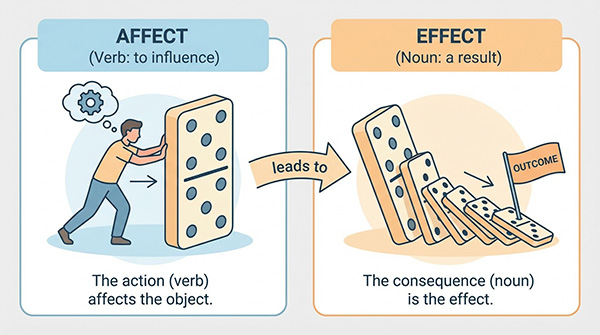
Many learners often ask what is the difference between affect/effect and when to use each word correctly. The main distinction is grammatical: affect is typically a verb, describing an action that influences something, while effect is usually a noun, referring to the result or outcome of that action. Understanding whats the difference between affect and effect becomes much easier with concrete examples.
Consider these difference between affect and effect examples: “The rising temperatures affect crop yields” (verb) versus “The effect of rising temperatures on crops was devastating” (noun). Knowing when to use effect and affect ensures your writing is precise and your meaning is clear. Practicing these examples in everyday writing or speaking will reinforce proper usage and prevent common mistakes.
The words “affect” and “effect” are frequently mixed up because they sound similar and share related meanings. However, they function differently in sentences. Understanding their definitions is the first step to mastering their correct usage.
Affect
Affect is primarily a verb that means to influence or produce a change in something. It describes the action of impacting or altering something. It can also refer to displaying an emotion, though this usage is less common in everyday language. In psychology, “affect” refers to a person’s emotional state or expression.
Effect
Effect is primarily a noun that refers to a result or consequence. It’s what happens as a result of a cause. “Effect” can also be used as a verb, meaning to bring about or accomplish something, but this usage is much less frequent.
Structural Breakdown
Understanding the structural roles of “affect” and “effect” in sentences is essential for using them correctly. The primary distinction lies in their function as a verb versus a noun.
Affect as a Verb
When used as a verb, “affect” typically takes a direct object. The subject of the sentence is the entity that is causing the change or influence, and the direct object is what is being affected. The structure usually follows the pattern: Subject + Verb (affect) + Object.
For example: The weather affects my mood. (The weather is the subject, affects is the verb, and mood is the object.)
Effect as a Noun
When used as a noun, “effect” often follows articles (a, an, the) or possessive pronouns (my, your, his, her, its, our, their). It represents the outcome or consequence. The structure often involves “effect” being the subject or object of a sentence, often following a preposition like “on” or “of.”
For example: The effect of the rain was flooding. (Effect is the subject, rain is the cause, and flooding is the result.)
Effect as a Verb (Rare)
When used as a verb, “effect” means to bring about or accomplish. This usage is less common and often sounds more formal. It also takes a direct object. The structure is Subject + Verb (effect) + Object.
For example: The new manager will effect many changes in the company. (The manager is the subject, effect is the verb, and changes is the object.)
Types and Categories
While “affect” and “effect” primarily function as verb and noun, respectively, they have specific usages in various fields, such as psychology and law. Recognizing these contexts can further clarify their meanings.
Affect in Psychology
In psychology, “affect” refers to the experience of feeling or emotion. It’s a broad term encompassing various emotional states, such as happiness, sadness, anger, and fear. It is often used to describe the outward expression of these emotions, such as facial expressions or tone of voice. For example, a person’s affect might be described as “flat” if they show little or no emotional expression.
Effect in Law
In legal contexts, “effect” often refers to the legal consequences or results of an action or decision. For example, a law might have a specific effect on a particular industry or group of people. The term is often used to describe the impact of legal rulings or regulations.
Examples
To solidify your understanding, let’s explore numerous examples of “affect” and “effect” used in different contexts. These examples will illustrate their diverse applications and help you distinguish between the two.
Affect Examples
The following table provides examples of “affect” used as a verb, demonstrating how it shows influence or change.
Here are some examples of “affect” used in sentences. The table shows the sentence, the part of speech of affect, and a short explanation.
| Sentence | Part of Speech | Explanation |
|---|---|---|
| The lack of sleep affects my ability to concentrate. | Verb | Sleep deprivation influences concentration. |
| Stress can affect your health negatively. | Verb | Stress impacts health adversely. |
| The new policy will affect all employees. | Verb | The policy will influence all employees. |
| How will the rising interest rates affect the housing market? | Verb | Asking about the influence on the housing market. |
| The movie deeply affected her. | Verb | The movie had a significant emotional impact. |
| Pollution can affect the quality of the air and water. | Verb | Pollution influences air and water quality. |
| The economic downturn affected many small businesses. | Verb | The downturn impacted small businesses. |
| His words did not affect her at all. | Verb | His words had no influence on her. |
| The disease affects the nervous system. | Verb | The disease influences the nervous system. |
| Her decision will affect the outcome of the project. | Verb | Her decision will influence the project’s result. |
| The change in leadership affected the company’s morale. | Verb | The leadership change influenced company morale. |
| The weather conditions affect the growth of the crops. | Verb | The weather influences crop growth. |
| The new tax laws will affect businesses of all sizes. | Verb | The tax laws will influence all businesses. |
| The teacher’s feedback affected the student’s motivation. | Verb | The feedback influenced the student’s motivation. |
| The news of the accident affected everyone in the community. | Verb | The news influenced the community. |
| The music affects my mood positively. | Verb | The music influences my mood. |
| The lack of exercise affects my energy levels. | Verb | Lack of exercise influences energy levels. |
| The constant noise affects my concentration. | Verb | Noise influences concentration. |
| The price increase will affect consumers. | Verb | The price increase will influence consumers. |
| His early experiences affected his later life. | Verb | His experiences influenced his life. |
| The medication can affect your vision. | Verb | The medication can influence vision. |
| The news of her promotion affected the team positively. | Verb | The news influenced the team. |
| The company’s reputation was affected by the scandal. | Verb | The scandal influenced the company’s reputation. |
Effect Examples
The following table provides examples of “effect” used as a noun, demonstrating how it indicates a result or consequence.
Here are some examples of “effect” used in sentences. The table shows the sentence, the part of speech of effect, and a short explanation.
| Sentence | Part of Speech | Explanation |
|---|---|---|
| The effect of the medicine was immediate. | Noun | The result of the medicine was quick. |
| What is the effect of climate change on coastal areas? | Noun | Asking about the consequence on coastal areas. |
| The new law had a positive effect on the economy. | Noun | The law’s result was beneficial for the economy. |
| The side effects of the drug are minimal. | Noun | The consequences of the drug are small. |
| The effect of the rain was a beautiful rainbow. | Noun | The result of the rain was a rainbow. |
| The effect of gravity keeps us grounded. | Noun | Gravity’s consequence is keeping us on the ground. |
| The effects of the policy were not what we expected. | Noun | The results of the policy differed from expectations. |
| The long-term effects of smoking are well-documented. | Noun | The consequences of smoking are known. |
| The effect of his speech was electrifying. | Noun | The result of his speech was exciting. |
| She could see the effect of her hard work in the results. | Noun | The result of her work was visible. |
| The effect of the sun on the skin can be damaging. | Noun | The sun’s consequence on the skin can be harmful. |
| The effects of the economic crisis are still being felt. | Noun | The consequences of the crisis are ongoing. |
| The effect of the exercise was improved fitness. | Noun | The result of the exercise was better fitness. |
| The effects of the medication are carefully monitored. | Noun | The consequences of the medication are watched closely. |
| The effect of the new technology is increased efficiency. | Noun | The result of the technology is better efficiency. |
| The effect of the teacher’s guidance was remarkable progress. | Noun | The result of the guidance was progress. |
| The effect of the storm was widespread damage. | Noun | The result of the storm was damage. |
| The effect of the advertisement was increased sales. | Noun | The result of the advertisement was sales. |
| The effect of the training program was skilled employees. | Noun | The result of the training program was skilled employees. |
| The effect of the new diet was weight loss. | Noun | The result of the new diet was weight loss. |
| The effect of the therapy was emotional healing. | Noun | The result of the therapy was healing. |
| The effect of the price cut was more customers. | Noun | The result of the price cut was more customers. |
| The effect of the conservation efforts was a restored habitat. | Noun | The result of the efforts was a habitat. |
Affect as a Verb: Examples
Here are more examples focusing solely on “affect” used as a verb to illustrate its impact and influence in various scenarios. These examples will help you visualize how “affect” functions within a sentence structure.
| Sentence | Explanation |
|---|---|
| The company’s decision to cut costs will affect the quality of its products. | This means the cost-cutting will influence the product quality. |
| The amount of sunlight affects how well plants grow. | Sunlight influences plant growth. |
| The news about the layoffs affected the employees’ morale. | The news had an impact on employee morale. |
| The constant negativity in the office affects my productivity. | Negativity influences productivity. |
| The new regulations will affect the way businesses operate. | Regulations will influence business operations. |
| The speaker’s passionate words affected the audience deeply. | The words had a strong impact on the audience. |
| The rising sea levels will affect coastal communities. | Sea levels will influence coastal communities. |
| The increase in taxes will affect household budgets. | Taxes will influence household budgets. |
| The lack of communication affects team performance. | Lack of communication influences performance. |
| The economic policies will affect job creation. | Policies will influence job creation. |
| The weather conditions will affect travel plans. | Weather will influence travel plans. |
| The quality of education affects future opportunities. | Education influences opportunities. |
| The cultural differences can affect social interactions. | Differences can influence interactions. |
| The new technology will affect the workforce. | Technology will influence the workforce. |
| The media coverage affected public opinion. | Coverage influenced opinion. |
Effect as a Noun: Examples
The following examples demonstrate “effect” as a noun, showing how it represents the outcome or result of an action or event. These examples will help you understand how “effect” completes the description of a consequence.
| Sentence | Explanation |
|---|---|
| One effect of the new policy is increased efficiency. | The policy resulted in better efficiency. |
| The effect of exercise is improved health. | Exercise leads to healthier outcomes. |
| The effects of the medication are still being studied. | Consequences of the medication are under investigation. |
| What is the effect of social media on teenagers? | Asking about the consequences of social media. |
| The effect of her speech was a standing ovation. | Her speech resulted in applause. |
| The effects of pollution can be seen in the air and water. | Consequences of pollution are visible. |
| The effect of the new marketing campaign was increased sales. | The campaign resulted in higher sales. |
| The effects of climate change are becoming more evident. | Consequences of climate change are clear. |
| The effect of the teacher’s encouragement was a motivated student. | Encouragement resulted in a motivated student. |
| The effects of the economic recovery are being felt nationwide. | Consequences of recovery are widespread. |
| The effect of the new law is a decrease in crime rates. | The law resulted in lower crime rates. |
| The effects of the therapy sessions are noticeable improvements. | Consequences of the therapy are improvements. |
| The effect of the company’s innovation is a competitive edge. | Innovation resulted in a competitive advantage. |
| The effects of the new training program are highly skilled workers. | Training resulted in skilled workers. |
| The effect of the community’s efforts is a cleaner environment. | Efforts resulted in a cleaner environment. |
Effect as a Verb: Examples (Rare)
While less common, “effect” can be used as a verb meaning to bring about or accomplish. These examples illustrate this less frequent usage. Note the formal tone often associated with this usage.
| Sentence | Explanation |
|---|---|
| The new manager hopes to effect significant changes in the department. | The manager aims to bring about changes. |
| The government is trying to effect economic reform. | The government is attempting to accomplish reform. |
| The company plans to effect a complete turnaround in its operations. | The company intends to bring about a turnaround. |
| The organization is working to effect positive social change. | The organization is trying to accomplish change. |
| The leader sought to effect unity among the diverse groups. | The leader wanted to bring about unity. |
Usage Rules
To use “affect” and “effect” correctly, you need to understand the general rules governing their usage, as well as some notable exceptions.
General Rules
Rule 1: Use “affect” as a verb to indicate influence or change. Ask yourself, “Am I describing an action that is causing a change?” If yes, “affect” is likely the correct choice.
Rule 2: Use “effect” as a noun to indicate a result or consequence. Ask yourself, “Am I referring to the outcome of something?” If yes, “effect” is likely the correct choice.
Rule 3: Remember that “effect” can also be a verb, but this is less common. In this case, it means to bring about or accomplish.
Exceptions
While the general rules are helpful, there are exceptions to be aware of. One exception is the psychological usage of “affect” as a noun, referring to emotional state. However, this is a specialized context.
Another exception is when “effect” is used as a verb, but as mentioned, this is rare. It’s important to consider the context to determine if this less common usage is appropriate.
Mnemonic Devices
To help remember the difference, consider these mnemonic devices:
- Affect is a Verb (AV) – Both start with the same letters
- Effect is a Noun (EN) – Both start with the same letters
Common Mistakes
One of the biggest challenges in mastering “affect” and “effect” is avoiding common mistakes. Recognizing these errors and understanding why they occur can help you prevent them.
Affect/Effect Confusion
The most common mistake is using “affect” when “effect” is needed, and vice versa. This often happens because the words sound similar and their meanings are related. It’s crucial to pause and consider whether you’re describing an action (affect) or a result (effect).
Incorrect vs. Correct Examples
Let’s look at some examples of incorrect usage and the corresponding corrections:
| Incorrect | Correct | Explanation |
|---|---|---|
| The effect of the loud noise affected my hearing. | The effect of the loud noise affected my hearing. | Both are used correctly in the revised sentence. |
| Stress can effect your health. | Stress can affect your health. | “Affect” is needed as a verb to show influence. |
| The medicine had no affect on his condition. | The medicine had no effect on his condition. | “Effect” is needed as a noun to show result. |
| The weather effected my mood. | The weather affected my mood. | “Affected” is the correct verb form to show influence. |
| What affect will the changes have? | What effect will the changes have? | “Effect” is needed as a noun to ask about the outcome. |
Practice Exercises
To reinforce your understanding, complete the following practice exercises. These exercises will test your ability to distinguish between “affect” and “effect” in various contexts.
Exercise 1: Fill in the Blanks
Fill in the blanks with the correct word: “affect” or “effect.”
| Question | Answer |
|---|---|
| 1. How will the new policy _________ our department? | affect |
| 2. The _________ of the storm was devastating. | effect |
| 3. The medicine did not _________ her condition. | affect |
| 4. What _________ will the new taxes have on small businesses? | effect |
| 5. The news deeply _________ him. | affected |
| 6. The _________ of her speech was inspiring. | effect |
| 7. The cold weather can _________ your mood. | affect |
| 8. The new rules will _________ all students. | affect |
| 9. The _________ of the changes is yet to be seen. | effect |
| 10. His words did not _________ her decision. | affect |
Exercise 2: Multiple Choice
Choose the correct word (“affect” or “effect”) in each sentence.
| Question | Answer |
|---|---|
| 1. The (affect/effect) of the treatment was immediate relief. a) affect b) effect | b) effect |
| 2. How will the new law (affect/effect) the economy? a) affect b) effect | a) affect |
| 3. The (affect/effect) of her words was profound. a) affect b) effect | b) effect |
| 4. The pollution can (affect/effect) the air quality. a) affect b) effect | a) affect |
| 5. What (affect/effect) will the changes have on the company? a) affect b) effect | b) effect |
| 6. The movie (affected/effected) me deeply. a) affected b) effected | a) affected |
| 7. The (affect/effect) of the humidity was unbearable. a) affect b) effect | b) effect |
| 8. The new policy will (affect/effect) all employees. a) affect b) effect | a) affect |
| 9. The (affect/effect) of the medication is drowsiness. a) affect b) effect | b) effect |
| 10. His decision will (affect/effect) the outcome. a) affect b) effect | a) affect |
Exercise 3: Sentence Correction
Correct the sentences that use “affect” and “effect” incorrectly. If the sentence is correct, write “Correct.”
| Question | Answer |
|---|---|
| 1. The affect of the rain was flooding. | The effect of the rain was flooding. |
| 2. Stress can effect your health negatively. | Stress can affect your health negatively. |
| 3. The medicine had a positive effect on his condition. | Correct |
| 4. The new law will affect a change in the economy. | The new law will effect a change in the economy. (less common, but technically correct) or The new law will affect the economy. |
| 5. The movie deeply affected my emotions. | Correct |
| 6. What effect will the decision have on the company? | Correct |
| 7. The weather affects my mood. | Correct |
| 8. The effect of the new policy is increased sales. | Correct |
| 9. Pollution can affect our health. | Correct |
| 10. The affect of her speech was inspiring. | The effect of her speech was inspiring. |
Advanced Topics
For advanced learners, understanding the nuances and context-specific usages of “affect” and “effect” is essential for mastering the subtleties of the English language.
Nuances in Usage
Pay attention to the subtle differences in meaning that can arise depending on the context. For example, while “affect” generally means to influence, it can also imply a more profound or emotional impact. Similarly, “effect” can refer to both immediate and long-term consequences.
Formal vs. Informal Writing
In formal writing, it’s especially important to use “affect” and “effect” correctly, as errors can detract from your credibility. In informal writing, while precision is still important, there may be more leeway for slight deviations, although accuracy is always preferred. The verb form of “effect,” meaning to bring about, is generally more common in formal contexts.
FAQ
Here are some frequently asked questions about “affect” and “effect,” along with detailed answers to clarify any remaining confusion.
Q: How can I quickly remember the difference between “affect” and “effect”?
A: Use the mnemonic devices: AV (Affect is a Verb) and EN (Effect is a Noun). These simple associations can help you recall their primary functions.
Q: Is it ever correct to use “effect” as a verb?
A: Yes, but it’s less common. “Effect” as a verb means to bring about or accomplish something. For example, “The new manager will effect many changes.”
Q: Does “affect” ever function as a noun?
A: Yes, in psychology, “affect” is a noun referring to a person’s emotional state or expression. However, this is a specialized usage.
Q: What’s the best way to practice using “affect” and “effect”?
A: Practice by writing your own sentences, completing exercises, and paying attention to how the words are used in books, articles, and conversations. The more you expose yourself to correct usage, the easier it will become.
Q: What are the most common mistakes people make with these words?
A: The most common mistake is confusing “affect” and “effect” due to their similar spellings and related meanings. Always consider whether you are describing an action causing a change (affect) or a result (effect).
Q: What should I do if I’m still unsure which word to use?
A: If you’re unsure, try rephrasing the sentence. Sometimes, using a different word altogether can help you avoid the “affect” vs. “effect” dilemma. You can also consult a dictionary or grammar guide for clarification.
Q: Are there any other words that are commonly confused with “affect” and “effect”?
A: While “affect” and “effect” are the most commonly confused pair, other words with similar sounds or spellings can also cause confusion. Always double-check your usage to ensure accuracy.
Q: How important is it to use “affect” and “effect” correctly?
A: Using “affect” and “effect” correctly is crucial for clear and effective communication. Incorrect usage can lead to misunderstandings and can detract from your credibility, especially in formal writing.
Conclusion
Mastering the distinction between “affect” and “effect” is essential for precise and effective communication in English. While “affect” primarily functions as a verb indicating influence or change, “effect” is usually a noun representing the result or outcome of an action.
Recognizing their differences, understanding context-specific nuances, and practicing correct usage can prevent common mistakes and enhance both your writing and speaking skills. By applying the rules, examples, and exercises outlined in this guide, you can confidently use “affect” and “effect” in everyday communication, formal writing, and professional contexts, ensuring clarity and accuracy in all your English expressions.