

Understanding the past tense of irregular verbs is crucial for fluency in English. One such verb, “read,” presents a unique challenge because its past tense form is spelled identically to its base form, but pronounced differently.
This article will delve into the intricacies of using “read” correctly in the past tense, covering its definition, structure, usage rules, common mistakes, and providing ample examples and practice exercises. Whether you’re a beginner or an advanced learner, this guide will equip you with the knowledge and skills to confidently use the past tense of “read” in your everyday communication.
This article is designed to provide a comprehensive understanding of the past tense of “read,” addressing common errors and offering practical exercises to reinforce your knowledge. By the end of this guide, you will be able to confidently use “read” in various past tense contexts, enhancing your overall English proficiency.
Table of Contents
- Definition: Understanding the Verb “Read”
- Structural Breakdown: The Verb “Read” Across Tenses
- Types and Categories of Usage
- Examples: “Read” in Action
- Usage Rules: Mastering the Nuances
- Common Mistakes: Avoiding Pitfalls
- Practice Exercises: Test Your Knowledge
- Advanced Topics: Delving Deeper
- FAQ: Frequently Asked Questions
- Conclusion: Key Takeaways
Definition: Understanding the Verb “Read”
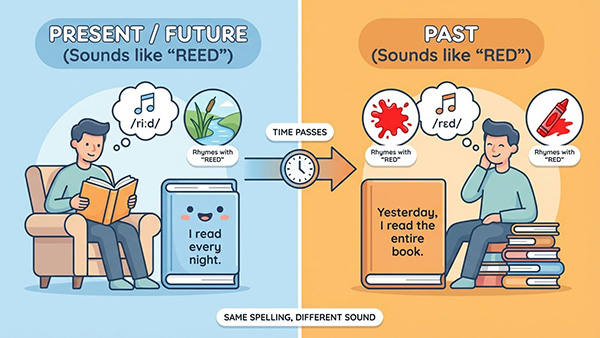
In simple terms, the past tense of read definition refers to the form of “read” that describes an action completed in the past. Despite being spelled identically to the present tense, its pronunciation changes to /rɛd/, distinguishing past actions from present ones.
The verb “read” is a versatile word in the English language, primarily used to describe the act of looking at and understanding written or printed matter. As an irregular verb, it’s past tense and past participle forms share the same spelling as its base form (“read”), but with a different pronunciation.
In the present tense, “read” is pronounced with a long “ee” sound (as in “seed,” transcribed phonetically as /riːd/), while in the past tense and past participle, it’s pronounced with a short “e” sound (as in “red,” transcribed phonetically as /rɛd/).
The primary function of “read” is to convey the action of interpreting written symbols. However, “read” can also extend to understanding non-written information, such as reading a map, reading body language, or reading a situation. The verb can be transitive (taking a direct object, e.g., “I read a book”) or intransitive (not taking a direct object, e.g., “I like to read”).
As one of the key past tense of read irregular verbs, “read” does not follow the standard -ed ending of regular verbs. Its base form remains the same, but the pronunciation shifts.
Understanding the verb read in past simple is crucial because it appears frequently in both spoken and written English, often creating confusion for learners due to its irregularity. Remember: practice reading sentences aloud to internalize the correct /rɛd/ pronunciation, and pair it with contextual time markers like “yesterday” or “last week” to reinforce accuracy.
Structural Breakdown: The Verb “Read” Across Tenses
Understanding how “read” functions across different tenses is essential for accurate usage. Here’s a breakdown of its forms:
Base Form: read (/riːd/) – Used in the present tense (except for the third-person singular), infinitive form, and with auxiliary verbs.
Past Simple: read (/rɛd/) – Used to describe completed actions in the past.
Past Participle: read (/rɛd/) – Used with auxiliary verbs like “have,” “has,” or “had” to form perfect tenses.
Present Participle: reading (/ˈriːdɪŋ/) – Used in continuous tenses, formed by adding “-ing” to the base form.
The table below summarizes the different forms of “read” across tenses:
| Tense | Form | Pronunciation | Example |
|---|---|---|---|
| Present Simple | read | /riːd/ | I read every day. |
| Third-Person Singular Present Simple | reads | /riːdz/ | He reads a lot. |
| Past Simple | read | /rɛd/ | I read that book yesterday. |
| Past Participle | read | /rɛd/ | I have read that book before. |
| Present Participle | reading | /ˈriːdɪŋ/ | I am reading right now. |
Types and Categories of Usage
Simple Past Tense
The simple past tense of “read” is used to describe a completed action in the past. The key characteristic is that the action started and finished at a specific time in the past. It does not continue into the present.
Example: “She read the entire novel last night.”
Past Perfect Tense
The past perfect tense of “read” describes an action completed before another action in the past. It uses the auxiliary verb “had” followed by the past participle “read.” This tense helps to clarify the sequence of events in the past, emphasizing that one action preceded another.
Example: “I had read the instructions before I started the project.”
Past Continuous Tense (Implied)
While “read” doesn’t directly form a past continuous tense in the same way as verbs like “walk” (e.g., “I was walking”), we can imply a continuous action of reading using the present participle “reading” with the auxiliary verb “was” or “were.” This describes an ongoing action in the past.
Example: “I was reading when the phone rang.”
Examples: “Read” in Action
Simple Past Tense Examples
The following table provides several examples of “read” used in the simple past tense, illustrating its usage in different contexts.
| Sentence | Explanation |
|---|---|
| I read the newspaper this morning. | Describes a completed action of reading the newspaper earlier today. |
| She read her favorite poem aloud. | Describes a completed action of reading a poem. |
| They read all the instructions before assembling the furniture. | Indicates that the action of reading the instructions happened before assembling the furniture. |
| He read a bedtime story to his children. | Describes the completed action of reading a story to his children. |
| We read about the historical event in class. | Indicates that the class read about the event at a specific time in the past. |
| The teacher read the students’ essays carefully. | Describes the teacher’s action of carefully reading the essays. |
| My friend read the entire series in one week. | Indicates that the friend completed reading the whole series within a week. |
| The actor read his lines perfectly during the rehearsal. | Describes the actor’s successful reading of his lines. |
| The detective read the clues and solved the mystery. | Indicates that the detective read the clues, leading to solving the mystery. |
| I read a fascinating article about climate change. | Describes the experience of reading an interesting article. |
| She read the letter with great anticipation. | Describes her action of reading the letter with excitement. |
| They read the terms and conditions before signing the contract. | Indicates their careful reading before signing the contract. |
| He read the message and immediately replied. | Describes his action of reading and replying quickly. |
| We read the reviews before deciding to watch the movie. | Indicates that the reviews influenced their decision to watch the movie. |
| The librarian read the title and placed the book on the shelf. | Describes the librarian’s action of reading and shelving the book. |
| The child read the picture book with delight. | Describes the child’s enjoyable experience of reading. |
| The tourist read the map to find the right direction. | Indicates the tourist’s action of using the map to navigate. |
| The musician read the sheet music before playing the song. | Describes the musician’s preparation before playing. |
| The scientist read the data and drew a conclusion. | Indicates the scientist’s analysis leading to a conclusion. |
| I read your proposal and found it very impressive. | Describes my positive impression after reading the proposal. |
| She read the script and decided to accept the role. | Indicates that her reading influenced her decision. |
| They read the instructions carefully to avoid any mistakes. | Describes their cautious approach to following instructions. |
| He read the email and understood the urgency. | Indicates his comprehension after reading the email. |
| We read the report and identified several key issues. | Describes their analysis and findings from the report. |
| The editor read the manuscript and provided feedback. | Indicates the editor’s role in reviewing the manuscript. |
| The student read the textbook and prepared for the exam. | Describes the student’s study preparation. |
| The journalist read the documents and uncovered the truth. | Indicates the journalist’s investigative work. |
| The lawyer read the contract and advised his client. | Describes the lawyer’s role in contract review. |
| I read a biography about Marie Curie. | Describes reading about a notable person. |
Past Perfect Tense Examples
To provide clear illustrations, here are additional past tense of read examples sentences: “I read the newspaper before breakfast,” “She read the chapter twice to understand it fully,” and “They read the instructions carefully before starting the experiment.” These examples demonstrate how the past tense is applied in everyday contexts.
The following table provides several examples of “read” used in the past perfect tense, illustrating its usage in different contexts.
| Sentence | Explanation |
|---|---|
| I had read the book before I saw the movie. | Indicates that the action of reading the book happened before watching the movie. |
| She had already read the email when I told her the news. | Indicates that she was already aware of the email’s content before the news was shared. |
| They had read all the reviews before they decided to buy the product. | Indicates that their decision to buy was influenced by previously reading the reviews. |
| He had read the instructions multiple times before he understood them. | Indicates that understanding the instructions required multiple readings. |
| We had read about the incident before it was reported on the news. | Indicates that we were informed about the incident before the news broadcast. |
| The teacher realized she had read the student’s name incorrectly. | Indicates a prior mistake in reading the name. |
| My friend had read the entire series before I even started the first book. | Highlights the difference in how far each person had progressed in the series. |
| The actor had read the script so many times that he knew it by heart. | Indicates a deep familiarity with the script due to repeated readings. |
| The detective had read the file before interviewing the suspect. | Indicates that the detective was prepared before the interview. |
| I had read a similar article last year, so I wasn’t surprised. | Indicates prior knowledge of the topic. |
| She had read the novel in French before translating it into English. | Indicates that she read the novel in French first and then translated it. |
| They had read the warnings, but they still proceeded with the experiment. | Indicates that they were aware of the risks but chose to ignore them. |
| He had read the contract thoroughly before signing it. | Indicates that he carefully reviewed the contract before signing. |
| We had read the research papers before conducting our own study. | Indicates that they based their study on previous research. |
| The librarian discovered that someone had read the rare book without gloves. | Indicates that someone read the book improperly. |
| The child admitted that he had read the comic book under the covers. | Indicates that the child read the comic book secretly. |
| The tourist realized he had read the map upside down. | Indicates that the tourist made a mistake in reading the map. |
| The musician had read the composer’s notes before performing the piece. | Indicates that the musician studied the notes before playing. |
| The scientist explained that she had read the results in the wrong column. | Indicates that she made a mistake in interpreting the results. |
| I had read your review and was excited to try the restaurant. | Indicates that my decision to try the restaurant was based on your review. |
| She had read the interview and felt inspired by the entrepreneur’s story. | Indicates that she was motivated by the interview. |
| They had read the safety guidelines before operating the machinery. | Indicates that they followed the safety protocols. |
| He had read the weather forecast and decided to bring an umbrella. | Indicates that his decision was based on the forecast. |
| We had read the comments and addressed the concerns in our presentation. | Indicates that they took the comments into account. |
| The editor confirmed that she had read the final draft and approved it. | Indicates that the draft was reviewed and approved. |
| The student confessed that he had read the summary instead of the entire book. | Indicates that he took a shortcut in his reading. |
| The journalist discovered that someone had read her article before it was published. | Indicates a breach of confidentiality. |
| The lawyer confirmed that he had read the amended document. | Indicates that he reviewed the updated document. |
| I had read several articles about that topic last year. | Indicates that I have some knowledge on the topic. |
Past Continuous Tense Examples (Implied)
The following table provides examples of the past continuous tense using “reading” to describe an ongoing action in the past.
| Sentence | Explanation |
|---|---|
| I was reading when the phone rang. | Describes an ongoing action of reading that was interrupted by the phone ringing. |
| She was reading a book while waiting for her train. | Describes an ongoing action of reading while waiting. |
| They were reading the instructions as they assembled the model. | Describes them reading the instructions while putting the model together. |
| He was reading quietly in the library when I saw him. | Describes his action of reading quietly in the library. |
| We were reading aloud in class when the principal walked in. | Describes the activity of reading aloud that was interrupted. |
| The children were reading their books under the tree. | Describes where the children were reading. |
| My friend was reading a mystery novel all afternoon. | Describes how my friend spent the afternoon. |
| The actor was reading his lines backstage before the show. | Describes the actor’s preparation. |
| The detective was reading the suspect’s statement carefully. | Describes the detective’s analysis. |
| I was reading the news when I heard about the accident. | Describes reading the news when I heard about the incident. |
| She was reading a magazine while getting her hair done. | Describes her action while getting her hair done. |
| They were reading the signs to find their way around the city. | Describes their navigation efforts. |
| He was reading the menu to decide what to order. | Describes his decision-making process. |
| We were reading the subtitles to understand the film. | Describes our effort to understand the film. |
| The librarian was reading a book during her lunch break. | Describes the librarian’s activity. |
| The child was reading a comic book in his room. | Describes the child’s activity in his room. |
| The tourist was reading the guidebook to learn about the attractions. | Describes the tourist’s learning process. |
| The musician was reading the music score intently. | Describes the musician’s focus. |
| The scientist was reading the lab report to analyze the data. | Describes the scientist’s research. |
| I was reading your blog post when I found the error. | Describes reading your blog when I found the error. |
| She was reading the invitation when she realized the mistake. | Describes her realization while reading the invitation. |
| They were reading the labels carefully to avoid allergens. | Describes their careful attention to the labels. |
| He was reading the fine print to understand the terms. | Describes his effort to understand the terms. |
| We were reading the agenda to prepare for the meeting. | Describes our preparation for the meeting. |
| The editor was reading the article to correct any mistakes. | Describes the editor’s work. |
| The student was reading the assignment to understand the requirements. | Describes the student’s understanding process. |
| The journalist was reading the documents to uncover the facts. | Describes the journalist’s investigation. |
| The lawyer was reading the case files to prepare for the trial. | Describes the lawyer’s preparation. |
| I was reading a fascinating book about ancient civilizations. | Describes reading about ancient civilizations. |
Examples in Reading Comprehension Contexts
Reading comprehension passages often utilize the past tense of “read” to recount events or analyze texts. Here are some examples:
“After she read the poem, she understood the deeper meaning behind the words.”
“The students read the passage and then answered the questions about the main idea.”
“He read the author’s biography to gain insight into the context of the novel.”
Examples in Literary Contexts
Literature frequently employs the past tense of “read” to narrate stories and describe characters’ experiences with reading. Here are some examples:
“She read his letter with tears in her eyes, her heart aching with longing.”
“He read the ancient inscription aloud, his voice echoing in the silent chamber.”
“They read by the flickering candlelight, their faces illuminated by the words on the page.”
Usage Rules: Mastering the Nuances
Pronunciation Rule: Present vs. Past
A common point of confusion is the past tense of read spelling, which remains identical to the present tense. While the letters do not change, always remember the pronunciation difference: /riːd/ for present and /rɛd/ for past. Correct spelling with the proper pronunciation ensures clarity in both written and spoken English.
The most important rule to remember is the pronunciation difference. In the present tense, “read” is pronounced /riːd/, while in the past tense and past participle, it’s pronounced /rɛd/. This distinction is crucial for clear communication.
Context Clues: Identifying the Correct Tense
Pay attention to context clues to determine whether “read” is in the present or past tense. Time adverbs (e.g., “yesterday,” “last week”) and other past tense verbs in the sentence can indicate that “read” is also in the past tense.
For example: “Yesterday, I read a great book.” The adverb “yesterday” clearly indicates the past tense.
Auxiliary Verbs: Using “Had” with Past Perfect
When using the past perfect tense, always use the auxiliary verb “had” before “read.” This indicates that the action of reading was completed before another action in the past.
For example: “I had read the report before the meeting started.”
Common Mistakes: Avoiding Pitfalls
One of the most common mistakes is mispronouncing the past tense of “read” as /riːd/ instead of /rɛd/. Another mistake is using the present tense form when the past tense is required.
Incorrect: I read (pronounced /riːd/) the book yesterday.
Correct: I read (pronounced /rɛd/) the book yesterday.
Incorrect: He read (present tense usage) the letter last week.
Correct: He read (past tense usage) the letter last week.
Practice Exercises: Test Your Knowledge
For extra practice, you can try a past tense of read exercise: fill in the blanks with the correct form of “read”: “Yesterday, I ______ a fascinating article about space travel.” This hands-on exercise reinforces correct usage and pronunciation.
Exercise 1: Fill in the Blanks
Fill in the blanks with the correct past tense form of “read.”
| Question | Answer |
|---|---|
| Yesterday, I ______ an interesting article about space exploration. | read |
| She ______ the entire series of Harry Potter books last summer. | read |
| They ______ the instructions carefully before assembling the furniture. | read |
| He ______ a bedtime story to his children every night. | read |
| We ______ about the historical event in class last week. | read |
| I had ______ the book before I watched the movie. | read |
| She had already ______ the email when I told her the news. | read |
| They had ______ all the reviews before they decided to buy the product. | read |
| He had ______ the instructions multiple times before he understood them. | read |
| We had ______ about the incident before it was reported on the news. | read |
Exercise 2: Sentence Transformation
Transform the following sentences into the past perfect tense.
| Question | Answer |
|---|---|
| I read the book before I saw the movie. | I had read the book before I saw the movie. |
| She already read the email when I told her the news. | She had already read the email when I told her the news. |
| They read all the reviews before they decided to buy the product. | They had read all the reviews before they decided to buy the product. |
| He read the instructions multiple times before he understood them. | He had read the instructions multiple times before he understood them. |
| We read about the incident before it was reported on the news. | We had read about the incident before it was reported on the news. |
| She finished the novel before the book club meeting. | She had read the novel before the book club meeting. |
| The students reviewed the material before the test. | The students had read the material before the test. |
| The journalist researched extensively before writing the article. | The journalist had read extensively before writing the article. |
| The audience studied the program before the concert began. | The audience had read the program before the concert began. |
| The team analyzed the data before making their presentation. | The team had read all the data before making their presentation. |
Exercise 3: Error Correction
Identify and correct the errors in the following sentences.
| Question | Answer |
|---|---|
| I read (pronounced /riːd/) the book last night. | I read (pronounced /rɛd/) the book last night. |
| She read (present tense usage) the letter yesterday. | She read (past tense usage) the letter yesterday. |
| They have read (pronounced /riːd/) the instructions. | They have read (pronounced /rɛd/) the instructions. |
| He had read (pronounced /riːd/) the message before I arrived. | He had read (pronounced /rɛd/) the message before I arrived. |
| We read (present tense usage) the report last week. | We read (past tense usage) the report last week. |
| I have read write book before. | I have read that book before. |
| She has read letter from her friend. | She has read a letter from her friend. |
| They has read document carefully. | They have read the document carefully. |
| He had readed all books on shelf. | He had read all the books on the shelf. |
| We readed news this morning. | We read the news this morning. |
Advanced Topics: Delving Deeper
Subjunctive Mood (Rare)
While rare, “read” can appear in the subjunctive mood, typically in formal or literary contexts, expressing a wish, possibility, or hypothetical situation. This usage is becoming less common in modern English.
Example: “It is essential that he read the contract carefully before signing.”
Idiomatic Expressions with “Read”
“Read” appears in several idiomatic expressions. Understanding these idioms can enhance your comprehension and fluency.
Read between the lines: To understand something that is not explicitly stated.
Read someone like a book: To understand someone’s thoughts and feelings easily.
Read up on something: To research or study something in detail.
FAQ: Frequently Asked Questions
Q1: How do I pronounce “read” in the past tense?
A1: In the past tense, “read” is pronounced with a short “e” sound, similar to the word “red” (/rɛd/).
Q2: How can I tell if “read” is in the present or past tense?
A2: Look for context clues such as time adverbs (e.g., “yesterday,” “last week”) or other verbs in the sentence that are in the past tense. Consider the overall meaning of the sentence to determine if the action of reading occurred in the past or is happening currently.
Q3: What is the past participle of “read”?
A3: The past participle of “read” is also “read,” pronounced /rɛd/.
Q4: How do I use “read” in the past perfect tense?
A4: Use the auxiliary verb “had” followed by the past participle “read.” For example: “I had read the book before I saw the movie.”
Q5: Can “read” be used in continuous tenses?
A5: Yes, “read” can be used in continuous tenses using the present participle “reading.” For example: “I was reading when the phone rang.”
Q6: Is “read” a regular or irregular verb?
A6: “Read” is an irregular verb because its past tense and past participle forms do not follow the standard “-ed” ending. Instead, it maintains the same spelling as the base form but changes pronunciation.
Q7: What are some common mistakes to avoid when using the past tense of “read”?
A7: Common mistakes include mispronouncing the past tense form as /riːd/ instead of /rɛd/ and using the present tense form when the past tense is required. Always pay attention to context and pronunciation.
Q8: How can I improve my understanding of irregular verbs like “read”?
A8: Practice is key. Read extensively, pay attention to how “read” is used in different contexts, and complete exercises that focus on irregular verb forms. Flashcards and online resources can also be helpful.
Conclusion: Key Takeaways
Mastering the past tense of “read” involves understanding its unique pronunciation shift and recognizing contextual cues. Remember that both the past tense and past participle of “read” are spelled the same as the base form but pronounced differently (/rɛd/). By paying attention to sentence structure, auxiliary verbs, and time adverbs, you can confidently use “read” in various past tense contexts.
Consistent practice and exposure to different examples will solidify your understanding. Be mindful of common mistakes and actively work to correct them. With dedication and attention to detail, you can master this tricky verb and enhance your overall English proficiency. Keep practicing, and you’ll soon be reading, writing, and speaking with greater accuracy and confidence.