
Understanding the nuances between sympathy and empathy is crucial for effective communication and building meaningful relationships. These two terms, often used interchangeably, represent distinct emotional responses with significant implications for how we interact with others.
This article will delve into the definitions, structures, and practical applications of both sympathy and empathy, clarifying their differences and highlighting their importance in personal and professional contexts. Whether you’re an English language learner, a student of psychology, or simply someone seeking to improve your interpersonal skills, this guide will provide you with the knowledge and tools to master these vital concepts.
This article will be beneficial to learners of all levels, from beginners to advanced English speakers, as well as professionals in fields such as healthcare, social work, and education, where understanding and responding to the emotions of others is paramount. By exploring the core differences and providing practical examples, this guide will equip you with a deeper understanding of human emotions and improve your ability to connect with others on a more profound level.
Off to College Deals

Save up to 30% on everything you need for the semester.
Contains affiliate link
Table of Contents
- Definitions of Sympathy and Empathy
- Structural Breakdown
- Types and Categories
- Examples of Sympathy and Empathy
- Usage Rules
- Common Mistakes
- Practice Exercises
- Advanced Topics
- Frequently Asked Questions (FAQ)
- Conclusion
When exploring what is the difference between sympathy and empathy, it’s important to recognize the emotional distance involved. A clear sympathy vs empathy definition shows that sympathy allows us to acknowledge another person’s feelings from afar, whereas empathy encourages us to immerse ourselves in their emotional experience.
Asking what is sympathy vs empathy can help learners, professionals, and caregivers understand when to respond with compassion or deeper connection. Similarly, understanding what’s the difference between empathy and sympathy ensures that our reactions are appropriate, whether offering support, guidance, or emotional understanding.
Definitions of Sympathy and Empathy
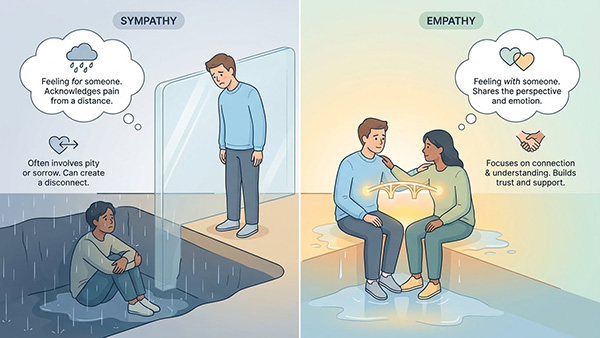
Sympathy is generally defined as feeling pity or sorrow for someone else’s misfortune. It involves understanding that someone is suffering and feeling compassion for them. However, sympathy often maintains a distance between the person feeling sympathetic and the person experiencing the pain. Think of it as acknowledging someone’s pain from an external perspective.
Empathy, on the other hand, goes beyond feeling sorry for someone. It involves understanding and sharing the feelings of another person. Empathy requires you to put yourself in someone else’s shoes and experience their emotions as if they were your own. It’s about truly connecting with their feelings and understanding their perspective from within.
Young Adults & Students:
Get 6 Months of Prime for $0

Ages 18-24 unlock exclusive perks including:
Contains affiliate link
In essence, sympathy is feeling *for* someone, while empathy is feeling *with* someone. This distinction is crucial for understanding the different ways we can respond to the emotions of others.
“A difference between sympathy and empathy brief is that sympathy involves acknowledging someone’s pain from an outside perspective, whereas empathy requires stepping into their shoes and sharing their emotional experience. This quick distinction is helpful for learners who need a concise reference.”
Structural Breakdown
The words “sympathy” and “empathy” are both nouns derived from Greek roots. “Sympathy” comes from “sympatheia,” meaning “feeling with,” but in the sense of agreement or shared disposition. “Empathy” comes from “empathia,” meaning “in-feeling” or “feeling into.”
Structurally, both words consist of a prefix and a root. The prefix “sym-” means “together” or “with,” while “pathos” (the root) refers to feeling or suffering. In “empathy,” the prefix “em-” (or “en-“) means “in” or “into,” indicating a deeper level of emotional involvement.
Understanding these structural components can help clarify the subtle differences in meaning. Sympathy involves a shared feeling or agreement, while empathy involves immersing oneself in another’s feelings. The difference between the prefixes encapsulates the core distinction between the two concepts.
Types and Categories
Empathy, in particular, is often categorized into different types to further refine our understanding of the concept. These categories help us to distinguish between different ways of experiencing and responding to the emotions of others.
Cognitive Empathy
Cognitive empathy, also known as perspective-taking, involves understanding another person’s thoughts and beliefs. It’s about being able to intellectually grasp their point of view without necessarily feeling their emotions. This type of empathy is crucial for effective communication and negotiation, as it allows you to anticipate how someone else might react to a situation.
For example, a salesperson using cognitive empathy might try to understand a customer’s needs and concerns by considering their background and motivations. This allows the salesperson to tailor their pitch and address any potential objections.
Emotional Empathy
Emotional empathy, also known as affective empathy, involves feeling what another person is feeling. It’s about experiencing their emotions as if they were your own. This type of empathy is often triggered by observing someone else’s emotional state, and it can lead to a strong sense of connection and understanding. Emotional empathy is critical for building close relationships and providing emotional support.
For example, if you see a friend crying, emotional empathy might cause you to feel a sense of sadness or grief as well. This shared emotional experience can strengthen your bond and allow you to offer comfort and support.
Compassionate Empathy
Compassionate empathy goes beyond simply understanding and feeling another person’s emotions. It involves taking action to help alleviate their suffering. This type of empathy combines cognitive and emotional empathy with a desire to improve the other person’s situation. Compassionate empathy is essential for prosocial behavior and making a positive impact on the world.
For example, a doctor exhibiting compassionate empathy might not only understand and feel a patient’s pain but also take steps to provide the best possible treatment and care. This might involve spending extra time listening to the patient’s concerns, explaining the treatment options in detail, and offering emotional support.
Examples of Sympathy and Empathy
To further illustrate the differences between sympathy and empathy, let’s examine some specific examples in various contexts. These examples will highlight how each concept is expressed and how it impacts the interaction between individuals.
The following table showcases examples of sympathetic responses in different scenarios. Notice how the responses acknowledge the other person’s suffering but maintain a degree of emotional distance.
“Here are additional sympathy vs empathy examples to illustrate the distinction: if a friend loses a pet, expressing, ‘I’m sorry for your loss’ is sympathy, while saying, ‘I understand how heartbreaking this must be for you’ reflects empathy. Recognizing these nuances in everyday interactions makes it easier to choose the right response and strengthens emotional connections.”
| Scenario | Sympathetic Response |
|---|---|
| A friend loses their job. | “Oh, I’m so sorry to hear that. That must be tough.” |
| A colleague is struggling with a difficult project. | “That sounds really challenging. I hope things get better soon.” |
| A family member is dealing with a serious illness. | “I’m really sorry you’re going through this. Let me know if there’s anything I can do.” |
| Someone is grieving the loss of a loved one. | “I’m so sorry for your loss. My thoughts are with you.” |
| A student fails an important exam. | “That’s too bad. I’m sure you’ll do better next time.” |
| A neighbor’s house is damaged in a fire. | “Oh no, that’s terrible! I hope they have insurance.” |
| A teammate is injured during a game. | “That’s awful! I hope it’s not too serious.” |
| A friend is going through a breakup. | “I’m really sorry you’re hurting. It’ll get easier with time.” |
| A coworker’s pet dies. | “I’m so sorry to hear about your pet. That’s always hard.” |
| A classmate is feeling overwhelmed with schoolwork. | “That sounds stressful. Just hang in there; the semester will be over soon.” |
| A relative is having financial difficulties. | “I’m sorry to hear you’re struggling financially. I hope you find a solution soon.” |
| A stranger is lost in a new city. | “Oh, you poor thing! Let me help you find your way.” |
| A child is upset about a scraped knee. | “Oh, honey, I’m so sorry! Let’s put a bandage on it.” |
| A writer is experiencing writer’s block. | “That must be frustrating. I hope you get your inspiration back soon.” |
| A musician is struggling to compose a new piece. | “That’s tough. Don’t worry, the creativity will come back.” |
| An artist is unhappy with their latest painting. | “I’m sorry you’re not happy with it. Maybe you can try again.” |
| A chef accidentally burns a dish. | “Oh no! That’s a shame. Hopefully, the next one will be better.” |
| A dancer injures themselves during a performance. | “That’s terrible! I hope it’s a minor injury.” |
| An actor forgets their lines on stage. | “That’s embarrassing! But don’t worry, it happens to everyone.” |
| A software developer encounters a bug in their code. | “That’s annoying! I hope you can fix it quickly.” |
| A teacher is having trouble managing their class. | “That sounds difficult. I hope you find a good strategy.” |
| A nurse is dealing with a demanding patient. | “That must be stressful. Remember to take care of yourself!” |
| A police officer is facing a dangerous situation. | “That’s scary! Stay safe out there.” |
| A firefighter is battling a large fire. | “That’s intense! I hope everyone is alright.” |
In contrast, the following table illustrates examples of empathetic responses in the same scenarios. Notice how the responses demonstrate a deeper understanding and sharing of the other person’s feelings.
| Scenario | Empathetic Response |
|---|---|
| A friend loses their job. | “I can only imagine how stressful that must be. Losing your job is a huge blow. How are you feeling?” |
| A colleague is struggling with a difficult project. | “I understand how frustrating it is when a project just isn’t coming together. I’ve been there before. What part are you finding most challenging?” |
| A family member is dealing with a serious illness. | “I can’t pretend to know exactly what you’re going through, but I’m here to listen and support you in any way I can. What’s been the hardest part of this?” |
| Someone is grieving the loss of a loved one. | “I know words can’t take away the pain, but I’m here for you. I remember when I lost my [relationship to deceased], and it felt like [feeling]. Is there anything you want to talk about?” |
| A student fails an important exam. | “I know how much you studied for that exam, and I can imagine how disappointed you must feel. What do you think went wrong?” |
| A neighbor’s house is damaged in a fire. | “Oh my goodness, that’s devastating! I can’t imagine how they must feel right now. Are they safe? What can we do to help them?” |
| A teammate is injured during a game. | “That looked really painful! I know how much you wanted to play. How are you feeling? Do you need anything?” |
| A friend is going through a breakup. | “Breakups are so tough. I remember when I went through one, and it felt like my world was ending. How are you coping?” |
| A coworker’s pet dies. | “I know how much you loved your pet. Losing a furry friend is like losing a family member. I’m so sorry for your pain.” |
| A classmate is feeling overwhelmed with schoolwork. | “I totally get how you feel. It’s easy to get buried under all the assignments. What’s making you feel most overwhelmed?” |
| A relative is having financial difficulties. | “I know how stressful it is to worry about money. It’s a heavy burden to carry. How are you managing?” |
| A stranger is lost in a new city. | “Oh, I know how disorienting it can feel to be lost in a new place. Don’t worry, I’m happy to help. Where are you trying to go?” |
| A child is upset about a scraped knee. | “Oh, sweetie, that looks like it hurts! I remember when I scraped my knee as a kid, and it stung so much. Let’s clean it up and put a bandage on it.” |
| A writer is experiencing writer’s block. | “Writer’s block is the worst! I know how frustrating it is when the words just won’t come. What have you tried so far?” |
| A musician is struggling to compose a new piece. | “I understand how disheartening it is when the music just isn’t flowing. I’ve been there before. What’s been the biggest challenge?” |
| An artist is unhappy with their latest painting. | “I know how frustrating it is when a piece doesn’t turn out the way you envisioned. What are you most unhappy with?” |
| A chef accidentally burns a dish. | “Oh no! I know how disappointing it is when you put so much effort into something and it goes wrong. What happened?” |
| A dancer injures themselves during a performance. | “That looked really painful! I can only imagine how upsetting it must be to get injured during a performance. How are you feeling?” |
| An actor forgets their lines on stage. | “That’s such a vulnerable feeling! I can imagine how mortified you must have felt. Don’t worry, it happens to the best of us.” |
| A software developer encounters a bug in their code. | “Bugs are the bane of our existence! I know how frustrating it is to spend hours debugging. What have you tried so far?” |
| A teacher is having trouble managing their class. | “I can only imagine how draining it is to deal with a difficult class. What strategies have you tried?” |
| A nurse is dealing with a demanding patient. | “That must be incredibly stressful. It’s hard to stay patient when someone is being difficult. How are you holding up?” |
| A police officer is facing a dangerous situation. | “That sounds incredibly nerve-wracking. I can’t imagine the pressure you must be under. Please be careful.” |
| A firefighter is battling a large fire. | “That’s so intense! I can’t imagine the heat and the danger you’re facing. Please stay safe and take care of your team.” |
This final table highlights the key differences between sympathy and empathy in action.
| Feature | Sympathy | Empathy |
|---|---|---|
| Focus | Feeling sorry for someone | Feeling with someone |
| Perspective | External; observing from a distance | Internal; stepping into their shoes |
| Emotional Involvement | Limited; acknowledging the pain | Deep; sharing the feelings |
| Response | Offering condolences or pity | Offering understanding and support |
| Connection | Less connected; maintaining a boundary | More connected; building a bond |
| Example Phrase | “I’m sorry that happened to you.” | “I can understand how you’re feeling.” |
| Action | May offer help, but not necessarily | More likely to take action to help |
| Impact | Can provide comfort but may feel distant | Can foster deeper connection and understanding |
| Level of Understanding | General understanding of the situation | Deeper understanding of the emotions involved |
| Emotional Contagion | Less likely to experience the other person’s emotions | More likely to feel the other person’s emotions |
| Personal Experience | Not necessarily based on personal experience | Often based on similar personal experiences |
| Motivation | Driven by compassion and a desire to alleviate suffering | Driven by a desire to connect and understand |
| Communication Style | More formal and reserved | More informal and open |
| Relationship Building | Can maintain relationships, but may not deepen them | Can strengthen and deepen relationships |
| Problem Solving | Offers general advice or solutions | Collaborates to find solutions that address emotional needs |
| Self-Awareness | Less emphasis on self-awareness | Requires a high degree of self-awareness |
| Emotional Regulation | Less need for emotional regulation | Requires strong emotional regulation skills |
| Burnout Risk | Lower risk of burnout | Higher risk of burnout if not managed properly |
| Professional Application | Useful in situations requiring detached compassion | Essential in fields requiring deep emotional connection |
| Personal Growth | Can promote feelings of goodwill and kindness | Can lead to greater self-understanding and personal growth |
Usage Rules
While there aren’t strict grammatical rules governing the use of “sympathy” and “empathy,” understanding their connotations is crucial for effective communication. Using one term when the other is more appropriate can lead to misunderstandings and strained relationships.
Generally, use “sympathy” when you want to express sorrow or pity for someone’s misfortune without necessarily sharing their feelings. Use “empathy” when you want to convey that you understand and share their emotions.
For example, you might say, “I have sympathy for those affected by the hurricane,” to express your sorrow for their suffering. However, you might say, “I feel empathy for single parents trying to balance work and family,” if you have personally experienced the challenges of being a single parent.
It’s also important to be mindful of cultural differences in the expression of sympathy and empathy. In some cultures, direct expressions of emotion may be discouraged, while in others, they are highly valued.
Common Mistakes
One common mistake is using “sympathy” and “empathy” interchangeably, assuming they mean the same thing. This can lead to miscommunication and a lack of genuine connection with others.
Another mistake is expressing sympathy when empathy is more appropriate. For example, saying “I feel sorry for you” to someone who is grieving can sound condescending and dismissive. A more empathetic response would be, “I can’t imagine how painful this must be. I’m here to listen if you need to talk.”
Finally, some people struggle to differentiate between empathy and simply agreeing with someone. Empathy is about understanding their feelings, even if you don’t agree with their perspective. It’s about recognizing the validity of their emotions, regardless of your own opinions.
Here are some examples of common mistakes and their corrections:
| Incorrect | Correct | Explanation |
|---|---|---|
| “I empathize with you losing your job. It’s probably for the best.” | “I sympathize with you losing your job. That must be incredibly stressful.” | Losing a job is a misfortune, warranting sympathy. The original statement also minimizes the person’s feelings. |
| “I feel sympathy for you being so happy about your promotion.” | “I feel empathy for you being so happy about your promotion. I know how hard you’ve worked for this.” | Happiness is a positive emotion, making empathy more appropriate. |
| “I sympathize with your excitement about the trip. You’ll probably be disappointed.” | “I empathize with your excitement about the trip. I hope you have a wonderful time!” | Excitement is a positive emotion, and the original statement is unnecessarily negative. |
| “I have empathy for those poor people who lost the lottery.” | “I have sympathy for those poor people who lost the lottery.” | Losing the lottery is a misfortune, though minor. Sympathy is more appropriate. |
| “I sympathize with your frustration about the traffic. It’s not a big deal.” | “I empathize with your frustration about the traffic. It’s so annoying when you’re running late.” | Frustration is a valid emotion, and empathy acknowledges the person’s feelings. |
Practice Exercises
Test your understanding of sympathy and empathy with the following exercises. For each scenario, identify whether a sympathetic or empathetic response is more appropriate, and then provide an example of each type of response.
Exercise 1: Identify the Appropriate Response
| Scenario | Sympathy or Empathy? | Sympathetic Response | Empathetic Response |
|---|---|---|---|
| A friend is feeling anxious about an upcoming presentation. | |||
| A neighbor’s garden is destroyed by a storm. | |||
| A colleague is celebrating a major accomplishment. | |||
| A family member is struggling with a difficult decision. | |||
| A child is disappointed after losing a game. | |||
| A teacher is feeling burnt out at the end of the school year. | |||
| A doctor is dealing with a patient who has a terminal illness. | |||
| A lawyer is feeling stressed about a difficult case. | |||
| An athlete is disappointed after losing a competition. | |||
| A musician is feeling discouraged after a bad performance. |
Exercise 2: Choose the Best Response
For each scenario, choose the response that demonstrates empathy:
- A friend tells you they are feeling overwhelmed with their responsibilities.
- a) “I’m sorry to hear that. Everyone feels overwhelmed sometimes.”
- b) “I understand how you feel. It sounds like you have a lot on your plate. What’s been the most challenging part?”
- A colleague shares that they are struggling with a personal issue.
- a) “I sympathize with your situation. Hopefully, things will get better soon.”
- b) “I can only imagine how difficult that must be. I’m here if you need someone to talk to.”
- A family member expresses their disappointment about a missed opportunity.
- a) “That’s too bad. There will be other opportunities.”
- b) “I know how much you wanted that opportunity. I can understand why you’re feeling disappointed.”
- A neighbor complains about their noisy neighbors.
- a) “I feel sorry for you. Noisy neighbors are the worst.”
- b) “That sounds really frustrating. I can understand why you’re annoyed.”
- A classmate confides that they are feeling insecure about their abilities.
- a) “I sympathize with you. Everyone has insecurities.”
- b) “I understand how you feel. It’s normal to doubt yourself sometimes. What’s making you feel insecure?”
- A coworker is feeling stressed about an upcoming deadline.
- a) “I sympathize with your stress. Deadlines are always tough.”
- b) “I get how you feel. It’s stressful when you’re under pressure. What can I do to help?”
- A friend is feeling lonely after moving to a new city.
- a) “I feel sorry for you. It’s hard to make friends.”
- b) “I can imagine how lonely you must feel. Moving to a new city is a big change. What have you tried to meet people?”
- A family member is feeling anxious about a medical procedure.
- a) “I sympathize with your anxiety. Medical procedures can be scary.”
- b) “I understand how you feel. It’s natural to be anxious before a medical procedure. What are you most worried about?”
- A neighbor is sad because their pet passed away.
- a) “I sympathize with your sadness. Losing a pet is always hard.”
- b) “I know how much you loved your pet. Losing a furry friend is like losing a family member. I’m so sorry for your pain.”
- A classmate is frustrated because they are struggling with a difficult assignment.
- a) “I sympathize with your frustration. Assignments can be tough.”
- b) “I get how you feel. It’s frustrating when you’re struggling with an assignment. What part are you finding most difficult?”
Answer Key:
Exercise 1:
| Scenario | Sympathy or Empathy? | Sympathetic Response | Empathetic Response |
|---|---|---|---|
| A friend is feeling anxious about an upcoming presentation. | Empathy | “I’m sorry you’re feeling anxious.” | “I understand how you feel. Presentations can be nerve-wracking. What are you most worried about?” |
| A neighbor’s garden is destroyed by a storm. | Sympathy | “Oh no, that’s terrible! I’m so sorry about your garden.” | “Oh my goodness, that’s devastating! I can’t imagine how you feel after putting so much work into your garden.” |
| A colleague is celebrating a major accomplishment. | Empathy | “Congratulations! I’m happy for you.” | “I’m so thrilled for you! I know how hard you’ve worked for this. You deserve it!” |
| A family member is struggling with a difficult decision. | Empathy | “I’m sorry you’re going through this. It sounds tough.” | “I know how hard it is to make difficult decisions. I’m here to listen if you want to talk it through.” |
| A child is disappointed after losing a game. | Empathy | “That’s too bad. You’ll win next time.” | “I know how much you wanted to win. It’s disappointing to lose. But you played really well!” |
| A teacher is feeling burnt out at the end of the school year. | Empathy | “I sympathize with your burnout. The end of the year is always tough.” | “I understand how you feel. Teaching is exhausting, especially at the end of the year. Make sure you take care of yourself.” |
| A doctor is dealing with a patient who has a terminal illness. | Both, but empathy is crucial | “I’m so sorry you’re going through this. Let me know if you need anything.” | “I can’t pretend to know what you’re feeling, but I’m here to support you in any way I can. What can I do to make things easier?” |
| A lawyer is feeling stressed about a difficult case. | Empathy | “I sympathize with your stress. Cases can be tough.” | “I understand how stressful it is to work on a difficult case. It’s a lot of pressure. What’s been the most challenging part?” |
| An athlete is disappointed after losing a competition. | Empathy | “That’s too bad. There will be other competitions.” | “I know how much you wanted to win. It’s disappointing to lose, especially after all the training. But you gave it your all!” |
| A musician is feeling discouraged after a bad performance. | Empathy | “I sympathize with your discouragement. Performances can be tough.” | “I understand how you feel. It’s discouraging when a performance doesn’t go well. What do you think went wrong?” |
Exercise 2:
- b
- b
- b
- b
- b
- b
- b
- b
- b
- b
Advanced Topics
For advanced learners, it’s important to understand the potential pitfalls of empathy. While empathy is generally considered a positive trait, it can also lead to emotional exhaustion and burnout, especially in professions that require a high degree of emotional involvement. It’s crucial to practice self-care and develop healthy boundaries to avoid becoming overwhelmed by the emotions of others.
Another advanced topic is the concept of “dark empathy,” which refers to using empathy for manipulative or harmful purposes. Individuals with dark empathy can understand and exploit the emotions of others to achieve their own goals, often without regard for the well-being of their victims.
Finally, it’s important to recognize that empathy is not always appropriate or necessary. In some situations, a more detached and objective approach may be required, especially when making difficult decisions that affect a large number of people. A leader making decisions for a large group may need to rely on logic and analysis rather than emotional responses.
Frequently Asked Questions (FAQ)
Is it always better to be empathetic than sympathetic?
Not necessarily. While empathy often fosters deeper connections, sympathy can be more appropriate in situations where emotional distance is necessary or when you lack the personal experience to truly understand someone’s feelings. For example, in a professional setting, sympathy might be more appropriate than intense empathy to maintain objectivity.
Can you be both sympathetic and empathetic at the same time?
Yes, it’s possible to experience both emotions simultaneously. You can feel sorry for someone’s situation (sympathy) while also understanding and sharing their feelings (empathy). The key is to express your emotions in a way that is genuine and supportive.
How can I develop my empathy skills?
Developing empathy requires conscious effort and practice. Start by actively listening to others and trying to understand their perspective. Ask open-ended questions and pay attention to their body language and tone of voice. Try to imagine yourself in their situation and consider how you would feel. Reading fiction and watching movies can also help you develop empathy by exposing you to different characters and experiences.
What are the benefits of being empathetic?
Empathy can lead to stronger relationships, improved communication, increased compassion, and a greater ability to resolve conflicts. It can also enhance your personal and professional success by allowing you to connect with others on a deeper level and understand their needs and motivations.
What are the drawbacks of being overly empathetic?
Excessive empathy can lead to emotional exhaustion, burnout, and a loss of objectivity. It can also make you more vulnerable to manipulation and exploitation. It’s important to develop healthy boundaries and practice self-care to avoid becoming overwhelmed by the emotions of others.
How does empathy differ from pity?
Pity is a feeling of sorrow and condescension towards someone else’s misfortune. It often implies a sense of superiority and maintains a distance between the person feeling pity and the person experiencing the suffering. Empathy, on the other hand, is about understanding and sharing the feelings of another person, without judgment or condescension. It involves stepping into their shoes and experiencing their emotions as if they were your own.
Is empathy a sign of weakness?
No, empathy is not a sign of weakness. In fact, it requires strength, self-awareness, and emotional intelligence to truly understand and share the feelings of others. Empathy
is a valuable skill that can enhance your relationships and improve your ability to navigate complex social situations.
Can empathy be taught and learned?
Yes, empathy can be developed through conscious effort and practice. While some people may be naturally more empathetic than others, anyone can improve their empathy skills by actively listening to others, trying to understand their perspectives, and practicing emotional regulation.
How does empathy relate to emotional intelligence?
Empathy is a key component of emotional intelligence, which is the ability to understand and manage your own emotions and the emotions of others. Emotional intelligence also includes self-awareness, self-regulation, social skills, and motivation. Empathy is essential for building strong relationships and effective communication, which are both important aspects of emotional intelligence.
What is the role of empathy in leadership?
Empathy is a crucial skill for effective leadership. Empathetic leaders are able to understand and connect with their team members, which can lead to increased trust, motivation, and productivity. Empathetic leaders are also better able to resolve conflicts, build consensus, and create a positive work environment.
Conclusion
Understanding the difference between sympathy and empathy is essential for building meaningful relationships, communicating effectively, and navigating the complexities of human emotions. While sympathy involves feeling sorry for someone’s misfortune, empathy involves understanding and sharing their feelings. By developing your empathy skills, you can foster deeper connections with others, improve your communication, and enhance your personal and professional success. Remember to practice self-care and set healthy boundaries to avoid emotional exhaustion, and always strive to express your emotions in a way that is genuine and supportive.

I’m James Terban, a teacher with a degree in Education and five years of experience working with students of all ages, from young kids learning their first grammar rules to adults picking up English as a second language. I started Linguistics Guide because I kept seeing good learners hit a wall due to explanations that were either too vague or too complicated. Every article here comes from a real question I have heard in a classroom or seen asked online.