

Hyperbole, a figure of speech characterized by extreme exaggeration, is a powerful tool in both writing and everyday conversation. Understanding hyperbole enhances your ability to not only recognize it in literature and speech but also to use it effectively to add color, humor, and emphasis to your own communication.
This article offers a comprehensive exploration of hyperbole, covering its definition, structural elements, various types, usage rules, common mistakes, and practice exercises. Whether you’re an English language learner, a student of literature, or simply someone looking to improve your communication skills, this guide will equip you with the knowledge and practice you need to master the art of hyperbole.
This guide is designed for learners of all levels, from beginners to advanced students, providing a clear and structured approach to understanding and using hyperbole. By the end of this article, you’ll be able to identify hyperbole, understand its nuances, and incorporate it confidently into your own writing and speech.
Table of Contents
- Definition of Hyperbole
- Structural Breakdown of Hyperbole
- Types of Hyperbole
- Examples of Hyperbole
- Usage Rules for Hyperbole
- Common Mistakes When Using Hyperbole
- Practice Exercises
- Advanced Topics in Hyperbole
- Frequently Asked Questions (FAQ)
- Conclusion
Definition of Hyperbole
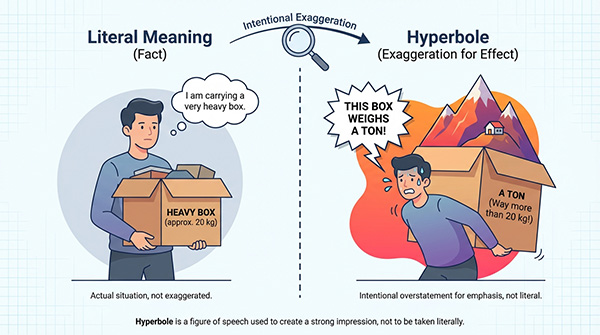
Hyperbole is a figure of speech that employs deliberate and obvious exaggeration for emphasis or effect. The term comes from the Greek word “hyperbole,” meaning “excess” or “exaggeration.” It’s not intended to be taken literally; rather, it’s used to create a strong impression or to evoke humor. Hyperbole is a common literary device and is frequently used in everyday speech to add color and intensity to language.
For students seeking clarity, what is a hyperbole can be explained as a deliberate exaggeration used to emphasize a point or create humor. The hyperbole definition highlights it as a rhetorical device that stretches reality to make ideas more vivid. In grammar and literature studies, whats a hyperbole called is often described as a figure of speech.
In other words, what is a hyperbole definition for students boils down to an intentional overstatement designed to capture attention. Simply put, hyperbole as figure of speech allows writers and speakers to add emotional intensity and creative flair to their language.
In essence, hyperbole amplifies a statement beyond its literal truth to emphasize a particular quality, feeling, or characteristic. It’s a versatile tool that can be used in various contexts, from casual conversations to formal literature. The key to effective hyperbole is that the exaggeration should be obvious and intentional, making it clear that the statement is not meant to be understood literally.
The function of hyperbole extends beyond mere exaggeration. It serves to highlight the importance of a particular aspect, to create a memorable image in the reader’s or listener’s mind, and to convey the speaker’s or writer’s attitude or emotion. It can inject humor, sarcasm, or even a sense of drama into a situation.
Structural Breakdown of Hyperbole
The structure of hyperbole is relatively simple: it involves an exaggeration of a statement or idea. However, the effectiveness of hyperbole lies in the context and the way the exaggeration is presented. A well-crafted hyperbole should be believable enough to resonate with the audience, while still being obviously exaggerated. The exaggeration should be proportional to the point being made, avoiding absurdity or unintentional humor.
Hyperbole typically involves the use of descriptive language that amplifies the qualities of the subject being described. This can include adjectives, adverbs, and figurative language such as metaphors and similes. The choice of words and the way they are combined can significantly impact the effectiveness of the hyperbole.
Here’s a breakdown of the key structural elements:
- Exaggeration: The core of hyperbole is the exaggeration itself. This can involve increasing the size, quantity, importance, or any other attribute of the subject.
- Descriptive Language: Adjectives, adverbs, and other descriptive words are used to amplify the exaggeration.
- Context: The context in which the hyperbole is used is crucial. The audience needs to understand that the statement is not meant to be taken literally.
- Intentionality: The exaggeration must be intentional and obvious. This distinguishes hyperbole from simple mistakes or misstatements.
Types of Hyperbole
While hyperbole is generally understood as exaggeration, it can be further categorized into two main types:
Overstatement
Overstatement is the most common type of hyperbole. It involves exaggerating a statement to an extreme degree. The goal is to emphasize a particular point or to create a humorous effect. Overstatements are often used in everyday conversation and in literature to add emphasis and color to language.
For example, saying “I’m so hungry I could eat a horse” is an overstatement. It’s not literally possible to eat an entire horse, but the exaggeration emphasizes the speaker’s extreme hunger.
Understatement (Litotes)
Understatement, also known as litotes, is the opposite of overstatement. It involves minimizing or downplaying a statement to create emphasis or irony. While it might seem counterintuitive, understatement can be just as effective as overstatement in conveying a message.
For instance, saying “It’s just a scratch” when referring to a large wound is an understatement. The minimization of the injury emphasizes its severity, often with a humorous or ironic effect.
Litotes often involves using a negative statement to express a positive one. For example, saying “He’s not the brightest bulb in the box” is an understatement that implies the person is unintelligent.
Understanding what is example of hyperbole can make the concept more tangible. Common instances include phrases like “I’m so hungry I could eat a horse” or “I’ve told you a million times.” In romantic contexts, hyperbole examples in love are abundant, such as “I will love you until all the seas run dry” or “I’d move the stars for you,” exaggerating emotions to express deep affection.
A less extreme form, called definition of minor hyperbole, involves subtle exaggeration for emphasis without creating absurdity, such as saying “I have a ton of homework” when the workload is heavy but manageable.
Examples of Hyperbole
Hyperbole is prevalent in various forms of communication, from everyday speech to literature and music. Recognizing hyperbole in these contexts can enhance your understanding of its function and effectiveness.
Hyperbole in Everyday Speech
Everyday speech is filled with hyperbolic expressions that we often use without even realizing it. These exaggerations add color and emphasis to our conversations.
The following table provides 30 examples of hyperbole used in everyday speech:
| Example | Explanation |
|---|---|
| I’m so hungry I could eat a horse. | Exaggerates the feeling of hunger. |
| I’ve told you a million times. | Emphasizes the frequency of repetition. |
| This bag weighs a ton. | Exaggerates the weight of the bag. |
| I’m dying of boredom. | Emphasizes the feeling of boredom. |
| It’s raining cats and dogs. | Exaggerates the intensity of the rain. |
| I haven’t seen you in ages. | Emphasizes the length of time since last seeing someone. |
| I’m so tired I could sleep for a year. | Exaggerates the feeling of tiredness. |
| My shoes are killing me. | Exaggerates the discomfort caused by the shoes. |
| I laughed my head off. | Exaggerates the intensity of laughter. |
| It cost me an arm and a leg. | Exaggerates the high price of something. |
| He’s as tall as a skyscraper. | Exaggerates the person’s height. |
| She has a heart of gold. | Exaggerates the person’s kindness. |
| I’m older than dirt. | Exaggerates the person’s age. |
| This is the worst thing that has ever happened to me. | Exaggerates the severity of the situation. |
| I have mountains of paperwork to do. | Exaggerates the amount of paperwork. |
| He runs faster than the wind. | Exaggerates the person’s speed. |
| I could eat this forever. | Exaggerates enjoyment of the food. |
| I’m so happy I could burst. | Exaggerates the feeling of happiness. |
| This class is taking forever. | Exaggerates the perceived length of the class. |
| I’ve walked a thousand miles today. | Exaggerates the distance walked. |
| Her brain is the size of a pea. | Exaggerates someone’s lack of intelligence. |
| He’s as skinny as a toothpick. | Exaggerates someone’s thinness. |
| I’m drowning in work. | Exaggerates the amount of work someone has. |
| It’s so hot, you could fry an egg on the sidewalk. | Exaggerates the intensity of the heat. |
| I’ll be there in a second. | Exaggerates the speed at which someone will arrive. |
| I’m so full, I could explode. | Exaggerates the feeling of fullness after eating. |
| That joke is older than time itself. | Exaggerates the age of the joke. |
| He’s got a memory like an elephant. | Exaggerates someone’s good memory. |
| I’ve been waiting here for eternity. | Exaggerates the length of time spent waiting. |
| She cried a river of tears. | Exaggerates the amount of tears someone cried. |
Hyperbole in Literature
Literature is rich with examples of hyperbole, used to create vivid imagery, emphasize emotions, and add depth to narratives.
Consider the following literary examples:
| Example | Source | Explanation |
|---|---|---|
| “Here once the embattled farmers stood / And fired the shot heard round the world.” | Ralph Waldo Emerson, “Concord Hymn” | The “shot heard round the world” exaggerates the impact of the first shot of the American Revolutionary War. |
| “I had to wait in the station for ten days—an eternity.” | Joseph Conrad, Heart of Darkness | The word “eternity” exaggerates the feeling of waiting for a long time. |
| “A thousand times good night!” | William Shakespeare, Romeo and Juliet | Exaggerates the number of times Romeo wishes Juliet good night, emphasizing his affection. |
| “The waves rose mountains high.” | (Common Literary Trope) | Exaggerates the height of the waves to emphasize the intensity of the storm. |
| “I’m so happy I could die!” | (Common Literary Trope) | Exaggerates the feeling of happiness to an extreme degree. |
| “It’s a slow burg. I spent a couple of weeks there one time, and one night I was walking down the street when a fire broke out in a bird-store. And before I could get there, every bird in the place was stone dead from smoke.” | Dashiell Hammett, Red Harvest | The quick death of the birds exaggerates the slowness of the town. |
| “He was so learned that he could name a horse in nine languages; so ignorant that he bought a cow to ride on.” | Benjamin Franklin | The contrast between knowing horse names in nine languages and buying a cow to ride on exaggerates the extremes of his knowledge and ignorance. |
| “Why, man, if the river was dry, I am able to fill it with my tears.” | William Shakespeare, The Two Gentlemen of Verona | Exaggerates the character’s sadness and ability to cry. |
| “I will love you until all the seas run dry.” | (Common Literary Trope) | Exaggerates the duration and intensity of love. |
| “They were so quiet, you could hear a pin drop.” | (Common Literary Trope) | Emphasizes the silence in the room. |
| “I’ve heard that before a million times.” | (Common Literary Trope) | Exaggerates the frequency of hearing something. |
| “Her smile could light up the entire world.” | (Common Literary Trope) | Exaggerates the brightness and impact of the smile. |
| “He’s got enough money to buy the whole country.” | (Common Literary Trope) | Exaggerates the person’s wealth. |
| “I haven’t slept in centuries.” | (Common Literary Trope) | Exaggerates the length of time without sleep. |
| “This car goes faster than the speed of light.” | (Common Literary Trope) | Exaggerates the car’s speed. |
| “I’m so tired I could sleep standing up.” | (Common Literary Trope) | Exaggerates the feeling of tiredness. |
| “She’s the best dancer in the universe.” | (Common Literary Trope) | Exaggerates the person’s dancing ability. |
| “He’s as old as the hills.” | (Common Literary Trope) | Exaggerates the person’s age. |
| “I’m so full I could explode.” | (Common Literary Trope) | Exaggerates the feeling of fullness after eating. |
| “I’ve climbed every mountain in the world.” | (Common Literary Trope) | Exaggerates the number of mountains climbed. |
| “He is braver than a lion.” | (Common Literary Trope) | Exaggerates the person’s bravery. |
| “I’m so excited I could fly to the moon.” | (Common Literary Trope) | Exaggerates the feeling of excitement. |
| “This is the most amazing thing that has ever happened.” | (Common Literary Trope) | Exaggerates the importance of the event. |
| “I could eat this cake for the rest of my life.” | (Common Literary Trope) | Exaggerates enjoyment of the cake. |
| “He’s the smartest person on the planet.” | (Common Literary Trope) | Exaggerates the person’s intelligence. |
| “I’ve read every book in the library.” | (Common Literary Trope) | Exaggerates the number of books read. |
| “She’s got eyes that could melt glaciers.” | (Common Literary Trope) | Exaggerates the attractiveness of the person’s eyes. |
| “He’s the funniest person in the world.” | (Common Literary Trope) | Exaggerates the person’s humor. |
| “I’m so relieved I could cry tears of joy.” | (Common Literary Trope) | Exaggerates the feeling of relief. |
| “This is the heaviest thing I’ve ever lifted.” | (Common Literary Trope) | Exaggerates the weight of the object. |
Hyperbole in Music
Songwriters often use hyperbole to express intense emotions, create memorable lyrics, and enhance the overall impact of their songs.
Here are some examples of hyperbole in music:
| Example | Song | Artist | Explanation |
|---|---|---|---|
| “I would walk 500 miles, and I would walk 500 more” | “I’m Gonna Be (500 Miles)” | The Proclaimers | Exaggerates the distance someone would walk for love. |
| “I will always love you” | “I Will Always Love You” | Whitney Houston | Exaggerates the duration and intensity of love. |
| “My heart will go on and on” | “My Heart Will Go On” | Celine Dion | Exaggerates the duration of the singer’s love and memory. |
| “I’d catch a grenade for ya” | “Grenade” | Bruno Mars | Exaggerates the extent of sacrifice the singer would make for love. |
| “I’m larger than life” | “Larger Than Life” | Backstreet Boys | Exaggerates the band’s fame and impact. |
| “You know I’d die for you” | “Die For You” | The Weeknd | Exaggerates the extent of sacrifice for someone. |
| “I’d do anything for love, but I won’t do that” | “I’d Do Anything for Love (But I Won’t Do That)” | Meat Loaf | Exaggerates willingness to do anything for love, with a comedic twist. |
| “I’ve been waiting a lifetime for you” | (Common Music Trope) | Various Artists | Exaggerates the length of time spent waiting. |
| “My love is a burning fire” | (Common Music Trope) | Various Artists | Exaggerates the intensity of love using a metaphor. |
| “I’m drowning in your love” | (Common Music Trope) | Various Artists | Exaggerates the feeling of being overwhelmed by love. |
| “I’d move the stars for you” | (Common Music Trope) | Various Artists | Exaggerates the effort someone would put forth. |
| “You’re the only thing I need” | (Common Music Trope) | Various Artists | Exaggerates the importance of the person. |
| “I’d give you the world” | (Common Music Trope) | Various Artists | Exaggerates the gift someone would give. |
| “I’ll never let you go” | (Common Music Trope) | Various Artists | Exaggerates the commitment to someone. |
| “I’m falling forever” | (Common Music Trope) | Various Artists | Exaggerates the duration of falling in love. |
| “You’re my everything” | (Common Music Trope) | Various Artists | Exaggerates the importance of the person. |
| “I’d climb the highest mountain” | (Common Music Trope) | Various Artists | Exaggerates the effort someone would put forth. |
| “I’d swim the deepest ocean” | (Common Music Trope) | Various Artists | Exaggerates the effort someone would put forth. |
| “You’re the sun, the moon, and all my stars” | (Common Music Trope) | Various Artists | Exaggerates the importance of the person. |
| “I’ll love you ’til the end of time” | (Common Music Trope) | Various Artists | Exaggerates the duration of love. |
| “I’d walk through fire for you” | (Common Music Trope) | Various Artists | Exaggerates the extent of sacrifice for someone. |
| “You’re the air that I breathe” | (Common Music Trope) | Various Artists | Exaggerates the importance of the person. |
| “I’ll hold you forever” | (Common Music Trope) | Various Artists | Exaggerates the duration of holding someone. |
| “You’re my dream come true” | (Common Music Trope) | Various Artists | Exaggerates the fulfillment the person brings. |
| “I’d give you my heart and soul” | (Common Music Trope) | Various Artists | Exaggerates the extent of sacrifice for someone. |
| “I’m lost without you” | (Common Music Trope) | Various Artists | Exaggerates dependence on the person. |
| “You’re my world” | (Common Music Trope) | Various Artists | Exaggerates the importance of the person. |
| “I’d go to the ends of the earth for you” | (Common Music Trope) | Various Artists | Exaggerates the effort someone would put forth. |
| “You’re my everything” | (Common Music Trope) | Various Artists | Exaggerates the importance of the person. |
| “I’d die without you” | (Common Music Trope) | Various Artists | Exaggerates dependence on the person. |
Knowing when is hyperbole appropriate to use is crucial for effective communication. It works best in informal writing, casual conversation, literature, music, and speeches where exaggeration enhances impact. Hyperbole should be used sparingly and clearly to avoid misinterpretation. For example, it’s appropriate to exaggerate feelings of love, excitement, or frustration, but less suitable in formal reports or precise technical descriptions.
Usage Rules for Hyperbole
While hyperbole is a flexible figure of speech, there are some guidelines to keep in mind to use it effectively:
- Context is Key: Ensure the context makes it clear that the statement is not to be taken literally. The audience should understand that you are exaggerating for effect.
- Avoid Misinterpretation: Be mindful of your audience. Some people may not recognize hyperbole and might take your statement literally, leading to misunderstanding.
- Use Sparingly: Overusing hyperbole can diminish its impact. Use it strategically to emphasize specific points.
- Maintain Believability: While hyperbole involves exaggeration, the exaggeration should still be somewhat relatable or believable. Extreme or nonsensical exaggerations can be ineffective.
- Consider Tone: Hyperbole can be used for humorous, dramatic, or sarcastic effect. Choose your words carefully to convey the intended tone.
- Be Aware of Cultural Differences: Some cultures may use hyperbole more frequently than others. Be sensitive to these differences when communicating with people from different backgrounds.
Common Mistakes When Using Hyperbole
Here are some common mistakes to avoid when using hyperbole:
- Taking Hyperbole Literally: This is a common mistake, especially for language learners. Remember that hyperbole is not meant to be taken literally.
- Overusing Hyperbole: Using hyperbole too frequently can make your language sound insincere or ridiculous.
- Creating Unbelievable Exaggerations: Exaggerations that are too extreme or nonsensical can be ineffective and confusing.
- Misunderstanding the Tone: Failing to convey the intended tone (e.g., humor, sarcasm, drama) can lead to misinterpretation.
- Ignoring Context: Using hyperbole in inappropriate contexts can be confusing or offensive.
Here are some examples of incorrect and correct use of hyperbole:
| Incorrect | Correct | Explanation |
|---|---|---|
| “I literally died laughing.” (when the person is still alive) | “I almost died laughing.” | The word “literally” contradicts the exaggeration. |
| “I have a few papers to grade.” (when there are hundreds) | “I have mountains of papers to grade.” | The first statement is an understatement, not hyperbole. The second exaggerates the amount of papers. |
| “The weather is slightly chilly.” (during a blizzard) | “It’s colder than Antarctica out here!” | The first statement is an understatement. The second exaggerates the cold. |
| “She’s a good singer.” (when she’s exceptionally talented) | “She has a voice that could move mountains.” | The first statement is a simple statement of fact. The second exaggerates the singer’s talent. |
| “He’s a bit tired.” (after running a marathon) | “He’s so tired he could sleep for a week.” | The first statement is an understatement. The second exaggerates the person’s tiredness. |
Practice Exercises
Test your understanding of hyperbole with these exercises:
Exercise 1: Identify Hyperbole
Identify the sentences that contain hyperbole:
| Question | Answer |
|---|---|
| 1. I’m so hungry I could eat a whole pizza. | Hyperbole |
| 2. The sky is blue. | Not Hyperbole |
| 3. I’ve told you a million times to clean your room. | Hyperbole |
| 4. The book was very interesting. | Not Hyperbole |
| 5. This suitcase weighs a ton. | Hyperbole |
| 6. She is a talented artist. | Not Hyperbole |
| 7. I’m dying of embarrassment. | Hyperbole |
| 8. The movie was two hours long. | Not Hyperbole |
| 9. I haven’t seen you in ages. | Hyperbole |
| 10. The coffee is hot. | Not Hyperbole |
Exercise 2: Rewrite Sentences Using Hyperbole
Rewrite the following sentences using hyperbole:
| Question | Answer |
|---|---|
| 1. I am very tired. | I’m so tired I could sleep for a year. |
| 2. The movie was long. | The movie was so long, it lasted an eternity. |
| 3. The test was difficult. | The test was so hard, it broke my brain. |
| 4. The food was delicious. | The food was so delicious, I could eat it forever. |
| 5. The room was very cold. | The room was so cold, it felt like the Arctic. |
| 6. He runs fast. | He runs faster than a speeding bullet. |
| 7. She is very happy. | She is so happy she could burst. |
| 8. I have a lot of work to do. | I have mountains of work to do. |
| 9. It rained hard. | It rained cats and dogs. |
| 10. The line was long. | The line stretched around the world. |
Exercise 3: Fill in the Blanks
Fill in the blanks with an appropriate hyperbolic expression:
| Question | Answer |
|---|---|
| 1. I’m so hungry, I could __________. | eat a horse |
| 2. I’ve told you _________ to clean your room. | a million times |
| 3. This box weighs __________. | a ton |
| 4. I’m __________ of boredom. | dying |
| 5. It’s raining __________. | cats and dogs |
| 6. I haven’t seen you in __________. | ages |
| 7. I’m so tired, I could __________. | sleep for a year |
| 8. My shoes are __________. | killing me |
| 9. I laughed my __________. | head off |
| 10. That cost me __________. | an arm and a leg |
Advanced Topics in Hyperbole
For advanced learners, explore the following more complex aspects of hyperbole:
- Hyperbole and Irony: Hyperbole can be combined with irony to create a more nuanced and complex effect. For example, saying “Oh, great!” when something terrible happens is both hyperbolic and ironic.
- Hyperbole and Satire: Satire often uses hyperbole to exaggerate flaws and vices for comedic or critical effect.
- Hyperbole in Different Genres: The use of hyperbole can vary depending on the genre. For example, hyperbole is often used in humorous writing, fantasy, and science fiction.
- The Role of Cultural Context: The effectiveness of hyperbole can be influenced by cultural context. Exaggerations that are considered acceptable in one culture may be seen as inappropriate in another.
Frequently Asked Questions (FAQ)
What is the difference between hyperbole and simile?
Hyperbole is an exaggeration used for emphasis or effect, while a simile is a comparison between two unlike things using “like” or “as.” Hyperbole aims to amplify a statement beyond reality, while a simile draws a parallel to create a vivid image or understanding.
How can I tell if something is hyperbole or just a mistake?
Hyperbole is intentional and obvious. It is used to emphasize a point or create a specific effect. A mistake, on the other hand, is unintentional and often results from error or lack of knowledge. Context is crucial in determining whether a statement is hyperbole or a mistake.
Is it okay to use hyperbole in formal writing?
Hyperbole is generally more appropriate for informal writing and speech. In formal writing, it’s best to use more precise and objective language. However, hyperbole can be used sparingly in formal writing if it serves a specific purpose and is used judiciously.
Can hyperbole be offensive?
Yes, hyperbole can be offensive if it is used insensitively or to exaggerate harmful stereotypes. Be mindful of your audience and the potential impact of your words. Avoid using hyperbole that could be construed as discriminatory or offensive.
How can I improve my use of hyperbole?
Practice recognizing hyperbole in various contexts, such as literature, movies, and everyday conversations. Experiment with using hyperbole in your own writing and speech, and pay attention to how your audience responds. Read widely and expose yourself to different writing styles and voices.
What i
the difference between hyperbole and metaphor?
Hyperbole is an exaggeration, while a metaphor is a direct comparison that states something *is* something else. Hyperbole is not meant to be taken literally, while a metaphor invites the reader to understand a subject in terms of another.
Conclusion
Hyperbole is a valuable tool for adding emphasis, humor, and color to your language. By understanding its definition, structural elements, types, usage rules, and common mistakes, you can effectively incorporate hyperbole into your writing and speech. Practice recognizing and using hyperbole in various contexts to enhance your communication skills and make your language more engaging and impactful. Whether you’re crafting a literary masterpiece or simply having a conversation with a friend, hyperbole can help you express yourself more vividly and memorably.