
Navigating the intricacies of English pluralization can be challenging, especially when encountering words like “deer.” Is the plural “deer” or “deers”?
This article delves into the fascinating world of irregular plurals, focusing specifically on the word “deer” and its grammatical nuances. Understanding these rules is crucial for clear and accurate communication, whether you’re writing a formal report, crafting a creative story, or simply engaging in everyday conversation. This guide is designed for English language learners, writers, and anyone curious about the peculiarities of English grammar.
This article will explore the definition, structural breakdown, and correct usage of the plural form of “deer.” We’ll examine why “deer” remains the same in both singular and plural contexts, while also addressing the occasional (and generally incorrect) use of “deers.” Through numerous examples, helpful tables, and practice exercises, you’ll gain a solid understanding of this grammatical concept and avoid common mistakes. Whether you’re a beginner or an advanced learner, this comprehensive guide will enhance your grasp of English pluralization.
Off to College Deals

Save up to 30% on everything you need for the semester.
Contains affiliate link
Table of Contents
- Definition of Deer and Pluralization
- Structural Breakdown: Why Deer is Unique
- Types of Nouns with Unchanging Plurals
- Examples of “Deer” in Singular and Plural Contexts
- Usage Rules for “Deer”
- Common Mistakes: Deer vs. Deers
- Practice Exercises
- Advanced Topics: Collective Nouns and Animal Plurals
- Frequently Asked Questions
- Conclusion
Definition of Deer and Pluralization
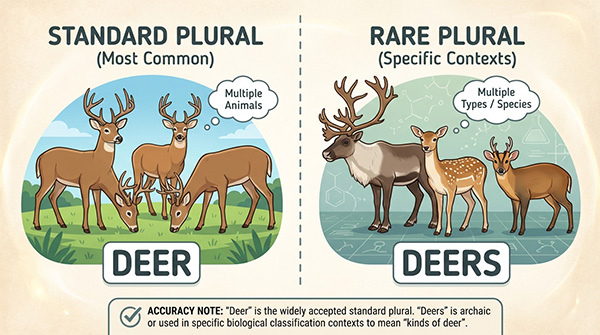
The word “deer” refers to a hoofed ruminant mammal belonging to the family Cervidae. Deer are known for their graceful appearance, herbivorous diet, and, in many species, the presence of antlers on the males. They inhabit a wide range of environments, from forests and grasslands to mountains and even suburban areas. Understanding the definition of “deer” is crucial before delving into its pluralization.
Pluralization, in general, is the process of forming the plural of a noun, indicating that there is more than one of something. In English, the most common way to form a plural is by adding “-s” or “-es” to the end of a singular noun (e.g., “cat” becomes “cats,” “box” becomes “boxes”).
However, English also has a number of irregular nouns that do not follow this standard rule. Some nouns have the same form in both singular and plural, and “deer” is one such example. This means that whether you’re referring to one deer or multiple deer, the word itself remains unchanged. The context of the sentence usually clarifies whether you are speaking about one or many.
Many English learners often ask what is the plural of deer or wonder if deer is singular or plural. The plural form of deer remains unchanged, so there is no need to add an ‘s.’ For those unsure how to spell deer plural, simply write deer in both singular and plural contexts. Understanding what is the plural of deer grammar will prevent common mistakes and ensure precise writing in both formal and informal communication.
Young Adults & Students:
Get 6 Months of Prime for $0

Ages 18-24 unlock exclusive perks including:
Contains affiliate link
Structural Breakdown: Why Deer is Unique
The unchanging plural form of “deer” is a relic of Old English grammar. Many words that referred to animals, particularly those hunted for food, retained the same form in both singular and plural. This grammatical feature likely arose from practical considerations related to hunting and resource management, where emphasizing the quantity of the animal was less important than identifying the animal itself. Over time, most of these nouns adopted standard plural forms, but “deer” persisted in its original form.
The lack of a distinct plural form for “deer” can be attributed to its historical usage and the patterns of language evolution. Unlike nouns that easily adopt the “-s” or “-es” suffix, “deer” maintained its singular form due to established convention and perhaps a lack of phonetic compatibility with the standard plural endings. Other words, like “sheep,” “fish,” and “aircraft,” share this characteristic of having identical singular and plural forms. These nouns often have roots in Old English or other Germanic languages, reflecting a different set of grammatical rules than those that govern the majority of modern English nouns.
Types of Nouns with Unchanging Plurals
Animals with Unchanging Plurals
Several animal nouns in English share the characteristic of having the same form for both singular and plural. This is most common for animals that are hunted or fished for food. Examples include:
- Sheep: One sheep, many sheep
- Fish: One fish, many fish (although “fishes” is sometimes used to refer to different species of fish)
- Swine: One swine, many swine
- Grouse: One grouse, many grouse
- Cod: One cod, many cod
- Trout: One trout, many trout
Other Nouns with Unchanging Plurals
Beyond animal names, some other nouns also have unchanging plurals. These often relate to units of measurement, materials, or abstract concepts. Examples include:
- Aircraft: One aircraft, many aircraft
- Spacecraft: One spacecraft, many spacecraft
- Series: One series, many series
- Species: One species, many species
- Headquarters: One headquarters, many headquarters
- Crossroads: One crossroads, many crossroads
Examples of “Deer” in Singular and Plural Contexts
The following tables provide examples of how “deer” is used in both singular and plural contexts. The tables are designed to illustrate the importance of context in understanding the number being referred to.
Singular vs. Plural Examples with Context
This table highlights how contextual clues help determine whether “deer” refers to one animal or multiple.
| Singular Context | Plural Context |
|---|---|
| The deer gracefully leaped over the fence. | The deer were grazing peacefully in the meadow. |
| I saw a deer near the edge of the forest. | We spotted several deer during our hike. |
| The hunter tracked the deer for miles. | The hunters tracked the deer through the snowy woods. |
| That deer has a beautiful coat. | Those deer have magnificent antlers. |
| A young deer was wandering alone. | Young deer often stay close to their mothers. |
| The injured deer was taken to a wildlife sanctuary. | Injured deer are often vulnerable to predators. |
| The deer ate the flowers in my garden. | The deer ate all the apples that had fallen from the tree. |
| One deer can cause significant damage to crops. | Deer can cause significant damage to crops. |
| The deer blended seamlessly with the forest background. | The deer blended seamlessly with the forest background. |
| I tried to photograph the deer. | I tried to photograph the deer. |
| The deer looked directly at me before running away. | The deer scattered as we approached. |
| A single deer crossed the road in front of our car. | A group of deer crossed the road in front of our car. |
| The deer left hoof prints in the soft mud. | The deer left many hoof prints in the soft mud. |
| The deer seemed unafraid of humans. | The deer seemed unafraid of humans. |
| The deer was grazing on the lush grass. | The deer were grazing on the lush grass. |
| The deer suddenly darted into the woods. | The deer suddenly darted into the woods. |
| I could hear the deer moving through the underbrush. | I could hear the deer moving through the underbrush. |
| The deer‘s antlers were covered in velvet. | The deer‘s antlers were covered in velvet. |
| The deer is a symbol of grace and beauty. | The deer are a symbol of grace and beauty. |
| The conservationist studied the deer‘s behavior. | The conservationist studied the deer‘s behavior. |
Examples with Numerical Quantifiers
This table shows how numerical quantifiers are used with “deer” to clearly indicate the number of animals.
| Singular | Plural |
|---|---|
| One deer stood in the clearing. | Five deer grazed in the field. |
| I saw a deer in the forest. | I saw several deer in the forest. |
| There is a deer outside my window. | There are many deer in the park. |
| Each deer has unique markings. | All the deer were startled by the noise. |
| A single deer can eat a lot of vegetation. | A few deer were spotted near the river. |
| I only saw a deer. | I saw dozens of deer. |
| An adult deer can weigh over 200 pounds. | Numerous deer inhabit the region. |
| I photographed a deer yesterday. | I photographed a large group of deer yesterday. |
| He tracked one deer for hours. | He tracked a herd of deer for hours. |
| Just one deer was enough to cause damage to the garden. | A number of deer were responsible for the damage. |
| There was only one deer. | There were at least ten deer. |
| I need to buy one deer tag. | I need to buy several deer tags. |
| He counted one deer. | He counted over twenty deer. |
| One deer approached cautiously. | Several deer approached cautiously. |
| A small deer emerged from the trees. | A large number of deer emerged from the trees. |
| He only saw a deer. | He saw hundreds of deer. |
| We observed a deer. | We observed a multitude of deer. |
| He aimed at one deer. | He aimed at a group of deer. |
| This deer is very young. | These deer are very young. |
| That deer is limping. | Those deer are limping. |
Examples in Different Sentence Structures
This table demonstrates the use of “deer” in various sentence structures to further illustrate its consistent form.
| Sentence Structure | Example |
|---|---|
| Simple Sentence | The deer ran. |
| Compound Sentence | The deer ran, and the fox followed. |
| Complex Sentence | Because the deer was startled, it ran into the woods. |
| Question | Did you see the deer? |
| Exclamatory Sentence | What a beautiful deer! |
| Imperative Sentence | Watch out for the deer! |
| Passive Voice | The deer was spotted by the hikers. |
| Present Continuous | The deer is grazing. |
| Past Perfect | The deer had already left when we arrived. |
| Future Tense | We will see deer tomorrow. |
| Conditional Sentence | If I see a deer, I will take a picture. |
| With a Possessive Pronoun | Its antlers are impressive (the deer’s). |
| With a Relative Clause | The deer that I saw was very young. |
| With an Infinitive Phrase | I went to the park to see the deer. |
| With a Gerund Phrase | Seeing the deer made my day. |
| With a Prepositional Phrase | The deer in the woods is well-camouflaged. |
| With an Appositive | The deer, a majestic creature, roamed freely. |
| Negative Sentence | I didn’t see any deer. |
| Emphatic Sentence | I did see a deer! |
| Rhetorical Question | Who wouldn’t want to see a deer? |
Usage Rules for “Deer”
The primary rule for using “deer” is simple: the word remains the same whether you are referring to one or many. Context is key to understanding the number. Use articles (a, an, the), quantifiers (one, several, many), and verb agreement to indicate whether you are talking about a singular or plural subject.
For example:
- Singular: A deer is standing in the field. (The article “a” indicates one deer.)
- Plural: Several deer are standing in the field. (The quantifier “several” and the plural verb “are” indicate multiple deer.)
While “deers” is sometimes used, it is generally considered incorrect in standard English. Its usage is rare and often seen in informal contexts or by non-native speakers.
A frequent question is is deers a word? While some informal sources may use deers, it is not correct in standard English. The word deer serves as both singular and plural, so adding an ‘s’ is unnecessary and considered a grammatical error.
Common Mistakes: Deer vs. Deers
The most common mistake is using “deers” as the plural form of “deer.” This is generally considered incorrect in standard English. Always use “deer” for both singular and plural.
Here are some examples of correct and incorrect usage:
| Incorrect | Correct | Explanation |
|---|---|---|
| I saw many deers in the park. | I saw many deer in the park. | “Deer” is already plural; adding an “s” is redundant. |
| The deers were grazing peacefully. | The deer were grazing peacefully. | “Deer” functions as both singular and plural. |
| How many deers did you count? | How many deer did you count? | Use “deer” regardless of the number. |
| Those deers belong to the farmer. | Those deer belong to the farmer. | “Deer” is the correct plural form. |
| A group of deers ran across the road. | A group of deer ran across the road. | “Deer” is the proper plural form. |
Practice Exercises
Exercise 1: Fill in the Blanks
Fill in the blanks with the correct form of “deer” (deer or deers).
| Question | Answer |
|---|---|
| 1. I saw a ______ in the forest. | deer |
| 2. There were several ______ grazing in the meadow. | deer |
| 3. How many ______ did you count? | deer |
| 4. The ______ tracks were clearly visible in the snow. | deer |
| 5. A herd of ______ ran across the road. | deer |
| 6. The hunter tracked the ______ for days. | deer |
| 7. The spotted ______ is a beautiful animal. | deer |
| 8. We saw many ______ on our hike. | deer |
| 9. A young ______ was wandering alone. | deer |
| 10. The ______ are eating the plants in my garden. | deer |
Exercise 2: Correct the Sentences
Correct the following sentences that incorrectly use “deers.”
| Incorrect Sentence | Correct Sentence |
|---|---|
| 1. The deers were eating the farmer’s crops. | The deer were eating the farmer’s crops. |
| 2. I saw five deers in the field. | I saw five deer in the field. |
| 3. The deers have beautiful antlers. | The deer have beautiful antlers. |
| 4. We counted ten deers near the river. | We counted ten deer near the river. |
| 5. Those deers belong to the wildlife preserve. | Those deer belong to the wildlife preserve. |
| 6. Several deers jumped over the fence. | Several deer jumped over the fence. |
| 7. The deers scattered when they heard the noise. | The deer scattered when they heard the noise. |
| 8. Many deers inhabit this forest. | Many deer inhabit this forest. |
| 9. The deers were startled by the car. | The deer were startled by the car. |
| 10. We spotted some deers during our drive. | We spotted some deer during our drive. |
Exercise 3: Sentence Completion
Complete the following sentences using the appropriate form of “deer” and a suitable verb.
| Sentence | Possible Completion |
|---|---|
| 1. The ______ in the forest ______ shyly. | deer, moved |
| 2. Several ______ near the river ______ drinking water. | deer, were |
| 3. One ______ ______ across the road. | deer, darted |
| 4. The ______ that I saw ______ a fawn. | deer, was |
| 5. Numerous ______ ______ the area. | deer, inhabit |
| 6. The ______ always ______ away when approached. | deer, runs |
| 7. Many ______ ______ attracted to the apple tree. | deer, are |
| 8. A ______ ______ a beautiful creature. | deer, is |
| 9. The ______ ______ their heads when they heard the sound. | deer, raised |
| 10. A group of ______ ______ grazing peacefully. | deer, was |
Advanced Topics: Collective Nouns and Animal Plurals
While “deer” itself does not change in the plural, the use of collective nouns can further refine how we describe groups of these animals. A collective noun is a word that represents a group of individuals, such as “herd,” “flock,” or “group.”
For deer, the most common collective noun is “herd.” Therefore, you might say “a herd of deer” to refer to a group of deer acting together. Other less common collective nouns for deer include “parcel” and “mob,” although these are rarely used in contemporary English.
The choice of collective noun can subtly alter the meaning of a sentence. “A herd of deer” emphasizes the group’s collective behavior, while simply stating “deer” focuses on the individual animals. Understanding these nuances can add precision to your writing and speech.
Frequently Asked Questions
Is “deers” ever correct?
No, “deers” is generally considered incorrect in standard English. The correct plural form is always “deer.” While you might occasionally encounter “deers,” it is best to avoid using it in formal writing or speech.
Why is “deer” the same in singular and plural?
This is a relic of Old English grammar, where certain animal names, especially those frequently hunted, retained the same form in both singular and plural. This convention persisted for “deer” while many other words adopted standard plural forms.
How do I know if “deer” is singular or plural in a sentence?
Context is crucial. Look for articles (a, an, the), quantifiers (one, several, many), and verb agreement (is vs. are) to determine whether “deer” refers to one animal or multiple animals. For example, “A deer is grazing” indicates a single deer, while “Several deer are grazing” indicates multiple deer.
Are there other animals with the same singular and plural forms?
Yes, several other animal names share this characteristic, including sheep, fish, swine, grouse, and cod. These words often have historical roots similar to “deer,” reflecting older grammatical patterns.
Can I use a collective noun with “deer”?
Yes, the most common collective noun for deer is “herd.” You can say “a herd of deer” to refer to a group of deer acting together. “Parcel” and “mob” are less common but also acceptable.
Is it ever acceptable to use “deers” in very informal contexts?
While technically incorrect, some people might use “deers” in very informal settings. However, it is generally best to avoid it to maintain clarity and grammatical correctness, especially in any type of formal communication or writing.
Does the word “deer” have different meanings besides the animal?
While primarily known as the animal, “deer” can occasionally be used metaphorically to describe someone who is timid or easily frightened. However, this usage is rare and usually clear from the context.
How can I best remember that the plural of “deer” is “deer”?
Think of other words that share this characteristic, such as “sheep” or “fish.” Remembering these similar examples can help reinforce the rule that “deer” remains unchanged in the plural.
Conclusion
Understanding the pluralization of “deer” is a key aspect of mastering English grammar. The word “deer” remains the same in both singular and plural contexts, and relying on context, quantifiers, and verb agreement is essential for clear communication. While the temptation to use “deers” may arise, especially for non-native speakers, remember that “deer” is always the correct plural form in standard English. By studying the examples, practicing the exercises, and understanding the historical context, you can confidently use “deer” in your writing and speech.
By avoiding common mistakes and embracing the nuances of irregular plurals, you enhance your overall command of the English language. Remember to consult this guide whenever you encounter uncertainty, and continue to practice and refine your understanding of English grammar. With dedication and attention to detail, you can achieve fluency and accuracy in your communication, whether writing or speaking.

I’m James Terban, a teacher with a degree in Education and five years of experience working with students of all ages, from young kids learning their first grammar rules to adults picking up English as a second language. I started Linguistics Guide because I kept seeing good learners hit a wall due to explanations that were either too vague or too complicated. Every article here comes from a real question I have heard in a classroom or seen asked online.