

Understanding the difference between “to” and “too” is crucial for clear and effective communication in English. These homophones (words that sound alike but have different meanings) are often confused, leading to grammatical errors and misunderstandings.
This article provides a comprehensive guide to mastering the use of “to” and “too,” covering their definitions, structural roles, usage rules, common mistakes, and practice exercises. Whether you are a beginner or an advanced learner, this guide will help you confidently use “to” and “too” in your writing and speech.
Table of Contents
- Introduction
- Definitions of ‘To’ and ‘Too’
- Structural Breakdown
- Types of ‘To’
- Usage of ‘Too’
- Examples
- Usage Rules
- Common Mistakes
- Practice Exercises
- Advanced Topics
- Frequently Asked Questions (FAQ)
- Conclusion
Definitions of ‘To’ and ‘Too’
Off to College Deals

Save up to 30% on everything you need for the semester.
Contains affiliate link
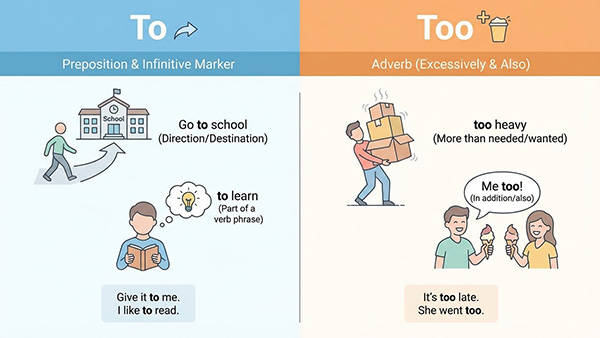
‘To’ and ‘too’ are homophones, meaning they sound alike but have different meanings and spellings. Understanding their distinct roles is essential for accurate writing and speaking.
A clear understanding of what is the difference between to and too is essential for accurate writing. While they sound identical, to is used as a preposition or part of an infinitive, connecting actions, directions, or purposes. In contrast, too functions as an adverb, expressing either an additional element, like “also,” or an excessive degree, as in “too hot.” Recognizing too or to meaning in a sentence depends on context: if the word modifies a verb, adjective, or adverb, it’s likely “too”; if it links a verb to a noun or completes an infinitive, it’s “to.” Understanding this distinction ensures clarity and prevents common grammatical errors.
To is primarily a preposition or part of an infinitive verb. As a preposition, it indicates direction, purpose, or relationship. As part of an infinitive, it precedes the base form of a verb (e.g., to eat, to sleep).
Too, on the other hand, is an adverb. It has two main meanings: ‘also’ or ‘in addition,’ and ‘excessively’ or ‘more than enough.’ The context determines which meaning is intended.
Structural Breakdown
The structural roles of ‘to’ and ‘too’ are quite different and understanding them will help you use them correctly. ‘To’ functions as a preposition or as part of an infinitive, while ‘too’ functions as an adverb modifying verbs, adjectives, or other adverbs.
Young Adults & Students:
Get 6 Months of Prime for $0

Ages 18-24 unlock exclusive perks including:
Contains affiliate link
When ‘to’ is used as a preposition, it is followed by a noun or pronoun, forming a prepositional phrase. This phrase often indicates direction, recipient, or purpose. For example, in the sentence “I am going to the store,” ‘to’ is a preposition followed by the noun phrase “the store.”
When ‘to’ is used as part of an infinitive, it is followed by the base form of a verb. This infinitive phrase can function as a noun, adjective, or adverb within a sentence. For example, in the sentence “I like to swim,” ‘to swim’ is an infinitive phrase acting as a noun (the object of the verb ‘like’).
‘Too,’ as an adverb, modifies other words. When it means ‘also,’ it typically appears at the end of a clause or sentence. For example, “I want to go, too.” When it means ‘excessively,’ it usually precedes the adjective or adverb it modifies. For example, “It is too hot.”
Types of ‘To’
The word ‘to’ has two primary functions in English grammar: as a preposition and as part of an infinitive.
To as a Preposition
As a preposition, ‘to’ indicates direction, purpose, or relationship. It is followed by a noun or pronoun, forming a prepositional phrase.
This prepositional phrase can function as an adverbial modifier, indicating where, when, or how something happens. It can also function as an adjectival modifier, describing a noun.
To in Infinitives
An infinitive is the base form of a verb preceded by ‘to.’ Infinitives can function as nouns, adjectives, or adverbs within a sentence.
When an infinitive functions as a noun, it can be the subject, object, or complement of a verb. When it functions as an adjective, it modifies a noun. When it functions as an adverb, it modifies a verb, adjective, or another adverb.
Usage of ‘Too’
The adverb ‘too’ has two primary meanings: ‘also’ or ‘in addition,’ and ‘excessively’ or ‘more than enough.’
Too Meaning ‘Also’
When ‘too’ means ‘also,’ it indicates that something is true or applicable in addition to something else. It typically appears at the end of a clause or sentence.
In this context, ‘too’ is often interchangeable with ‘as well’ or ‘in addition,’ although ‘too’ is generally considered more informal.
Too Meaning ‘Excessively’
When ‘too’ means ‘excessively,’ it indicates that something is more than necessary or desirable. It usually precedes the adjective or adverb it modifies.
In this context, ‘too’ often implies a negative consequence or undesirable outcome resulting from the excess.
Examples
Here are some examples illustrating the different uses of ‘to’ and ‘too’.
Examples of ‘To’ as a Preposition
The following table provides examples of ‘to’ used as a preposition, showing its diverse functions in indicating direction, purpose, and relationship.
| Sentence | Explanation |
|---|---|
| I am going to the library. | ‘To’ indicates the direction of movement. |
| This gift is to you. | ‘To’ indicates the recipient of the gift. |
| We need water to survive. | ‘To’ indicates the purpose or need. |
| He is related to her. | ‘To’ indicates a relationship. |
| She listened to the music. | ‘To’ connects the verb ‘listened’ with its object. |
| They traveled to Europe last year. | ‘To’ indicates the destination of the travel. |
| He gave the book to his friend. | ‘To’ specifies the recipient of the book. |
| She is accustomed to waking up early. | ‘To’ is part of the phrase ‘accustomed to’. |
| The key to success is hard work. | ‘To’ indicates a relationship or connection. |
| I prefer tea to coffee. | ‘To’ indicates a preference. |
| The letter was addressed to Mr. Smith. | ‘To’ indicates who the letter is intended for. |
| She is dedicated to her work. | ‘To’ indicates a commitment or dedication. |
| They are looking forward to the party. | ‘To’ is part of the phrase ‘looking forward to’. |
| He is allergic to peanuts. | ‘To’ indicates an allergy. |
| The answer to the question is complex. | ‘To’ connects the answer with the question. |
| I went to the doctor for a check-up. | ‘To’ indicates the purpose of going. |
| She is committed to making a difference. | ‘To’ indicates a strong commitment. |
| They are inviting everyone to the wedding. | ‘To’ indicates who is being invited. |
| He is responsible to his manager. | ‘To’ indicates accountability. |
| She is similar to her sister. | ‘To’ indicates a similarity. |
| He is used to driving on the left. | ‘To’ is part of the phrase ‘used to’. |
| The road to success is not easy. | ‘To’ metaphorically indicates the path. |
| She gave the information to the police. | ‘To’ indicates who received the information. |
| He is grateful to his parents. | ‘To’ indicates who he is grateful to. |
| She is opposed to the idea. | ‘To’ indicates opposition. |
Examples of ‘To’ in Infinitives
The following table illustrates the use of ‘to’ in infinitives, demonstrating their function as nouns, adjectives, and adverbs.
| Sentence | Explanation |
|---|---|
| I like to swim. | ‘To swim’ is an infinitive used as a noun (object of ‘like’). |
| He needs to study for the exam. | ‘To study’ is an infinitive used as a noun (object of ‘needs’). |
| My goal is to travel the world. | ‘To travel’ is an infinitive used as a noun (complement of ‘is’). |
| It is important to be on time. | ‘To be’ is an infinitive used as a noun (subject of ‘is’). |
| She went outside to play. | ‘To play’ is an infinitive used as an adverb (modifying ‘went’). |
| I want to learn a new language. | ‘To learn’ functions as a noun, the object of the verb “want.” |
| He decided to accept the job offer. | ‘To accept’ is a noun acting as the object of “decided.” |
| She is trying to improve her skills. | ‘To improve’ serves as a noun, the object of “trying.” |
| They planned to visit their grandparents. | ‘To visit’ is a noun, the object of the verb “planned.” |
| It’s necessary to understand the instructions. | ‘To understand’ functions as a noun, the subject complement. |
| He went to the store to buy milk. | ‘To buy’ acts as an adverb modifying the verb “went.” |
| She exercises regularly to stay healthy. | ‘To stay’ is an adverb modifying “exercises.” |
| I woke up early to catch the train. | ‘To catch’ functions as an adverb modifying “woke up.” |
| He studies hard to get good grades. | ‘To get’ is an adverb modifying “studies.” |
| She practices piano to perform well. | ‘To perform’ acts as an adverb modifying “practices.” |
| I need a pen to write with. | ‘To write’ functions as an adjective modifying “pen.” |
| He has a lot of work to do. | ‘To do’ is an adjective modifying “work.” |
| She needs some time to relax. | ‘To relax’ acts as an adjective modifying “time.” |
| They have a house to sell. | ‘To sell’ is an adjective modifying “house.” |
| He has a reason to celebrate. | ‘To celebrate’ functions as an adjective modifying “reason.” |
| She is excited to see the movie. | ‘To see’ expresses the reason for her excitement. |
| He is eager to start the new project. | ‘To start’ conveys the reason for his eagerness. |
| I am happy to help you with your work. | ‘To help’ explains the reason for my happiness. |
| She is ready to go on vacation. | ‘To go’ clarifies the reason for her readiness. |
| He is willing to try new things. | ‘To try’ expresses his willingness. |
Examples of ‘Too’ Meaning ‘Also’
The table below provides examples of ‘too’ used to mean ‘also’ or ‘in addition’.
| Sentence | Explanation |
|---|---|
| I want to go, too. | ‘Too’ indicates that the speaker also wants to go. |
| She likes chocolate, and I do, too. | ‘Too’ indicates that the speaker also likes chocolate. |
| He is coming to the party, and his brother is, too. | ‘Too’ indicates that the brother is also coming. |
| They went to the beach, and we did, too. | ‘Too’ indicates that the speakers also went to the beach. |
| If you are going to the concert, I want to come, too. | ‘Too’ indicates that the speaker also wants to come. |
| I enjoy playing tennis, and my sister does, too. | ‘Too’ indicates that the speaker’s sister also enjoys playing tennis. |
| She likes to read novels, and her brother does, too. | ‘Too’ indicates that the speaker’s brother also likes to read novels. |
| They are planning a trip, and we are, too. | ‘Too’ indicates that the speaker and their group are also planning a trip. |
| He is learning to play the guitar, and she is, too. | ‘Too’ indicates that the speaker’s sister is also learning to play the guitar. |
| I am excited about the vacation, and my friends are, too. | ‘Too’ indicates that the speaker’s friends are also excited about the vacation. |
| She is studying for the exam, and he is, too. | ‘Too’ indicates that the speaker’s brother is also studying for the exam. |
| They are volunteering at the shelter, and we are, too. | ‘Too’ indicates that the speaker and their group are also volunteering at the shelter. |
| He enjoys hiking, and his friends do, too. | ‘Too’ indicates that the speaker’s friends also enjoy hiking. |
| I am interested in science, and my classmates are, too. | ‘Too’ indicates that the speaker’s classmates are also interested in science. |
| She is working on a project, and her colleagues are, too. | ‘Too’ indicates that the speaker’s colleagues are also working on a project. |
| He is a fan of classical music, and I am, too. | ‘Too’ indicates agreement or shared preference. |
| She is good at cooking, and her sister is, too. | ‘Too’ indicates a shared skill or talent. |
| They are attending the conference, and we are, too. | ‘Too’ indicates that the speaker and their group are also attending. |
| I am learning Spanish, and my neighbor is, too. | ‘Too’ indicates a shared learning experience. |
| She is involved in the community, and her family is, too. | ‘Too’ indicates shared involvement. |
| I like to read, and my roommate does, too. | Indicates a shared hobby or interest. |
| He enjoys playing video games, and his friends do, too. | Indicates a shared leisure activity. |
| She is a member of the club, and her colleagues are, too. | Indicates shared membership. |
| They are participating in the event, and we are, too. | Indicates shared participation. |
| I am looking forward to the weekend, and my family is, too. | Indicates shared anticipation. |
Examples of ‘Too’ Meaning ‘Excessively’
The following table provides examples of ‘too’ used to mean ‘excessively’ or ‘more than enough’.
| Sentence | Explanation |
|---|---|
| It is too hot in here. | ‘Too’ indicates that the temperature is excessively high. |
| The coffee is too sweet. | ‘Too’ indicates that the coffee contains an excessive amount of sugar. |
| He is too young to drive. | ‘Too’ indicates that his age is excessively young for driving. |
| She is too tired to go out. | ‘Too’ indicates that her level of tiredness is excessive for going out. |
| The music is too loud. | ‘Too’ indicates that the volume of the music is excessively high. |
| The soup is too salty to eat. | ‘Too’ indicates the soup contains an excessive amount of salt. |
| He is too busy to take a break. | ‘Too’ indicates he is excessively occupied to take a break. |
| The dress is too expensive for me. | ‘Too’ indicates the dress costs an excessive amount. |
| She is too nervous to speak in public. | ‘Too’ indicates she feels excessively anxious to speak in public. |
| The movie is too violent for children. | ‘Too’ indicates the movie contains an excessive amount of violence. |
| The shoes are too small for my feet. | ‘Too’ indicates the shoes are excessively tight. |
| He is too proud to ask for help. | ‘Too’ indicates he is excessively arrogant to seek assistance. |
| The situation is too complicated to explain. | ‘Too’ indicates the situation is excessively intricate. |
| She is too sensitive to criticism. | ‘Too’ indicates she is excessively affected by critique. |
| The task is too difficult for beginners. | ‘Too’ indicates the task is excessively challenging. |
| The light is too bright. | Indicates an excessive level of brightness. |
| The question is too complicated. | Indicates an excessive level of complexity. |
| The deadline is too soon. | Indicates an insufficient amount of time. |
| The lecture was too boring. | Indicates an excessive lack of interest. |
| The problem is too serious. | Indicates an excessive level of gravity. |
| It’s too late to apologize. | Signifies that the opportunity for apology has passed. |
| The water is too cold for swimming. | Indicates an unsuitably low temperature for swimming. |
| He’s too stubborn to change his mind. | Suggests an excessive level of inflexibility. |
| The information is too detailed for a summary. | Indicates an excessive amount of detail for a concise version. |
| She’s too generous for her own good. | Implies that her generosity is excessive and potentially harmful. |
Usage Rules
Proper usage of ‘to’ and ‘too’ requires understanding their distinct grammatical roles and meanings.
When learning English grammar, it’s helpful to remember too vs to rules and to or too grammar rules. Knowing when to use to and too can prevent common mistakes, such as using “too” when “to” is required for an infinitive. These rules are straightforward once you understand that “to” typically links verbs and nouns, while “too” modifies adjectives, adverbs, or indicates addition. Practicing these distinctions with exercises will reinforce correct usage.
Rules for Using ‘To’
- Use ‘to’ as a preposition to indicate direction, recipient, or purpose.
- Use ‘to’ before the base form of a verb to form an infinitive.
- ‘To’ is followed by a noun, pronoun, or verb (in the infinitive form).
Rules for Using ‘Too’
- Use ‘too’ to mean ‘also’ or ‘in addition,’ typically at the end of a clause or sentence.
- Use ‘too’ to mean ‘excessively’ or ‘more than enough,’ usually before an adjective or adverb.
- ‘Too’ modifies verbs, adjectives, or other adverbs.
Common Mistakes
One of the most common mistakes is using ‘too’ when ‘to’ is required, or vice versa. Here are some examples of common errors and their corrections:
| Incorrect | Correct | Explanation |
|---|---|---|
| I want too go to the store. | I want to go to the store. | ‘To’ is needed to form the infinitive ‘to go’. |
| She is going to the party, me to. | She is going to the party, me too. | ‘Too’ is needed to mean ‘also’. |
| The soup is to hot. | The soup is too hot. | ‘Too’ is needed to mean ‘excessively’. |
| I am too tired to walk to far. | I am too tired to walk too far. | The first instance requires ‘too’ to mean ‘excessively,’ the second requires ‘too’ also. |
| Are you going to the concert, to? | Are you going to the concert, too? | ‘Too’ is needed at the end of the sentence to signify “also.” |
Practice Exercises
Test your understanding of ‘to’ and ‘too’ with these practice exercises.
Exercise 1: Fill in the Blanks
Fill in the blanks with the correct word: ‘to’ or ‘too’.
| Question | Answer |
|---|---|
| I am going _____ the park. | to |
| She wants _____ come with us. | to |
| It is _____ cold outside _____ play. | too, to |
| I like ice cream, and my brother does, _____. | too |
| He is _____ young _____ drive a car. | too, to |
| Are you going _____ the movies _____? | to, too |
| She gave the book _____ her friend. | to |
| The music is _____ loud _____ hear anything. | too, to |
| I want _____ learn how _____ dance. | to, to |
| This cake is _____ sweet for me _____ eat. | too, to |
Exercise 2: Identify the Error
Identify the error in each sentence and correct it.
| Question | Correct Answer |
|---|---|
| I am going to the store, to. | I am going to the store, too. |
| She is to tired to study. | She is too tired to study. |
| He wants too go to the beach. | He wants to go to the beach. |
| This coffee is to hot for me. | This coffee is too hot for me. |
| I want to come to. | I want to come, too. |
| She is to busy to help. | She is too busy to help. |
| He is going to the game, me to. | He is going to the game, me too. |
| The shirt is to small for him. | The shirt is too small for him. |
| I need to go to the bank, to. | I need to go to the bank, too. |
| It is to late to apologize. | It is too late to apologize. |
Advanced Topics
For advanced learners, here are some more complex aspects of using ‘to’ and ‘too’.
Elliptical Constructions with ‘Too’
In elliptical constructions, ‘too’ can be used without repeating the entire verb phrase. For example, instead of saying “I want to go, and she wants to go, too,” you can simply say “I want to go, and she does, too.” This construction is common in informal speech and writing.
These constructions often use auxiliary verbs (e.g., do, does, did, is, are, was, were, have, has, had) to stand in for the main verb phrase. The choice of auxiliary verb depends on the tense and form of the verb phrase being replaced.
Idiomatic Expressions with ‘To’ and ‘Too’
English contains numerous idiomatic expressions that use ‘to’ and ‘too.’ These expressions often have meanings that are not immediately obvious from the individual words. Understanding these idioms can enhance your fluency and comprehension.
Examples of idiomatic expressions with ‘to’ include “get to,” “look forward to,” “used to,” and “up to.” Examples of idiomatic expressions with ‘too’ are less common, but the concept of ‘too much of a good thing’ is a good example.
Frequently Asked Questions (FAQ)
Here are some frequently asked questions about the use of ‘to’ and ‘too’.
What is the difference between ‘to,’ ‘too,’ and ‘two’?
To is a preposition or part of an infinitive. Too is an adverb meaning ‘also’ or ‘excessively.’ Two is a number.
How can I easily remember when to use ‘too’?
Think of the extra ‘o’ in ‘too’ as meaning ‘extra’ or ‘also.’ If you mean ‘also’ or ‘excessively,’ use ‘too’.
Is it ever correct to start a sentence with ‘too’?
Starting a sentence with ‘too’ is generally discouraged in formal writing, especially when it means “also.” It’s better to use “also” or rephrase the sentence for clarity. However, it is acceptable when ‘too’ signifies ‘excessively,’ setting up a condition – for example, “Too much sun can cause sunburn.”
Can ‘too’ be used with uncountable nouns?
Yes, ‘too’ can be used with uncountable nouns to indicate an excessive amount. For example, “There is too much water in the pool.”
What is an infinitive, and how does ‘to’ relate to it?
An infinitive is the base form of a verb preceded by ‘to’ (e.g., to eat, to sleep, to study). Infinitives can function as nouns, adjectives, or adverbs within a sentence.
Are there any exceptions to the rules for using ‘to’ and ‘too’?
While the rules provided are generally applicable, idiomatic expressions and specific grammatical contexts may present exceptions. Always consider the overall meaning and structure of the sentence.
What’s the best way to practice using ‘to’ and ‘too’ correctly?
The best way to practice is through consistent writing and reading. Pay attention to how ‘to’ and ‘too’ are used in different contexts, and actively practice using them in your own writing. Also, use online exercises and grammar quizzes to reinforce your understanding.
How can I teach the difference between ‘to’ and ‘too’ to someone else?
Start by explaining their definitions and grammatical roles clearly. Use visual aids and examples to illustrate the different usages. Provide plenty of practice exercises and encourage them to ask questions. Focus on the common mistakes and provide clear corrections.
Conclusion
Mastering the difference between ‘to’ and ‘too’ is a fundamental aspect of English grammar. By understanding their definitions, structural roles, and usage rules, you can avoid common mistakes and communicate more effectively. Remember that ‘to’ functions primarily as a preposition or part of an infinitive, while ‘too’ is an adverb meaning ‘also’ or ‘excessively’. Consistent practice and attention to detail will solidify your understanding and enable you to use these words confidently in your writing and speech.
Continue to practice with exercises, read widely, and pay attention to how these words are used in various contexts. With dedication, you will undoubtedly master the correct usage of ‘to’ and ‘too,’ enhancing your overall command of the English language. Keep practicing, and you’ll soon find that the distinction becomes second nature, allowing you to focus on expressing your ideas clearly and accurately.

I’m James Terban, a teacher with a degree in Education and five years of experience working with students of all ages, from young kids learning their first grammar rules to adults picking up English as a second language. I started Linguistics Guide because I kept seeing good learners hit a wall due to explanations that were either too vague or too complicated. Every article here comes from a real question I have heard in a classroom or seen asked online.