

Understanding the correct past tense forms of the verb “take” – take, took, and taken – is crucial for accurate and effective communication in English. These forms are used in different contexts and grammatical structures, and using them incorrectly can lead to confusion or misinterpretation.
This comprehensive guide will provide a detailed explanation of each form, along with examples, usage rules, and practice exercises to help you master this essential aspect of English grammar. This article is designed for English language learners of all levels, from beginners to advanced speakers, who want to improve their understanding and use of the verb “take” in the past tense. By the end of this guide, you’ll be able to confidently use “take,” “took,” and “taken” in various situations.
Table of Contents
- Introduction
- Definition of “Take,” “Took,” and “Taken”
- Structural Breakdown
- Types and Categories of “Take”
- Examples of “Take,” “Took,” and “Taken”
- Usage Rules
- Common Mistakes
- Practice Exercises
- Advanced Topics
- FAQ
- Conclusion
Definition of “Take,” “Took,” and “Taken”
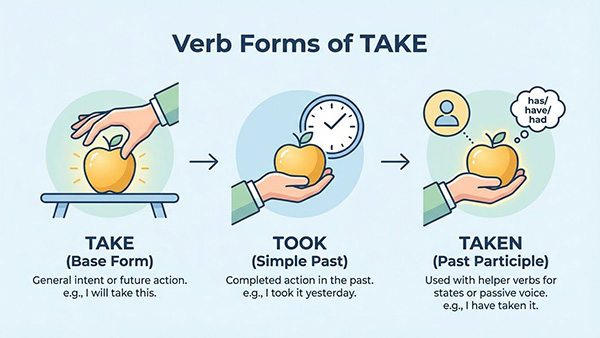

The verb “take” is a versatile and commonly used verb in English. It has numerous meanings, ranging from physically grasping something to accepting or assuming responsibility. Understanding its various forms is essential for fluency. Here’s a breakdown of the different forms:
- Take: This is the base form of the verb, used in the present tense and with modal verbs.
- Took: This is the simple past tense form of “take,” used to describe actions that happened at a specific time in the past.
- Taken: This is the past participle form of “take,” used with auxiliary verbs like “have,” “has,” “had,” “is,” “are,” “was,” and “were” to form perfect tenses and passive voice constructions.
In essence, “take” represents the action in its present or infinitive form, “took” describes a completed action in the past, and “taken” is used in conjunction with other verbs to indicate completed actions or passive states.
Many learners search for the past tense of take because this verb changes form in a way that isn’t predictable from regular patterns. Instead of adding “-ed,” English uses three core forms: take, took, and taken. Together, they cover present, simple past, and past participle usage, which explains why mastering take took taken is essential for speaking and writing accurately across different tenses.
Structural Breakdown
The structure of sentences using “take,” “took,” and “taken” depends on the tense and voice of the verb. Here’s a detailed look at each form:
Simple Present and Future Tense (“Take”)
In the simple present tense, “take” is used for habitual actions or general truths. In the simple future, it’s used with “will” or “shall.”
- Structure: Subject + take (or takes for third-person singular) + Object/Complement
- Example: I take the bus to work every day. He takes the train. We will take a vacation next month.
Simple Past Tense (“Took”)
“Took” is used to describe a completed action in the past. There is no auxiliary verb needed, making it relatively straightforward.
- Structure: Subject + took + Object/Complement
- Example: She took my advice. They took the opportunity. The dog took the bone and ran away.
Present Perfect Tense (“Taken”)
The present perfect tense uses “have” or “has” + “taken” to describe an action that started in the past and continues to the present or has a result in the present.
- Structure: Subject + have/has + taken + Object/Complement
- Example: I have taken the test already. He has taken all the cookies. We have taken many pictures on our trip.
Past Perfect Tense (“Taken”)
The past perfect tense uses “had” + “taken” to describe an action that was completed before another action in the past.
- Structure: Subject + had + taken + Object/Complement
- Example: They had taken their seats before the movie started. She had taken the course before she applied for the job. By the time we arrived, they had taken all the good spots.
Future Perfect Tense (“Taken”)
The future perfect tense uses “will have” + “taken” to describe an action that will be completed before a specific time in the future.
- Structure: Subject + will have + taken + Object/Complement
- Example: By next year, I will have taken all the required courses. By the time we arrive, they will have taken their lunch break. She will have taken the exam by then.
Passive Voice (“Taken”)
“Taken” is also used in the passive voice, where the subject receives the action rather than performs it. It uses a form of “be” (is, are, was, were, been, being) + “taken.”
- Structure: Subject + is/are/was/were/been/being + taken + (by + Agent)
- Example: The book was taken from the library. The cookies were taken by the children. My wallet has been taken.
Types and Categories of “Take”
The verb “take” is incredibly versatile and can be used in a wide variety of contexts. Understanding these different categories can help you use “take,” “took,” and “taken” more effectively.
Taking Physical Objects
This is one of the most common uses of “take,” referring to physically grasping or removing something.
- Examples: Take the book. He took the keys. She has taken my pen.
Taking Actions or Opportunities
This refers to seizing an opportunity or performing an action.
- Examples: Take a chance. He took a break. They have taken responsibility.
Taking People Somewhere
This involves escorting or leading someone to a location.
- Examples: I take my children to school. She took him to the doctor. We have taken them to the park.
Taking Measurements or Samples
This refers to obtaining measurements or samples for analysis.
- Examples: Take a temperature reading. He took a blood sample. They have taken measurements of the room.
Taking Abstract Concepts
This involves understanding, accepting, or considering abstract ideas.
- Examples: Take my word for it. She took his advice. He has taken the criticism to heart.
Examples of “Take,” “Took,” and “Taken”
To further illustrate the usage of “take,” “took,” and “taken,” here are several examples categorized by tense and context. These examples will provide a clear understanding of how each form is used in different situations.
Examples of “Take” (Present Tense)
The following table shows how “take” is used in the present tense, indicating habitual actions, general truths, or instructions.
| Sentence | Context |
|---|---|
| I take the train to work every morning. | Habitual action |
| She takes her dog for a walk in the evening. | Habitual action (third-person singular) |
| We take pride in our work. | General truth/attitude |
| They take turns doing the dishes. | Habitual action |
| You take the first step. | Instruction |
| He takes his medicine every day. | Habitual action (third-person singular) |
| The company takes its responsibilities seriously. | General truth/attitude (third-person singular) |
| Do you take sugar in your coffee? | Question about a habit |
| I take notes during the meeting. | Habitual action |
| She takes care of her younger brother. | Habitual action (third-person singular) |
| We take a break every hour. | Habitual action |
| They take the bus to school. | Habitual action |
| You take a left at the next intersection. | Instruction |
| He takes after his father. | General observation (third-person singular) |
| The teacher takes attendance every morning. | Habitual action (third-person singular) |
| I take my vitamins every day. | Habitual action |
| She takes her time when she works. | Habitual action (third-person singular) |
| We take a moment to appreciate the view. | General action |
| They take their jobs very seriously. | General truth/attitude |
| You take responsibility for your actions. | Instruction/advice |
| He takes the lead in the project. | Habitual action (third-person singular) |
| The cat takes a nap in the sun. | Habitual action (third-person singular) |
| I take pleasure in helping others. | General truth/attitude |
| She takes pride in her accomplishments. | General truth/attitude (third-person singular) |
| We take into consideration all factors. | General action |
| They take advantage of the opportunity. | General action |
Examples of “Took” (Simple Past Tense)
The following table provides examples of “took” in the simple past tense, describing actions completed in the past.
| Sentence | Context |
|---|---|
| I took the exam yesterday. | Completed action |
| She took a taxi to the airport. | Completed action |
| We took a vacation last summer. | Completed action |
| They took all the cookies from the jar. | Completed action |
| He took my advice and succeeded. | Completed action |
| The dog took the bone and buried it. | Completed action |
| She took a deep breath before speaking. | Completed action |
| We took a wrong turn and got lost. | Completed action |
| They took the opportunity to travel abroad. | Completed action |
| He took responsibility for his actions. | Completed action |
| I took the book from the shelf. | Completed action |
| She took a picture of the sunset. | Completed action |
| We took a walk in the park. | Completed action |
| They took a vote on the proposal. | Completed action |
| He took a risk and it paid off. | Completed action |
| I took the job offer. | Completed action |
| She took the lead in the project. | Completed action |
| We took the train to the city. | Completed action |
| They took the challenge head-on. | Completed action |
| He took the blame for the mistake. | Completed action |
| I took the medicine and felt better. | Completed action |
| She took the compliment graciously. | Completed action |
| We took the time to relax. | Completed action |
| They took the necessary precautions. | Completed action |
| He took the opportunity to learn a new skill. | Completed action |
| I took the initiative to solve the problem. | Completed action |
Examples of “Taken” (Past Participle)
The following table demonstrates the usage of “taken” as a past participle in various tenses and passive voice constructions.
| Sentence | Context |
|---|---|
| I have taken the test three times. | Present perfect tense |
| She has taken a course in photography. | Present perfect tense |
| We had taken our seats before the show started. | Past perfect tense |
| They had taken all the available tickets. | Past perfect tense |
| The book was taken from the library. | Passive voice |
| The cookies were taken by the children. | Passive voice |
| He has been taken to the hospital. | Present perfect passive |
| She had been taken advantage of. | Past perfect passive |
| I will have taken all my exams by next week. | Future perfect tense |
| She will have taken the job by then. | Future perfect tense |
| The decision has been taken. | Present perfect passive |
| The necessary steps have been taken. | Present perfect passive |
| I have taken responsibility for my actions. | Present perfect tense |
| She has taken a liking to her new job. | Present perfect tense |
| We had taken all the precautions necessary. | Past perfect tense |
| They had taken the opportunity to learn a new language. | Past perfect tense |
| The photograph has been taken beautifully. | Present perfect passive |
| The measurements have been taken accurately. | Present perfect passive |
| I will have taken a break by the time you arrive. | Future perfect tense |
| She will have taken the initiative to solve the problem. | Future perfect tense |
| The matter has been taken into consideration. | Present perfect passive |
| The information has been taken from a reliable source. | Present perfect passive |
| I have taken the liberty to arrange the meeting. | Present perfect tense |
| She has taken the challenge with enthusiasm. | Present perfect tense |
| We had taken the necessary steps to ensure success. | Past perfect tense |
| They had taken the time to prepare thoroughly. | Past perfect tense |
One of the most common points of confusion for learners is the take took taken difference, especially when comparing took vs taken. Although both refer to past time, they are not interchangeable. Took functions as the simple past form and stands alone in a sentence: “She took the keys.” Taken, on the other hand, is the past participle and must appear with an auxiliary verb: “She has taken the keys” or “The keys were taken.” Understanding this distinction prevents tense errors and makes your sentences sound natural and precise.
Usage Rules
To use “take,” “took,” and “taken” correctly, it’s essential to follow specific grammar rules. These rules govern how each form is used in different tenses and sentence structures.
Rule 1: Use “Take” for Present Tense and Infinitives
Use “take” for actions happening now, habitual actions, and in infinitive phrases (e.g., “to take”).
- Examples: I take the bus every day. They want to take a vacation.
Rule 2: Use “Took” for Simple Past Tense
Use “took” to describe actions that were completed at a specific time in the past.
- Examples: She took my keys. We took a walk in the park yesterday.
Rule 3: Use “Taken” with Auxiliary Verbs
Use “taken” with auxiliary verbs like “have,” “has,” “had,” “is,” “are,” “was,” and “were” to form perfect tenses and passive voice constructions.
- Examples: I have taken the test. The book was taken from the shelf.
Rule 4: Subject-Verb Agreement
Ensure that the verb “take” agrees with the subject. Use “takes” for third-person singular subjects (he, she, it).
- Examples: I take, he takes, we take, they take.
Rule 5: Avoid Mixing Tenses
Be consistent with tenses within a sentence or paragraph. Avoid unnecessary shifts between past, present, and future tenses.
- Correct: I took the book and read it.
- Incorrect: I took the book and read it now.
Learners also struggle with taken vs taking because both appear after auxiliary verbs but serve different grammatical purposes. Taken is the past participle, used to complete perfect tenses and passive constructions, such as “He has taken the exam” or “The wallet was taken.” Taking is the present participle, used in continuous tenses and gerunds: “He is taking the exam now” or “Taking notes helps you remember.” Choosing the correct form depends on whether you are describing a completed action or one in progress.
Common Mistakes
Even experienced English speakers sometimes make mistakes with “take,” “took,” and “taken.” Here are some common errors to watch out for:
Mistake 1: Using “Take” Instead of “Took” in the Past Tense
- Incorrect: I take the exam yesterday.
- Correct: I took the exam yesterday.
Mistake 2: Using “Took” Instead of “Taken” with Auxiliary Verbs
- Incorrect: I have took the test.
- Correct: I have taken the test.
Mistake 3: Using “Taken” Instead of “Took” in the Simple Past
- Incorrect: She has taken a taxi yesterday.
- Correct: She took a taxi yesterday.
Mistake 4: Incorrect Subject-Verb Agreement
- Incorrect: He take the bus every day.
- Correct: He takes the bus every day.
Mistake 5: Mixing Up Passive and Active Voice
- Incorrect: The library was took the book from.
- Correct: The book was taken from the library.
Practice Exercises
Test your understanding of “take,” “took,” and “taken” with these practice exercises. Choose the correct form of the verb for each sentence.
Exercise 1: Fill in the Blanks
Choose the correct form of “take” (take, took, or taken) to complete the sentences.
| Question | Answer |
|---|---|
| 1. I usually ______ the bus to work, but yesterday I walked. | take |
| 2. She ______ a deep breath before entering the room. | took |
| 3. They have ______ all the necessary precautions. | taken |
| 4. He will ______ the job if they offer it to him. | take |
| 5. The book was ______ from the library without permission. | taken |
| 6. We ______ a wrong turn and got lost. | took |
| 7. Have you ever ______ a ride in a hot air balloon? | taken |
| 8. I will have ______ all my exams by the end of the week. | taken |
| 9. She ______ the opportunity to learn a new language. | took |
| 10. They ______ their time to complete the project carefully. | took |
Exercise 2: Multiple Choice
Choose the correct form of “take” for each sentence.
| Question | Answer |
|---|---|
| 1. She always ______ notes in class. a) take b) took c) taken | a) take |
| 2. He ______ the blame for the accident. a) take b) took c) taken | b) took |
| 3. The cake has been ______ from the table. a) take b) took c) taken | c) taken |
| 4. They will ______ a vacation next month. a) take b) took c) taken | a) take |
| 5. I have ______ the medicine already. a) take b) took c) taken | c) taken |
| 6. She ______ a picture of the mountains. a) take b) took c) taken | b) took |
| 7. We ______ pride in our work. a) take b) took c) taken | a) take |
| 8. He had ______ the keys with him. a) take b) took c) taken | c) taken |
| 9. They ______ the bus to school every day. a) take b) took c) taken | a) take |
| 10. I ______ the train to work yesterday. a) take b) took c) taken | b) took |
Exercise 3: Error Correction
Identify and correct the errors in the following sentences.
| Question | Answer |
|---|---|
| 1. I have took the test already. | I have taken the test already. |
| 2. She take a taxi to the airport. | She took a taxi to the airport. |
| 3. They had take all the tickets. | They had taken all the tickets. |
| 4. He taken my advice and succeeded. | He took my advice and succeeded. |
| 5. The cookies were took by the children. | The cookies were taken by the children. |
| 6. I will take the job yesterday. | I took the job. |
| 7. She have taken the course. | She has taken the course. |
| 8. We has taken a break. | We have taken a break. |
| 9. They take responsibility yesterday. | They took responsibility yesterday. |
| 10. He is take to the hospital. | He is taken to the hospital. |
Advanced Topics
For advanced learners, understanding the nuances of “take,” “took,” and “taken” in idiomatic expressions and more complex grammatical structures is essential.
Idiomatic Expressions with “Take”
“Take” is used in numerous idiomatic expressions, which often have meanings that are not immediately obvious. Understanding these expressions can greatly enhance your fluency.
- Take after: To resemble someone, usually a family member. Example: He takes after his father.
- Take off: To depart or remove. Example: The plane took off on time.
- Take over: To assume control. Example: She took over the company.
- Take up: To start a new hobby or activity. Example: He took up painting.
- Take back: To retract or return something. Example: I take back what I said.
“Take” in Complex Sentences
“Take” can be used in complex sentences with multiple clauses, requiring careful attention to tense and agreement.
- Example: After she had taken the exam, she felt relieved that she had taken the time to study.
“Take” in Conditional Sentences
In conditional sentences, the form of “take” depends on the type of conditional.
- Type 1 (real conditional): If you take the bus, you will arrive on time.
- Type 2 (unreal conditional): If I took the job, I would move to New York.
- Type 3 (past unreal conditional): If I had taken his advice, I would have succeeded.
Frequently Asked Questions
Here are some frequently asked questions about “take,” “took,” and “taken,” along with detailed answers to help clarify any remaining confusion.
Q: When should I use “take” instead of “took” or “taken”?
A: Use “take” in the present tense for habitual actions, general truths, or instructions. Also, use “take” in the infinitive form (e.g., “to take”). For example, “I take the bus every day,” or “You need to take a break.”
Q: What is the difference between “took” and “taken”?
A: “Took” is the simple past tense form of “take” and is used to describe completed actions in the past without any auxiliary verbs. “Taken” is the past participle form and is used with auxiliary verbs like “have,” “has,” “had,” “is,” “are,” “was,” and “were” to form perfect tenses and passive voice constructions. For example, “She took the book” (simple past) versus “She has taken the book” (present perfect).
Q: How do I know when to use the passive voice with “taken”?
A: Use the passive voice when the subject of the sentence receives the action rather than performs it. The structure is typically “Subject + is/are/was/were/been/being + taken.” For example, “The book was taken from the library” (the book is receiving the action of being taken).
Q: Can “take” be used in phrasal verbs? If so, how does that affect its past tense forms?
A: Yes, “take” is commonly used in phrasal verbs, and the past tense forms (“took” and “taken”) still apply. For example, “He took off his hat” (past tense of “take off”) or “The company has taken over its competitor” (present perfect tense of “take over”). The meaning of the phrasal verb may differ from the literal meaning of “take,” so it’s important to learn these expressions individually.
Q: What are some common idiomatic expressions using “take,” and how do I use them correctly?
A: Some common idiomatic expressions include “take after” (resemble), “take off” (depart), “take over” (assume control), and “take up” (start a hobby). It’s best to learn these expressions individually and understand their specific meanings. For example, “He takes after his father” means he resembles his father, and “She took up painting” means she started painting as a hobby.
Q: How does subject-verb agreement affect the use of “take”?
A: Subject-verb agreement means the verb must agree in number with the subject. For third-person singular subjects (he, she, it), use “takes” in the present tense. For all other subjects (I, you, we, they), use “take.” For example, “I take the bus” versus “He takes the bus.”
Q: What is the difference between “take” and “bring”?
A: “Take” means to move something away from the speaker, while “bring” means to move something towards the speaker. For example, “Take this book to the library” (move the book away from me) versus “Bring the book to me” (move the book towards me).
Q: How can I improve my understanding and use of “take,” “took,” and “taken”?
A: Practice, practice, practice! Read English texts, listen to English conversations, and try to use “take,” “took,” and “taken” in your own speaking and writing. Pay attention to how native speakers use these forms and correct yourself when you make mistakes. Use online resources and grammar guides to reinforce your learning.
Conclusion
Mastering the correct usage of “take,” “took,” and “taken” is essential for clear and accurate communication in English. By understanding the definitions, structural breakdowns, usage rules, and common mistakes associated with these forms, you can significantly improve your grammar skills.
Remember to practice regularly, pay attention to context, and use the resources available to you to reinforce your learning. With consistent effort, you’ll be able to confidently use “take,” “took,” and “taken” in various situations, enhancing your overall fluency and comprehension.
The key takeaways from this guide include the importance of using “take” in the present tense and with infinitives, “took” for simple past actions, and “taken” with auxiliary verbs in perfect tenses and passive voice. Be mindful of subject-verb agreement and avoid common mistakes like mixing up tenses or using the wrong form with auxiliary verbs. Keep practicing and you’ll find that using these forms becomes second nature.

I’m James Terban, a teacher with a degree in Education and five years of experience working with students of all ages, from young kids learning their first grammar rules to adults picking up English as a second language. I started Linguistics Guide because I kept seeing good learners hit a wall due to explanations that were either too vague or too complicated. Every article here comes from a real question I have heard in a classroom or seen asked online.