

Understanding the correct past tense and past participle forms of irregular verbs like “split” is crucial for clear and accurate communication in English. Many learners grapple with whether “split” or “splitted” is the appropriate form.
This article provides a comprehensive guide to mastering the past tense of “split,” clarifying its usage, exploring examples, and offering practice exercises to solidify your understanding. Whether you’re a beginner or an advanced learner, this detailed exploration will help you confidently use “split” in all its tenses.
Table of Contents
- Introduction
- Definition of ‘Split’
- Structural Breakdown
- Types of ‘Split’ Usage
- Examples of ‘Split’ in Different Tenses
- Usage Rules for ‘Split’
- Common Mistakes with ‘Split’
- Practice Exercises
- Advanced Topics
- Frequently Asked Questions
- Conclusion
Introduction
Off to College Deals

Save up to 30% on everything you need for the semester.
Contains affiliate link
The English language, with its rich history and diverse influences, often presents challenges when it comes to verb conjugations, especially irregular verbs. One such verb is “split,” which commonly confuses learners due to its unexpected past tense form. Knowing when to use “split” versus an incorrect form like “splitted” is essential for both written and spoken English.
This article aims to demystify the past tense of “split,” providing clear explanations, numerous examples, and practical exercises to ensure you can use it correctly and confidently. This detailed exploration is beneficial for ESL/EFL students, writers, and anyone looking to improve their English grammar skills.
Definition of ‘Split’
The verb “split” has several meanings, broadly relating to dividing or separating something into two or more parts. It can also refer to ending a relationship or sharing something. Understanding its various definitions is key to using it correctly in different contexts. The most common uses involve physical division or metaphorical separation.
Classification and Function
“Split” is an irregular verb. This means that its past tense and past participle forms do not follow the standard “-ed” ending rule. Understanding this is critical for avoiding common mistakes. It functions as both a transitive and intransitive verb, depending on the context.
Contexts of Use
- Physical Division: To divide something physically into separate parts, e.g., “to split wood.”
- Separation: To break up or end a relationship or association, e.g., “The couple split up.”
- Sharing: To divide something and share it among people, e.g., “They split the profits.”
- Movement: To move quickly away from something, e.g., “He split from the group.”
- Figurative Use: To express disagreement or division within a group, e.g., “The issue split the party.”
Structural Breakdown
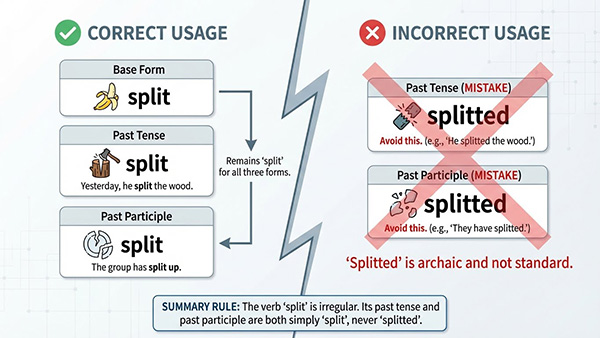
The verb “split” follows a unique pattern in its conjugation. The base form, past tense, and past participle are all the same: “split.” This is a key characteristic of irregular verbs and requires memorization. The present participle, however, follows the standard rule by adding “-ing,” resulting in “splitting.”
Young Adults & Students:
Get 6 Months of Prime for $0

Ages 18-24 unlock exclusive perks including:
Contains affiliate link
Verb Forms
- Base Form: split (e.g., I split the apple.)
- Past Tense: split (e.g., I split the apple yesterday.)
- Past Participle: split (e.g., I have split the apple.)
- Present Participle: splitting (e.g., I am splitting the apple.)
Understanding Irregular Verbs
Irregular verbs often have unpredictable forms, making them challenging for learners. Unlike regular verbs that simply add “-ed” to form the past tense and past participle, irregular verbs have unique conjugations that must be memorized. “Split” belongs to a group of irregular verbs that maintain the same form in the base, past tense, and past participle, such as “cut,” “hit,” and “hurt.” Recognizing this pattern can aid in remembering the correct form.
Types of ‘Split’ Usage
The verb “split” is versatile and used in various contexts. Understanding these different usages can help you use the verb accurately and effectively. We can categorize its usage based on the type of action or event it describes.
Physical Division
This refers to the action of physically dividing something into two or more parts. Examples include splitting wood, splitting a cake, or splitting a piece of paper.
Separation (Relationships)
This refers to the ending of a relationship, partnership, or association. Examples include a couple splitting up, a company splitting into two entities, or a team splitting due to disagreements.
Sharing or Distribution
This refers to the action of dividing something and sharing it among multiple parties. Examples include splitting the bill, splitting the profits, or splitting the workload.
Sudden Departure or Movement
This refers to leaving a place or group quickly and suddenly. Examples include splitting from the crowd, splitting from the scene, or splitting from the team.
Figurative or Abstract Division
This refers to a division of opinions, beliefs, or ideologies within a group or society. Examples include a political party splitting over an issue, a community splitting over a decision, or a family splitting over a disagreement.
Examples of ‘Split’ in Different Tenses
To fully grasp the correct usage of “split,” it’s essential to examine it in various tenses and contexts. The following tables provide extensive examples, illustrating how “split” functions in the present, past, and future tenses, as well as in different voices and moods.
Present Tense Examples
The present tense is used to describe actions happening now or habitual actions. The examples below illustrate the usage of ‘split’ in different present tense forms.
| Sentence | Explanation |
|---|---|
| I split the pizza with my friend. | Describes a current action of sharing. |
| He splits wood every weekend. | Describes a habitual action. |
| The company splits its profits annually. | Describes a recurring event. |
| She always splits the bill evenly. | Describes a consistent habit. |
| The rock splits under the pressure. | Describes a natural phenomenon. |
| The team splits into smaller groups for the exercise. | Describes a current division. |
| The road splits ahead. | Describes a present state. |
| The issue splits the community. | Describes a current division of opinion. |
| The seam splits when I pull too hard. | Describes a conditional action. |
| The magician splits the cards with a flourish. | Describes a performance action. |
| He splits his time between two jobs. | Describes how he manages his time. |
| The river splits into two streams. | Describes a geographical feature. |
| The teacher splits the class into teams. | Describes an action in the classroom. |
| The baker splits the dough before baking. | Describes a step in a recipe. |
| The athlete splits his training sessions. | Describes a training regimen. |
| The politician splits his speech into segments. | Describes how a speech is structured. |
| The scientist splits the atom. | Describes a scientific process. |
| The investor splits his portfolio. | Describes a financial strategy. |
| She splits her attention between the children. | Describes divided attention. |
| The light splits into a rainbow. | Describes a physical phenomenon. |
| The program splits the data into categories. | Describes a function of a program. |
| The dancer splits at the height of the performance. | Describes a specific dance move. |
| The editor splits the article into sections. | Describes an editorial process. |
| He splits the difference to make a deal. | Describes a negotiation tactic. |
| The screen splits into multiple views. | Describes a feature of a device. |
Past Tense Examples
The past tense is used to describe actions that happened at a specific time in the past. Remember, the past tense of “split” is also “split.”
| Sentence | Explanation |
|---|---|
| I split the firewood yesterday. | Action completed in the past. |
| The couple split up last year. | Separation occurred in the past. |
| We split the cost of the gift. | Sharing happened in the past. |
| He split from the group and went his own way. | Departure occurred in the past. |
| The party split over the controversial issue. | Division happened in the past. |
| She split the cake into equal slices. | Division of food occurred in the past. |
| The earthquake split the ground. | Physical event occurred in the past. |
| The band split after their final concert. | Group dissolution happened in the past. |
| They split the winnings from the lottery. | Sharing of prize money occurred in the past. |
| He split his pants while dancing. | Accidental event occurred in the past. |
| The chef split the chicken in half. | Cooking action occurred in the past. |
| The detective split the case wide open. | Figurative breakthrough occurred in the past. |
| The CEO split the company into divisions. | Business reorganization occurred in the past. |
| The athlete split the record time. | Achieved a fast intermediate time in the past. |
| The spy split the secret code. | Deciphering the code occurred in the past. |
| The magician split the assistant in two (illusion). | Stage illusion occurred in the past. |
| The general split the troops into platoons. | Military division occurred in the past. |
| The programmer split the task into subroutines. | Software development action occurred in the past. |
| The artist split the canvas into quadrants. | Artistic preparation occurred in the past. |
| The climber split from the climbing team due to injury. | Separation from team occurred in the past. |
| The movie split the critics, some loved it, others hated it. | Division of critical opinion occurred in the past. |
| The storm split the old oak tree. | Nature event occurred in the past. |
| The judge split the assets in the divorce case. | Legal division occurred in the past. |
| The negotiators split the difference to reach an agreement. | Compromise occurred in the past. |
| The light split into colors through the prism. | Scientific phenomenon occurred in the past. |
Past Participle Examples
The past participle is used in perfect tenses (e.g., present perfect, past perfect, future perfect) and passive voice constructions. Again, the past participle of “split” is “split.”
| Sentence | Explanation |
|---|---|
| I have split the log for the fire. | Present perfect tense, completed action. |
| The couple had split before the divorce was finalized. | Past perfect tense, action completed before another past action. |
| The profits will have been split by the end of the year. | Future perfect tense, action to be completed in the future. |
| The wood was split with an axe. | Passive voice, action done to the subject. |
| The company’s assets have been split among the shareholders. | Passive voice, completed distribution. |
| The atom had been split in the experiment. | Passive voice, action completed before a point in the past. |
| The team’s strategy has split the defense. | Present perfect, the strategy has caused the defense to separate. |
| The land had been split by the earthquake. | Past perfect passive, the earthquake caused the land to separate. |
| The responsibility has been split between the two departments. | Present perfect passive, completed distribution of responsibility. |
| The group will have split into smaller units by tomorrow. | Future perfect, indicating a completed division in the future. |
| The shares have been split among family members. | Present perfect passive, completed distribution of shares. |
| The secret had been split amongst the conspirators. | Past perfect passive, shared before a point in the past. |
| The earnings have been split equally. | Present perfect passive, equal distribution. |
| The work has been split to improve efficiency. | Present perfect passive, divided for a purpose. |
| The ice had split from the weight of the snow. | Past perfect, separated before a point in the past. |
| The responsibilities had been split before the project started. | Past perfect passive, divided before the project. |
| The funds have been split and distributed to various charities. | Present perfect passive, distributed among multiple charities. |
| The information has been split into several documents for security purposes. | Present perfect passive, divided for security. |
| The decision has split the community. | Present perfect, caused a division in the community. |
| The atom has been split to release energy. | Present perfect passive, divided for energy release. |
| The data has been split into manageable chunks. | Present perfect passive, divided into smaller parts. |
| The pie has been split into eight slices. | Present perfect passive, divided into slices. |
| The task has been split among the team members. | Present perfect passive, distributed among the team. |
| The loot had been split before the police arrived. | Past perfect passive, divided before police arrival. |
| The workload will have been split evenly before the deadline. | Future perfect passive, divided evenly before the deadline. |
Although many learners search for the phrase splitted meaning, it is important to clarify that “splitted” is not a standard English verb form. In formal grammar, “splitted” has no accepted meaning as the past tense or past participle of “split.”
Instead, English uses “split” for both forms. When people look up “splitted meaning,” they are usually trying to understand why “splitted” feels wrong and what the correct alternative should be. This confusion often comes from regular verb patterns, where “-ed” is added, but “split” does not follow that rule.
Usage Rules for ‘Split’
The primary rule to remember is that the past tense and past participle of “split” are also “split.” There is no “splitted” form in standard English. Using “splitted” is a common mistake that should be avoided. While non-standard dialects might use “splitted,” it is not considered grammatically correct in formal or academic writing.
Learners often ask about the past tense of split because it looks identical to the base form. The correct form is always “split,” as in “Yesterday, I split the wood,” and “Today, I have split the logs for the fire,” not “I have split or splitted.” Remember, “splitted” is never used in standard English, even in perfect tenses.
Avoiding ‘Splitted’
The most crucial rule is never to use “splitted” as the past tense or past participle. Always use “split.” For example:
- Correct: I split the log yesterday.
- Incorrect: I splitted the log yesterday.
- Correct: The log has been split.
- Incorrect: The log has been splitted.
Correct Tense Usage
Ensure you are using the correct tense to convey your intended meaning. Using the correct auxiliary verbs (e.g., “have,” “had,” “will have”) is essential for forming perfect tenses correctly.
Another frequent area of confusion is choosing between “split by or splited by.” In passive sentences, the correct structure is always “split by,” never “splited by.” For example, “The wood was split by the carpenter” is grammatically correct, while “The wood was splited by the carpenter” is not. Because “split” is irregular, the past participle remains “split,” even in passive voice constructions.
Active vs. Passive Voice
Be mindful of whether you are using the active or passive voice. In the active voice, the subject performs the action (e.g., “I split the wood”). In the passive voice, the subject receives the action (e.g., “The wood was split by me”).
Many grammar questions focus on choosing the right form, such as “to be split or to be splitted,” “has been split or splitted,” and “will be split or splitted.” In every case, the correct option is “split.” English never uses “splitted” as the past participle. You should say, “The log has been split,” and “The cake will be split evenly,” not “has been splitted” or “will be splitted.” These patterns reinforce the rule that “split” stays the same across base form, past tense, and past participle.
Common Mistakes with ‘Split’
The most common mistake is using “splitted” as the past tense or past participle of “split.” This error often arises from a misunderstanding of irregular verb conjugations. Another mistake is misusing the present participle “splitting.”
‘Splitted’ vs. ‘Split’
This is the most frequent error. Always remember that “split” is the correct form for both the past tense and past participle.
| Incorrect | Correct | Explanation |
|---|---|---|
| I splitted the apple. | I split the apple. | “Split” is the correct past tense form. |
| The wood has been splitted. | The wood has been split. | “Split” is the correct past participle form. |
| He splitted the profits evenly. | He split the profits evenly. | Incorrect past tense. |
| She had splitted the cake before we arrived. | She had split the cake before we arrived. | “Split” is the correct past participle in past perfect. |
Misusing ‘Splitting’
While “splitting” is the correct present participle, ensure it’s used in the appropriate context, typically with a form of the verb “to be.”
| Incorrect | Correct | Explanation |
|---|---|---|
| I splitting the wood. | I am splitting the wood. | Requires a form of “to be” (am, is, are, was, were). |
| He splitting the bill. | He is splitting the bill. | Missing auxiliary verb. |
| They splitting the prize. | They are splitting the prize. | Needs a form of “to be.” |
Practice Exercises
These exercises will help you solidify your understanding of the correct usage of “split.” Fill in the blanks with the correct form of “split” (split, splitting).
Exercise 1: Fill in the Blanks
| Question | Answer |
|---|---|
| Yesterday, I ______ the firewood. | split |
| They are ______ the cost of the trip. | splitting |
| The couple had ______ before the divorce. | split |
| He is ______ the pizza with his friends. | splitting |
| The team ______ into two groups for the exercise. | split |
| The company has ______ its profits among the shareholders. | split |
| She was ______ the cake when I arrived. | splitting |
| The river ______ into several streams. | split |
| They ______ the winnings evenly. | split |
| He is ______ his time between work and family. | splitting |
Exercise 2: Correct the Sentences
Identify and correct the errors in the following sentences.
| Incorrect Sentence | Correct Sentence |
|---|---|
| I splitted the apple in half. | I split the apple in half. |
| The wood was splitted by the axe. | The wood was split by the axe. |
| He is splitted the bill with her. | He is splitting the bill with her. |
| They had splitted up before I met them. | They had split up before I met them. |
| She splitted the difference to make the deal. | She split the difference to make the deal. |
| The party has splitted over the issue. | The party has split over the issue. |
| The land was splitted by the earthquake. | The land was split by the earthquake. |
| I am splitted my time between two jobs. | I am splitting my time between two jobs. |
| The prize money was splitted equally. | The prize money was split equally. |
| The group splitted after the argument. | The group split after the argument. |
Exercise 3: Sentence Completion
Complete the following sentences using the correct form of ‘split’.
| Sentence Start | Possible Completion |
|---|---|
| Before the game, the coach ______ | split the team into smaller practice groups. |
| Having ______ the workload, everyone felt less stressed. | split |
| While hiking, the path ______ into two trails. | split |
| The negotiators ______ the difference to reach a compromise. | split |
| The baker is ______ the dough into smaller portions. | splitting |
| The issue ______ the community, causing heated debates. | split |
| After the argument, the friends ______. | split up |
| The magician ______ the deck of cards with a flourish. | split |
| The scientist ______ the atom in the experiment. | split |
| The river is ______ the valley in two parts. | splitting |
Advanced Topics
For advanced learners, understanding the nuances of “split” can involve exploring its idiomatic uses and its subtle differences in meaning depending on context. Additionally, examining its historical usage can provide a deeper appreciation for its evolution.
Idiomatic Expressions
“Split” appears in several idiomatic expressions, each with a unique meaning. Understanding these expressions can enhance your comprehension and fluency.
- Split hairs: To argue about trivial or insignificant details.
- Split the difference: To compromise by meeting halfway.
- Split second: A very brief moment of time.
- Split personality: A condition characterized by multiple distinct identities (now known as dissociative identity disorder).
Regional Variations
While “splitted” is generally considered incorrect in standard English, some non-standard dialects might use it. However, it’s essential to avoid “splitted” in formal writing or speech. Understanding these variations is primarily for comprehension rather than active use.
Historical Usage
The verb “split” has been used in English for centuries, with its irregular form remaining consistent over time. Studying its historical usage can provide insight into the evolution of the English language and the persistence of irregular verbs.
Frequently Asked Questions
Here are some common questions learners have about the verb “split.”
Is “splitted” ever correct?
No, “splitted” is not considered correct in standard English. The past tense and past participle of “split” are always “split.”
How do I remember that “split” is irregular?
Associate “split” with other common irregular verbs that share the same form in the base, past tense, and past participle, such as “cut,” “hit,” and “hurt.” Repetition and practice are key to memorization.
When should I use “splitting”?
“Splitting” is the present participle and should be used with a form of the verb “to be” (am, is, are, was, were) to form continuous tenses (e.g., “I am splitting the wood”).
What are some common mistakes to avoid with “split”?
The most common mistake is using “splitted” instead of “split.” Also, ensure you use the correct auxiliary verbs when forming perfect tenses (e.g., “have split,” “had split”).
Can “split” be used as a noun?
Yes, “split” can also be a noun, referring to a division or separation (e.g., “a split in the party”).
What does “split hairs” mean?
“Split hairs” is an idiom that means to argue about trivial or insignificant details.
How can I improve my understanding of irregular verbs?
Create flashcards, practice verb conjugation exercises, and read extensively to see irregular verbs used in context. Focus on learning verbs in groups that share similar patterns.
Is there a difference in meaning between ‘split’ and other verbs like ‘divide’ or ‘separate’?
While ‘split’, ‘divide’, and ‘separate’ can often be used interchangeably, ‘split’ often implies a more forceful or sudden division. ‘Divide’ is more general, and ‘separate’ suggests a removal or distancing.
Conclusion
Mastering the past tense of “split” is essential for accurate and effective communication in English. Remember that the past tense and past participle of “split” are both “split,” and avoid the common mistake of using “splitted.”
By understanding the various contexts in which “split” can be used, practicing with examples, and reviewing the usage rules, you can confidently use this irregular verb in your writing and speech. Consistent practice and attention to detail will help solidify your understanding and prevent future errors. Keep practicing, and you’ll become more comfortable and confident in your use of “split.”

I’m James Terban, a teacher with a degree in Education and five years of experience working with students of all ages, from young kids learning their first grammar rules to adults picking up English as a second language. I started Linguistics Guide because I kept seeing good learners hit a wall due to explanations that were either too vague or too complicated. Every article here comes from a real question I have heard in a classroom or seen asked online.