
The English language is rich with opportunities for creative expression, and similes are a powerful tool to paint vivid pictures with words. A smile, a universal expression of joy and warmth, can be described in countless ways using similes.
Understanding how to effectively use similes to describe a smile not only enhances your writing but also improves your overall communication skills. This article delves into the art of crafting compelling similes for smiles, exploring various categories, providing numerous examples, and offering practical exercises to master this skill.
Whether you are a student, a writer, or simply someone looking to improve your vocabulary, this guide will equip you with the knowledge and tools to describe smiles in captivating and memorable ways.
Off to College Deals

Save up to 30% on everything you need for the semester.
Contains affiliate link
Table of Contents
- Introduction
- Definition of Simile
- Structural Breakdown of Similes
- Types of Similes for Smiles
- Examples of Similes for Smiles
- Usage Rules for Similes
- Common Mistakes When Using Similes
- Practice Exercises
- Advanced Topics in Similes
- Frequently Asked Questions
- Conclusion
Definition of Simile
A simile is a figure of speech that directly compares two different things using the words “like” or “as.” Its primary function is to enhance description by drawing a parallel between something familiar and something being described, thereby creating a more vivid and relatable image in the reader’s mind. Similes are a subset of figurative language, which includes metaphors, analogies, and personification.
Unlike metaphors, which state that something *is* something else, similes suggest a resemblance or similarity. The context in which a simile is used can significantly impact its effectiveness.
A well-crafted simile adds depth, emotion, and clarity to writing or speech.
For instance, instead of simply saying “Her smile was bright,” a simile might say, “Her smile was as bright as the morning sun.” This comparison evokes a stronger image and conveys a sense of warmth and joy associated with the sun. Similes are particularly useful in poetry, prose, and everyday conversation to make descriptions more engaging and memorable.
Structural Breakdown of Similes
The basic structure of a simile involves three core components: the subject, the linking word, and the object of comparison. The subject is the thing being described, in our case, a smile. The linking word is either “like” or “as,” which establishes the comparison. The object of comparison is the thing to which the smile is being compared. Understanding this structure is crucial for creating effective and grammatically correct similes.
Young Adults & Students:
Get 6 Months of Prime for $0

Ages 18-24 unlock exclusive perks including:
Contains affiliate link
The formula can be represented as: Subject + Linking Word + Object of Comparison. For example: “Her smile (subject) was like (linking word) sunshine (object of comparison).” The object of comparison should have a quality that is similar to the subject, creating a meaningful and understandable connection. The effectiveness of a simile often depends on the relevance and clarity of this connection.
Furthermore, the order of elements can sometimes be varied for stylistic effect. For example, instead of “His smile was like a ray of hope,” one could say, “Like a ray of hope, his smile shone through the darkness.” While less common, this inversion can add emphasis and poetic flair.
Types of Similes for Smiles
Similes can be categorized based on the type of imagery they evoke. When describing a smile, different types of similes can be used to emphasize different aspects, such as its brightness, warmth, sincerity, or effect on others.
Here are some common categories:
Similes Using Light
Light-related similes are used to describe the brightness and radiance of a smile. These similes often compare a smile to sources of light, such as the sun, stars, or lamps, to emphasize its illuminating and joyful quality.
They can convey a sense of warmth, positivity, and clarity.
Similes Using Nature
Nature-related similes draw comparisons between a smile and elements of the natural world, such as flowers, landscapes, or weather phenomena. These similes can highlight the beauty, freshness, and naturalness of a smile, often evoking feelings of peace, serenity, or growth.
They can also reflect the changing moods and seasons, adding depth to the description.
Similes Using Objects
Object-related similes compare a smile to inanimate objects, often chosen for their specific qualities or connotations. These similes can emphasize the shape, texture, or symbolic meaning of a smile.
Examples include comparing a smile to a perfectly crafted arc, a polished gem, or a comforting blanket.
Similes Using Emotions
Emotion-related similes describe a smile by linking it to various feelings and emotional states. These similes can convey the sincerity, depth, and impact of a smile on others.
They might compare a smile to a wave of comfort, a burst of happiness, or a beacon of hope.
Similes Using Sound
Sound-related similes are less common but can be very effective in describing the audible or resonant qualities associated with a smile, such as a chuckle or a joyful laugh. These similes can evoke a sense of liveliness, energy, and connection.
They might compare a smile to the chime of bells, the ripple of laughter, or the melody of a song.
Examples of Similes for Smiles
To illustrate the different types of similes for smiles, here are several examples organized by category. These examples aim to provide a diverse range of options for describing smiles in various contexts and styles.
Light-Related Similes
These similes emphasize the brightness and radiance of a smile, comparing it to various sources of light.
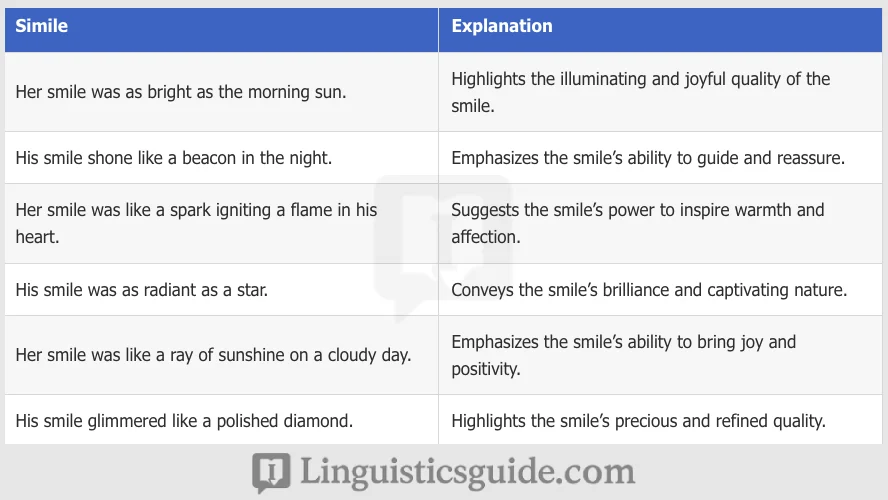
| Simile | Explanation |
|---|---|
| Her smile was as bright as the morning sun. | Highlights the illuminating and joyful quality of the smile. |
| His smile shone like a beacon in the night. | Emphasizes the smile’s ability to guide and reassure. |
| Her smile was like a spark igniting a flame in his heart. | Suggests the smile’s power to inspire warmth and affection. |
| His smile was as radiant as a star. | Conveys the smile’s brilliance and captivating nature. |
| Her smile was like a ray of sunshine on a cloudy day. | Emphasizes the smile’s ability to bring joy and positivity. |
| His smile glimmered like a polished diamond. | Highlights the smile’s precious and refined quality. |
| Her smile was as luminous as a full moon. | Conveys the smile’s gentle and calming radiance. |
| His smile was like a flashlight in the dark, guiding her way. | Emphasizes the smile’s ability to provide clarity and direction. |
| Her smile was as incandescent as a firefly on a summer night. | Highlights the smile’s delicate and enchanting glow. |
| His smile was like a spotlight, drawing everyone’s attention. | Emphasizes the smile’s captivating and attention-grabbing nature. |
| Her smile was as dazzling as fireworks on New Year’s Eve. | Conveys the smile’s spectacular and celebratory quality. |
| His smile was like a lantern in the window, welcoming her home. | Emphasizes the smile’s warmth and inviting nature. |
| Her smile was as effulgent as the summer sky. | Highlights the smile’s brilliant and expansive quality. |
| His smile was like a sunbeam piercing through the clouds. | Emphasizes the smile’s ability to break through negativity. |
| Her smile was as bright as a halogen lamp. | Conveys the smile’s intense and focused radiance. |
| His smile shone like a Christmas tree light. | Emphasizes the smile’s festive and joyful quality. |
| Her smile was like a lighthouse, guiding lost ships to shore. | Highlights the smile’s ability to offer guidance and safety. |
| His smile was as radiant as a supernova. | Conveys the smile’s explosive brilliance and impact. |
| Her smile was like a candle flame, flickering with warmth. | Emphasizes the smile’s gentle and comforting glow. |
| His smile was as luminous as the North Star. | Highlights the smile’s constant and reliable presence. |
| Her smile was like a laser beam, focused and intense. | Conveys the smile’s sharp and penetrating quality. |
| His smile shone like a strobe light, catching everyone’s eye. | Emphasizes the smile’s attention-grabbing and dynamic nature. |
Nature-Related Similes
These similes draw comparisons between a smile and elements of the natural world, emphasizing its beauty and naturalness.
| Simile | Explanation |
|---|---|
| Her smile was like a blooming flower in spring. | Highlights the smile’s beauty and freshness. |
| His smile spread like ripples across a calm lake. | Emphasizes the smile’s gentle and expansive effect. |
| Her smile was as refreshing as a cool breeze on a hot day. | Conveys the smile’s revitalizing and pleasant quality. |
| His smile was like the warmth of the sun on her skin. | Emphasizes the smile’s comforting and soothing nature. |
| Her smile was as natural as the rolling hills. | Highlights the smile’s authenticity and ease. |
| His smile was like a gentle rain nourishing a parched land. | Emphasizes the smile’s ability to rejuvenate and restore. |
| Her smile was as vibrant as a rainbow after a storm. | Conveys the smile’s colorful and uplifting quality. |
| His smile was like a mountain stream, clear and pure. | Emphasizes the smile’s honesty and sincerity. |
| Her smile was as serene as a still forest. | Highlights the smile’s peaceful and calming nature. |
| His smile was like a field of sunflowers turning towards the light. | Emphasizes the smile’s optimism and positivity. |
| Her smile was as comforting as a warm campfire on a cold night. | Conveys the smile’s cozy and reassuring quality. |
| His smile was like the first bloom of spring, full of promise. | Emphasizes the smile’s hopeful and anticipatory nature. |
| Her smile was as gentle as a butterfly’s wing. | Highlights the smile’s delicate and tender quality. |
| His smile was like the steady current of a river, unwavering. | Emphasizes the smile’s stability and reliability. |
| Her smile was as refreshing as a morning dewdrop. | Conveys the smile’s purity and freshness. |
| His smile was like the rustling of leaves in a gentle breeze. | Emphasizes the smile’s soothing and calming effect. |
| Her smile was as colorful as an autumn forest. | Highlights the smile’s rich and varied beauty. |
| His smile was like the deep roots of an ancient tree, strong and enduring. | Emphasizes the smile’s resilience and longevity. |
| Her smile was as sweet as the nectar of a flower. | Conveys the smile’s delightful and pleasing quality. |
| His smile was like a sunrise over the ocean, breathtaking. | Emphasizes the smile’s awe-inspiring and majestic nature. |
| Her smile was as wild and free as a bird in flight. | Highlights the smile’s unrestrained and joyful quality. |
Object-Related Similes
These similes compare a smile to inanimate objects, emphasizing their specific qualities or connotations.
| Simile | Explanation |
|---|---|
| Her smile was like a key unlocking a hidden door. | Highlights the smile’s ability to reveal something new. |
| His smile was as smooth as polished glass. | Emphasizes the smile’s effortless and refined quality. |
| Her smile was like a warm blanket on a cold day. | Conveys the smile’s comforting and reassuring nature. |
| His smile was as sharp as a newly forged blade. | Emphasizes the smile’s intensity and precision. |
| Her smile was like a perfectly crafted melody. | Highlights the smile’s harmonious and pleasing quality. |
| His smile was as solid as a brick wall, unwavering. | Emphasizes the smile’s strength and reliability. |
| Her smile was like a priceless gem, rare and beautiful. | Conveys the smile’s precious and exquisite quality. |
| His smile was as light as a feather, effortless and carefree. | Emphasizes the smile’s ease and lightness. |
| Her smile was like a well-tuned instrument, perfectly balanced. | Highlights the smile’s harmony and grace. |
| His smile was as sturdy as an old oak table. | Emphasizes the smile’s reliability and strength. |
| Her smile was like a vintage photograph, full of nostalgia. | Conveys the smile’s sentimental and evocative quality. |
| His smile was as comforting as a familiar armchair. | Emphasizes the smile’s cozy and reassuring nature. |
| Her smile was like a compass guiding him home. | Highlights the smile’s guiding and directional quality. |
| His smile was as precise as a surgeon’s cut. | Emphasizes the smile’s accuracy and focus. |
| Her smile was like a silk scarf, soft and elegant. | Conveys the smile’s smooth and refined quality. |
| His smile was as reliable as a grandfather clock. | Emphasizes the smile’s consistency and dependability. |
| Her smile was like a lifeline thrown to a drowning man. | Highlights the smile’s saving and supportive quality. |
| His smile was as unbreakable as a diamond. | Emphasizes the smile’s resilience and strength. |
| Her smile was like a well-oiled machine, smooth and efficient. | Conveys the smile’s seamless and effective nature. |
| His smile was as transparent as a window pane. | Emphasizes the smile’s honesty and openness. |
Emotion-Related Similes
These similes describe a smile by linking it to various feelings and emotional states, emphasizing its impact.
| Simile | Explanation |
|---|---|
| Her smile was like a wave of comfort washing over him. | Highlights the smile’s soothing and reassuring effect. |
| His smile was as warm as a loving embrace. | Emphasizes the smile’s affectionate and comforting nature. |
| Her smile was like a burst of happiness spreading through the room. | Conveys the smile’s joyful and infectious quality. |
| His smile was as sincere as a heartfelt apology. | Emphasizes the smile’s honesty and genuineness. |
| Her smile was like a beacon of hope in a dark time. | Highlights the smile’s ability to inspire optimism. |
| His smile was as comforting as a mother’s lullaby. | Emphasizes the smile’s soothing and nurturing quality. |
| Her smile was like a gentle reminder that everything would be okay. | Conveys the smile’s reassuring and calming effect. |
| His smile was as contagious as a child’s laughter. | Emphasizes the smile’s infectious and joyful nature. |
| Her smile was like a silent promise of better days. | Highlights the smile’s hopeful and anticipatory quality. |
| His smile was as uplifting as a victory celebration. | Emphasizes the smile’s celebratory and joyful nature. |
| Her smile was like a shared secret, creating a bond between them. | Conveys the smile’s intimate and connecting quality. |
| His smile was as genuine as a friend’s unwavering support. | Emphasizes the smile’s authenticity and reliability. |
| Her smile was like a bridge over troubled waters. | Highlights the smile’s ability to overcome difficulties. |
| His smile was as reassuring as a doctor’s diagnosis. | Emphasizes the smile’s comforting and trustworthy quality. |
| Her smile was like a warm hug on a chilly day. | Conveys the smile’s comforting and affectionate nature. |
| His smile was as invigorating as a breath of fresh air. | Emphasizes the smile’s revitalizing and refreshing quality. |
| Her smile was like a gentle hand guiding him forward. | Highlights the smile’s supportive and encouraging nature. |
| His smile was as comforting as the sound of rain on a roof. | Emphasizes the smile’s soothing and calming effect. |
| Her smile was like a ray of hope piercing through despair. | Conveys the smile’s ability to overcome negativity. |
Sound-Related Similes
These similes describe a smile by linking it to various sounds, emphasizing its audible qualities or resonant effect.
| Simile | Explanation |
|---|---|
| Her smile was like the soft chime of distant bells. | Highlights the gentle and melodious quality of the smile. |
| His smile was as musical as a perfectly tuned guitar. | Emphasizes the smile’s harmonious and pleasing sound. |
| Her smile was like the ripple of laughter echoing through the room. | Conveys the smile’s joyful and resonant effect. |
| His smile was as clear as the sound of a babbling brook. | Emphasizes the smile’s purity and clarity. |
| Her smile was like the gentle murmur of a summer breeze. | Highlights the smile’s soothing and calming effect. |
| His smile was as resonant as the deep notes of a cello. | Emphasizes the smile’s depth and richness. |
| Her smile was like the sweet melody of a favorite song. | Conveys the smile’s delightful and pleasing quality. |
| His smile was as crisp as the snap of a twig. | Emphasizes the smile’s sharp and distinct nature. |
| Her smile was like the harmonious blend of voices in a choir. | Highlights the smile’s unified and pleasing sound. |
| His smile was as comforting as the crackling of a warm fire. | Emphasizes the smile’s cozy and reassuring effect. |
| Her smile was like the tinkling of fairy bells. | Highlights the smile’s magical and enchanting quality. |
| His smile was as gentle as the whisper of wind through leaves. | Emphasizes the smile’s soft and soothing nature. |
| Her smile was like a chord struck on a piano, resonating with emotion. | Conveys the smile’s emotional depth and impact. |
| His smile was as vibrant as the beat of a drum. | Emphasizes the smile’s energetic and lively quality. |
| Her smile was like the hum of contentment. | Highlights the smile’s peaceful and satisfying nature. |
| His smile was as melodious as birdsong at dawn. | Emphasizes the smile’s sweet and harmonious quality. |
| Her smile was like a soft echo, lingering in the air. | Conveys the smile’s lasting and memorable effect. |
Usage Rules for Similes
Using similes effectively involves adhering to certain grammatical and stylistic rules. First, ensure that the comparison is logical and understandable.
The two things being compared should share a common quality or characteristic that is easily recognizable. Second, avoid clichés.
Overused similes, such as “as red as a rose,” can weaken your writing. Instead, strive for originality and creativity.
Third, maintain consistency in tone and style. The simile should fit seamlessly into the overall context of your writing.
Additionally, be mindful of cultural context. A simile that resonates in one culture may not have the same effect in another.
Finally, use similes sparingly. Overusing them can make your writing feel forced and unnatural.
The key is to use similes judiciously to enhance description and add depth to your writing without overshadowing the subject matter.
Common Mistakes When Using Similes
Several common mistakes can undermine the effectiveness of similes. One frequent error is using illogical or far-fetched comparisons.
For example, “Her smile was like a refrigerator” is nonsensical unless the context provides a clear connection between a smile and a refrigerator (perhaps it was cold and distant). Another mistake is mixing metaphors and similes.
For instance, saying “Her smile was like a ray of sunshine, melting the icy grip of winter” inappropriately combines a simile (“like a ray of sunshine”) with a metaphor (“melting the icy grip of winter”).
Overuse of similes is also a common pitfall. While similes can enhance description, too many can clutter your writing and make it feel contrived.
Finally, misusing “like” and “as” can lead to grammatical errors. Remember that “like” is a preposition, while “as” can function as a conjunction.
Therefore, use “like” to compare nouns or pronouns and “as” to compare clauses or phrases. For example: “Her smile was like sunshine” (correct) vs.
“Her smile was as bright as the sun” (correct).
Here are some examples of correct and incorrect usage:
| Incorrect | Correct | Explanation |
|---|---|---|
| Her smile was like a refrigerator. | Her smile was as cold as ice. | The correct simile makes a logical comparison. |
| Her smile was like a ray of sunshine, melting the icy grip of winter. | Her smile was like a ray of sunshine. | The correct sentence avoids mixing a simile with a metaphor. |
| Her smile was like everything. | Her smile was like a warm embrace. | The correct sentence provides a specific and evocative comparison. |
| Her smile as sunshine. | Her smile was as bright as sunshine. | The correct sentence uses ‘as’ in a grammatically correct way. |
Practice Exercises
To reinforce your understanding of similes for smiles, here are several practice exercises. Each exercise challenges you to create similes using different categories and contexts.
Exercise 1: Fill in the Blanks
Complete the following sentences by adding a simile to describe the smile.
| Question | Answer |
|---|---|
| 1. Her smile was as ____________ as ____________. | Her smile was as radiant as the morning sun. |
| 2. His smile spread like ____________ across ____________. | His smile spread like ripples across a calm lake. |
| 3. Her smile was like ____________ unlocking a ____________. | Her smile was like a key unlocking a hidden door. |
| 4. His smile was as warm as ____________. | His smile was as warm as a loving embrace. |
| 5. Her smile was like the soft ____________ of ____________. | Her smile was like the soft chime of distant bells. |
| 6. His smile was as bright as ____________. | His smile was as bright as a supernova. |
| 7. Her smile was like a ____________ in the darkness. | Her smile was like a lantern in the darkness. |
| 8. His smile was as refreshing as ____________. | His smile was as refreshing as a morning dewdrop. |
| 9. Her smile was like a ____________ in the garden. | Her smile was like a blooming flower in the garden. |
| 10. His smile was as comforting as ____________. | His smile was as comforting as a warm campfire. |
Exercise 2: Category-Based Similes
Create a simile for a smile using each of the following categories: light, nature, object, emotion, and sound.
| Category | Simile |
|---|---|
| Light | Her smile was like a beacon in the night. |
| Nature | His smile was as refreshing as a cool breeze. |
| Object | Her smile was like a key unlocking a hidden door. |
| Emotion | His smile was as warm as a loving embrace. |
| Sound | Her smile was like the chime of distant bells. |
Exercise 3: Sentence Rewriting
Rewrite the following sentences using a simile to describe the smile more vividly.
| Original Sentence | Rewritten Sentence with Simile |
|---|---|
| 1. Her smile was beautiful. | Her smile was like a blooming flower in spring. |
| 2. His smile was comforting. | His smile was as warm as a loving embrace. |
| 3. Her smile was bright. | Her smile was like a ray of sunshine on a cloudy day. |
| 4. His smile was genuine. | His smile was as sincere as a heartfelt apology. |
| 5. Her smile was joyful. | Her smile was like a burst of happiness spreading through the room. |
| 6. His smile was radiant. | His smile was as radiant as the morning sun. |
| 7. Her smile was gentle. | Her smile was like a gentle rain nourishing a parched land. |
| 8. His smile was strong. | His smile was as solid as a brick wall, unwavering. |
| 9. Her smile was precious. | Her smile was like a priceless gem, rare and beautiful. |
| 10. His smile was light. | His smile was as light as a feather, effortless and carefree. |
Exercise 4: Contextual Similes
Create a simile for a smile based on the given context.
| Context | Simile |
|---|---|
| 1. Describing a smile after a long period of sadness. | Her smile was like a rainbow after a storm. |
| 2. Describing a smile from a child. | His smile was as innocent as a newborn’s. |
| 3. Describing a smile that is meant to deceive. | Her smile was like a wolf in sheep’s clothing. |
| 4. Describing a smile that is comforting during a difficult time. | His smile was like a warm blanket on a cold day. |
| 5. Describing a smile that is full of hope. | Her smile was like a beacon in the night. |
| 6. Describing the smile of a long lost friend. | His smile was like finding a familiar compass. |
| 7. Describing a smile of a lover. | Her smile was like a sunrise to my soul. |
| 8. Describing a smile of a teacher to a student. | His smile was as reassuring as an encouraging word. |
| 9. Describing a smile of an elderly person. | Her smile like the wrinkles on her face, a map of life. |
| 10. Describing a smile after a victory. | His smile was like a winner’s trophy. |
Advanced Topics in Similes
For advanced learners, exploring more complex aspects of similes can further enhance descriptive writing skills. One advanced technique is using extended similes, which involve developing a single comparison over several sentences or even paragraphs.
This allows for a more detailed and nuanced exploration of the similarities between the subject and the object of comparison. Another advanced topic is using unconventional or unexpected comparisons to create a unique and memorable effect.
This requires a deep understanding of the connotations and associations of different words and images.
Additionally, exploring the use of similes in different genres and styles can broaden your understanding of their versatility. For example, similes in poetry often employ more figurative and evocative language than similes in scientific writing, which tend to be more precise and literal.
Finally, studying the works of accomplished writers and analyzing their use of similes can provide valuable insights and inspiration.
Frequently Asked Questions
- What is the difference between a simile and a metaphor?
A simile compares two things using “like” or “as,” while a metaphor states that one thing *is* another. Similes suggest a resemblance, while metaphors imply a stronger identification. For example, “Her smile was like sunshine” (simile) vs. “Her smile was sunshine” (metaphor).
- How can I avoid using clichés in my similes?
To avoid clichés, focus on originality and specificity. Instead of using overused comparisons, try to find unique and unexpected connections between the subject and the object of comparison. Brainstorm different images
and associations, and choose the ones that are most vivid and relevant. - Is it okay to use multiple similes in a single paragraph?
Yes, but use them sparingly. Too many similes can clutter your writing and make it feel forced. Focus on quality over quantity, and ensure that each simile adds something meaningful to the description.
- How do I choose the right object of comparison for a simile?
Consider the qualities you want to emphasize about the subject. Choose an object of comparison that shares those qualities in a clear and recognizable way. The object should also be appropriate for the tone and style of your writing.
- Can similes be used in formal writing?
Yes, but use them judiciously. In formal writing, similes should be used to clarify complex ideas or enhance understanding, rather than to add stylistic flair. Avoid overly figurative or emotional language.
- What makes a simile effective?
An effective simile is clear, relevant, and evocative. It creates a vivid image in the reader’s mind and enhances understanding or appreciation of the subject. It also avoids clichés and fits seamlessly into the overall context of the writing.
- How important is it to understand the cultural context when using similes?
It’s very important. Similes often rely on cultural associations and shared knowledge. A simile that resonates in one culture may be confusing or meaningless in another. Be mindful of your audience and choose comparisons that are likely to be understood and appreciated.
- Can I use similes in spoken language as well as in writing?
Yes, similes are a valuable tool in both spoken and written communication. They can make your descriptions more engaging and memorable, and they can help you express complex ideas in a clear and relatable way.
- What should I do if I’m struggling to come up with a good simile?
Try brainstorming different images and associations related to the subject. Look for unexpected connections and think outside the box. You can also consult a thesaurus or simile dictionary for inspiration. If all else fails, ask a friend or colleague for suggestions.
- How can I improve my ability to create effective similes?
Practice regularly. Pay attention to the similes used by other writers and speakers, and analyze what makes them effective. Experiment with different categories and styles, and seek feedback from others. The more you practice, the better you will become at crafting compelling similes.
Conclusion
Mastering the art of crafting similes for smiles is a valuable skill that can significantly enhance your descriptive language abilities. By understanding the structure, types, and usage rules of similes, you can create vivid and memorable images in your writing and speech.
Whether you are a student, a writer, or simply someone looking to improve your communication skills, the knowledge and exercises provided in this article will equip you with the tools to describe smiles in captivating and imaginative ways. Remember to practice regularly, seek feedback, and strive for originality to unlock the full potential of similes in your expressive toolkit.
With dedication and creativity, you can transform ordinary descriptions into extraordinary works of art.

I’m James Terban, a teacher with a degree in Education and five years of experience working with students of all ages, from young kids learning their first grammar rules to adults picking up English as a second language. I started Linguistics Guide because I kept seeing good learners hit a wall due to explanations that were either too vague or too complicated. Every article here comes from a real question I have heard in a classroom or seen asked online.