
Understanding and using similes effectively can significantly enhance your writing and speaking. Similes, particularly those describing speed, add vividness and clarity by comparing quick actions or movements to something familiar and relatable.
This article delves into the art of crafting similes for the adjective “quick,” exploring their structure, usage, and impact. Whether you’re a student, writer, or language enthusiast, mastering these similes will enrich your descriptive skills and make your communication more engaging.
This comprehensive guide will provide you with numerous examples, practical exercises, and detailed explanations to help you master the art of using similes to describe quickness. By the end of this article, you’ll be equipped to create compelling and memorable descriptions that capture the essence of speed and agility.
Table of Contents
- Definition of Simile
- Structural Breakdown of Similes for “Quick”
- Types of Similes for “Quick”
- Examples of Similes for “Quick”
- Usage Rules for Similes
- Common Mistakes When Using Similes
- Practice Exercises
- Advanced Topics: Nuances and Subtleties
- Frequently Asked Questions
- Conclusion
Definition of Simile
A simile is a figure of speech that directly compares two different things, typically using the words “like” or “as.” The purpose of a simile is to provide a more vivid and descriptive image by associating the subject with something familiar or easily understood. Similes are crucial for adding color and depth to writing and speech, making them essential tools for effective communication.
In the context of describing “quick,” similes allow us to convey the speed or rapidity of an action or object by comparing it to something else known for its quickness. This comparison helps the audience visualize and understand the speed more effectively than simply stating that something is “quick.” The effectiveness of a simile lies in its ability to create a strong and memorable image in the reader’s or listener’s mind.
Similes are a subset of figurative language, which also includes metaphors, personification, and hyperbole. While similes use explicit comparison words like “like” or “as,” metaphors imply a comparison without using these words.
For example, “He is quick like a cheetah” is a simile, while “He is a cheetah on the field” is a metaphor. Understanding the distinction between these figures of speech is essential for using them correctly and effectively.
Structural Breakdown of Similes for “Quick”
The basic structure of a simile includes three main components: the subject, the comparison word (“like” or “as”), and the object of comparison. Understanding this structure is crucial for constructing effective similes.
The subject is the thing being described as quick. This could be a person, an animal, an object, or an action. The subject is what the simile aims to characterize or emphasize its speed.
The comparison word (“like” or “as”) is the link between the subject and the object of comparison. It signals that the subject shares a characteristic with the object, specifically in terms of quickness. While both “like” and “as” can be used interchangeably in many cases, subtle differences in connotation may make one more appropriate than the other in certain contexts.
The object of comparison is the thing to which the subject is being compared. This should be something widely recognized for its quickness or speed. Common objects of comparison include animals (e.g., cheetah, rabbit), natural phenomena (e.g., lightning, wind), and technological objects (e.g., bullet, rocket).
Here’s a breakdown of the structural components with an example:
- Subject: The runner
- Comparison word: Like
- Object of comparison: A cheetah
- Complete simile: The runner is like a cheetah.
Types of Similes for “Quick”
Similes for “quick” can be categorized based on the type of object used for comparison. These categories help in understanding the different nuances and contexts in which similes can be effectively used.
Below are some common types of similes for “quick.”
Animal-Based Similes
Animal-based similes compare the subject’s speed to that of a fast animal. These similes are often very effective because animals are commonly associated with specific speeds and agility.
Nature-Based Similes
Nature-based similes use elements of nature known for their speed, such as lightning, wind, or falling objects, to describe the subject’s quickness. These similes can evoke a sense of power and unpredictability.
Technology-Based Similes
Technology-based similes compare the subject’s speed to that of fast-moving machines or technological advancements. These similes are particularly effective in modern contexts where technology is readily associated with speed and efficiency.
Abstract Similes
Abstract similes use less tangible concepts to convey the idea of quickness. These similes often rely on metaphorical or imaginative comparisons to express speed.
Examples of Similes for “Quick”
The following tables provide extensive examples of similes for “quick,” categorized by the types mentioned above. These examples demonstrate the variety and creativity that can be employed when crafting similes.
Animal-Based Similes: 30 Examples
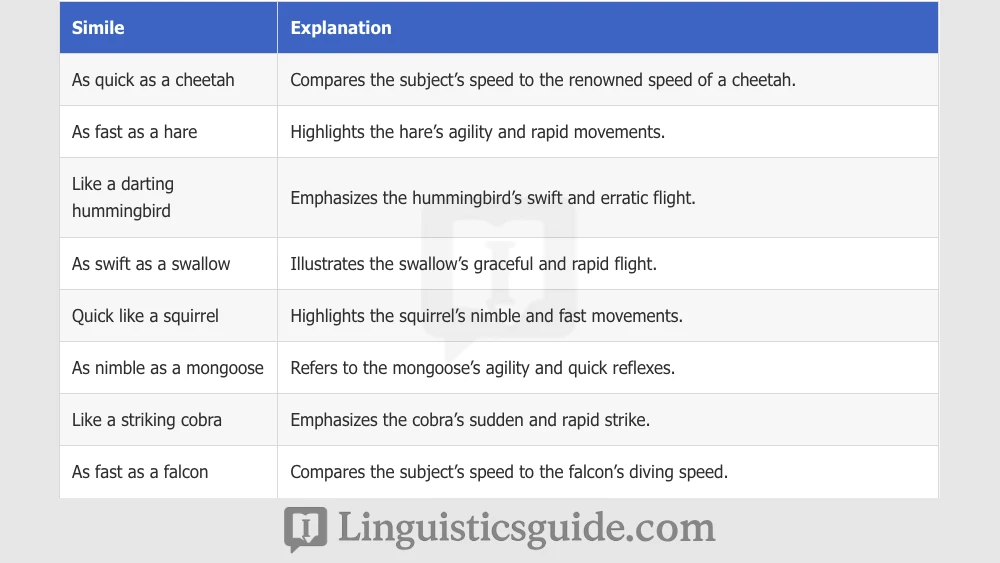
This table provides 30 examples of similes using animals to describe quickness. Each simile aims to create a vivid image of speed and agility by associating the subject with a fast-moving animal.
| Simile | Explanation |
|---|---|
| As quick as a cheetah | Compares the subject’s speed to the renowned speed of a cheetah. |
| As fast as a hare | Highlights the hare’s agility and rapid movements. |
| Like a darting hummingbird | Emphasizes the hummingbird’s swift and erratic flight. |
| As swift as a swallow | Illustrates the swallow’s graceful and rapid flight. |
| Quick like a squirrel | Highlights the squirrel’s nimble and fast movements. |
| As nimble as a mongoose | Refers to the mongoose’s agility and quick reflexes. |
| Like a striking cobra | Emphasizes the cobra’s sudden and rapid strike. |
| As fast as a falcon | Compares the subject’s speed to the falcon’s diving speed. |
| Quick like a cat | Highlights the cat’s agility and swift reactions. |
| As agile as a monkey | Refers to the monkey’s ability to move quickly and gracefully. |
| Like a leaping frog | Emphasizes the frog’s sudden and powerful jump. |
| As swift as a gazelle | Compares the subject’s speed to the gazelle’s rapid running. |
| Quick like a mouse | Highlights the mouse’s ability to dart quickly and unnoticed. |
| As fast as a spider | Refers to the spider’s quick movements when catching prey. |
| Like a diving hawk | Emphasizes the hawk’s speed and precision when diving. |
| As swift as an antelope | Compares the subject’s speed to the antelope’s graceful running. |
| Quick like a ferret | Highlights the ferret’s quick and agile movements. |
| As nimble as a weasel | Refers to the weasel’s ability to move quickly and stealthily. |
| Like a pouncing lion | Emphasizes the lion’s sudden and powerful pounce. |
| As fast as a racehorse | Compares the subject’s speed to the racehorse’s rapid gallop. |
| Quick like a dragonfly | Highlights the dragonfly’s agile and rapid flight. |
| As swift as a salmon | Refers to the salmon’s ability to swim quickly upstream. |
| Like a darting minnow | Emphasizes the minnow’s quick and erratic movements in water. |
| As fast as a greyhound | Compares the subject’s speed to the greyhound’s rapid running. |
| Quick like a grasshopper | Highlights the grasshopper’s ability to jump quickly and far. |
| As nimble as a gerbil | Refers to the gerbil’s quick and agile movements. |
| Like a striking rattlesnake | Emphasizes the rattlesnake’s sudden and rapid strike. |
| As swift as a peregrine falcon | Compares the subject’s speed to the peregrine falcon’s diving speed, one of the fastest animals on earth. |
| Quick like a gecko | Highlights the gecko’s ability to move quickly on various surfaces. |
| As agile as a lemur | Refers to the lemur’s ability to leap and move quickly through trees. |
Nature-Based Similes: 30 Examples
This table provides 30 examples of similes using elements of nature to describe quickness. These similes aim to evoke a sense of natural power and speed.
| Simile | Explanation |
|---|---|
| As quick as lightning | Compares the subject’s speed to the instantaneous flash of lightning. |
| As fast as the wind | Highlights the wind’s swift and unstoppable movement. |
| Like a falling star | Emphasizes the rapid descent of a meteor. |
| As swift as a river | Illustrates the river’s continuous and rapid flow. |
| Quick like a blink of an eye | Highlights the almost instantaneous nature of a blink. |
| As nimble as a sunbeam | Refers to the quick and fleeting nature of sunlight. |
| Like a shooting star | Emphasizes the sudden and rapid appearance of a meteor. |
| As fast as a tsunami | Compares the subject’s speed to the overwhelming speed of a tsunami. |
| Quick like melting snow | Highlights the rapid disappearance of snow in warm conditions. |
| As agile as a whirlwind | Refers to the whirlwind’s quick and erratic movement. |
| Like a rolling stone | Emphasizes the continuous and rapid movement of a rolling stone. |
| As swift as a waterfall | Compares the subject’s speed to the rapid descent of water. |
| Quick like a ripple in water | Highlights the rapid spread of a ripple. |
| As fast as a dust devil | Refers to the dust devil’s quick and swirling movement. |
| Like a bolt from the blue | Emphasizes the sudden and unexpected nature of lightning. |
| As swift as a landslide | Compares the subject’s speed to the rapid descent of earth. |
| Quick like morning dew evaporating | Highlights the rapid disappearance of dew in the morning sun. |
| As nimble as a gust of wind | Refers to the unpredictable and swift movement of wind. |
| Like a flash flood | Emphasizes the sudden and overwhelming speed of a flash flood. |
| As fast as erosion | Compares the subject’s speed to the gradual but relentless power of erosion. |
| Quick like a falling leaf | Highlights the unpredictable and swift descent of a leaf. |
| As swift as a summer storm | Refers to the sudden and intense nature of a summer storm. |
| Like a volcanic eruption | Emphasizes the sudden and explosive nature of an eruption. |
| As fast as a tidal wave | Compares the subject’s speed to the overwhelming speed of a tidal wave. |
| Quick like a spreading wildfire | Highlights the rapid and uncontrollable spread of a wildfire. |
| As nimble as a desert mirage | Refers to the fleeting and deceptive nature of a mirage. |
| Like a supernova | Emphasizes the explosive and sudden nature of a supernova. |
| As swift as a solar flare | Compares the subject’s speed to the rapid burst of energy from the sun. |
| Quick like a geyser eruption | Highlights the sudden and powerful eruption of a geyser. |
| As agile as a heatwave | Refers to the sudden and intense arrival of a heatwave. |
Technology-Based Similes: 20 Examples
This table provides 20 examples of similes using technology to describe quickness. These similes aim to associate the subject with modern advancements known for their speed and efficiency.
| Simile | Explanation |
|---|---|
| As quick as a bullet | Compares the subject’s speed to the high velocity of a bullet. |
| As fast as a rocket | Highlights the rocket’s rapid acceleration and speed. |
| Like a speeding train | Emphasizes the train’s fast and unstoppable movement. |
| As swift as a jet plane | Illustrates the jet plane’s high-speed flight. |
| Quick like a race car | Highlights the race car’s rapid acceleration and speed on the track. |
| As nimble as a drone | Refers to the drone’s agile and quick movements in the air. |
| Like a laser beam | Emphasizes the speed and precision of a laser beam. |
| As fast as data transfer | Compares the subject’s speed to the rapid transmission of digital information. |
| Quick like a computer processor | Highlights the processor’s ability to perform calculations rapidly. |
| As agile as a robot | Refers to the robot’s precise and quick movements. |
| Like a satellite orbiting Earth | Emphasizes the satellite’s constant and high-speed orbit. |
| As swift as a Formula 1 car | Compares the subject’s speed to the high-performance speed of a Formula 1 car. |
| Quick like a server response | Highlights the rapid response time of a computer server. |
| As fast as a 5G connection | Refers to the rapid speed of a 5G network connection. |
| Like an electric current | Emphasizes the almost instantaneous flow of electricity. |
| As swift as a digital download | Compares the subject’s speed to the rapid downloading of digital content. |
| Quick like a camera shutter | Highlights the rapid opening and closing of a camera shutter. |
| As nimble as a CNC machine | Refers to the precise and quick movements of a CNC machine. |
| Like a 3D printer | Emphasizes the speed and precision with which a 3D printer creates objects. |
| As fast as a quantum computer | Compares the subject’s speed to the unparalleled processing speed of a quantum computer. |
Usage Rules for Similes
Using similes effectively requires an understanding of certain rules and guidelines. These rules ensure that the simile is clear, relevant, and impactful.
- Relevance: The object of comparison should be relevant to the subject. The comparison should make sense and highlight a specific quality of quickness that is shared between the subject and the object.
- Clarity: The simile should be easily understood. Avoid using obscure or unfamiliar objects of comparison. The goal is to create a clear image in the reader’s or listener’s mind.
- Originality: While common similes can be effective, try to create original similes that offer a fresh and unique perspective. This can make your writing more engaging and memorable.
- Context: Consider the context in which the simile is being used. The simile should be appropriate for the tone and style of the writing or speech.
- Avoid Clichés: Be careful to avoid overused similes that have lost their impact due to overuse. Strive for originality to make your writing stand out.
- Logical Comparison: Ensure the comparison is logical and not contradictory. The shared characteristic of quickness should be evident and reasonable.
For example, comparing someone’s speed to a “snail” would be illogical and ineffective, as snails are known for their slowness. A more appropriate simile would be “as quick as a hare” or “as fast as lightning.”
Common Mistakes When Using Similes
Even with a good understanding of similes, it’s easy to make mistakes. Here are some common errors to avoid:
- Using incorrect comparison words: Confusing “like” and “as” or using other words that don’t create a direct comparison.
- Creating illogical comparisons: Comparing the subject to something that doesn’t share the quality being described.
- Using clichés: Relying on overused similes that lack impact.
- Being too vague: Not providing enough detail or context to make the simile clear.
- Overusing similes: Using too many similes in a short space, which can make the writing feel cluttered and distracting.
Here are some examples of common mistakes and their corrections:
| Incorrect | Correct | Explanation |
|---|---|---|
| He is quick than a turtle. | He is as quick as a hare. | “Than” is used for comparisons of inequality, not similes. The corrected version uses “as” to create a simile with a fast animal. |
| She runs quick like a rock. | She runs quick like the wind. | Rocks are not associated with speed. The corrected version uses “the wind,” which is associated with speed. |
| He was as quick as quick can be. | He was as quick as lightning. | The original sentence is redundant and lacks imagery. The corrected version provides a vivid comparison. |
| The response was like something. | The response was like a shot from a cannon. | The original sentence is too vague. The corrected version provides a clear and impactful comparison. |
Practice Exercises
Test your understanding of similes for “quick” with these practice exercises. Each exercise requires you to either identify the correct simile or create your own based on a given subject.
Exercise 1: Identifying Correct Similes
Choose the correct simile from the options provided.
| Question | Options | Answer |
|---|---|---|
| The car sped off ___________. | a) as slow as a snail, b) as quick as a bullet, c) as heavy as a rock | b) as quick as a bullet |
| Her response was ___________. | a) like a long wait, b) as quick as a flash, c) as calm as the sea | b) as quick as a flash |
| The athlete moved ___________. | a) like a resting bear, b) as swift as a gazelle, c) like a slow dance | b) as swift as a gazelle |
| His decision was made ___________. | a) as slow as molasses, b) as quick as lightning, c) as steady as a tree | b) as quick as lightning |
| The data transferred ___________. | a) like a paper airplane, b) as fast as a 5G connection, c) as constant as a dripping faucet | b) as fast as a 5G connection |
| The cat pounced ___________. | a) like a sleeping log, b) as quick as a striking cobra, c) as gentle as a lamb | b) as quick as a striking cobra |
| The news spread ___________. | a) as slow as winter, b) as fast as wildfire, c) as quiet as a mouse | b) as fast as wildfire |
| The chef chopped vegetables ___________. | a) as clumsy as an elephant, b) as quick as a computer processor, c) as dull as a rock | b) as quick as a computer processor |
| The runner sprinted ___________. | a) like a grounded bird, b) as swift as a racehorse, c) as tired as a sloth | b) as swift as a racehorse |
| The magician’s trick was ___________. | a) as confusing as a maze, b) as quick as a blink of an eye, c) as predictable as sunrise | b) as quick as a blink of an eye |
Exercise 2: Creating Similes
Create a simile for “quick” based on the given subject.
| Subject | Your Simile | Possible Answer |
|---|---|---|
| A cheetah | __________ | As quick as a cheetah chasing its prey. |
| A rocket | __________ | As fast as a rocket launching into space. |
| Lightning | __________ | As quick as lightning striking the ground. |
| A computer | __________ | As fast as a computer processing data. |
| A ninja | __________ | As nimble as a ninja evading capture. |
| A hummingbird | __________ | As swift as a hummingbird darting between flowers. |
| A Formula 1 Car | __________ | As fast as a Formula 1 car zooming around the track. |
| A snake | __________ | As quick as a striking snake. |
| A download | __________ | As swift as a high-speed download. |
| A server | __________ | As quick as a server responding to a request. |
Advanced Topics: Nuances and Subtleties
For advanced learners, understanding the nuances and subtleties of similes can further enhance their writing and speaking skills. This involves exploring the cultural and contextual implications of different similes, as well as using them in more complex and creative ways.
Cultural Context: Different cultures may have different associations with certain objects or animals. A simile that is effective in one culture may not be as meaningful or appropriate in another. For example, a simile involving a specific animal that is not native to a particular region may not resonate with the audience.
Subtlety and Suggestion: Similes can be used to create a sense of subtlety and suggestion, rather than explicitly stating a fact. By carefully choosing the object of comparison, the writer can imply certain qualities or characteristics without directly mentioning them.
Combining Similes: Advanced writers may combine multiple similes to create a more complex and layered description. This can add depth and richness to the writing, but it should be done carefully to avoid overwhelming the reader.
Frequently Asked Questions
Here are some frequently asked questions about similes for “quick,” along with detailed answers to help clarify any confusion.
- What is the difference between a simile and a metaphor?
A simile is a direct comparison using “like” or “as,” while a metaphor implies a comparison without using these words. For example, “He is as quick as a cheetah” is a simile, while “He is a cheetah on the field” is a metaphor.
- Can I use any object for comparison in a simile?
While you can use a wide range of objects, it’s important to ensure that the comparison is relevant and logical. The object should share a characteristic with the subject that is being described.
- How can I avoid using clichés in my similes?
To avoid clichés, try to think of fresh and original comparisons that haven’t been overused. Consider the specific qualities you want to emphasize and brainstorm objects that uniquely embody those qualities.
- Is it better to use “like” or “as” in a simile?
Both “like” and “as” can be used interchangeably in many cases, but subtle differences in connotation may make one more appropriate in certain contexts. “As” is often used for more formal or emphatic comparisons, while “like” can be more casual.
- How many similes should I use in a piece of writing?
There is no set limit, but it’s important to use similes judiciously. Overusing similes can make the writing feel cluttered and distracting. Use them sparingly and strategically to enhance your descriptions.
- Can I create similes using abstract concepts?
Yes, you can create similes using abstract concepts, but it’s important to ensure that the comparison is clear and understandable. Abstract similes can be very effective when used creatively and thoughtfully.
- How do I choose the best simile for a particular context?
Consider the tone and style of the writing, as well as the intended audience. Choose a simile that is appropriate for the context and that will resonate with the readers or listeners.
- What makes a simile effective?
An effective simile is clear, relevant, original, and appropriate for the context. It should create a vivid image in the reader’s or listener’s mind and enhance their understanding of the subject being described.
- How can I improve my ability to create similes?
Practice regularly, read widely, and pay attention to the similes used by other writers. Experiment with different objects of comparison and ask for feedback on your similes.
- Are there any specific types of writing where similes are particularly useful?
Similes are useful in a wide range of writing types, including descriptive writing, narrative writing, and poetry. They are particularly effective in creating vivid imagery and engaging the reader’s imagination.
Conclusion
Mastering similes for “quick” is a valuable skill that can significantly enhance your communication abilities. By understanding the structure, types, and usage rules of similes, you can create vivid and memorable descriptions that capture the essence of speed and agility.
Remember to practice regularly, avoid common mistakes, and strive for originality in your comparisons.
By incorporating these techniques into your writing and speaking, you’ll be able to convey your ideas more effectively and engage your audience on a deeper level. Continue to explore and experiment with similes to unlock their full potential and elevate your descriptive skills.
The ability to craft compelling similes is a testament to a strong command of language and a creative approach to expression.