
Understanding and using similes effectively can significantly enhance your descriptive writing and speaking skills. Similes allow you to create vivid comparisons, making your language more engaging and impactful.
This is especially true when describing something as loud, where a well-chosen simile can bring the sound to life for your audience. This article delves into the art of crafting similes for ‘loud,’ exploring various examples, usage rules, and common pitfalls.
Whether you’re a student, writer, or language enthusiast, this guide will equip you with the knowledge and tools to master the use of similes to describe loudness in compelling ways. By the end of this guide, you’ll be able to create clear, vivid, and accurate descriptions of loud sounds, enriching your writing and communication.
Off to College Deals

Save up to 30% on everything you need for the semester.
Contains affiliate link
This comprehensive guide is designed for English language learners, writers, and anyone seeking to improve their descriptive writing skills. Whether you’re preparing for an exam, working on a creative writing project, or simply looking to expand your vocabulary, this article will provide you with a solid foundation in using similes to describe loudness effectively.
Table of Contents
- Definition of Simile
- Structural Breakdown of Similes
- Types of Similes for Loud
- Examples of Similes for Loud
- Usage Rules for Similes
- Common Mistakes with Similes
- Practice Exercises
- Advanced Topics in Similes
- Frequently Asked Questions
- Conclusion
Definition of Simile
A simile is a figure of speech that compares two unlike things using the words “like” or “as.” It’s a powerful tool for creating vivid imagery and making abstract concepts more concrete. Similes are essential for adding depth and color to writing, allowing authors to paint a picture with words and evoke specific emotions or sensations in the reader. They help in making descriptions more relatable by connecting unfamiliar concepts to familiar ones. In essence, a simile bridges the gap between two different entities, highlighting a shared quality or characteristic.
The primary function of a simile is to enhance understanding and create a more engaging experience for the reader or listener. By drawing a comparison, the writer can clarify a complex idea or intensify a particular feeling.
Similes are not merely decorative; they serve a crucial role in communication by making language more precise and evocative. They are frequently used in literature, poetry, and everyday conversation to add flair and impact.
The effective use of similes demonstrates a strong command of language and an ability to think creatively.
Young Adults & Students:
Get 6 Months of Prime for $0

Ages 18-24 unlock exclusive perks including:
Contains affiliate link
In the context of describing loudness, similes are particularly useful. They allow you to convey the intensity and quality of a sound by comparing it to something else that is known for its loudness.
For example, saying a sound is “as loud as a jet engine” immediately gives the listener a sense of its magnitude. The effectiveness of a simile depends on the clarity and relevance of the comparison.
A well-chosen simile can transform a mundane description into something memorable and impactful. The choice of simile depends on the specific effect the writer wants to achieve, as different comparisons evoke different emotions and associations.
Structural Breakdown of Similes
A simile typically consists of three key components: the subject (the thing being described), the linking word (either “like” or “as”), and the comparison (the thing to which the subject is being compared). Understanding these components is crucial for constructing effective similes. The subject is what you are trying to describe, and the comparison is the element that provides a point of reference or similarity. The linking word acts as the bridge between the subject and the comparison, making the connection explicit.
The basic structure of a simile can be represented as: Subject + Linking Word + Comparison. For instance, in the simile “The thunder was as loud as a bomb,” “the thunder” is the subject, “as” is the linking word, and “a bomb” is the comparison. This structure allows for a clear and concise comparison, making it easy for the reader to understand the intended meaning. The order of these components can sometimes be varied for stylistic effect, but the core elements remain the same.
The strength of a simile lies in the relevance and clarity of the comparison. The more familiar and impactful the comparison, the more effective the simile will be.
When describing loudness, it’s important to choose comparisons that are universally recognized as loud. For example, comparing a sound to a whisper would be ineffective, while comparing it to an explosion would be highly impactful.
The choice of comparison should also be appropriate for the context and the audience. A simile that resonates with one audience may not be as effective with another.
Therefore, careful consideration should be given to the selection of the comparison to ensure maximum impact and clarity.
Types of Similes for Loud
Similes for describing loudness can be categorized based on the intensity and nature of the comparison. Here are some common types:
Similes Based on Natural Phenomena
These similes compare loudness to natural events that are known for their powerful sounds. Examples include thunder, storms, and volcanic eruptions.
They often evoke a sense of awe and intensity.
Similes Based on Mechanical Sounds
These similes use machines and technology as a point of comparison, such as jet engines, construction equipment, or sirens. They often convey a sense of harshness and artificiality.
Similes Based on Animal Sounds
These similes draw comparisons to the sounds made by animals, such as roars, howls, or screeches. They can add a primal or emotional quality to the description of loudness.
Similes Based on Explosions or Impacts
These similes compare loudness to the sounds of explosions, crashes, or impacts. They are particularly effective for conveying sudden, intense bursts of sound.
Similes Based on Human Activities
These similes relate loudness to human actions or events, such as concerts, rallies, or construction sites. They can provide a relatable and immediate sense of the sound’s intensity.
Examples of Similes for Loud
Here are several examples of similes for describing loudness, categorized by type.
Similes Based on Natural Phenomena
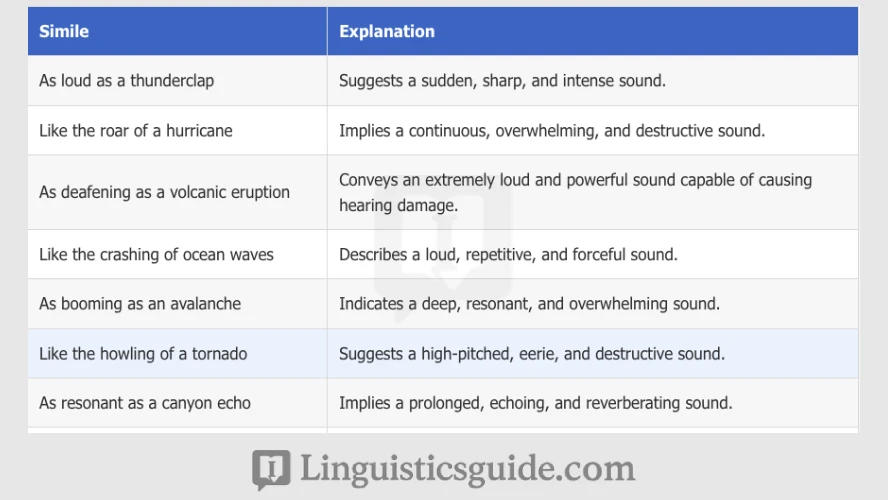
The following table provides examples of similes using natural phenomena to describe loudness. It includes a variety of natural events like thunderstorms, volcanic eruptions, and ocean waves, each known for their distinct and powerful sounds.
These comparisons aim to convey the intensity and scale of the sound being described, helping readers visualize the magnitude of the auditory experience.
| Simile | Explanation |
|---|---|
| As loud as a thunderclap | Suggests a sudden, sharp, and intense sound. |
| Like the roar of a hurricane | Implies a continuous, overwhelming, and destructive sound. |
| As deafening as a volcanic eruption | Conveys an extremely loud and powerful sound capable of causing hearing damage. |
| Like the crashing of ocean waves | Describes a loud, repetitive, and forceful sound. |
| As booming as an avalanche | Indicates a deep, resonant, and overwhelming sound. |
| Like the howling of a tornado | Suggests a high-pitched, eerie, and destructive sound. |
| As resonant as a canyon echo | Implies a prolonged, echoing, and reverberating sound. |
| Like the rumble of an earthquake | Describes a low, continuous, and ominous sound. |
| As piercing as a lightning strike | Conveys a sharp, sudden, and penetrating sound. |
| Like the crashing of a glacier calving | Suggests a massive, impactful, and resounding sound. |
| As intense as a solar flare | Implies an extremely powerful and overwhelming sound. |
| Like the rush of a waterfall | Describes a constant, powerful, and cascading sound. |
| As vibrant as a geyser eruption | Conveys an energetic, forceful, and explosive sound. |
| Like the whisper of a sandstorm (ironic) | Used ironically to emphasize an exceptionally loud sound, contrasting with a quiet sandstorm. |
| As echoing as a rain forest downpour | Suggests a dense, reverberating, and all-encompassing sound. |
| Like the crack of polar ice breaking | Describes a sharp, sudden, and powerful sound. |
| As omnipresent as the wind during a storm | Implies a sound that surrounds and fills the entire environment. |
| Like the reverberation of a meteor impact | Conveys a deep, resonating, and earth-shaking sound. |
| As alarming as a tsunami warning siren | Suggests an urgent, piercing, and attention-grabbing sound. |
| Like the chaotic symphony of jungle wildlife | Describes a complex, overwhelming, and cacophonous sound. |
| As dramatic as a cinematic score during a climax | Implies a sound that builds intensity and resonates deeply. |
| Like the overwhelming crescendo of a choir | Suggests a sound that gradually increases in volume and emotional impact. |
Similes Based on Mechanical Sounds
The following table provides examples of similes using mechanical sounds to describe loudness. These comparisons often involve machines, vehicles, and technology, which are known for their powerful and often harsh sounds.
The aim is to convey the intensity and sometimes the unpleasant nature of the sound being described, helping readers visualize and feel the auditory experience.
| Simile | Explanation |
|---|---|
| As loud as a jet engine | Suggests an extremely loud, high-pitched, and powerful sound. |
| Like the blare of a siren | Implies a piercing, attention-grabbing, and often alarming sound. |
| As deafening as a construction site | Conveys a chaotic, overwhelming, and continuous loud noise. |
| Like the roar of a motorcycle engine | Describes a deep, powerful, and aggressive sound. |
| As grating as a jackhammer | Indicates a harsh, repetitive, and irritating sound. |
| Like the shriek of train brakes | Suggests a high-pitched, screeching, and abrupt sound. |
| As deafening as a rock concert | Implies an overwhelmingly loud, amplified, and intense musical sound. |
| Like the blast of a factory whistle | Describes a loud, piercing, and attention-demanding sound. |
| As overpowering as a Formula 1 race | Conveys an extremely loud, high-speed, and intense sound. |
| Like the thrum of a helicopter rotor | Suggests a deep, rhythmic, and vibrating sound. |
| As intense as a welding arc | Implies a sharp, intense, and potentially harmful sound. |
| Like the hum of a power transformer | Describes a low, constant, and often unnoticed sound. |
| As ear-splitting as a chainsaw | Conveys an extremely loud, high-pitched, and dangerous sound. |
| Like the rumble of a garbage truck | Suggests a deep, grinding, and disruptive sound. |
| As startling as a car backfiring | Implies a sudden, unexpected, and loud sound. |
| Like the whir of a dentist’s drill | Describes a high-pitched, irritating, and unpleasant sound. |
| As pervasive as the noise of a busy airport | Conveys a constant, widespread, and overwhelming sound. |
| Like the clatter of a printing press | Suggests a repetitive, mechanical, and somewhat chaotic sound. |
| As jarring as a pneumatic drill | Implies a loud, disruptive, and physically felt sound. |
| Like the insistent beep of a smoke alarm | Describes a high-pitched, repetitive, and urgent sound. |
| As overwhelming as the roar of a stadium crowd | Suggests a unified, loud, and enthusiastic sound. |
| Like the deafening blast of a demolition explosion | Implies an incredibly powerful and destructive sound. |
Similes Based on Animal Sounds
The following table provides examples of similes using animal sounds to describe loudness. These comparisons leverage the distinct sounds of various animals, such as roars, screeches, and howls, to convey the intensity and character of the sound being described.
The aim is to create a vivid auditory experience by associating the sound with familiar animal noises.
| Simile | Explanation |
|---|---|
| As loud as a lion’s roar | Suggests a powerful, commanding, and intimidating sound. |
| Like the screech of an eagle | Implies a high-pitched, piercing, and sharp sound. |
| As deafening as a pack of wolves howling | Conveys a haunting, collective, and overwhelming sound. |
| Like the trumpet of an elephant | Describes a loud, resonant, and distinctive sound. |
| As grating as a parrot squawking | Indicates a harsh, repetitive, and irritating sound. |
| Like the hiss of a snake | Suggests a sharp, sibilant, and threatening sound. |
| As piercing as a cicada’s shrill | Implies a high-pitched, continuous, and often annoying sound. |
| Like the croak of a bullfrog | Describes a deep, guttural, and resonant sound. |
| As alarming as a crow cawing | Conveys a raucous, attention-grabbing, and often ominous sound. |
| Like the chatter of monkeys | Suggests a high-pitched, chaotic, and incessant sound. |
| As intense as a swarm of bees buzzing | Implies a collective, vibrating, and overwhelming sound. |
| Like the song of a whale | Describes a deep, melodic, and sometimes mournful sound. |
| As ear-splitting as a peacock’s call | Conveys an extremely loud, harsh, and attention-seeking sound. |
| Like the bellow of a buffalo | Suggests a deep, powerful, and commanding sound. |
| As startling as a dog barking | Implies a sudden, sharp, and attention-demanding sound. |
| Like the hoot of an owl | Describes a deep, resonant, and mysterious sound. |
| As pervasive as the chirping of crickets at night | Conveys a constant, widespread, and often soothing sound. |
| Like the growl of a bear | Suggests a deep, threatening, and powerful sound. |
| As jarring as a donkey braying | Implies a loud, harsh, and disruptive sound. |
| Like the insistent honking of geese | Describes a loud, repetitive, and attention-grabbing sound. |
| As overwhelming as the chorus of a frog pond | Suggests a collective, loud, and complex sound. |
| Like the deafening squawk of a flock of seagulls | Implies an incredibly loud and chaotic sound. |
Usage Rules for Similes
When using similes, it’s essential to follow certain rules to ensure clarity and effectiveness. Firstly, the two things being compared should be distinctly different.
A simile loses its impact if the comparison is too obvious or similar. Secondly, the comparison should highlight a specific shared quality or characteristic.
This shared quality should be relevant and contribute to the overall meaning of the description. Thirdly, the simile should be appropriate for the context and audience.
A simile that is too obscure or culturally specific may not be understood by everyone. Finally, avoid clichés.
Overused similes can make your writing sound unoriginal and uninspired.
Appropriateness: The chosen comparison should align with the tone and style of your writing. A simile that is too informal or humorous may not be suitable for a serious or academic context. Clarity: Ensure that the comparison is easily understood by your audience. Avoid using obscure or overly complex references that may confuse the reader. Originality: Strive for originality in your similes. While it’s acceptable to use common comparisons as a starting point, try to add your own creative twist to make them more unique and memorable. Relevance: The shared quality between the subject and the comparison should be significant and contribute to the overall meaning of the description. A random or irrelevant comparison will only detract from the effectiveness of the simile. Conciseness: Keep your similes concise and to the point. Avoid adding unnecessary details or embellishments that may dilute the impact of the comparison.
Consider the impact of your simile on the reader. Does it evoke the desired emotion or sensation?
Does it enhance understanding and create a more vivid image? By carefully considering these factors, you can ensure that your similes are both effective and engaging.
Common Mistakes with Similes
One common mistake is using similes that are too cliché. For example, “as loud as a bomb” is a frequently used simile that can lack originality.
Instead, try to come up with more unique and descriptive comparisons. Another mistake is using similes that don’t make sense or are illogical.
The comparison should be clear and relevant to the subject being described. For instance, saying “as loud as a whisper” is contradictory and ineffective.
Additionally, avoid mixing metaphors and similes. While both are figures of speech, they function differently, and combining them can create confusing and awkward sentences.
For example, “The sound was like a roaring fire that painted the sky” mixes a simile with a metaphor, which can be jarring for the reader.
Another frequent error is using similes that are too vague or general. A simile should provide specific information about the subject being described.
Saying “as loud as something big” doesn’t convey much information and is not very effective. Instead, be more precise and choose a comparison that is more descriptive and impactful.
Also, be mindful of your audience and avoid using similes that may be unfamiliar or confusing to them. Consider the cultural background and knowledge level of your readers when selecting your comparisons.
Finally, proofread your writing carefully to ensure that your similes are grammatically correct and make sense in the context of the sentence.
Incorrect Example: The noise was as loud as noise.
Correct Example: The noise was as loud as a freight train passing by.
Incorrect Example: Her voice was like a whisper that shook the room.
Correct Example: Her voice was like a foghorn in the night, cutting through the silence.
Incorrect Example: The explosion was as loud as a quiet mouse.
Correct Example: The explosion was as loud as a volcano erupting.
Practice Exercises
Test your understanding of similes with these practice exercises.
Exercise 1: Fill in the Blanks
Complete the following sentences with appropriate similes for “loud.”
| Question | Answer |
|---|---|
| The music was ________. | The music was as loud as a rock concert. |
| His shout was ________. | His shout was like a lion’s roar. |
| The thunder was ________. | The thunder was as loud as a cannon firing. |
| The construction noise was ________. | The construction noise was like a swarm of angry bees. |
| The siren was ________. | The siren was as loud as a tornado siren. |
| The crowd’s cheer was ________. | The crowd’s cheer was like a thunderous wave. |
| The explosion was ________. | The explosion was as loud as a dynamite blast. |
| The engine’s roar was ________. | The engine’s roar was like a dragon’s bellow. |
| The baby’s cry was ________. | The baby’s cry was as loud as a smoke alarm. |
| The argument was ________. | The argument was like a battlefield of yelling. |
Exercise 2: Create Your Own Similes
Write your own similes for “loud” based on the given scenarios.
| Scenario | Your Simile |
|---|---|
| Describe the sound of a busy airport. | Like the cacophony of a thousand conversations overlapping. |
| Describe the sound of a heavy metal concert. | As intense as being inside a jet engine. |
| Describe the sound of a fireworks display. | Like the sky itself is cracking open with each explosion. |
| Describe the sound of a demolition site. | As destructive and overpowering as an earthquake in slow motion. |
| Describe the sound of a political rally. | Like a hive of bees buzzing with fervent energy. |
| Describe the sound of a crowded marketplace. | As chaotic and vibrant as a jungle teeming with life. |
| Describe the sound of a train speeding by. | Like a metal dragon roaring through the night. |
| Describe the sound of a bowling alley. | As thunderous as a series of small explosions. |
| Describe the sound of a classroom full of children. | Like a symphony of organized chaos. |
| Describe the sound of a busy restaurant. | As lively as a concert hall before the performance begins. |
Exercise 3: Identify and Correct the Mistakes
Identify and correct the mistakes in the following similes.
| Incorrect Simile | Corrected Simile |
|---|---|
| The sound was as loud as a quiet mouse. | The sound was as loud as a roaring lion. |
| The noise was like silence. | The noise was like a freight train. |
| It was loud as a feather. | It was as loud as a thunderclap. |
| The music was loud like a soft breeze. | The music was loud like a hurricane. |
| The explosion was as loud as nothing. | The explosion was as loud as a volcano erupting. |
| The shout was like a mute person. | The shout was like a foghorn. |
| The cry was as loud as a sleeping baby. | The cry was as loud as a wailing banshee. |
| The engine’s roar was like a silent whisper. | The engine’s roar was like a dragon’s bellow. |
| The construction was as loud as a library. | The construction was as loud as a demolition site. |
| The party was as loud as a graveyard. | The party was as loud as a stadium concert. |
Advanced Topics in Similes
For advanced learners, exploring the nuances of simile construction can lead to more sophisticated and impactful writing. One advanced technique is the use of extended similes, where the comparison is developed over several sentences or even paragraphs. This allows for a more detailed and nuanced exploration of the shared qualities between the subject and the comparison. Another advanced topic is the use of subverted similes, where the expected comparison is deliberately twisted or contradicted to create a surprising or ironic effect. This can add a layer of complexity and wit to your writing. Additionally, exploring the cultural and historical context of similes can provide valuable insights into their meaning and impact. Similes often reflect the values and beliefs of the culture in which they are used, and understanding these cultural nuances can help you to use them more effectively.
Furthermore, consider the use of synesthesia in similes, where you combine different senses to create a more vivid and multi-sensory experience for the reader. For example, you might describe a sound as “as sharp as a lemon’s tang,” combining the sense of hearing with the sense of taste. This can add a unique and memorable quality to your writing. Experiment with different types of comparisons, such as abstract concepts, emotions, or even other figures of speech, to create unexpected and thought-provoking similes. The key is to be creative and to push the boundaries of language to create truly original and impactful descriptions.
Another advanced technique involves the strategic use of negative similes, which compare something to what it is *not* like. For example, “The silence was not like the gentle quiet of a library, but more like the vacuum after an explosion.” This can be particularly effective for emphasizing the absence of a quality or for highlighting a stark contrast. By mastering these advanced techniques, you can elevate your writing to a new level of sophistication and create similes that are both memorable and meaningful.
Frequently Asked Questions
- What is the difference between a simile and a metaphor?
A simile compares two things using “like” or “as,” while a metaphor directly equates two things without using these words. For example, “He is as brave as a lion” is a simile, while “He is a lion” is a metaphor.
- How can I avoid using clichés in my similes?
To avoid clichés, try to think of original and unexpected comparisons. Brainstorm different options and choose the one that is most specific and descriptive. Also, consider using less common words and phrases to make your simile more unique.
- What makes a simile effective?
An effective simile is clear, relevant, and impactful. It should highlight a specific shared quality between the two things being compared and create a vivid image in the reader’s mind. It should also be appropriate for the context and audience.
- Can a simile be too complex?
Yes, a simile can be too complex if it uses obscure references or overly complicated language. The comparison should be easily understood by the reader. If the simile is too difficult to decipher, it will lose its effectiveness.
- How do I choose the right comparison for my simile?
Consider the specific quality you want to emphasize and choose a comparison that strongly embodies that quality. Think about what the reader will easily recognize and understand. Also, consider the tone and style of your writing and choose a comparison that is appropriate for the context.
- Is it okay to use similes in formal writing?
Yes, similes can be used in formal writing, but they should be used sparingly and with careful consideration. Choose similes that are appropriate for the tone and style of the writing and avoid using clichés or overly informal comparisons.
- How can I improve my simile writing skills?
Practice writing similes regularly and experiment with different types of comparisons. Read widely and pay attention to how other writers use similes. Also, ask for feedback from others and be open to suggestions for improvement.
- What are some common categories of things to compare loudness to?
Common categories include natural phenomena (thunder, volcanoes), mechanical sounds (jet engines, sirens), animal sounds (roars, howls), explosions or impacts, and human activities (concerts, rallies).
- Can a simile be too obvious?
Yes, a simile can be too obvious if the comparison is too similar or predictable. The goal of a simile is to create a fresh and insightful comparison, so avoid using comparisons that are too commonplace or unoriginal.
- How important is the word choice in a simile?
Word choice is extremely important in a simile. The words you choose can significantly impact the effectiveness and impact of the comparison. Be precise and deliberate in your word choice, and consider the connotations and associations of each word.
Conclusion
Mastering the art of using similes to describe loudness can greatly enhance your writing and communication skills. By understanding the structure, types, and usage rules of similes, you can create vivid and impactful descriptions that bring sound to life for your audience.
Remember to avoid clichés, choose relevant and clear comparisons, and practice regularly to hone your skills. The effective use of similes demonstrates a strong command of language and an ability to think creatively.
This comprehensive guide has provided you with a solid foundation in using similes to describe loudness effectively. Whether you’re a student, writer, or language enthusiast, you now have the knowledge and tools to craft compelling and memorable descriptions of sound.
Continue to experiment with different types of comparisons and explore advanced techniques to further refine your skills. With practice and dedication, you can become a master of simile writing and elevate your writing to a new level of sophistication.
Remember to always consider your audience and the context in which you are writing. A well-crafted simile can transform a mundane description into something truly special, adding depth, color, and emotion to your words.
So go forth and unleash the power of similes to create vivid and unforgettable auditory experiences for your readers!

I’m James Terban, a teacher with a degree in Education and five years of experience working with students of all ages, from young kids learning their first grammar rules to adults picking up English as a second language. I started Linguistics Guide because I kept seeing good learners hit a wall due to explanations that were either too vague or too complicated. Every article here comes from a real question I have heard in a classroom or seen asked online.