
Understanding how to use similes effectively is crucial for enhancing your descriptive writing and adding color to your everyday speech. Similes, particularly those describing someone as “crazy,” can be both humorous and insightful, offering a vivid comparison that goes beyond literal language.
This article will guide you through the definition, structure, and usage of similes for “crazy,” providing numerous examples and practice exercises to help you master this aspect of English grammar. Whether you’re an ESL student, a writer looking to improve your craft, or simply someone interested in language, this comprehensive guide will equip you with the knowledge and skills to use similes with confidence and creativity.
Table of Contents
- Introduction
- Definition of Similes for “Crazy”
- Structural Breakdown of Similes
- Types of Similes for “Crazy”
- Examples of Similes for “Crazy”
- Usage Rules for Similes
- Common Mistakes When Using Similes
- Practice Exercises
- Advanced Topics in Simile Usage
- Frequently Asked Questions
- Conclusion
Introduction
Similes are powerful tools within the realm of figurative language, allowing us to paint vivid pictures with words by drawing comparisons between seemingly unrelated things. When used to describe someone as “crazy,” similes can convey a wide range of emotions, from amusement and lightheartedness to concern and even fear.
Mastering the art of using similes effectively not only enhances your writing and speaking skills but also deepens your understanding of how language can be used creatively. This article delves into the nuances of similes for “crazy,” providing you with a comprehensive guide to understanding, identifying, and using them correctly and imaginatively.
Definition of Similes for “Crazy”
A simile is a figure of speech that compares two unlike things using the words “like” or “as.” Its primary function is to create a vivid image or convey a deeper meaning by highlighting a shared characteristic between the two items being compared. When we use similes to describe someone as “crazy,” we’re not literally saying they are insane; instead, we’re using a comparison to emphasize their erratic, unpredictable, or unconventional behavior.
These similes can range from humorous and playful to more serious and critical, depending on the context and the specific comparison being made.
Essentially, similes for “crazy” fall under the broader category of descriptive similes, which aim to provide a more colorful and engaging description than a literal statement. They serve to amplify the degree of perceived insanity, eccentricity, or unconventionality.
The effectiveness of a simile lies in its ability to resonate with the audience, drawing on shared cultural understandings and experiences to create a memorable and impactful image. Thus, the choice of comparison is crucial in determining the overall effect of the simile.
Structural Breakdown of Similes
The basic structure of a simile is quite straightforward, typically following the pattern: A is like B or A is as [adjective] as B. In the context of similes for “crazy,” ‘A’ represents the person or entity being described as crazy, and ‘B’ represents the object, idea, or situation to which their behavior is being compared. The linking words “like” or “as” are essential components, signaling that a comparison is being made rather than a literal statement.
Let’s break down the structural elements with examples:
- Subject (A): The person being described (e.g., “He,” “She,” “My neighbor”)
- Linking Word: “like” or “as” (e.g., “is like,” “acts as”)
- Comparison (B): The object or concept used to illustrate craziness (e.g., “a loon,” “a headless chicken,” “a fruitcake”)
For example:
- He is like a cat on a hot tin roof.
- She acts as mad as a hatter.
- My neighbor is like a squirrel burying nuts for the winter.
The adjective in the “as…as” construction can further refine the comparison, adding another layer of descriptive detail. For instance, “He’s as unpredictable as a weather vane” uses the adjective “unpredictable” to emphasize a specific aspect of his “craziness.” The key to a successful simile is choosing a ‘B’ that clearly and effectively conveys the intended meaning of “crazy” in a relatable and impactful way.
Types of Similes for “Crazy”
Similes for “crazy” can be categorized based on the specific aspect of craziness they emphasize. Here are some common types:
Humorous Similes
These similes use lighthearted and often absurd comparisons to evoke laughter. They are typically used in informal settings and aim to entertain rather than criticize.
For example, “He’s like a one-legged cat in a sandbox” paints a funny picture of someone flailing around ineptly.
Exaggerated Similes
Exaggerated similes amplify the sense of craziness to an extreme degree, often using hyperbole for effect. These similes aim to emphasize the sheer magnitude of someone’s erratic behavior.
An example would be, “She’s as crazy as a soup sandwich,” implying that the person is beyond the pale, nonsensical, and totally out of line.
Descriptive Similes
These similes focus on providing a detailed and vivid description of the person’s behavior, highlighting specific actions or characteristics that contribute to their perceived craziness. For instance, “He’s like a hummingbird on caffeine” describes someone who is hyperactive and jittery.
Figurative Similes
Figurative similes use abstract or symbolic comparisons to convey a deeper meaning about the person’s mental state. These similes often require more interpretation and can be more thought-provoking than literal comparisons.
“She’s like a broken compass, always pointing in the wrong direction” suggests a sense of disorientation and confusion.
Examples of Similes for “Crazy”
Here are numerous examples of similes for “crazy,” categorized for clarity. Each category is designed to showcase the diversity and versatility of similes in conveying this particular concept.
Note how each simile uses “like” or “as” to draw a comparison, creating a more vivid and memorable image than a simple statement.
Humorous Similes:
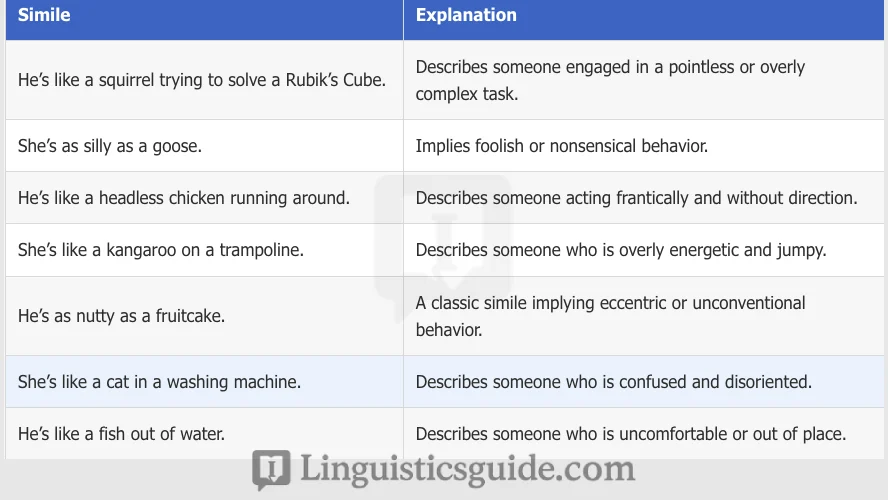
The following table provides examples of humorous similes used to describe someone as “crazy”. These similes are intended to be lighthearted and funny, often using absurd or unexpected comparisons.
| Simile | Explanation |
|---|---|
| He’s like a squirrel trying to solve a Rubik’s Cube. | Describes someone engaged in a pointless or overly complex task. |
| She’s as silly as a goose. | Implies foolish or nonsensical behavior. |
| He’s like a headless chicken running around. | Describes someone acting frantically and without direction. |
| She’s like a kangaroo on a trampoline. | Describes someone who is overly energetic and jumpy. |
| He’s as nutty as a fruitcake. | A classic simile implying eccentric or unconventional behavior. |
| She’s like a cat in a washing machine. | Describes someone who is confused and disoriented. |
| He’s like a fish out of water. | Describes someone who is uncomfortable or out of place. |
| She’s as daft as a brush. | A British English expression implying foolishness. |
| He’s like a dog chasing its tail. | Describes someone engaged in a futile or repetitive activity. |
| She’s as batty as a belfry. | Implies someone is eccentric or slightly insane. |
| He’s like a bumblebee in a jam jar. | Describes someone trapped and agitated. |
| She’s as loony as a tune. | Implies someone is eccentric and unpredictable. |
| He’s like a clown at a funeral. | Describes someone acting inappropriately in a serious situation. |
| She’s as bonkers as a bag of frogs. | Implies someone is utterly insane. |
| He’s like a monkey with a machine gun. | Describes someone unpredictable and dangerous. |
| She’s as mad as a box of frogs | Implies someone is completely crazy or eccentric. |
| He’s like a busted shopping cart wheel. | Describes someone who is erratic and unstable. |
| She’s as wacky as a waving inflatable arm flailing tube man. | Implies someone is eccentric and entertaining. |
| He’s like a caffeinated hummingbird. | Describes someone who is hyperactive and jittery. |
| She’s as screwy as a three-dollar bill. | Implies someone is odd, peculiar, or counterfeit. |
| He’s like a confused chameleon in a bag of Skittles. | Describes someone who is bewildered and out of place. |
| She’s as zany as a zebra in a tutu. | Implies someone is eccentric and amusing. |
| He’s like a chicken playing the banjo. | Describes someone doing something unconventional and amusingly inept. |
| She’s as dotty as a Dalmatian. | Implies someone is slightly eccentric and amusing. |
Exaggerated Similes:
The following table provides examples of exaggerated similes used to describe someone as “crazy”. These similes use hyperbole to emphasize the extreme nature of the person’s behavior.
| Simile | Explanation |
|---|---|
| He’s as crazy as a sack full of hammers. | Implies extreme craziness and unpredictability. |
| She’s like a tornado in a trailer park. | Describes someone who is destructive and chaotic. |
| He’s as mad as a hatter on a caffeine binge. | Implies extreme eccentricity and hyperactivity. |
| She’s like a runaway train. | Describes someone who is out of control and unstoppable. |
| He’s as loony as a left-handed monkey wrench. | Implies extreme foolishness and eccentricity. |
| She’s like a broken record stuck on repeat. | Describes someone who is repetitive and annoying. |
| He’s as off as a herd of turtles on a skateboard. | Implies extreme awkwardness and incompetence. |
| She’s like a walking, talking disaster. | Describes someone who consistently creates problems. |
| He’s as cracked as the Liberty Bell. | Implies someone is extremely flawed or damaged. |
| She’s like a supernova waiting to explode. | Describes someone with intense and unpredictable emotions. |
| He’s as unstable as a house of cards in a hurricane. | Implies someone is extremely volatile and prone to collapse. |
| She’s like a volcano about to erupt. | Describes someone with pent-up anger or frustration. |
| He’s as unhinged as a screen door in a windstorm. | Implies someone is erratic and unpredictable. |
| She’s like a wild fire spreading through dry grass. | Describes someone who is rapidly escalating out of control. |
| He’s as nutty as a truckload of almonds. | Implies someone is extremely eccentric or unconventional. |
| She’s like a pressure cooker ready to blow. | Describes someone who is about to lose their temper. |
| He’s as unpredictable as a lottery drawing. | Implies someone’s behavior is completely random. |
| She’s like a rogue wave crashing on the shore. | Describes someone who is powerful and destructive. |
| He’s as erratic as a broken washing machine. | Implies someone’s behavior is unpredictable and chaotic. |
| She’s like a runaway freight train barreling down the tracks. | Describes someone who is unstoppable and dangerous. |
| He’s as illogical as a screen door on a submarine. | Implies someone’s reasoning is completely nonsensical. |
| She’s like a ticking time bomb. | Describes someone who is about to explode with anger or frustration. |
| He’s as daft as a two-headed donkey. | Implies someone is extremely foolish or senseless. |
Descriptive Similes:
The following table provides examples of descriptive similes used to describe someone as “crazy”. These similes focus on specific behaviors or characteristics that contribute to the impression of craziness.
| Simile | Explanation |
|---|---|
| He talks like a man possessed. | Describes someone speaking with unusual intensity or fervor. |
| She laughs like a hyena. | Describes a loud, unsettling, or manic laugh. |
| He stares like a deer caught in headlights. | Describes someone who is bewildered and unable to react. |
| She moves like a puppet on strings. | Describes jerky, unnatural movements, often suggesting being controlled. |
| He acts like he’s got ants in his pants. | Describes someone who is restless and fidgety. |
| She dresses like a scarecrow. | Describes someone with an eccentric or haphazard sense of style. |
| He sings like a banshee. | Describes a loud, piercing, and unpleasant vocal performance. |
| She dances like a whirling dervish. | Describes someone who is spinning and moving erratically. |
| He eats like a ravenous wolf. | Describes someone who eats quickly and voraciously. |
| She sleeps like the dead. | Describes someone who sleeps very deeply and soundly, oblivious to surroundings. |
| He argues like a lawyer. | Describes someone who is skilled at debate and persuasion. |
| She worries like a mother hen. | Describes someone who is overly concerned and protective. |
| He plans like a mad scientist. | Describes elaborate, ambitious, and potentially dangerous schemes. |
| She schemes like a Bond villain. | Describes intricate and often malevolent plans. |
| He shouts like a town crier. | Describes someone who is loud and attention-seeking. |
| She whispers like a conspirator. | Describes someone who is secretive and suggestive. |
| He hides like a fugitive. | Describes someone who is paranoid and evasive. |
| She wanders like a lost soul. | Describes someone who is aimless and disoriented. |
| He fidgets like a child waiting for Christmas. | Describes someone who is restless and impatient. |
| She giggles like a schoolgirl. | Describes a high-pitched, nervous, or immature laugh. |
| He obsesses like a detective on a cold case. | Describes someone who is intensely focused on a particular issue. |
| She retaliates like a cornered animal. | Describes someone who is fiercely defensive when threatened. |
| He rants like a street preacher. | Describes someone who is delivering a passionate and often erratic speech. |
Usage Rules for Similes
Using similes effectively requires adhering to certain guidelines to ensure clarity, impact, and appropriateness. Here are some key usage rules:
- Ensure a Clear Connection: The comparison between the two things being compared (A and B) should be logical and understandable. The shared characteristic should be evident to the reader.
- Avoid Clichés: While some common similes are effective, overuse can make your writing stale. Strive for originality and creativity.
- Consider the Context: The appropriateness of a simile depends on the context of your writing or conversation. Humorous similes may not be suitable for serious situations.
- Maintain Consistency: Ensure that the simile aligns with the overall tone and style of your writing. Avoid jarring shifts in tone.
- Use Sparingly: Overusing similes can clutter your writing and diminish their impact. Use them strategically to highlight key points or create vivid images.
Exceptions: In creative writing, you might intentionally break these rules for stylistic effect. For example, using a deliberately absurd or nonsensical simile can create a surreal or humorous effect. However, such deviations should be deliberate and serve a clear purpose.
Common Mistakes When Using Similes
Even experienced writers can make mistakes when using similes. Here are some common errors to avoid:
- Using Tautologies: A tautology is a statement that is true by definition, making the simile redundant. Incorrect: “He’s as crazy as someone who is insane.” Correct: “He’s as crazy as a bag of cats.”
- Mixing Metaphors and Similes: Confusing metaphors and similes can create illogical comparisons. Incorrect: “He’s a crazy storm, like a tempest.” (This mixes a metaphor “crazy storm” with a simile). Correct: “He’s like a crazy storm.”
- Using Unclear Comparisons: If the connection between A and B is obscure or confusing, the simile will fail to resonate. Incorrect: “He’s as crazy as the color blue.” Correct: “He’s as crazy as a painter who only uses the color blue.” (Added context makes this a valid simile).
- Overusing Similes: Too many similes in a short space can dilute their impact and make your writing feel contrived.
Example Table of Correct vs. Incorrect Similes
| Incorrect Simile | Correct Simile | Explanation |
|---|---|---|
| He’s as crazy as a crazy person. | He’s as crazy as a street corner preacher. | The incorrect simile is tautological/redundant. |
| She’s a whirlwind, like a gentle breeze. | She’s like a whirlwind. | The incorrect simile creates a contradictory comparison. |
| He’s as crazy as Tuesday. | He’s as crazy as a Tuesday morning traffic jam. | The incorrect simile lacks a clear connection. |
Practice Exercises
Test your understanding of similes for “crazy” with these exercises:
Exercise 1: Identify the Similes
Identify the similes in the following sentences:
| Question | Answer |
|---|---|
| 1. He’s like a loose cannon, always causing trouble. | like a loose cannon |
| 2. She’s as mad as a wet hen. | as mad as a wet hen |
| 3. The car was moving fast. | No simile |
| 4. He acts like he’s lost his mind. | like he’s lost his mind |
| 5. She’s as nutty as a squirrel in autumn. | as nutty as a squirrel in autumn |
| 6. He’s like a bull in a china shop. | like a bull in a china shop |
| 7. The sun is bright today. | No simile |
| 8. She’s as eccentric as my aunt Mildred. | as eccentric as my aunt Mildred |
| 9. He’s like a dog with two tails. | like a dog with two tails |
| 10. He’s as bonkers as a clockwork orange. | as bonkers as a clockwork orange |
Exercise 2: Complete the Similes
Complete the following similes using your own creative comparisons:
| Question | Possible Answer |
|---|---|
| 1. He’s as crazy as a _____. | He’s as crazy as a mime in a library. |
| 2. She’s like a _____ when she’s angry. | She’s like a hornet’s nest when she’s angry. |
| 3. He acts like a _____. | He acts like a toddler who’s missed his nap. |
| 4. She’s as nutty as a _____. | She’s as nutty as a fruitcake at Christmas. |
| 5. He’s like a _____ on caffeine. | He’s like a hamster on caffeine. |
| 6. She’s as loony as a _____. | She’s as loony as a weather forecast. |
| 7. He’s like a _____ trying to fly. | He’s like a penguin trying to fly. |
| 8. She’s as batty as a _____. | She’s as batty as a belfry full of bats. |
| 9. He’s like a _____ lost in space. | He’s like a cosmonaut lost in space. |
| 10. She’s as wacky as a _____ at a tea party. | She’s as wacky as a walrus at a tea party. |
Exercise 3: Create Your Own Similes
Write your own similes for “crazy” based on the following scenarios:
- Describe a person who is constantly changing their mind.
- Describe someone who is obsessed with conspiracy theories.
- Describe a character who is acting erratically due to stress.
- Describe someone who is overly enthusiastic about a mundane topic.
- Describe someone who has a bizarre sense of humor.
- Describe someone who is completely out of touch with reality.
- Describe someone who is acting impulsively and without thinking.
- Describe someone who is stubbornly clinging to an outdated belief.
- Describe someone who is exhibiting signs of paranoia.
- Describe someone who is behaving in a completely unpredictable manner.
Advanced Topics in Simile Usage
For advanced learners, exploring more complex aspects of simile usage can further refine your writing skills. Here are some advanced topics:
- Extended Similes: Developing a simile over several sentences or paragraphs to create a more elaborate and detailed comparison.
- Subverted Similes: Intentionally using a simile that defies expectations or subverts conventional meaning for a surprising effect.
- Cultural Sensitivity: Being aware of cultural differences and avoiding similes that may be offensive or inappropriate in certain contexts.
- Originality and Innovation: Striving to create unique and memorable similes that showcase your individual style and perspective.
Frequently Asked Questions
- What is the difference between a simile and a metaphor?
A simile compares two things using “like” or “as,” while a metaphor directly equates two things without using those words. For example, “He’s like a lion” (simile) vs. “He is a lion” (metaphor). Metaphors state that something *is* something else, while similes only suggest that something *is similar* to something else.
- Why use similes instead of direct descriptions?
Similes add color, depth, and emotional resonance to your writing. They can make your descriptions more vivid, engaging, and memorable by creating a connection between the reader’s existing knowledge and the new information you’re presenting.
- How can I avoid using clichés in my similes?
Brainstorm unique and unexpected comparisons. Think about specific details and sensory experiences that relate to the concept you’re trying to convey. Read widely and pay attention to how other writers use figurative language. Consider the original meaning of the cliché and try to come up with a fresh analogy that captures the same idea in a new way.
- Are similes always appropriate?
No. Similes are most effective in creative writing, informal communication, and situations where you want to add emphasis or create a particular mood. In formal or technical writing, direct and literal language is often preferred.
- Can a simile be too complex?
Yes. If the comparison is too obscure or requires too much explanation, the simile will fail to resonate with the reader. Aim for a balance between originality and clarity. If your audience cannot understand the connection you’re trying to make, the simile will be ineffective.
- How do I choose the right “B” for my “A is like B” simile?
Consider the specific aspect of “A” that you want to emphasize. Choose a “B” that shares that characteristic in a clear and compelling way. Think about the connotations and associations that “B” evokes and whether they align with your intended meaning. If you’re aiming for humor, choose something absurd or unexpected. If you’re aiming for drama, choose something powerful or evocative.
- Can I use similes in poetry?
Absolutely! Similes are a common and effective tool in poetry, adding imagery, rhythm, and emotional depth to your verses. They can help create vivid mental pictures and evoke strong feelings in the reader.
- How can I practice using similes effectively?
Practice writing similes regularly. Start by brainstorming different comparisons for common concepts. Experiment with different types of similes (humorous, exaggerated, descriptive). Share your similes with others and ask for feedback. Read widely and pay attention to how other writers use similes in their work.
- Is it okay to mix different types of figurative language?
While it’s possible, it’s generally best to use different types of figurative language sparingly and intentionally. Mixing metaphors and similes carelessly can lead to confusing or illogical comparisons. However, a skilled writer can sometimes create a powerful effect by juxtaposing different types of figurative language in a deliberate way.
- Can similes be culturally specific?
Yes, similes can be culturally specific. What might be a common and easily understood comparison in one culture could be completely foreign or meaningless in another. It’s important to be aware of your audience and choose similes that will resonate with them.
Conclusion
Mastering similes, especially those relating to “crazy,” enhances your ability to communicate effectively and creatively. By understanding the structure, types, and usage rules of similes, you can add depth, color, and emotional resonance to your writing and speaking.
Remember to avoid clichés, consider your audience, and practice regularly to develop your skills. With careful attention and consistent effort, you can harness the power of similes to create vivid and memorable expressions.
Continue to explore different examples of similes in literature and everyday conversation. Pay attention to how skilled writers use similes to create specific effects.
Experiment with your own unique comparisons and don’t be afraid to break the rules occasionally for stylistic effect. The more you practice, the more confident and creative you will become in your use of similes.
Understanding these nuances allows for better communication and a deeper appreciation of the English language.