
Understanding the nuances of the English language is crucial for effective communication. Two words that often cause confusion are “rational” and “rationale.” While they sound similar and share a common root, their meanings and usage are quite distinct. Mastering the difference between “rational” and “rationale” will not only improve your vocabulary but also enhance your ability to express yourself with precision.
This article aims to provide a comprehensive guide to these two words, exploring their definitions, usage, common mistakes, and offering practical exercises to solidify your understanding. This guide is suitable for English language learners of all levels, from beginners to advanced speakers, as well as anyone looking to refine their grasp of English grammar and vocabulary.
Table of Contents
- Definition of Rational and Rationale
- Structural Breakdown
- Types or Categories
- Examples of Rational and Rationale in Sentences
- Usage Rules for Rational and Rationale
- Common Mistakes with Rational and Rationale
- Practice Exercises
- Advanced Topics
- Frequently Asked Questions
- Conclusion
Definition of Rational and Rationale
Off to College Deals

Save up to 30% on everything you need for the semester.
Contains affiliate link
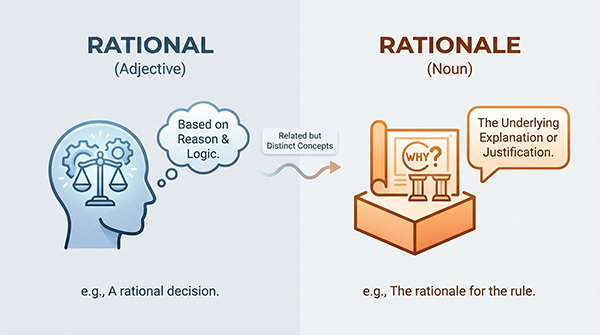
Many learners often wonder, “what is the difference between rational and rational?” The key is understanding that rational vs rationale meaning differs by grammatical role: rational is an adjective describing logical thought, while rationale is a noun explaining the underlying reason. A frequent question is, “is it rational or rationale?” — remember to use rational for decisions, behavior, or thinking, and rationale when providing justification.
Many learners ask how to spell rationale. The correct spelling is R-A-T-I-O-N-A-L-E, and remembering the final “-e” can help distinguish it from rational, which lacks the “-e.”
To effectively differentiate between “rational” and “rationale,” it’s essential to understand their individual meanings, grammatical classifications, and the contexts in which they are typically used. These words, while related, serve distinct purposes in the English language.
Rational
Here is a concise rational vs rationale definition: rational describes reasoning or logic behind an action, while rationale explains the reason or justification supporting it. Keeping this in mind avoids common mistakes in usage.
Rational is primarily an adjective. It describes something that is based on reason or logic, or someone who is capable of clear thought and sound judgment. It implies an absence of emotion or irrationality in decision-making or behavior. The word is derived from the Latin word “ratio,” meaning reason.
Young Adults & Students:
Get 6 Months of Prime for $0

Ages 18-24 unlock exclusive perks including:
Contains affiliate link
In essence, “rational” signifies:
- Being consistent with or based on reason.
- Having or exercising the ability to reason.
- Of sound mind; sane.
Rationale
Rationale is a noun. It refers to the underlying reason or justification for a particular decision, action, belief, or procedure. It explains why something is done or believed, providing a logical basis for it. The word also originates from the Latin “ratio.”
The core meaning of “rationale” encompasses:
- A set of reasons or a logical basis for a course of action or a particular belief.
- The fundamental principles or reasons upon which something is based.
- An explanation of controlling principles of opinion, belief, practice, or phenomena.
Understanding goal vs rationale can clarify writing and communication. A goal describes what you aim to achieve, while a rationale explains the reasoning behind pursuing that goal.
Similarly, disposition rational vs rationale highlights a subtle difference: a rational disposition refers to a person’s tendency to think logically, whereas rationale refers to the justification for their choices or actions. Keeping these distinctions in mind ensures precise usage in both professional and educational contexts.
Structural Breakdown
Understanding the structure of “rational” and “rationale” can further clarify their usage. “Rational” functions as an adjective, modifying nouns, while “rationale” acts as a noun, serving as a subject, object, or complement in a sentence.
Rational Structure
As an adjective, “rational” typically precedes the noun it modifies. It can also follow a linking verb (e.g., “is,” “are,” “was,” “were”) to describe the subject. “Rational” can also be modified by adverbs, such as “highly rational” or “perfectly rational.”
Here are some common patterns:
- Rational + Noun: A rational decision, a rational explanation, a rational person.
- Subject + Linking Verb + Rational: He is rational, the decision was rational.
- Adverb + Rational + Noun: A perfectly rational argument.
Rationale Structure
As a noun, “rationale” can function in various ways within a sentence. It can be the subject, the object of a verb, or the object of a preposition. It can also be modified by adjectives, such as “primary rationale” or “underlying rationale.”
Common patterns include:
- The rationale + Verb + …: The rationale behind the decision is clear.
- Verb + the rationale: He explained the rationale.
- Preposition + the rationale: Due to the rationale, we proceeded.
- Adjective + rationale: A compelling rationale.
Types or Categories
While “rational” and “rationale” don’t necessarily have distinct “types,” it’s useful to consider different contexts in which they are used to further clarify their meanings.
Rational: Contextual Categories
The adjective “rational” can be categorized based on the context in which it’s used:
- Decision-making: Describing a decision or choice based on logic and reason (e.g., a rational choice).
- Behavior: Describing actions or conduct that are reasonable and sensible (e.g., rational behavior).
- Thought process: Describing a way of thinking that is logical and coherent (e.g., a rational thought process).
- People: Describing individuals who are capable of rational thought (e.g., a rational person).
Rationale: Contextual Categories
The noun “rationale” can be categorized based on the area or subject it provides justification for:
- Policy: The rationale behind a particular government policy.
- Action: The rationale for taking a specific course of action.
- Belief: The rationale for holding a particular belief or opinion.
- Design: The rationale behind a specific design or plan.
Examples of Rational and Rationale in Sentences
To solidify your understanding, let’s examine numerous examples of “rational” and “rationale” used in various contexts. These examples are categorized for clarity.
Examples Using “Rational”
The following table provides examples of “rational” used as an adjective in different sentence structures.
| Sentence | Context |
|---|---|
| It was a rational decision, based on careful analysis. | Decision-making |
| His behavior was surprisingly rational under the circumstances. | Behavior |
| She approached the problem with a rational thought process. | Thought process |
| He is a rational person who always thinks things through. | People |
| The company made a rational investment in renewable energy. | Business |
| We need a rational approach to solving this problem. | Problem-solving |
| The scientist presented a rational explanation for the phenomenon. | Scientific Explanation |
| Her argument was rational and well-supported by evidence. | Argumentation |
| A rational consumer weighs the costs and benefits before making a purchase. | Consumer Behavior |
| The judge made a rational ruling based on the law. | Legal Context |
| It’s important to maintain a rational perspective during a crisis. | Crisis Management |
| The policy was designed to promote rational resource allocation. | Policy Making |
| His calm and rational demeanor helped to de-escalate the situation. | Conflict Resolution |
| The team developed a rational strategy for achieving their goals. | Strategic Planning |
| The economic model assumes that individuals are rational actors. | Economics |
| The teacher encouraged the students to think in a rational manner. | Education |
| The engineer designed a rational system for managing the water supply. | Engineering |
| The doctor made a rational diagnosis based on the patient’s symptoms. | Medicine |
| The philosopher explored the nature of rational thought. | Philosophy |
| The investor made a rational decision to diversify their portfolio. | Finance |
| The algorithm makes rational predictions based on the data. | Data Science |
| The diplomat sought a rational solution to the international dispute. | Diplomacy |
| The artist approached the project with a rational and methodical process. | Artistic Process |
| The urban planner designed a rational layout for the new city. | Urban Planning |
| The psychologist studied the factors that contribute to rational decision-making. | Psychology |
Examples Using “Rationale”
This table illustrates the use of “rationale” as a noun, providing the reasoning behind various actions and decisions.
| Sentence | Context |
|---|---|
| The rationale behind the new policy is to improve efficiency. | Policy |
| He explained the rationale for his decision to resign. | Action |
| The rationale for believing in climate change is based on extensive scientific evidence. | Belief |
| The rationale behind the design was to maximize space. | Design |
| What is the rationale for cutting the budget? | Budgeting |
| The company provided a detailed rationale for the merger. | Business |
| The teacher outlined the rationale for assigning the project. | Education |
| The rationale for the new law is to protect consumers. | Law |
| The scientist presented the rationale for his hypothesis. | Science |
| The rationale for investing in the stock market is the potential for high returns. | Finance |
| The rationale behind the security measures is to prevent unauthorized access. | Security |
| The rationale for the change in strategy was to adapt to the changing market conditions. | Strategic Planning |
| The rationale for the experiment was to test a new theory. | Scientific Experimentation |
| The rationale for the project was to improve the community’s infrastructure. | Community Development |
| The rationale for the marketing campaign was to increase brand awareness. | Marketing |
| The rationale for the training program was to enhance employee skills. | Human Resources |
| The rationale for the government’s intervention was to stabilize the economy. | Economics |
| The rationale for the ethical guidelines was to ensure responsible conduct. | Ethics |
| The rationale for the historical interpretation was based on new evidence. | History |
| The rationale for the artistic choice was to evoke a specific emotion. | Art |
| The rationale behind the architectural design was to create a sustainable building. | Architecture |
| The rationale for the medical treatment was to alleviate the patient’s symptoms. | Medicine |
| The rationale for the educational reform was to improve student outcomes. | Education Reform |
| The rationale for the software update was to fix bugs and improve performance. | Software Development |
| The rationale for the policy change was to address social inequality. | Social Policy |
Comparative Examples: Rational vs. Rationale
This table provides direct comparisons of “rational” and “rationale” to highlight their distinct uses.
| Sentence with “Rational” | Sentence with “Rationale” |
|---|---|
| He made a rational decision to sell his stocks. | The rationale for selling his stocks was to reduce risk. |
| Her rational arguments convinced the jury. | She provided a strong rationale for her client’s innocence. |
| It’s important to be rational when dealing with financial matters. | The rationale behind the investment strategy was to maximize long-term growth. |
| The company needs a rational plan to overcome the crisis. | The rationale for the restructuring plan was to improve efficiency. |
| The scientist presented a rational explanation of the phenomenon. | The rationale for the scientific theory was supported by empirical evidence. |
| A rational approach is needed to solve this complex problem. | The rationale for the project’s methodology was based on best practices. |
| Even in stressful situations, she remains rational and composed. | The rationale for her calm demeanor was her extensive experience in crisis management. |
| The committee sought a rational solution that would benefit everyone. | The rationale behind the compromise was to achieve a mutually beneficial outcome. |
| The engineer designed a rational system to manage resources efficiently. | The rationale for the design was to minimize waste and maximize productivity. |
| The economist proposed a rational model to explain market behavior. | The rationale for the economic model was to provide a clearer understanding of market dynamics. |
Usage Rules for Rational and Rationale
Proper usage of “rational” and “rationale” hinges on understanding their grammatical roles and the contexts in which they are appropriate. Here’s a comprehensive overview of the rules governing their use.
Rules for Using “Rational”
- Use “rational” as an adjective. It should modify a noun, describing it as being based on reason or logic.
- Ensure the noun being modified can logically be described as “rational.” For instance, a decision, a person, or an argument can be rational, but an object (like a table) generally cannot.
- Consider the context. “Rational” implies a lack of emotion or irrationality, so ensure this connotation is appropriate for the situation.
Rules for Using “Rationale”
- Use “rationale” as a noun. It should function as a subject, object, or complement in a sentence, representing the underlying reason or justification.
- Ensure the “rationale” explains why something is done or believed. It should provide a logical basis for an action, decision, or belief.
- Avoid using “rationale” to describe a person. It refers to the reasoning itself, not the person doing the reasoning.
Exceptions and Special Cases
While the rules are generally straightforward, there are some nuances to consider:
- “Rational” in mathematics: In mathematics, a rational number can be expressed as a fraction p/q, where p and q are integers and q ≠ 0. This is a specialized usage but still consistent with the idea of logic and order.
- “Rationalization”: While not directly related to “rationale,” the term “rationalization” (a psychological defense mechanism) involves creating seemingly rational explanations for behaviors or feelings that are actually driven by unconscious motives.
Common Mistakes with Rational and Rationale
One of the best ways to learn is by understanding and avoiding common mistakes. Here are some frequent errors made when using “rational” and “rationale,” along with corrections.
Mistakes with “Rational”
| Incorrect | Correct | Explanation |
|---|---|---|
| The rational for the decision was unclear. | The rationale for the decision was unclear. | “Rational” is an adjective; “rationale” is the correct noun. |
| He is a very rationale person. | He is a very rational person. | “Rational” is the adjective form. |
| She provided a rational for her actions. | She provided a rationale for her actions. | “Rational” cannot be used as a noun in this context. |
Mistakes with “Rationale”
| Incorrect | Correct | Explanation |
|---|---|---|
| He made a rationale decision. | He made a rational decision. | “Rationale” is a noun; “rational” is the adjective needed here. |
| The rationale person thought carefully. | The rational person thought carefully. | “Rationale” cannot describe a person; “rational” is the correct adjective. |
| The plan was very rationale. | The plan was very rational. | Here, we need the adjective ‘rational’ to describe the plan. |
Practice Exercises
Test your understanding of “rational” and “rationale” with these exercises. Each exercise focuses on different aspects of their usage.
Exercise 1: Fill in the Blanks
Fill in the blanks with either “rational” or “rationale.”
| Question | Answer |
|---|---|
| 1. The _________ behind the investment was to diversify the portfolio. | rationale |
| 2. It was a _________ decision to sell the house during the boom. | rational |
| 3. What is the _________ for implementing these new rules? | rationale |
| 4. He tried to provide a _________ explanation, but it didn’t make sense. | rational |
| 5. The company’s _________ for the merger was to increase market share. | rationale |
| 6. A _________ approach is needed to solve this problem effectively. | rational |
| 7. The _________ behind the design change was to improve usability. | rationale |
| 8. She remained _________ even in the face of adversity. | rational |
| 9. They needed a clear _________ for their actions. | rationale |
| 10. His _________ thinking helped him navigate the complex situation. | rational |
Exercise 2: Identify the Correct Word
Choose the correct word (“rational” or “rationale”) in each sentence.
| Question | Answer |
|---|---|
| 1. The (rational / rationale) for the experiment was to test the hypothesis. | rationale |
| 2. She made a (rational / rationale) choice to pursue her dreams. | rational |
| 3. What is the (rational / rationale) behind this decision? | rationale |
| 4. He presented a (rational / rationale) argument for his proposal. | rational |
| 5. The (rational / rationale) of the policy is to reduce pollution. | rationale |
| 6. It’s important to remain (rational / rationale) during a crisis. | rational |
| 7. The (rational / rationale) for the investment was based on market trends. | rationale |
| 8. A (rational / rationale) approach is necessary to solve this problem. | rational |
| 9. They demanded a clear (rational / rationale) for the changes. | rationale |
| 10. His (rational / rationale) thinking helped him find a solution. | rational |
Exercise 3: Sentence Completion
Complete the following sentences using “rational” or “rationale” in a grammatically correct and meaningful way.
| Question | Answer |
|---|---|
| 1. The company’s _________ for downsizing was to cut costs and improve profitability. | rationale |
| 2. A _________ person considers all the facts before making a decision. | rational |
| 3. The _________ for the new marketing campaign was to attract younger customers. | rationale |
| 4. It is important to approach the situation with a _________ mindset. | rational |
| 5. The _________ behind the design of the building was to maximize natural light. | rationale |
| 6. Despite the emotional pressure, she remained _________ and composed. | rational |
| 7. The _________ for the educational reform was to improve student outcomes and prepare them for the future. | rationale |
| 8. The team developed a _________ strategy based on data analysis and market research. | rational |
| 9. The _________ for the government’s intervention in the economy was to prevent a recession. | rationale |
| 10. The judge made a _________ decision based on the evidence presented in court. | rational |
Advanced Topics
For advanced learners, understanding the nuances of “rational” and “rationale” involves exploring their usage in more complex contexts and related concepts.
Philosophical Implications
In philosophy, the concept of rationality is central to discussions about knowledge, ethics, and decision-making. Rationality is often contrasted with empiricism (knowledge derived from sensory experience) and intuition (knowledge gained without conscious reasoning). Philosophers debate the extent to which human beings are truly rational and the role of emotions and biases in shaping our beliefs and actions.
Economic Rationality
In economics, the concept of “economic rationality” assumes that individuals make decisions to maximize their own self-interest. This assumption is used to build models of consumer behavior, market dynamics, and resource allocation. However, behavioral economics has challenged this assumption by showing that people often make irrational decisions due to cognitive biases, social influences, and emotional factors.
Rational Choice Theory
Rational choice theory is a framework used in social sciences to understand and model social and economic behavior. The theory posits that individuals make decisions by weighing the costs and benefits of different options and choosing the option that maximizes their expected utility. This theory has been applied to a wide range of phenomena, including voting behavior, criminal activity, and organizational decision-making.
Frequently Asked Questions
Here are some common questions about “rational” and “rationale,” along with detailed answers.
- What is the difference between “rational” and “reasonable”?
While both imply sound judgment, “rational” emphasizes logic and reason, while “reasonable” suggests fairness and moderation. A decision can be rational but not reasonable if it prioritizes logic over fairness. Similarly, a decision can be reasonable but not fully rational if it compromises on logical efficiency for the sake of acceptability.
Can “rationale” be used in plural form?
Yes, “rationales” is the plural form of “rationale.” It is used when referring to multiple sets of reasons or justifications. For example, “The company presented several rationales for the restructuring.”
Is it ever appropriate to use “rational” as a noun?
While “rational” is primarily an adjective, it can be used as a noun in specialized contexts, such as in philosophy or psychology, to refer to the capacity for rational thought or a rational being. However, this usage is rare and usually confined to academic or theoretical discussions.
How can I improve my understanding of when to use “rational” vs. “rationale”?
Practice is key. Try writing sentences using both words in different contexts. Pay attention to how they are used in written and spoken English. Additionally, consider using online grammar checkers and dictionaries to verify your usage.
Can “rationale” be replaced with “reason” in all cases?
While “rationale” and “reason” are similar, “rationale” often implies a more formal, comprehensive, and well-developed explanation than “reason.” “Reason” can be a simple justification, while “rationale” typically encompasses a broader set of principles and considerations.
Is there a difference in formality between “rational” and “rationale”?
“Rationale” tends to be more formal than “rational.” “Rational” is commonly used in everyday conversation, while “rationale” is often found in academic, professional, or official contexts.
What are some synonyms for “rational” and “rationale”?
Synonyms for “rational” include: logical, reasonable, sensible, sound, and coherent. Synonyms for “rationale” include: justification, explanation, grounds, basis, and reason.
How does the word “irrational” relate to “rational”?
“Irrational” is the antonym of “rational.” It means not based on reason or logic, or lacking the ability to think clearly. Understanding “irrational” can help clarify the meaning of “rational” by providing a contrasting concept.
Conclusion
Mastering the distinction between “rational” and “rationale” is crucial for precise and effective communication in English. “Rational,” as an adjective, describes something based on reason, while “rationale,” as a noun, provides the underlying justification.
By understanding their definitions, structural roles, and usage rules, you can avoid common mistakes and enhance your writing and speaking skills. Remember to practice using these words in various contexts to solidify your understanding and build confidence in your language abilities.
Continue to explore the nuances of English grammar and vocabulary to refine your communication skills further. Consistent practice and attention to detail will help you become a more proficient and articulate speaker and writer. With a solid grasp of these concepts, you’ll be well-equipped to express yourself clearly and persuasively in any situation.

I’m James Terban, a teacher with a degree in Education and five years of experience working with students of all ages, from young kids learning their first grammar rules to adults picking up English as a second language. I started Linguistics Guide because I kept seeing good learners hit a wall due to explanations that were either too vague or too complicated. Every article here comes from a real question I have heard in a classroom or seen asked online.