
Understanding the correct past tense of irregular verbs can be tricky for English language learners. One verb that often causes confusion is “put.” Is the past tense “put” or “putted”?
This article will comprehensively explore the correct past tense form of “put,” providing clear explanations, numerous examples, and practical exercises to help you master its usage. Whether you’re a beginner or an advanced learner, this guide will clarify the rules and common pitfalls associated with using “put” in the past tense.
Table of Contents
- Introduction
- Definition of ‘Put’
- Structural Breakdown
- Types and Categories of ‘Put’ Usage
- Examples of ‘Put’ in Different Tenses
- Usage Rules for ‘Put’
- Common Mistakes with ‘Put’
- Practice Exercises
- Advanced Topics: Phrasal Verbs with ‘Put’
- Frequently Asked Questions
- Conclusion
Introduction
Off to College Deals

Save up to 30% on everything you need for the semester.
Contains affiliate link
The English language is full of quirks, and irregular verbs are a prime example. These verbs don’t follow the standard pattern of adding “-ed” to form the past tense and past participle. “Put” belongs to this group, and its past tense form often surprises learners. Many incorrectly assume that “putted” is the past tense, perhaps influenced by regular verbs.
This article will demystify the past tense of “put,” providing a clear understanding of its correct usage and helping you avoid common errors. Mastering this seemingly simple verb will significantly improve your overall grammatical accuracy and fluency in English.
Definition of ‘Put’
The verb “put” is a versatile word with several meanings, but its core definition revolves around the act of placing something in a specific location or position. It is classified as an irregular verb because its past tense and past participle forms do not follow the standard “-ed” ending. Its function in a sentence is primarily as a transitive verb, meaning it typically takes a direct object. However, it can also be used intransitively in certain contexts. Understanding these different aspects of “put” is crucial for using it correctly.
Classification and Function
“Put” is fundamentally a verb of placement. It describes the action of setting something down, positioning it, or assigning it to a particular state. It’s a crucial verb for describing everyday actions and conveying spatial relationships. The verb can also be used to describe mental placement, such as “put your mind at ease”.
Contexts of ‘Put’ Usage
The contexts in which “put” can be used are exceptionally broad. It appears in everyday conversation, formal writing, and technical documentation. Here are some common scenarios where “put” is used:
Young Adults & Students:
Get 6 Months of Prime for $0

Ages 18-24 unlock exclusive perks including:
Contains affiliate link
- Physical Placement: Put the book on the table.
- Figurative Placement: Put your trust in me.
- Assigning State: Put the car in park.
- Expressing Ideas: How would you put it?
- Mathematical Contexts: Put x equal to 5.
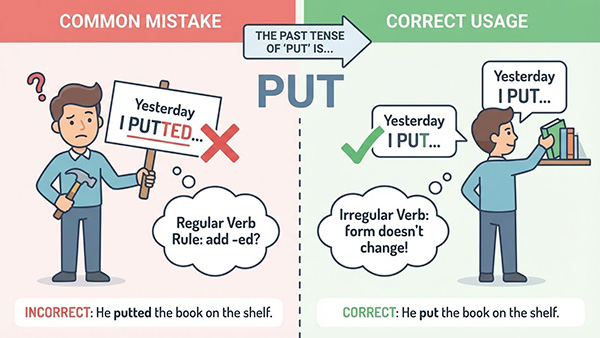
Many learners often wonder about the put past tense form, and it is important to clarify that put remains the same in both past simple and past participle. The phrase is putted a word is a common misconception—putted is not correct in any standard English context. Questions like i putted or i put are resolved by remembering that the correct form is always put.
To illustrate, here are several put past verb examples: “I put the keys on the table yesterday” or “She put her trust in him last week.” Understanding the past of put is straightforward once you know putted definition is simply invalid, and the past simple of put is always put. For clarity, when asked what is the past tense of put, the answer is consistently put
Structural Breakdown
The verb “put” is unique because its base form, past simple, and past participle are all the same: “put.” This simplicity can be deceptive, as it requires careful attention to context to determine the tense. Unlike regular verbs that change form with the addition of suffixes, “put” relies on auxiliary verbs or contextual clues to indicate tense.
Base Form (Present Tense)
The base form “put” is used in the present tense, especially with plural subjects or with the pronouns “I,” “you,” “we,” and “they.” In the third-person singular (he, she, it), the verb takes the form “puts.”
Example: I put the keys on the counter every day.
Past Simple (Past Tense)
The past simple form of “put” remains “put.” The tense is determined by context or the presence of time adverbs.
Example: Yesterday, I put the keys in my pocket.
Past Participle
The past participle form of “put” is also “put.” It’s used with auxiliary verbs like “have” or “be” to form perfect tenses or passive voice constructions.
Example: I have put the finishing touches on the project.
Types and Categories of ‘Put’ Usage
Understanding the different categories of “put” usage can help clarify its meaning and application. These categories include literal placement, figurative placement, and its use in phrasal verbs.
Literal Placement
This is the most straightforward use of “put,” involving the physical act of placing something in a particular location.
Example: She put the vase on the shelf.
Figurative Placement
In this context, “put” is used metaphorically to describe assigning someone to a role or situation, or expressing an idea in a certain way.
Example: He put me in a difficult position.
Phrasal Verbs with ‘Put’
“Put” combines with prepositions and adverbs to form numerous phrasal verbs, each with a unique meaning. Examples include “put off,” “put up with,” and “put down.”
Example: We had to put off the meeting until next week.
Examples of ‘Put’ in Different Tenses
To fully grasp the usage of “put,” it’s essential to see it in action across different tenses and contexts. The following tables provide a comprehensive set of examples to illustrate its versatility.
Present Tense Examples
The following table provides present tense examples, which help to illustrate how the base form of ‘put’ is used in various scenarios.
| Subject | Example Sentence | Explanation |
|---|---|---|
| I | I put my phone in my pocket every morning. | Describes a habitual action. |
| You | You put too much sugar in your coffee. | Expresses a general statement or observation. |
| He | He puts his keys on the table when he gets home. | Third-person singular form “puts.” |
| She | She puts a lot of effort into her work. | Third-person singular form “puts.” |
| It | It puts a strain on our relationship. | Third-person singular form “puts.” |
| We | We put our trust in you. | Describes a present state or belief. |
| They | They put their differences aside. | Describes a present action or decision. |
| I | I always put the milk back in the fridge. | Expressing a routine. |
| You | You put me in an awkward situation. | Describing a present consequence. |
| He | He puts on a brave face. | Expressing a present state. |
| She | She puts her heart and soul into her art. | Expressing dedication. |
| It | The company puts profits before people. | Expressing a company policy. |
| We | We put the needs of our children first. | Expressing a family value. |
| They | They put on a show every time they argue. | Expressing a habitual behavior. |
| I | I put my faith in the scientific method. | Expressing a personal belief. |
| You | You put too much pressure on yourself. | Expressing a concern. |
| He | He puts others before himself. | Expressing altruism. |
| She | She puts her own spin on everything. | Expressing individuality. |
| It | The government puts regulations in place to protect consumers. | Expressing a regulatory action. |
| We | We put a deadline on the project to keep it on track. | Expressing project management. |
| They | They put their heads together to solve the problem. | Expressing collaboration. |
Past Tense Examples
The following table provides past tense examples, which help to illustrate how the past simple form of ‘put’ is used in various scenarios. Note that it is identical to the base form.
| Subject | Example Sentence | Explanation |
|---|---|---|
| I | I put the letter in the mailbox yesterday. | Describes a completed action in the past. |
| You | You put your keys on the table last night. | Specifies when the action occurred. |
| He | He put the book back on the shelf after reading it. | Describes a sequential action. |
| She | She put her coat on and left the house. | Describes a series of actions. |
| It | It put a smile on my face. | Describes a past effect. |
| We | We put our differences aside and worked together. | Describes a collaborative effort. |
| They | They put a lot of effort into the project. | Describes a past investment. |
| I | I put my faith in him then, but I don’t anymore. | Expressing former trust. |
| You | You put me in a difficult position when you lied. | Describing a past consequence. |
| He | He put on a show to impress her. | Expressing past behavior. |
| She | She put her foot down and refused to compromise. | Expressing past firmness. |
| It | The rain put a damper on our picnic. | Expressing a past disruption. |
| We | We put our plan into action last week. | Expressing a past initiative. |
| They | They put their stamp on the project, making it unique. | Expressing past influence. |
| I | I put my heart and soul into that performance. | Expressing past dedication. |
| You | You put too much pressure on me yesterday. | Expressing past stress. |
| He | He put his career before his family. | Expressing past prioritization. |
| She | She put her own twist on the recipe. | Expressing past creativity. |
| It | The new law put restrictions on businesses. | Expressing past regulation. |
| We | We put a stop to the rumors spreading around the office. | Expressing past intervention. |
| They | They put the blame on me for the mistake. | Expressing past accusation. |
Past Participle Examples
The following table provides past participle examples, which help to illustrate how the past participle form of ‘put’ is used in various scenarios, typically with auxiliary verbs.
| Subject | Example Sentence | Explanation |
|---|---|---|
| I | I have put the groceries away already. | Used with “have” to form the present perfect tense. |
| You | You had put your phone on silent before the meeting. | Used with “had” to form the past perfect tense. |
| He | He has put a lot of time into this project. | Indicates completed action with present relevance. |
| She | She had put her keys in her purse before leaving. | Indicates action completed before another past action. |
| It | It has been put to good use. | Used in the passive voice. |
| We | We have put our trust in this company for years. | Indicates a continuing action that started in the past. |
| They | They had put all their savings into the business. | Indicates a completed investment in the past. |
| I | I have put my worries aside and decided to enjoy the moment. | Expressing a present decision based on a past action. |
| You | You have put me in a very awkward position with your request. | Expressing a present consequence of a past action. |
| He | He has put on a lot of weight since he quit exercising. | Expressing a present state resulting from a past change. |
| She | She has put her heart and soul into this performance. | Expressing a current state of dedication. |
| It | The company has put new policies in place to improve safety. | Expressing a current state of regulatory action. |
| We | We have put all our resources into finding a solution. | Expressing a current state of dedication to a task. |
| They | They have put their differences aside for the sake of the children. | Expressing a current state of cooperation. |
| I | I had put my name on the list weeks ago. | Expressing a past action with continued relevance. |
| You | You had put too much faith in her promises. | Expressing a past misjudgment. |
| He | He had put his career aspirations on hold to care for his family. | Expressing a past sacrifice. |
| She | She had put her own spin on the traditional dance. | Expressing a past creative adaptation. |
| It | The government had put strict regulations on the industry. | Expressing a past regulatory decision. |
| We | We had put a lot of effort into the fundraising campaign. | Expressing a past investment of effort. |
| They | They had put all the blame on him before the investigation. | Expressing a past misattribution of blame. |
Usage Rules for ‘Put’
The primary rule for using “put” is that its base form, past simple, and past participle are all the same. Therefore, context is crucial for determining the tense. Using time adverbs and auxiliary verbs correctly is essential.
Using Time Adverbs
Time adverbs like “yesterday,” “last week,” “ago,” or “in the past” clearly indicate that the action occurred in the past. In such cases, “put” is used in its past simple form.
Example: I put the documents on your desk yesterday.
Using Auxiliary Verbs
Auxiliary verbs like “have,” “had,” “is,” “was,” “are,” and “were” help to form perfect tenses and passive voice constructions. When used with these verbs, “put” is in its past participle form.
Example: The letter has been put in the mail.
Exceptions and Special Cases
There are no true exceptions to the rule that “put” remains the same in the past tense and past participle. However, understanding its use in phrasal verbs is essential, as the meaning can change significantly based on the preposition or adverb used.
Common Mistakes with ‘Put’
The most common mistake is using “putted” as the past tense of “put.” This is incorrect. Remember that “put” is an irregular verb that does not follow the standard “-ed” pattern.
| Incorrect | Correct | Explanation |
|---|---|---|
| I putted the book on the shelf. | I put the book on the shelf. | “Putted” is not a valid past tense form. |
| He has putted his heart into his work. | He has put his heart into his work. | The past participle is also “put.” |
Practice Exercises
Test your understanding of “put” with these practice exercises. Fill in the blanks with the correct form of “put.”
Exercise 1: Simple Tense
Fill in the blanks with the correct tense of “put”.
| Question | Answer |
|---|---|
| Yesterday, I ______ the keys in my bag. | put |
| She always ______ her phone on the charger at night. | puts |
| We have ______ a lot of effort into this project. | put |
| They ______ their differences aside and worked together. | put |
| I ______ the groceries away as soon as I got home. | put |
| You ______ me in a difficult position with your request. | put |
| He ______ his career before his family. | put |
| She ______ her own spin on the recipe. | put |
| The government ______ new regulations in place. | put |
| We ______ a stop to the rumors spreading around the office. | put |
Exercise 2: Identifying Correct Usage
Choose the correct sentence in each pair.
| Question | Answer |
|---|---|
| A) I putted the letter in the mailbox. B) I put the letter in the mailbox. | B) I put the letter in the mailbox. |
| A) She has putted her trust in him. B) She has put her trust in him. | B) She has put her trust in him. |
| A) He put the blame on me. B) He putted the blame on me. | A) He put the blame on me. |
| A) We had putted our plan into action. B) We had put our plan into action. | B) We had put our plan into action. |
| A) They put a lot of effort into the project. B) They putted a lot of effort into the project. | A) They put a lot of effort into the project. |
| A) I put the keys on the table yesterday. B) I putted the keys on the table yesterday. | A) I put the keys on the table yesterday. |
| A) You have put me in an awkward situation. B) You have putted me in an awkward situation. | A) You have put me in an awkward situation. |
| A) He puts others before himself. B) He putts others before himself. | A) He puts others before himself. |
| A) She puts her heart and soul into her art. B) She putts her heart and soul into her art. | A) She puts her heart and soul into her art. |
| A) It puts a strain on our relationship. B) It putts a strain on our relationship. | A) It puts a strain on our relationship. |
Exercise 3: Sentence Completion
Complete the sentences using the correct form of “put” and any necessary auxiliary verbs.
| Question | Answer |
|---|---|
| Before I left, I had ______ the documents in the safe. | put |
| She ______ her foot down and refused to compromise. | put |
| They have ______ a lot of money into that venture. | put |
| We ______ the plan into action last month. | put |
| He ______ on a brave face, even though he was scared. | put |
| I ______ my trust in her, and she didn’t disappoint me. | put |
| You should ______ more effort into your studies. | put |
| She always ______ the needs of others before her own. | puts |
| It ______ a smile on my face to see you succeed. | puts |
| We have ______ our differences aside for the sake of the team. | put |
Advanced Topics: Phrasal Verbs with ‘Put’
The verb “put” is frequently used in phrasal verbs, which combine “put” with a preposition or adverb to create a new meaning. Mastering these phrasal verbs is crucial for advanced English proficiency.
Put Off
Meaning: To postpone or delay.
Example: We had to put off the meeting until next week.
Put Up With
Meaning: To tolerate or endure something unpleasant.
Example: I can’t put up with his constant complaining.
Put Down
Meaning: To criticize or belittle someone.
Example: He always puts me down in front of my friends.
Put Out
Meaning: To extinguish (a fire), or to inconvenience someone.
Example: Please put out your cigarette before entering the building.
Put On
Meaning: To dress oneself, to deceive, or to stage a performance.
Example: She put on her coat and went outside.
Frequently Asked Questions
Is “putted” ever a correct form?
No, “putted” is never the correct past tense or past participle form of “put.” The correct form remains “put” in all tenses.
How do I know if “put” is in the past tense?
Context is key. Look for time adverbs (e.g., yesterday, last week) or other clues in the sentence that indicate the action occurred in the past. Additionally, consider the surrounding sentences for context to clarify the timing of the action.
Can “put” be used in the future tense?
Yes, “put” can be used in the future tense with the help of auxiliary verbs like “will” or “be going to.” For example, “I will put the book on your desk tomorrow.”
What is the difference between “put on” and “wear”?
“Put on” refers to the action of getting dressed, while “wear” describes the state of being dressed. For example, “I put on my coat” means I am in the process of dressing, while “I wear a coat” means I am currently dressed in a coat.
How are phrasal verbs with “put” formed?
Phrasal verbs with “put” are formed by combining “put” with a preposition (e.g., “on,” “off,” “up”) or an adverb (e.g., “down,” “out”). The combination creates a new meaning that is often different from the individual words.
Is “put” a transitive or intransitive verb?
“Put” is primarily a transitive verb, meaning it usually takes a direct object. However, it can be used intransitively in certain contexts, typically within phrasal verbs. For example, in the sentence “He put out the fire,” “fire” is the direct object. In a sentence like “I need to put out,” put out is used intransitively.
What are some common phrasal verbs using put?
Some common phrasal verbs using “put” include: put off (delay), put up with (tolerate), put down (criticize), put out (extinguish), put on (dress, deceive), put away (store). Each phrasal verb has a unique meaning and usage.
Can you give more examples of “put” in the passive voice?
Certainly! Here are a few examples: “The blame was put on him unfairly.” “The meeting has been put off until next week.” “The new regulations have been put in place to protect consumers.” In all these examples, ‘put’ is used in the passive voice with an auxiliary verb (was, has been) and indicates that the subject is receiving the action.
Conclusion
Mastering the past tense of “put” is essential for accurate and fluent English communication. Remember that the past tense and past participle of “put” are both “put,” and context is crucial for determining the tense. Avoid the common mistake of using “putted.” By understanding the usage rules, recognizing common errors, and practicing with examples, you can confidently use “put” in various contexts. Continue to expand your vocabulary and understanding of phrasal verbs with “put” to further enhance your English proficiency. Consistent practice and attention to detail will solidify your knowledge and improve your overall grammatical accuracy.

I’m James Terban, a teacher with a degree in Education and five years of experience working with students of all ages, from young kids learning their first grammar rules to adults picking up English as a second language. I started Linguistics Guide because I kept seeing good learners hit a wall due to explanations that were either too vague or too complicated. Every article here comes from a real question I have heard in a classroom or seen asked online.