

Understanding the nuances of simple words can significantly enhance your English communication. The terms “ok” and “okay” are common in everyday conversation and writing, but knowing when and how to use them correctly is essential for clarity and professionalism.
This article will delve into the definitions, usage rules, and common mistakes associated with “ok” and “okay,” providing you with the knowledge and practice needed to master their proper application. Whether you’re a student, a professional, or simply an English language enthusiast, this guide will equip you with the tools to use these terms confidently and accurately.
Table of Contents
- Introduction
- Definition of “Ok” and “Okay”
- Structural Breakdown
- Types and Categories of Usage
- Examples of “Ok” and “Okay” in Use
- Usage Rules for “Ok” and “Okay”
- Common Mistakes to Avoid
- Practice Exercises
- Advanced Topics
- Frequently Asked Questions
- Conclusion
Definition of “Ok” and “Okay”
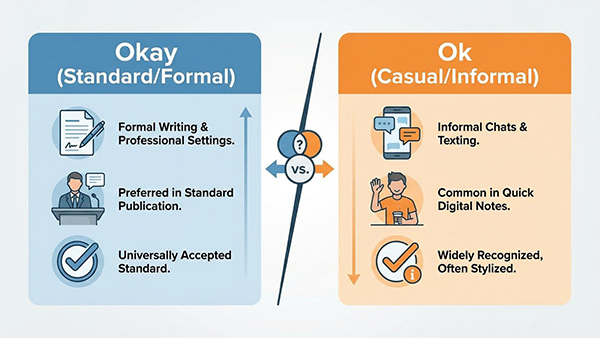 Both “ok” and “okay” function primarily as adverbs, adjectives, and interjections. As an adverb, they mean “all right” or “satisfactorily.” As an adjective, they describe something as being satisfactory or acceptable. As an interjection, they express agreement, acceptance, or understanding. The terms are interchangeable in most contexts, but subtle differences in formality and usage exist.
The origin of “ok” is widely attributed to a 19th-century fad for using abbreviations, where “ok” stood for “oll korrect,” a humorous misspelling of “all correct.” This playful origin contributed to its informal character.
Classification and Function
The word “okay” and its shorter form “ok” are incredibly versatile, fitting into several grammatical categories. Understanding these categories helps in grasping the breadth of their usage.
- Adverb: Modifying a verb to indicate acceptance or satisfactory completion. Example: “The plan works okay.”
- Adjective: Describing a noun as being acceptable or in a satisfactory condition. Example: “The food was okay.”
- Interjection: Expressing agreement, understanding, or acceptance. Example: “Ok, I understand.”
- Noun: (Less common) Indicating approval or permission. Example: “He gave the ok to proceed.”
Contexts of Use
“Ok” and “okay” are prevalent in various contexts, ranging from casual conversations to formal settings. However, the choice between the two can subtly influence the tone of the communication. In informal settings, “ok” is perfectly acceptable and often preferred due to its brevity. In more formal written communication, “okay” might be favored for its slightly more polished appearance. Understanding the context will guide you in making the appropriate choice.
Consider these scenarios:
- Casual Conversation: Text messages, informal emails, chats with friends.
- Business Communication: Emails to colleagues, presentations, reports.
- Academic Writing: Essays, research papers (generally avoided in very formal academic writing).
- Creative Writing: Novels, short stories, scripts.
Structural Breakdown
Both “ok” and “okay” are relatively simple in structure. “Ok” is a two-letter abbreviation, while “okay” is a four-letter word. There are no complex grammatical rules associated with their formation or usage.
The structural simplicity contributes to their ease of use and widespread adoption. The lack of inflections or variations simplifies their integration into different sentence structures. Whether used as an interjection, adverb, or adjective, they maintain their basic form.
Common Patterns
Here are a few common patterns in which “ok” and “okay” appear:
- Standalone Response: “Ok.” or “Okay.” (Expressing agreement or understanding)
- Adverbial Modifier: “The presentation went okay.” or “The presentation went ok.”
- Adjectival Descriptor: “Is everything okay?” or “Is everything ok?”
- Noun Usage: “He gave the okay.” or “He gave the ok.” (Less common)
Types and Categories of Usage
While the basic meaning of “ok” and “okay” remains consistent, their usage can be categorized based on the function they serve in a sentence.
As an Interjection
When used as an interjection, “ok” and “okay” express agreement, acceptance, or acknowledgment. They often stand alone or begin a sentence.
Examples:
- Ok, I’ll do it.
- Okay, I understand now.
- Ok, sounds good.
- Okay, let’s proceed.
As an Adverb
As adverbs, “ok” and “okay” modify verbs, indicating that an action is performed satisfactorily or acceptably.
Examples:
- The machine is working okay.
- The plan is progressing ok.
- The food tastes okay.
- The repairs seem to be holding up ok.
As an Adjective
When used as adjectives, “ok” and “okay” describe nouns, indicating that something is in a satisfactory or acceptable condition.
Examples:
- Is everything okay here?
- The weather is ok for a picnic.
- The report is okay, but it needs some revisions.
- Are you ok with this arrangement?
As a Noun
Although less common, “ok” and “okay” can function as nouns, referring to permission or approval.
Examples:
- He gave the ok to start the project.
- We need the okay from the manager before we can proceed.
- Without the ok, we can’t move forward.
- Getting the okay is the first step.
Examples of “Ok” and “Okay” in Use
To further illustrate the usage of “ok” and “okay,” let’s examine various examples in different contexts. The following tables provide a comprehensive overview of their application as interjections, adverbs, adjectives, and nouns.
Table 1: “Ok” and “Okay” as Interjections
This table shows examples of ‘ok’ and ‘okay’ being used as interjections, demonstrating their role in expressing agreement, understanding, or acceptance.
| Sentence | Context |
|---|---|
| Ok, I’ll be there in five minutes. | Arranging a meeting |
| Okay, that sounds like a good plan. | Agreeing to a suggestion |
| Ok, I understand your point. | Acknowledging someone’s opinion |
| Okay, let’s get started. | Initiating an activity |
| Ok, sounds good to me. | Expressing approval |
| Okay, I’ll take care of it. | Accepting responsibility |
| Ok, no problem. | Offering reassurance |
| Okay, that’s fine with me. | Expressing agreement |
| Ok, I’m ready when you are. | Indicating readiness |
| Okay, I’ll call you later. | Concluding a conversation |
| Ok, got it. | Confirming understanding |
| Okay, I see what you mean. | Gaining clarity |
| Ok, thanks for letting me know. | Expressing gratitude |
| Okay, I appreciate your help. | Acknowledging assistance |
| Ok, I’ll keep that in mind. | Noting a suggestion |
| Okay, I’ll give it a try. | Agreeing to attempt something |
| Ok, I’m on my way. | Indicating departure |
| Okay, I’ll see you soon. | Anticipating a meeting |
| Ok, that’s all for now. | Concluding a session |
| Okay, any questions? | Soliciting inquiries |
| Ok, next slide please. | Requesting the next slide in a presentation |
| Okay, let’s wrap this up. | Suggesting to finish a meeting or activity |
| Ok, I concur. | Expressing formal agreement |
| Okay, noted. | Acknowledging information |
| Ok, consider it done. | Assuring completion of a task |
Table 2: “Ok” and “Okay” as Adverbs
This table provides examples of ‘ok’ and ‘okay’ functioning as adverbs, showing how they modify verbs to indicate satisfactory performance or condition.
| Sentence | Context |
|---|---|
| The car is running okay now. | Describing the condition of a vehicle |
| The project is progressing ok. | Reporting on project status |
| The dinner tasted okay, but not great. | Evaluating the quality of food |
| The presentation went okay, considering the circumstances. | Assessing a presentation’s success |
| The new software seems to be working ok. | Evaluating software performance |
| The patient is recovering okay after surgery. | Describing a patient’s recovery |
| The weather is holding up okay for the outdoor event. | Assessing weather suitability |
| The experiment went okay, but we need more data. | Evaluating experimental results |
| The meeting went okay, but there are still unresolved issues. | Describing a meeting’s progress |
| The negotiations are proceeding ok. | Reporting on negotiation progress |
| The business is performing okay given the current market conditions. | Evaluating business performance |
| The repairs seem to be holding up ok. | Assessing the durability of repairs |
| The test results came back okay. | Reporting on test outcomes |
| The student is doing okay in the class. | Evaluating student performance |
| The relationship is progressing okay. | Describing relationship status |
| The system is functioning okay. | Reporting on system functionality |
| The product is selling okay. | Evaluating product sales |
| The team is working together ok. | Assessing team collaboration |
| The plan is working okay so far. | Evaluating plan effectiveness |
| The treatment is progressing ok. | Reporting medical progress |
| The new policy seems to be working okay. | Assessing policy effectiveness |
| The engine is running ok after the tune-up. | Describing engine performance |
| The event was managed okay despite the challenges. | Evaluating event management |
| The construction is proceeding okay. | Reporting on construction progress |
| The feedback was received okay. | Assessing feedback reception |
Table 3: “Ok” and “Okay” as Adjectives
This table showcases examples of ‘ok’ and ‘okay’ used as adjectives, illustrating their role in describing nouns as being in a satisfactory or acceptable condition.
| Sentence | Context |
|---|---|
| Is everything okay with you? | Inquiring about someone’s well-being |
| The weather is ok for a walk. | Assessing weather suitability |
| The report is okay, but it needs revisions. | Evaluating report quality |
| Are you ok with this decision? | Seeking agreement |
| The food at the restaurant was just okay. | Rating food quality |
| The movie was okay, but not memorable. | Evaluating a film |
| The hotel room was okay for the price. | Assessing accommodation quality |
| The service was okay, but slow. | Evaluating service quality |
| The performance was okay, but lacked energy. | Assessing a performance |
| The outcome was okay, considering the effort. | Evaluating results |
| The compromise was okay for both parties. | Assessing agreement suitability |
| The condition of the car is okay for its age. | Evaluating car condition |
| The arrangement is okay with me. | Expressing agreement |
| The situation is okay for now. | Assessing the current state |
| The solution is okay as a temporary fix. | Evaluating solution effectiveness |
| The compromise was ok with both sides. | Assessing agreement suitability |
| The response was okay given the circumstances. | Evaluating a reaction |
| The plan is okay as a starting point. | Assessing plan validity |
| The suggestion is okay, but needs refinement. | Evaluating a suggestion |
| The quality is okay for the price. | Assessing value for money |
| The salary is okay for an entry-level position. | Evaluating compensation |
| The progress is okay given the timeline. | Assessing advancement |
| The results are okay, but could be better. | Evaluating outcomes |
| The terms are okay for a short-term agreement. | Assessing contract suitability |
| The terms are okay for a short-term agreement. | Assessing contract suitability |
Table 4: “Ok” and “Okay” as Nouns
This table presents examples of ‘ok’ and ‘okay’ functioning as nouns, indicating permission or approval to proceed.
| Sentence | Context |
|---|---|
| We need the okay from the boss before we can proceed. | Seeking managerial approval |
| He gave the ok to start the project. | Granting project authorization |
| Without the okay, we can’t move forward. | Lacking necessary permission |
| Getting the ok is the first step. | Prioritizing approval acquisition |
| She gave the okay to release the report. | Authorizing document publication |
| They are waiting for the ok to begin construction. | Anticipating construction permission |
| The team received the okay to implement the new strategy. | Authorizing strategy implementation |
| We need to get the okay before we can announce the changes. | Seeking approval for announcements |
| The manager gave the ok to purchase the new equipment. | Authorizing equipment acquisition |
| The board gave the okay to proceed with the merger. | Authorizing merger proceedings |
| The scientist received the ok to publish the research. | Authorizing research publication |
| The committee gave the okay to approve the budget. | Authorizing budget approval |
| We need to get the ok from legal before we can finalize the contract. | Seeking legal authorization |
| The city council gave the okay to build the new park. | Authorizing park construction |
| The parents gave the ok for their child to participate. | Authorizing participation |
| The doctor gave the okay for the patient to be discharged. | Authorizing patient discharge |
| The pilot received the ok to take off. | Authorizing flight takeoff |
| The judge gave the okay to release the evidence. | Authorizing evidence release |
| The inspector gave the ok to open the restaurant. | Authorizing restaurant opening |
| The director gave the okay to start filming. | Authorizing filming commencement |
| The engineer received the ok to activate the system. | Authorizing system activation |
| The artist received the okay to display the artwork. | Authorizing artwork display |
| The author received the ok to publish the book. | Authorizing book publication |
| The developer received the okay to begin construction. | Authorizing construction start |
| The musician received the ok to release the album. | Authorizing album release |
Usage Rules for “Ok” and “Okay”
The usage rules for “ok” and “okay” are relatively straightforward. Both are acceptable in most contexts, but there are subtle nuances to consider.
Formality Considerations
In formal writing, “okay” is generally preferred. It is perceived as slightly more polished and professional than “ok.” In informal settings, such as text messages, emails to friends, and casual conversations, “ok” is perfectly acceptable and often favored for its brevity.
When discussing ok vs okay in writing, the primary distinction lies in tone rather than meaning. While both forms communicate the same idea, “okay” often appears more deliberate and polished in written contexts such as reports, articles, or professional emails. This subtle difference explains why many writers reserve “ok” for quick acknowledgments and prefer “okay” when clarity and presentation matter.
A common question is whether is ok or okay formal?, and the answer depends on context. Neither form is inherently formal, but “okay” is more acceptable in semi-formal writing, whereas “ok” is typically associated with casual or conversational tone.
Consistency within a Text
It’s essential to maintain consistency within a single piece of writing. If you choose to use “ok,” stick with it throughout the document. Similarly, if you opt for “okay,” use it consistently. Mixing both forms within the same text can appear inconsistent and unprofessional.
Grammatical Agreement
Ensure that “ok” and “okay” agree grammatically with the rest of the sentence. When used as adjectives, they should correctly modify the nouns they describe. When used as adverbs, they should appropriately modify the verbs.
Exceptions and Special Cases
There are no strict exceptions to the usage rules of “ok” and “okay.” However, certain contexts might favor one form over the other based on stylistic preferences or established conventions. For instance, some style guides might recommend “okay” for all formal writing, while others might allow “ok” in specific contexts.
Common Mistakes to Avoid
While “ok” and “okay” are relatively simple, some common mistakes can occur. Being aware of these errors can help you avoid them.
A frequent point of confusion for learners is okay or okey, particularly in informal writing and online communication. It’s important to note that “okey” is not a standard or accepted spelling in English. The correct forms are “ok,” “OK,” and “okay,” all of which carry the same meaning but vary in tone and formality.
Using “okey” may be perceived as a spelling error rather than a stylistic choice, especially in professional or academic contexts. To avoid misunderstandings or appearing careless, writers should always stick to the recognized spellings and reserve playful variations only for very casual or personal exchanges, if at all.
Table 5: Common Mistakes with “Ok” and “Okay”
This table demonstrates common errors made when using ‘ok’ and ‘okay’, along with their corrected versions to guide proper usage.
| Incorrect | Correct | Explanation |
|---|---|---|
| The report was ok, but needs some work. | The report was okay, but needs some work. | Using “okay” is slightly more formal in written text. |
| Okay, I will do it. Ok. | Okay, I will do it. Okay. | Maintaining consistency within the same sentence. |
| Is every thing ok? | Is everything ok? / Is everything okay? | Correcting the spelling of “everything.” |
| The machine workings ok. | The machine is working ok. / The machine is working okay. | Adding the necessary auxiliary verb “is.” |
| He give the ok to proceed. | He gave the ok to proceed. / He gave the okay to proceed. | Correcting the verb tense to “gave.” |
| Ok, sounds good. Okay! | Ok, sounds good. Ok! / Okay, sounds good. Okay! | Maintaining consistency in tone and formality. |
| Are you ok? I hope your ok. | Are you ok? I hope you’re ok. / Are you okay? I hope you’re okay. | Using the correct contraction “you’re” for “you are.” |
| The movie was ok, not amazing. | The movie was okay, not amazing. | Using “okay” for a slightly more polished feel. |
| The food tasted ok, but not great also. | The food tasted ok, but not great. / The food tasted okay, but not great. | Removing the redundant “also.” |
| It’s ok to do that. It’s okayy. | It’s ok to do that. It’s okay. / It’s okay to do that. It’s okay. | Correcting the spelling of “okay.” |
| The plans ok. | The plan is ok. / The plan is okay. | Adding the necessary verb “is”. |
| The situation is ok, but not ideal also. | The situation is ok, but not ideal. / The situation is okay, but not ideal. | Removing the redundant “also.” |
| Ok, thanks you! | Ok, thank you! / Okay, thank you! | Correcting the spelling to “thank you”. |
| He gave me ok for use the car. | He gave me ok to use the car. / He gave me okay to use the car. | Correcting the grammar to ‘to use’. |
| I’m ok, and you? | I’m ok, and you? / I’m okay, and you? | Ensuring sentence structure is correct by adding a question mark. |
Practice Exercises
To solidify your understanding of “ok” and “okay,” complete the following practice exercises.
Exercise 1: Choose the Correct Word
Select the correct word (“ok” or “okay”) to fill in the blanks in the following sentences. Provide a brief explanation for your choice.
Table 6: Practice Exercise 1
This table presents a practice exercise where you must choose between ‘ok’ and ‘okay’ to complete the sentences correctly, followed by the answers for self-assessment.
| Question | Answer | Explanation |
|---|---|---|
| 1. Is it ___________ if I leave early? | okay | More formal tone is better in this context. |
| 2. ___________, I’ll see you tomorrow. | Ok | Informal closing is acceptable. |
| 3. The food was ___________, but not great. | okay | Slightly more formal for written assessment. |
| 4. He gave the ___________ to start the project. | ok | Common usage as a noun. |
| 5. The machine is working ___________ now. | okay | More formal to describe the machine’s status. |
| 6. ___________, I understand your point. | Ok | Informal agreement. |
| 7. Is everything ___________? | okay | More formal inquiry. |
| 8. Just say ___________ if you agree. | ok | Informal agreement. |
| 9. The weather is ___________ for a picnic. | ok | Informal assessment. |
| 10. I received the ___________ from my manager. | okay | More formal in a business context. |
Exercise 2: Rewrite the Sentences
Rewrite the following sentences, replacing “ok” with “okay” or vice versa, as appropriate for the context.
Table 7: Practice Exercise 2
Here’s another practice exercise focused on rewriting sentences using ‘ok’ or ‘okay’ appropriately, along with the answers for you to check your work.
| Original Sentence | Rewritten Sentence |
|---|---|
| 1. Ok, let’s proceed with the meeting. | Okay, let’s proceed with the meeting. |
| 2. The report is okay, but needs revisions. | The report is ok, but needs revisions. |
| 3. Are you ok with this decision? | Are you okay with this decision? |
| 4. He gave the okay to start the project. | He gave the ok to start the project. |
| 5. The machine is working ok now. | The machine is working okay now. |
| 6. Okay, I understand your point. | Ok, I understand your point. |
| 7. Is everything ok? | Is everything okay? |
| 8. Just say okay if you agree. | Just say ok if you agree. |
| 9. The weather is okay for a picnic. | The weather is ok for a picnic. |
| 10. I received the ok from my manager. | I received the okay from my manager. |
Advanced Topics
For advanced learners, it’s beneficial to understand the historical context and evolving usage of “ok” and “okay.”
Historical Origins of “Ok”
As mentioned earlier, “ok” originated from a 19th-century fad for abbreviations, specifically “oll korrect.” This humorous origin contributed to its informal character and widespread adoption. Understanding this history provides insight into its continued informality.
Cross-Cultural Usage
The usage of “ok” and “okay” can vary across different English-speaking cultures. While they are generally understood and accepted, subtle differences in preference and formality might exist. Being aware of these variations can enhance your cross-cultural communication skills.
Frequently Asked Questions
Here are some frequently asked questions about the usage of “ok” and “okay.”
Is “ok” or “okay” more correct?
Both “ok” and “okay” are correct. “Okay” is generally considered more formal and is often preferred in written communication. “Ok” is more common in informal settings like text messages and casual conversations.
Can I use “ok” in a business email?
Yes, you can use “ok” in a business email, but “okay” might be a safer choice if you want to maintain a more professional tone. Consider your relationship with the recipient and the overall formality of the communication.
Is it ever wrong to use “ok” or “okay”?
It’s rarely “wrong” to use either “ok” or “okay,” but context matters. Avoid using “ok” in highly formal documents or situations where a more polished tone is required.
Which form is more common in American English?
Both forms are widely used in American English. “Ok” might be slightly more prevalent in informal settings, while “okay” is often favored in formal writing.
Are there any regional differences in usage?
While both forms are generally understood across different regions, there might be slight regional preferences. However, these differences are not significant enough to cause confusion.
Can “ok” or “okay” be used in academic writing?
It’s generally best to avoid “ok” and “okay” in formal academic writing. Opt for more formal alternatives like “acceptable,” “satisfactory,” or rephrase the sentence to avoid using these terms altogether.
What about using “OK” (all caps)?
Using “OK” in all caps is generally acceptable, especially for emphasis or in informal contexts. However, it can sometimes appear too forceful or informal, so use it judiciously.
Is it appropriate to use “ok” or “okay” in a thank you note?
Using “okay” in a thank-you note is more appropriate than “ok” as it is perceived as slightly more formal and polite. For example, “Okay, I received your gift.” would be more appropriate compared to “Ok, I received your gift.”
Conclusion
Understanding the subtle differences between “ok” and “okay” can significantly enhance your English communication. While both forms are generally interchangeable, being mindful of formality and context can help you choose the most appropriate option.
By mastering the usage rules and avoiding common mistakes, you can confidently use these terms in various settings, from casual conversations to professional communications. Remember to maintain consistency within your writing and consider your audience when making your choice.
Ultimately, effective communication is about clarity and appropriateness. By understanding the nuances of simple words like “ok” and “okay,” you can ensure that your message is conveyed accurately and professionally. Continue practicing and refining your understanding, and you’ll be well-equipped to navigate the complexities of the English language with confidence.