
Choosing the right words to describe someone is crucial for clear and effective communication. Words that start with “O” can add a unique flavor to your descriptions, conveying a range of qualities from positive attributes to neutral characteristics.
This article provides an in-depth exploration of “O” words used to describe people, focusing on their meanings, usage, and nuances. Whether you’re a student, writer, or simply someone looking to expand your vocabulary, this guide will equip you with the knowledge to use “O” words with confidence and precision.
When expanding your vocabulary, it’s helpful to explore words that start with o to describe someone. These words can range from personality traits to behavioral descriptions. Similarly, words that start with o that describe people provide writers and speakers with creative ways to portray individuals in both professional and casual contexts.
Learning words beginning with o to describe someone allows you to craft more vivid and precise character sketches. Focusing on o adjectives to describe a person ensures that your descriptions are accurate, nuanced, and engaging, whether in writing, conversation, or storytelling.
Table of Contents
- Introduction
- Definition of “O” Words to Describe Someone
- Structural Breakdown
- Types and Categories of “O” Words
- Examples of “O” Words in Sentences
- Usage Rules for “O” Words
- Common Mistakes When Using “O” Words
- Practice Exercises
- Advanced Topics
- Frequently Asked Questions (FAQ)
- Conclusion
Introduction
Describing people effectively is an essential skill in both written and spoken English. The words we choose paint a picture of a person’s character, personality, and overall impression. While many adjectives can be used, words starting with the letter “O” offer a specific and often overlooked set of options.
This article delves into the realm of “O” words that describe individuals, exploring their meanings, appropriate usage, and potential pitfalls. From optimistic to obnoxious, these words provide a diverse palette for painting vivid portraits of people.
Understanding these words can significantly enhance your ability to communicate clearly and precisely. Whether you’re writing a character description in a novel, providing feedback to a colleague, or simply engaging in everyday conversation, a well-chosen “O” word can add depth and nuance to your descriptions. This guide is designed for English language learners of all levels, writers seeking to enrich their vocabulary, and anyone interested in improving their communication skills.
Definition of “O” Words to Describe Someone
“O” words used to describe someone are adjectives or nouns that begin with the letter “O” and are used to characterize a person’s qualities, traits, or behaviors. These words can be either positive, neutral, or negative, depending on the specific meaning and context. They serve to provide a more detailed and nuanced understanding of an individual’s personality, appearance, or actions. These words help to better understand and describe people, enriching our interactions and communication.
The function of these words is primarily descriptive. They add detail and specificity to our understanding of a person. For instance, saying someone is “optimistic” provides a different impression than simply saying they are “happy.” The context in which these words are used is crucial. A word like “opinionated” can be seen as positive in a debate setting, suggesting someone is well-informed and articulate, but it might be viewed negatively in a team project if the person is unwilling to consider other perspectives.
Structural Breakdown
The structure of “O” words used to describe someone is generally straightforward. Most are adjectives that directly modify a noun (the person being described). For example, in the sentence “She is an optimistic person,” the adjective “optimistic” modifies the noun “person.” Some “O” words can also function as nouns, referring to a person who embodies a particular quality. For instance, “He is a true original,” where “original” acts as a noun.
Many of these words are derived from root words with prefixes or suffixes. For example, “obnoxious” comes from the Latin word “obnoxius,” meaning “liable” or “exposed.” Understanding the etymology of these words can often provide deeper insight into their meanings and nuances. Also, many “o” words are used as a direct description. For example, in the sentence “The child was **obedient** to his parents,” the ‘o’ word, obedient, is used to directly describe the child.
The grammatical structure is typically simple: adjective + noun (e.g., “outgoing personality”) or subject + verb + adjective (e.g., “He is observant”). The key is to ensure the word agrees with the subject in number and gender, where applicable. Also, sentence structure can change the word a bit. For example, instead of saying, “She is **ostentatious**,” you can say, “She has an **ostentatious** style.” While both use the same ‘o’ word, the sentence structure changes a bit.
Types and Categories of “O” Words
“O” words that describe someone can be categorized based on the nature of the qualities they convey. These categories help to understand the different shades of meaning and ensure appropriate usage.
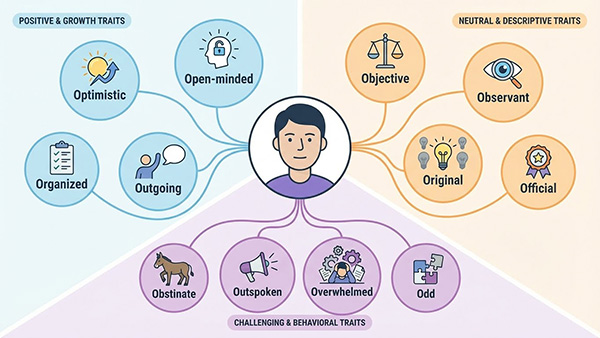
Among the “O” words, some stand out as particularly uplifting. Using positive words that start with o to describe a person can brighten descriptions and convey admirable traits. Examples include optimistic, outgoing, open-minded, and obliging.
These words emphasize qualities that are encouraging, approachable, and inspiring. Likewise, integrating positive words to describe someone starting with o in your writing or speech adds clarity and positivity, helping your audience understand not just who the person is, but the admirable aspects of their character.
Positive Qualities
This category includes words that describe admirable or desirable traits. These words are typically used to praise or commend someone. These words are often used to describe someone we admire or respect.
Examples include: Optimistic (having a positive outlook), Open-minded (receptive to new ideas), Outgoing (sociable and friendly), Observant (attentive to detail), Orderly (organized and methodical), Outstanding (remarkable and exceptional), Obliging (willing to help), Original (unique and creative), Obedient (following rules and instructions), and Omniscient (having complete knowledge – often used hyperbolically).

Neutral Qualities
This category includes words that describe traits that are neither inherently positive nor negative. Their connotation depends on the context and the speaker’s perspective. These words are often used to describe someone as a matter of information.
Examples include: Objective (impartial and unbiased), Official (formal and authorized), Ordinary (common and unremarkable), Opinionated (holding strong beliefs), Occupied (busy and engaged), Older (advanced in age), Only (sole or singular), Overseas (from another country), Overdressed (dressed too formally), and Overqualified (having more qualifications than necessary).
Negative Qualities
This category includes words that describe undesirable or unfavorable traits. These words are typically used to criticize or express disapproval. These words are often used to describe someone we dislike or disagree with.
Examples include: Obnoxious (extremely unpleasant), Obstinate (stubborn and inflexible), Obese (excessively overweight), Obtuse (slow to understand), Overbearing (domineering and bossy), Officious (assertive of authority in an annoying way), Onerous (burdensome and oppressive), Oppressive (harsh and tyrannical), Opportunistic (taking advantage of situations), and Ostentatious (showy and pretentious).
Examples of “O” Words in Sentences
To further illustrate the usage of “O” words to describe someone, here are examples organized by category. These examples provide context and demonstrate how these words can be incorporated into sentences.
Positive Examples
The following table showcases positive “O” words used to describe individuals, providing context and clarity for their application.
| Word | Example Sentence | Explanation |
|---|---|---|
| Optimistic | She is an optimistic person, always seeing the best in every situation. | Describes someone who maintains a positive outlook. |
| Open-minded | He is very open-minded and willing to consider different perspectives. | Describes someone receptive to new ideas and opinions. |
| Outgoing | Sarah is an outgoing individual who makes friends easily. | Describes someone who is sociable and enjoys interacting with others. |
| Observant | The detective was highly observant, noticing even the smallest details. | Describes someone who is attentive and perceptive. |
| Orderly | He is an orderly person, keeping his workspace neat and organized. | Describes someone who is organized and methodical. |
| Outstanding | She is an outstanding student, consistently achieving top grades. | Describes someone who is exceptional and remarkable. |
| Obliging | He is always obliging, willing to go out of his way to help others. | Describes someone who is helpful and accommodating. |
| Original | The artist is known for his original and innovative creations. | Describes someone who is unique and creative. |
| Obedient | The dog was very obedient, following every command. | Describes someone who follows rules and instructions. |
| Omniscient | The narrator in the novel seemed almost omniscient, knowing everything about the characters. | Describes someone with complete knowledge (often used hyperbolically). |
| Overjoyed | The children were overjoyed when they learned they were going to Disney World. | Describes someone who is extremely happy. |
| Overpowering | Her overpowering kindness made everyone feel welcome. | Describes someone whose positive qualities are very strong. |
| Outstanding | The team celebrated their outstanding performance with a dinner party. | Describes someone whose performance is exceptional. |
| Openhearted | Her openhearted nature made her a beloved member of the community. | Describes someone who is generous and kind. |
| Original | The designer’s original ideas set her apart from her peers. | Describes someone who has unique and creative ideas. |
| Observant | He is an observant scientist, carefully noting every detail of the experiment. | Describes someone who is attentive and perceptive. |
| Optimistic | Despite the challenges, she remained optimistic about the future. | Describes someone who maintains a positive outlook. |
| Outgoing | As an outgoing ambassador, she was able to build strong international relationships. | Describes someone who is sociable and enjoys interacting with others. |
| Obedient | The obedient soldiers followed their commander’s orders without question. | Describes someone who follows rules and instructions. |
| Open-minded | The open-minded professor encouraged students to challenge conventional wisdom. | Describes someone receptive to new ideas and opinions. |
Neutral Examples
The following table illustrates neutral “O” words used to describe individuals, showing how they can provide factual information without implying positive or negative judgment.
| Word | Example Sentence | Explanation |
|---|---|---|
| Objective | The journalist tried to remain objective in reporting the news. | Describes someone who is impartial and unbiased. |
| Official | He is the official spokesperson for the company. | Describes someone who is formally authorized. |
| Ordinary | She described herself as an ordinary person with no special talents. | Describes someone who is common and unremarkable. |
| Opinionated | He is quite opinionated and always ready to share his views. | Describes someone who holds strong beliefs. |
| Occupied | She is occupied with several projects and has little free time. | Describes someone who is busy and engaged. |
| Older | He is the older of the two brothers. | Describes someone who is advanced in age. |
| Only | She is the only child in her family. | Describes someone who is sole or singular. |
| Overseas | He is an overseas worker, employed in another country. | Describes someone who is from another country. |
| Overdressed | She felt overdressed for the casual party. | Describes someone who is dressed too formally. |
| Overqualified | He was considered overqualified for the entry-level position. | Describes someone who has more qualifications than necessary. |
| Overworked | The doctor was overworked due to the high number of patients. | Describes someone who is working too much. |
| Open | The store owner was open to suggestions from his customers. | Describes someone who is receptive to new ideas. |
| Organized | The professor was very organized, which helped the students learn. | Describes someone who is methodical and structured. |
| Original | The artist created an original piece for the show. | Describes someone who is unique and creative. |
| Outgoing | The outgoing representative visited many countries to spread the company’s message. | Describes someone who is sociable and enjoys interacting with others. |
| Objective | The objective observer watched the argument without taking sides. | Describes someone who is impartial and unbiased. |
| Older | The older sister took on a caretaker’s role for her siblings. | Describes someone who is advanced in age. |
| Overseas | The overseas consultant brought unique experience to the project. | Describes someone who is from another country. |
| Official | Only the official spokesperson could make the announcement. | Describes someone who is formally authorized. |
| Overqualified | Although overqualified, he took the job for the experience. | Describes someone who has more qualifications than necessary. |
Negative Examples
The following table presents negative “O” words used to describe individuals, illustrating how they convey unfavorable traits and characteristics.
| Word | Example Sentence | Explanation |
|---|---|---|
| Obnoxious | His obnoxious behavior made him unpopular with his colleagues. | Describes someone who is extremely unpleasant. |
| Obstinate | She is an obstinate person who refuses to change her mind. | Describes someone who is stubborn and inflexible. |
| Obese | The doctor warned him that he was obese and needed to lose weight. | Describes someone who is excessively overweight. |
| Obtuse | He is often obtuse and slow to understand simple concepts. | Describes someone who is slow to understand. |
| Overbearing | His overbearing personality made it difficult to work with him. | Describes someone who is domineering and bossy. |
| Officious | The officious security guard insisted on checking everyone’s ID. | Describes someone who is assertive of authority in an annoying way. |
| Onerous | The task was so onerous that no one wanted to take it on. | Describes something that is burdensome and oppressive. |
| Oppressive | The oppressive regime suppressed all forms of dissent. | Describes something that is harsh and tyrannical. |
| Opportunistic | He is an opportunistic person, always looking for ways to exploit situations. | Describes someone who takes advantage of situations. |
| Ostentatious | Her ostentatious display of wealth was distasteful to many. | Describes someone who is showy and pretentious. |
| Outrageous | His outrageous behavior at the party shocked everyone. | Describes someone whose behavior is shockingly bad. |
| Overcritical | The overcritical boss made his employees feel inadequate. | Describes someone who is excessively critical. |
| Overconfident | His overconfident attitude often led to mistakes. | Describes someone who is excessively confident. |
| Opinionated | The opinionated guest monopolized the conversation with his strong views. | Describes someone who is stubborn and inflexible. |
| Obsolete | The obsolete manager refused to try new methods. | Describes someone who is no longer useful. |
| Obnoxious | The obnoxious fan yelled insults at the players. | Describes someone who is extremely unpleasant. |
| Obstinate | The obstinate child insisted on having things his way. | Describes someone who is stubborn and inflexible. |
| Obtuse | The obtuse student struggled to grasp the basic concepts. | Describes someone who is slow to understand. |
| Overbearing | The overbearing mother controlled every aspect of her children’s lives. | Describes someone who is domineering and bossy. |
| Opportunistic | The opportunistic scammer preyed on vulnerable individuals. | Describes someone who takes advantage of situations. |
Usage Rules for “O” Words
Using “O” words correctly requires understanding their specific meanings and connotations. Here are some general rules to follow:
- Consider the context: The same word can have different implications depending on the situation. For example, “opinionated” can be positive in a debate but negative in a collaborative project.
- Be mindful of connotations: Some words have subtle nuances that can affect how they are perceived. Ensure the word accurately reflects the intended meaning.
- Avoid generalizations: Be specific in your descriptions. Instead of saying someone is “ordinary,” provide details that illustrate their unique qualities.
- Use sparingly: Overusing any particular type of adjective can make your writing or speech monotonous. Vary your word choice to keep your descriptions engaging.
- Ensure accuracy: Double-check the meaning of the word to ensure it accurately describes the person you are referring to. Misusing words can lead to misunderstandings or misrepresentations.
Exceptions and special cases may also apply: Some “O” words have formal or informal usages. For instance, “obese” is a clinical term and should be used with sensitivity. Many “O” words can be intensified with adverbs, such as “very optimistic” or “extremely obnoxious,” to emphasize the degree of the quality being described.
Common Mistakes When Using “O” Words
Several common mistakes can occur when using “O” words to describe someone. Being aware of these errors can help you avoid them and use the words more effectively.
| Incorrect | Correct | Explanation |
|---|---|---|
| “He is very obnoxious, I like him.” | “He is very outgoing, I like him.” | “Obnoxious” has a negative connotation and is not usually used to describe someone you like. |
| “She is an obtuse leader.” | “She is an objective leader.” | “Obtuse” means slow to understand, while “objective” means impartial, which is more suitable for a leader. |
| “He is an ordinary genius.” | “He is an original genius.” | “Ordinary” contradicts the idea of being a genius, while “original” suggests unique brilliance. |
| “She is an overdressed athlete.” | “She is an outstanding athlete.” | “Overdressed” refers to attire, while “outstanding” describes exceptional performance. |
| “He is overjoyed with sadness.” | “He is overcome with sadness.” | “Overjoyed” means extremely happy, which contradicts sadness. |
| “She is an ostentatious minimalist.” | “She is an original minimalist.” | “Ostentatious” implies showiness, which is the opposite of minimalism. |
| “He is an obedient rebel.” | “He is an obnoxious rebel.” | “Obedient” is the opposite of rebel, while “obnoxious” can describe someone who defies norms. |
| “She is an open-minded bigot.” | “She is an opinionated bigot.” | “Open-minded” is the opposite of bigoted, while “opinionated” can describe someone with strong, intolerant views. |
| “He is an overqualified novice.” | “He is an observant novice.” | “Overqualified” means having too many qualifications, while “observant” can describe someone who learns quickly as a novice. |
| “She is an optimistic pessimist.” | “She is an opinionated pessimist.” | “Optimistic” is the opposite of pessimist, while “opinionated” can describe someone with strong, negative views. |
Practice Exercises
Test your understanding of “O” words with the following exercises. Choose the best “O” word to complete each sentence.
Exercise 1: Fill in the Blanks
| Question | Answer |
|---|---|
| 1. Despite the setbacks, she remained ________ about the project’s success. | Optimistic |
| 2. He is an ________ individual who enjoys meeting new people. | Outgoing |
| 3. The detective was very ________, noticing every detail in the room. | Observant |
| 4. Her ________ behavior at the party made everyone uncomfortable. | Obnoxious |
| 5. He is an ________ person who always insists on having his way. | Obstinate |
| 6. The task was so ________ that no one wanted to volunteer. | Onerous |
| 7. She is an ________ employee, always following the rules. | Obedient |
| 8. He is an ________ journalist, reporting the facts without bias. | Objective |
| 9. The artist is known for his ________ and innovative creations. | Original |
| 10. She felt ________ dressed for the casual gathering. | Overdressed |
Exercise 2: Multiple Choice
| Question | Options | Answer |
|---|---|---|
| 1. Which word describes someone willing to consider new ideas? | a) Obstinate b) Open-minded c) Obnoxious d) Obtuse | b) Open-minded |
| 2. Which word describes someone who is excessively overweight? | a) Ordinary b) Outgoing c) Obese d) Official | c) Obese |
| 3. Which word describes someone who is domineering and bossy? | a) Optimistic b) Obliging c) Overbearing d) Observant | c) Overbearing |
| 4. Which word describes someone who takes advantage of situations? | a) Orderly b) Opportunistic c) Ordinary d) Open-minded | b) Opportunistic |
| 5. Which word describes someone who is showy and pretentious? | a) Obedient b) Obliging c) Ostentatious d) Objective | c) Ostentatious |
| 6. Which word describes someone who is impartial and unbiased? | a) Outgoing b) Ostentatious c) Objective d) Obnoxious | c) Objective |
| 7. Which word describes someone who is extremely unpleasant? | a) Outgoing b) Ostentatious c) Objective d) Obnoxious | d) Obnoxious |
| 8. Which word describes someone who is stubborn and inflexible? | a) Obstinate b) Ostentatious c) Objective d) Obnoxious | a) Obstinate |
| 9. Which word describes someone who is slow to understand? | a) Obtuse b) Ostentatious c) Objective d) Obnoxious | a) Obtuse |
| 10. Which word describes someone who is harsh and tyrannical? | a) Opportunistic b) Oppressive c) Ordinary d) Open-minded | b) Oppressive |
Advanced Topics
For advanced learners, exploring the etymology and historical usage of “O” words can provide deeper insights. Understanding how these words have evolved over time can enhance your appreciation for their nuances. Also, explore the use of “O” words in literature and rhetoric. Analyzing how authors and speakers use these words to create specific effects can improve your own writing and communication skills. Further, compare “O” words with similar words starting with other letters to appreciate subtle differences in meaning and connotation. This comparative analysis can refine your vocabulary and improve your ability to choose the most appropriate word for a given context. This can help you to better understand the origins of the words, as well as see words in different contexts.
For example, researching the origins of “obnoxious” reveals its roots in the Latin word “obnoxius,” meaning “liable” or “exposed,” which adds depth to its current meaning of “extremely unpleasant.” By understanding the history of a word, you can gain a better understanding of its connotations and implications. Another example is the word “ostentatious,” which comes from the Latin word “ostentare,” meaning “to display,” giving a richer sense of its meaning of being showy or pretentious. By researching this, you can gain a better understanding of the word.
Frequently Asked Questions (FAQ)
Here are some frequently asked questions about using “O” words to describe someone.
Q: How can I avoid misusing “O” words?
A: Always double-check the meaning of the word in a dictionary or thesaurus. Consider the context and ensure the word accurately reflects the intended meaning. Pay attention to the connotations of the word and whether they align with your intended message.
Q: Are there any “O” words that are considered offensive?
A: Some “O” words can be offensive depending on the context and the person you are describing. For example, “obese” is a clinical term that can be hurtful if used insensitively. Be mindful of the potential impact of your words and avoid using them in a derogatory or disrespectful manner.
Q: How can I expand my vocabulary of “O” words?
A: Read widely and pay attention to how authors use “O” words in their writing. Use a dictionary or thesaurus to explore synonyms and related words. Practice using new words in your own writing and speech.
Q: Can “O” words be used to describe objects or situations?
A: Yes, many “O” words can be used to describe objects or situations as well as people. For example, “onerous” can describe a task, and “outstanding” can describe a performance. However, the specific meaning and connotation may vary depending on the context.
Q: What is the difference between “objective” and “opinionated”?
A: “Objective” means impartial and unbiased, while “opinionated” means holding strong beliefs. An objective person tries to present facts without personal feelings, while an opinionated person readily expresses their views.
Q: How can I tell if an “O” word has a positive or negative connotation?
A: Consider the overall meaning of the word and how it is typically used. Look up the word in a dictionary and pay attention to any notes about its connotations. Think about the effect the word is likely to have on the person you are describing.
Q: Are there any “O” words that have both positive and negative connotations?
A: Yes, some “O” words can have both positive and negative connotations depending on the context. “Opinionated” can be seen as positive in a debate setting but negative in a collaborative project.
Q: How important is it to use “O” words correctly?
A: Using “O” words correctly is essential for clear and effective communication. Misusing words can lead to misunderstandings, misrepresentations, or even offense. Accurate word choice enhances your credibility and ensures your message is conveyed as intended.
Conclusion
Mastering the use of “O” words to describe someone can significantly enhance your communication skills. By understanding the meanings, nuances, and appropriate contexts for these words, you can paint more vivid and accurate portraits of individuals. Remember to consider the context, be mindful of connotations, and avoid generalizations. Regular practice and a willingness to expand your vocabulary will further refine your ability to use “O” words effectively. Understanding the different meanings and connotations of these words will help you to better communicate with others.
This guide has provided a comprehensive overview of “O” words, equipping you with the knowledge and tools to use them with confidence and precision. Whether you’re a student, writer, or simply someone looking to improve your communication skills, the insights and exercises in this article will help you to enrich your vocabulary and express yourself more effectively. Keep practicing and exploring new words to continue honing your language skills.