
Joy, a fundamental human emotion, is often described through metaphors that paint vivid pictures of happiness. Understanding these metaphors enriches our comprehension of the English language and allows us to express joyful feelings with greater nuance and creativity.
This article explores the diverse landscape of metaphors for joy, examining their structures, types, and proper usage. Whether you’re an English language learner, a writer seeking expressive tools, or simply curious about the power of figurative language, this guide will illuminate the art of conveying joy through metaphor.
By delving into the various ways joy can be metaphorically expressed, you’ll gain a deeper appreciation for the beauty and complexity of the English language. Mastering these metaphors will enhance your communication skills, allowing you to articulate emotions with greater precision and impact.
This article is designed to be a comprehensive resource, providing clear explanations, numerous examples, and practical exercises to solidify your understanding of metaphors for joy.
Table of Contents
- Definition of Metaphor for Joy
- Structural Breakdown of Joy Metaphors
- Types and Categories of Joy Metaphors
- Examples of Metaphors for Joy
- Usage Rules for Metaphors of Joy
- Common Mistakes with Joy Metaphors
- Practice Exercises
- Advanced Topics in Joy Metaphors
- Frequently Asked Questions
- Conclusion
Definition of Metaphor for Joy
A metaphor for joy is a figure of speech that expresses the feeling of happiness or elation by comparing it to something else, without using “like” or “as.” It’s an implicit comparison, suggesting a resemblance between joy and an unrelated concept to create a more vivid and impactful description. Metaphors allow us to understand and articulate abstract emotions like joy by grounding them in more concrete experiences.
The function of a metaphor for joy is to evoke a feeling or create an image in the reader’s mind that resonates with the experience of joy. By using metaphors, writers and speakers can move beyond simple descriptions of happiness and tap into deeper emotional connections.
These metaphors enrich language, making it more expressive and engaging.
Metaphors for joy can be found in various contexts, including literature, poetry, song lyrics, and everyday conversation. They often draw on common experiences and sensory perceptions to create relatable and understandable comparisons.
The effectiveness of a metaphor depends on its originality, clarity, and ability to resonate with the audience’s understanding of both joy and the concept it’s being compared to.
Structural Breakdown of Joy Metaphors
A typical metaphor consists of two main elements: the tenor and the vehicle. The tenor is the subject being described (in this case, joy), and the vehicle is the object or concept used to describe it. The connection between the tenor and the vehicle is the basis of the metaphor.
For example, in the metaphor “Joy is sunshine,” joy is the tenor, and sunshine is the vehicle. The metaphor suggests that joy, like sunshine, is warm, bright, and uplifting.
The shared qualities between joy and sunshine create the metaphorical link.
The effectiveness of a metaphor also depends on the context in which it’s used. The surrounding words and phrases can influence the interpretation of the metaphor and enhance its impact. Consider the sentence, “Her joy was a bubbling spring.” The image of a bubbling spring evokes feelings of freshness, vitality, and abundance, which contribute to a richer understanding of her joy.
Metaphors for joy can also be extended, meaning they are developed over several sentences or even an entire paragraph. An extended metaphor allows for a more detailed exploration of the connection between joy and the vehicle, creating a more sustained and impactful image.
The underlying meaning of a metaphor is crucial for its understanding. While the literal interpretation might seem nonsensical, the figurative meaning points to the deeper connection between the tenor and the vehicle. Recognizing this figurative meaning is key to appreciating the power of metaphor.
Types and Categories of Joy Metaphors
Metaphors for joy can be categorized based on the sensory experiences or concepts they draw upon. Understanding these categories can help you identify and appreciate the diverse ways joy can be expressed metaphorically.
Here are some common categories:
Light Metaphors
Light metaphors associate joy with brightness, illumination, and radiance. These metaphors often use words like “sunshine,” “light,” “spark,” and “glow” to convey the feeling of happiness.
Examples include: “Her joy was a beacon,” “His laughter was pure sunlight,” and “Their happiness sparkled like diamonds.” These metaphors suggest that joy is something that illuminates and brings warmth to the world.
Height Metaphors
Height metaphors associate joy with upward movement, elevation, and a sense of lightness. These metaphors often use words like “soaring,” “floating,” “sky,” and “clouds” to convey the feeling of elation.
Examples include: “She was floating on a cloud of joy,” “His spirits soared with happiness,” and “Their laughter lifted the room.” These metaphors suggest that joy is something that elevates and liberates.
Warmth Metaphors
Warmth metaphors associate joy with physical warmth, comfort, and affection. These metaphors often use words like “sun,” “fire,” “heat,” and “glow” to convey the feeling of happiness.
Examples include: “Her joy warmed my heart,” “His smile was like a ray of sunshine,” and “Their love was a burning flame of happiness.” These metaphors suggest that joy is something that provides comfort and emotional warmth.
Motion Metaphors
Motion metaphors associate joy with movement, energy, and dynamism. These metaphors often use words like “leaping,” “dancing,” “flowing,” and “bubbling” to convey the feeling of excitement.
Examples include: “Her joy was a bubbling spring,” “His laughter danced in the air,” and “Their happiness flowed like a river.” These metaphors suggest that joy is something that is active and full of life.
Taste Metaphors
Taste metaphors associate joy with pleasurable flavors, sweetness, and delight. These metaphors often use words like “sweet,” “delicious,” “honey,” and “nectar” to convey the feeling of satisfaction.
Examples include: “Her joy was a sweet nectar,” “His laughter was like honey to my ears,” and “Their happiness was a delicious treat.” These metaphors suggest that joy is something that is pleasurable and satisfying.
Sound Metaphors
Sound metaphors associate joy with pleasant sounds, harmony, and music. These metaphors often use words like “laughter,” “song,” “melody,” and “chime” to convey the feeling of happiness.
Examples include: “Her joy was a melodious song,” “His laughter chimed like bells,” and “Their happiness resonated like a beautiful symphony.” These metaphors suggest that joy is something that is harmonious and uplifting.
Color Metaphors
Color metaphors associate joy with vibrant hues, brightness, and beauty. These metaphors often use words like “gold,” “rainbow,” “sunflower,” and “azure” to convey the feeling of happiness.
Examples include: “Her joy was as golden as the sun,” “His laughter painted the room with rainbow colors,” and “Their happiness blossomed like sunflowers.” These metaphors suggest that joy is something that is vibrant and beautiful.
Nature Metaphors
Nature metaphors associate joy with natural elements, growth, and beauty. These metaphors often use words like “flowers,” “trees,” “sunshine,” and “rivers” to convey the feeling of happiness and vitality.
Examples include: “Her joy blossomed like a flower,” “His laughter was as refreshing as a spring rain,” and “Their happiness grew like a strong tree.” These metaphors suggest that joy is something that is natural, healthy, and life-affirming.
Examples of Metaphors for Joy
The following tables provide extensive examples of metaphors for joy, organized by the categories discussed above. Each example illustrates how joy can be expressed through different figurative comparisons.
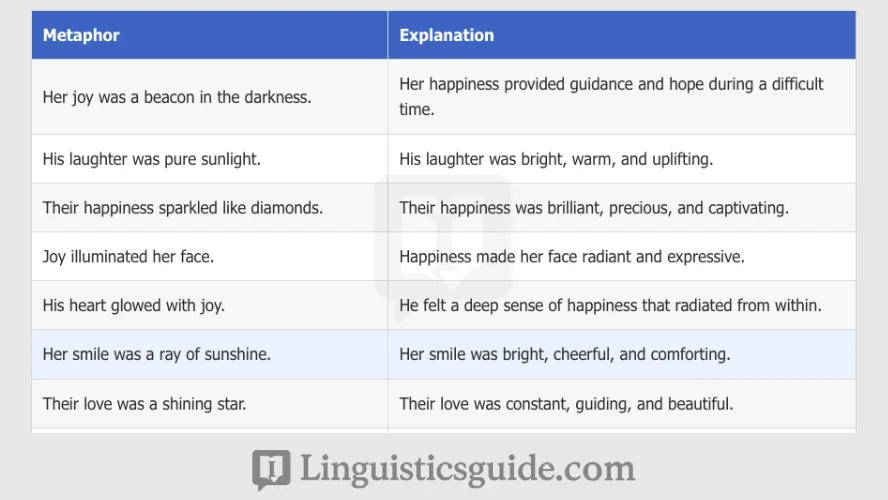
Table 1: Light Metaphors for Joy
This table presents examples of metaphors that use light as the vehicle to describe joy. These metaphors highlight the brightness, clarity, and illuminating qualities associated with happiness.
| Metaphor | Explanation |
|---|---|
| Her joy was a beacon in the darkness. | Her happiness provided guidance and hope during a difficult time. |
| His laughter was pure sunlight. | His laughter was bright, warm, and uplifting. |
| Their happiness sparkled like diamonds. | Their happiness was brilliant, precious, and captivating. |
| Joy illuminated her face. | Happiness made her face radiant and expressive. |
| His heart glowed with joy. | He felt a deep sense of happiness that radiated from within. |
| Her smile was a ray of sunshine. | Her smile was bright, cheerful, and comforting. |
| Their love was a shining star. | Their love was constant, guiding, and beautiful. |
| Joy lit up his eyes. | His eyes sparkled with happiness and excitement. |
| Her presence was a bright light in his life. | Her presence brought happiness and positivity into his life. |
| His spirit shone with joy. | He radiated happiness and enthusiasm. |
| Their laughter was like a flash of lightning. | Their laughter was sudden, powerful, and exhilarating. |
| Joy was a flame burning brightly within her. | She felt a passionate and intense sense of happiness. |
| The news was a spotlight on their achievements. | The news highlighted and celebrated their successes. |
| His eyes twinkled with joy. | His eyes sparkled with amusement and delight. |
| Her heart was a lantern filled with joy. | Her heart was full of happiness that she shared with others. |
| Their happiness was a luminous pearl. | Their happiness was rare, beautiful, and precious. |
| Joy cast a warm glow over the room. | Happiness created a pleasant and inviting atmosphere. |
| His face was a sunbeam of joy. | His face radiated happiness and warmth. |
| Her voice shone with happiness. | Her voice was bright and filled with joy. |
| Their future looked as bright as the morning sun. | Their future seemed promising and full of happiness. |
| Joy was a lighthouse guiding him home. | Happiness provided direction and comfort during a difficult time. |
| His spirit was a radiant dawn. | He emanated freshness, hope, and joy. |
| Their happiness was a sparkling constellation. | Their happiness was a beautiful and complex arrangement of joy. |
Table 2: Height Metaphors for Joy
This table presents examples of metaphors that use height as the vehicle to describe joy. These metaphors emphasize the uplifting, liberating, and elevated nature of happiness.
| Metaphor | Explanation |
|---|---|
| She was floating on a cloud of joy. | She felt light, carefree, and blissful. |
| His spirits soared with happiness. | He felt uplifted and energized by his joy. |
| Their laughter lifted the room. | Their laughter created a cheerful and uplifting atmosphere. |
| Joy elevated her mood. | Happiness lifted her spirits and made her feel better. |
| He felt on top of the world with joy. | He felt extremely happy and successful. |
| Her heart took flight with happiness. | She felt a sense of freedom and excitement. |
| Their dreams reached for the sky with joy. | Their aspirations were fueled by their happiness. |
| Joy lifted him to new heights. | Happiness helped him achieve great things. |
| Her voice rose with joy. | Her voice was filled with excitement and happiness. |
| His soul ascended with happiness. | He felt a deep sense of spiritual joy. |
| Their joy was a mountain peak. | Their happiness was a significant and triumphant achievement. |
| She felt like she could touch the sky with joy. | She felt incredibly happy and empowered. |
| His heart was a balloon, lifted by joy. | His heart was filled with happiness, making him feel light and buoyant. |
| Their happiness was a skyrocket, bursting with color. | Their happiness was explosive, vibrant, and exciting. |
| Joy gave her wings to fly. | Happiness gave her the freedom and ability to achieve her dreams. |
| Their laughter echoed through the heavens. | Their laughter was powerful, resonant, and deeply joyful. |
| He was carried aloft by joy. | He was lifted up and supported by his happiness. |
| Her heart danced on air with joy. | Her heart felt light and joyful, as if dancing in the sky. |
| Their spirits climbed to the summit of joy. | Their spirits reached the highest point of happiness. |
| She felt as light as a feather with joy. | She felt incredibly happy and unburdened. |
| His dreams floated among the stars with joy. | His aspirations were filled with happiness and limitless possibilities. |
| Their future ascended towards a brighter horizon. | Their future promised greater happiness and success. |
| Joy was the ladder that helped her climb her goals. | Happiness provided a means for achieving her aspirations. |
Table 3: Warmth Metaphors for Joy
This table presents examples of metaphors that use warmth as the vehicle to describe joy. These metaphors highlight the comforting, affectionate, and nurturing qualities of happiness.
| Metaphor | Explanation |
|---|---|
| Her joy warmed my heart. | Her happiness made me feel comforted and loved. |
| His smile was like a ray of sunshine. | His smile was warm, cheerful, and comforting. |
| Their love was a burning flame of happiness. | Their love was passionate, intense, and filled with joy. |
| Joy radiated from her like heat from a fire. | She exuded happiness and warmth. |
| He felt a warm glow of joy inside him. | He felt a deep sense of happiness and contentment. |
| Her laughter was like a warm embrace. | Her laughter was comforting, welcoming, and affectionate. |
| Their friendship was a source of warmth and joy. | Their friendship provided comfort, support, and happiness. |
| Joy melted away his worries. | Happiness eased his anxieties and concerns. |
| Her voice was a warm fire on a cold night. | Her voice was comforting, reassuring, and filled with warmth. |
| His soul was filled with the warmth of joy. | He felt a deep and profound sense of happiness. |
| Their joy was a cozy fireplace. | Their happiness was comforting, inviting, and filled with warmth. |
| She wrapped herself in the warmth of joy. | She surrounded herself with happiness and contentment. |
| His heart was a furnace, fueled by joy. | His heart was filled with intense and passionate happiness. |
| Their happiness was a sun-kissed summer day. | Their happiness was warm, bright, and filled with joy. |
| Joy was the warm blanket that soothed her soul. | Happiness provided comfort, security, and peace of mind. |
| Their laughter was like a bonfire, spreading warmth. | Their laughter was infectious, joyful, and filled with warmth. |
| He basked in the warmth of their joy. | He enjoyed and absorbed their happiness. |
| Her spirit was a hearth, radiating joy. | Her spirit was a source of warmth, comfort, and happiness. |
| Their happiness was like a hot cup of cocoa on a cold day. | Their happiness was comforting, satisfying, and enjoyable. |
| She felt the sun of joy shining in her heart. | She felt a warm, bright, and joyful feeling inside her. |
| His kindness was a warmth spreading joy. | His kindness created happiness and comfort for others. |
| Their future was as warm and inviting as a summer breeze. | Their future promised comfort, happiness, and pleasant experiences. |
| Joy was the gentle fire that kept their love alive. | Happiness sustained and nurtured their loving relationship. |
Usage Rules for Metaphors of Joy
When using metaphors for joy, it’s important to follow certain guidelines to ensure clarity and effectiveness:
- Choose appropriate vehicles: Select vehicles that are relatable and resonate with the audience’s understanding of joy. The comparison should be logical and meaningful.
- Avoid clichés: Steer clear of overused metaphors that have lost their impact. Aim for originality and creativity in your comparisons.
- Maintain consistency: Ensure that the metaphor is consistent throughout the passage. Avoid mixing metaphors that create confusing or contradictory images.
- Consider the context: Tailor the metaphor to the specific context and audience. A metaphor that works in one situation may not be appropriate in another.
- Use sparingly: While metaphors can enhance writing, overuse can make it feel forced or unnatural. Use metaphors judiciously to create the desired effect.
Understanding these usage rules will help you create more effective and impactful metaphors for joy.
Common Mistakes with Joy Metaphors
Several common mistakes can detract from the effectiveness of metaphors for joy. Recognizing and avoiding these errors will improve your writing and communication skills.
Incorrect: “His joy was like a car.” (This is a simile, not a metaphor, and the comparison is unclear.)
Correct: “His joy was a speeding train.” (This is a metaphor that conveys energy and excitement.)
Incorrect: “Her joy was a little bit happy.” (This is redundant and lacks impact.)
Correct: “Her joy was a radiant sunrise.” (This is a metaphor that evokes beauty and warmth.)
Incorrect: “Their joy was flying and also a warm blanket.” (This is a mixed metaphor that creates a confusing image.)
Correct: “Their joy was a warm blanket on a cold night.” (This is a consistent metaphor that conveys comfort and security.)
Incorrect: “Joy is a thing that happened.” (This is a literal statement, not a metaphor.)
Correct: “Joy is a song that never ends.” (This is a metaphor that suggests enduring happiness.)
By avoiding these common mistakes, you can create more effective and meaningful metaphors for joy.
Practice Exercises
Test your understanding of metaphors for joy with the following exercises.
Exercise 1: Identify the Metaphor
For each sentence, identify the metaphor used to describe joy.
| Question | Answer |
|---|---|
| 1. Her joy was a bubbling spring. | A bubbling spring |
| 2. His laughter was pure sunlight. | Pure sunlight |
| 3. Their happiness sparkled like diamonds. | Sparkled like diamonds |
| 4. Joy lit up his eyes. | Lit up his eyes |
| 5. She was floating on a cloud of joy. | Floating on a cloud |
| 6. His spirits soared with happiness. | Soared with happiness |
| 7. Their love was a burning flame of happiness. | A burning flame |
| 8. Her joy warmed my heart. | Warmed my heart |
| 9. His soul ascended with happiness. | Ascended with happiness |
| 10. Their joy was a melodious song. | A melodious song |
Exercise 2: Create Your Own Metaphor
Create your own metaphor for joy based on the given prompts.
| Prompt | Your Answer (Example) |
|---|---|
| 1. Joy as a color | Joy is a splash of gold on a canvas of gray. |
| 2. Joy as a sound | Joy is the gentle chime of wind chimes on a summer breeze. |
| 3. Joy as a taste | Joy is the sweet taste of victory after a long struggle. |
| 4. Joy as a feeling | Joy is a warm embrace on a cold winter day. |
| 5. Joy as a place | Joy is a hidden garden, filled with vibrant flowers and secret pathways. |
| 6. Joy as a natural phenomenon | Joy is a sunrise after a long, dark night. |
| 7. Joy as a journey | Joy is a winding path leading to a breathtaking vista. |
| 8. Joy as a person | Joy is a friend who always knows how to make you smile. |
| 9. Joy as an object | Joy is a precious jewel, carefully guarded and cherished. |
| 10. Joy as an event | Joy is the grand finale of a spectacular fireworks display. |
Exercise 3: Correct the Incorrect Metaphor
Identify and correct the incorrect or ineffective metaphors in the following sentences.
| Question | Corrected Answer |
|---|---|
| 1. His joy was like a shoe. | His joy was a comfortable pair of shoes, perfect for any journey. |
| 2. Her joy was a little bit happy. | Her joy was an overflowing cup of happiness. |
| 3. Their joy was flying and also a warm blanket. | Their joy was a warm blanket on a cold night, providing comfort and security. |
| 4. Joy is a thing that happened. | Joy is a song that echoes through the halls of the heart. |
| 5. His joy was as tall as a building. | His joy was a towering monument of happiness. |
| 6. Her joy was running and also very still. | Her joy was a deep, still lake reflecting the clear blue sky. |
| 7. Their joy was like a rock. | Their joy was a steady anchor in the storms of life. |
| 8. His joy was a little cloud. | His joy was a bright, cheerful cloud drifting across a summer sky. |
| 9. Her joy was a thing. | Her joy was a vibrant tapestry woven with threads of love and laughter. |
| 10. Their joy was like a potato. | Their joy was a nourishing meal, providing comfort and sustenance. |
Advanced Topics in Joy Metaphors
For advanced learners, exploring the nuances of extended metaphors and the use of mixed metaphors (used intentionally for effect) can add depth to their understanding. Analyzing literary examples of metaphors for joy in poetry and prose can also provide valuable insights into their artistic application.
Consider the use of personification in metaphors for joy, where joy is given human qualities. For example, “Joy danced in her eyes” is a metaphor that personifies joy, giving it the ability to dance.
Understanding these advanced techniques can enhance your ability to create and interpret complex metaphors.
Exploring the cultural variations in metaphors for joy can also be enlightening. Different cultures may have different associations with joy and express it through different metaphorical comparisons.
Studying these variations can broaden your understanding of language and culture.
Frequently Asked Questions
Here are some frequently asked questions about metaphors for joy:
- What is the difference between a metaphor and a simile?
A metaphor is an implicit comparison between two unlike things, without using “like” or “as.” A simile is an explicit comparison, using “like” or “as” to draw a connection between two things. For example, “Joy is sunshine” is a metaphor, while “Joy is like sunshine” is a simile. - Why are metaphors useful in writing?
Metaphors add depth, imagery, and emotional resonance to writing. They help readers understand abstract concepts by relating them to concrete experiences. Metaphors can also make writing more engaging and memorable. - How can I create effective metaphors for joy?
To create effective metaphors, choose vehicles that are relatable, original, and consistent with the context. Avoid clichés and consider the audience’s understanding of both joy and the concept you’re comparing it to. Experiment with different sensory experiences and emotions to find the most impactful comparison. - What are some common categories of metaphors for joy?
Common categories include light metaphors, height metaphors, warmth metaphors, motion metaphors, taste metaphors, sound metaphors, color metaphors, and nature metaphors. These categories provide a framework for exploring different ways to express joy metaphorically. - What are some common mistakes to avoid when using metaphors?
Avoid using similes instead of metaphors, being redundant, mixing metaphors, and using literal statements instead of figurative comparisons. Ensure that your metaphors are clear, consistent, and meaningful. - How can I improve my understanding of metaphors?
Read widely, paying attention to the metaphors used by different writers. Practice creating your own metaphors and analyzing the metaphors used by others. Consider the context, audience, and intended effect of each metaphor. - Are there cultural differences in metaphors for joy?
Yes, different cultures may have different associations with joy and express it through different metaphorical comparisons. Studying these variations can broaden your understanding of language and culture. - How can metaphors for joy be used in everyday conversation?
Metaphors can add color and expressiveness to everyday conversation. Use them to describe your own feelings of joy or to relate to others’ experiences. Be mindful of the context and audience to ensure that your metaphors are appropriate and understandable. - Is it okay to use extended metaphors?
Yes, extended metaphors can be very effective. They allow for a more detailed exploration of the connection between joy and the vehicle, creating a more sustained and impactful image. However, ensure that the extended metaphor remains consistent and doesn’t become overly complex. - How do I avoid using clichéd metaphors for joy?
To avoid clichéd metaphors, think outside the box and try to find unique and original comparisons. Consider using less common sensory experiences or emotions to create more impactful metaphors. Researching different cultural expressions of joy can also provide inspiration. - Can a metaphor be too complex?
Yes, a metaphor can be too complex if it’s difficult to understand or if the connection between the tenor and the vehicle is too obscure. Aim for clarity and ensure that the metaphor resonates with the audience’s understanding of both joy and the concept it’s being compared to.
Conclusion
Metaphors for joy provide a powerful and expressive way to communicate the feeling of happiness. By understanding the structure, types, and usage rules of these metaphors, you can enhance your writing and communication skills.
Remember to choose appropriate vehicles, avoid clichés, and consider the context to create effective and impactful metaphors.
Practice identifying and creating metaphors for joy to solidify your understanding and develop your creative expression. By mastering the art of figurative language, you can unlock new levels of communication and connect with others on a deeper emotional level.
Embrace the power of metaphor to illuminate the beauty and complexity of joy.
Continue to explore and experiment with different metaphors for joy to expand your vocabulary and enhance your ability to express emotions with nuance and creativity. The more you practice, the more comfortable and confident you will become in using metaphors to enrich your language and captivate your audience.