
Metaphors are powerful tools in the English language, allowing us to create vivid imagery and deeper connections between seemingly unrelated things. Understanding how metaphors work, particularly when applied to something as beautiful and versatile as flowers, enhances both our comprehension and creative expression.
This article explores the rich landscape of metaphors for flowers, examining their structure, types, and usage. Whether you’re a student, writer, or simply someone who appreciates the beauty of language, this guide will provide you with the knowledge and skills to effectively use and interpret floral metaphors.
Table of Contents
- Introduction
- Definition of Metaphor
- Structural Breakdown
- Types and Categories of Floral Metaphors
- Examples of Metaphors for Flowers
- Usage Rules
- Common Mistakes
- Practice Exercises
- Advanced Topics
- FAQ
- Conclusion
Definition of Metaphor
What is a Metaphor?
A metaphor is a figure of speech that directly compares two unrelated things without using “like” or “as.” It asserts that one thing is another, creating a connection based on shared qualities or characteristics. This comparison is not literal but figurative, designed to illuminate a particular aspect of the subject and evoke a deeper understanding or emotional response. Metaphors enrich language by adding layers of meaning and prompting the reader or listener to make connections they might not otherwise consider.

Classification of Metaphors
Metaphors can be classified based on their explicitness and originality. Explicit metaphors clearly state the comparison, while implicit metaphors imply the comparison without directly stating it. Dead metaphors are so overused that they have lost their figurative impact and are often considered clichés. In contrast, fresh metaphors are original and inventive, creating a strong and memorable image. Understanding these classifications helps in analyzing and crafting effective metaphors.
For example, the phrase “time is money” is a common, almost dead metaphor. However, a more original metaphor might be “her smile was a blooming garden,” offering a fresher, more vivid image.
Function of Metaphors
The primary function of a metaphor is to enhance understanding by relating an unfamiliar concept to a familiar one. Metaphors can also evoke emotions, create vivid imagery, and add depth to writing or speech.
They allow for concise expression by conveying complex ideas in a single, impactful statement. In literature, metaphors are often used to develop themes, characterize characters, and create symbolic meaning.
Furthermore, metaphors can be persuasive tools, influencing the audience’s perception by framing an issue in a particular way. For example, describing a political opponent as a “snake in the grass” is a metaphor designed to evoke suspicion and distrust.
Contexts of Metaphors
Metaphors are used in various contexts, including literature, poetry, everyday conversation, and scientific discourse. The effectiveness of a metaphor depends heavily on the context in which it is used.
A metaphor that works well in a poem might be inappropriate in a scientific paper. Understanding the audience and the purpose of communication is crucial for selecting and using metaphors effectively.
In creative writing, metaphors are often used to create atmosphere and mood, while in technical writing, they can simplify complex concepts.
Consider the difference between using the metaphor “the stock market is a rollercoaster” in a news report versus a casual conversation. In the former, it serves to quickly convey volatility; in the latter, it might simply express personal anxiety about investing.
Structural Breakdown
Tenor and Vehicle
I.A. Richards, a prominent literary critic, introduced the terms tenor and vehicle to describe the two components of a metaphor. The tenor is the subject being described, while the vehicle is the object or concept used to represent the tenor. In the metaphor “life is a garden,” life is the tenor, and garden is the vehicle. Understanding this distinction is crucial for analyzing how metaphors create meaning.
The vehicle carries the attributes that are being transferred to the tenor. In this case, the attributes of a garden (growth, nurturing, beauty, potential) are being associated with life.
The Ground
The ground refers to the shared characteristics or similarities between the tenor and the vehicle. It’s the basis for the comparison and the reason why the metaphor works. Identifying the ground helps to understand the intended meaning of the metaphor. In the example “life is a garden,” the ground might include the ideas of growth, cultivation, and the need for care.
The ground can be explicit or implicit. Sometimes, the shared characteristics are obvious, while other times, they require more interpretation.
Implicature
Implicature refers to the implied meaning or the additional layer of meaning that the metaphor conveys beyond its literal interpretation. It’s the unspoken understanding that arises from the comparison. In the metaphor “life is a garden,” the implicature might be that life requires effort and attention to flourish, and that there are cycles of growth and decay.
Understanding implicature requires considering the context, the cultural background, and the speaker’s intentions. It adds depth and complexity to the interpretation of metaphors.
Types and Categories of Floral Metaphors
Beauty Metaphors
Flowers are often used as metaphors for beauty due to their aesthetic appeal. These metaphors can describe a person’s appearance, a work of art, or any object or concept that possesses beauty.
The specific type of flower used in the metaphor can further refine the meaning, as different flowers symbolize different types of beauty and characteristics.
For example, a rose might represent romantic beauty, while a lily might represent purity and elegance.
Fragility Metaphors
The delicate nature of flowers makes them apt metaphors for fragility. These metaphors can describe physical weakness, emotional vulnerability, or the impermanence of life.
The image of a flower easily wilting or being crushed conveys a sense of vulnerability and the potential for loss.
These metaphors are commonly used to describe the vulnerability of youth or the delicate balance of relationships.
Growth Metaphors
Flowers, with their life cycle of budding, blooming, and withering, are powerful metaphors for growth and development. These metaphors can describe personal growth, the development of ideas, or the progress of a project.
The image of a flower reaching towards the sun symbolizes aspiration and achievement.
These metaphors often highlight the importance of nurturing and patience in the process of growth.
Resilience Metaphors
Despite their delicate appearance, flowers can also be metaphors for resilience, particularly those that bloom in harsh environments. These metaphors describe the ability to overcome adversity and thrive despite challenges.
The image of a flower pushing through concrete symbolizes strength and determination.
These metaphors are often used to inspire hope and encourage perseverance in difficult situations.
Transience Metaphors
The fleeting beauty of flowers makes them poignant metaphors for transience and the ephemeral nature of life. These metaphors can describe the passing of time, the impermanence of beauty, or the inevitability of death.
The image of a flower wilting and fading serves as a reminder of mortality.
These metaphors often evoke a sense of nostalgia and a recognition of the preciousness of the present moment.
Examples of Metaphors for Flowers
Beauty Examples
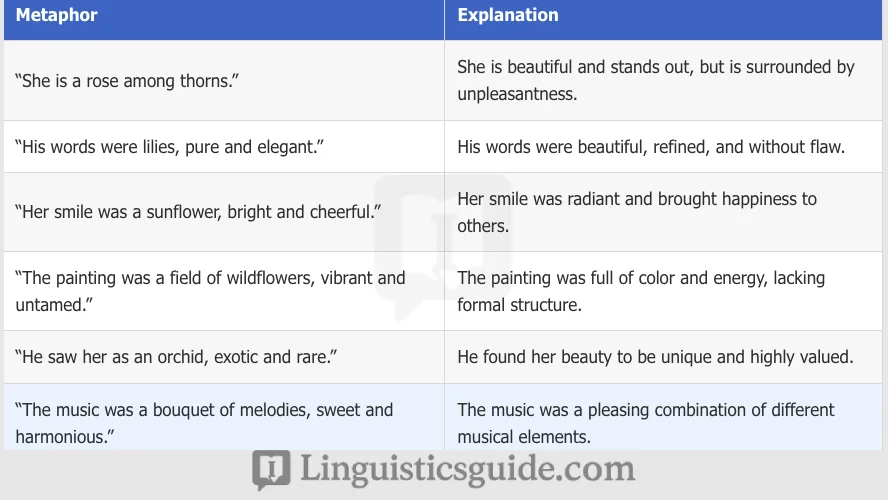
Flowers are frequently used to describe beauty, often personifying the qualities they represent. The following table provides examples of how different flowers can be used metaphorically to describe beauty.
| Metaphor | Explanation |
|---|---|
| “She is a rose among thorns.” | She is beautiful and stands out, but is surrounded by unpleasantness. |
| “His words were lilies, pure and elegant.” | His words were beautiful, refined, and without flaw. |
| “Her smile was a sunflower, bright and cheerful.” | Her smile was radiant and brought happiness to others. |
| “The painting was a field of wildflowers, vibrant and untamed.” | The painting was full of color and energy, lacking formal structure. |
| “He saw her as an orchid, exotic and rare.” | He found her beauty to be unique and highly valued. |
| “The music was a bouquet of melodies, sweet and harmonious.” | The music was a pleasing combination of different musical elements. |
| “Her dress was adorned with floral patterns, making her a walking garden.” | Her dress was beautifully decorated, giving her an enchanting appearance. |
| “The sunset was a bloom of colors, painting the sky with beauty.” | The sunset displayed a beautiful and vibrant array of colors. |
| “Her eyes were violets, deep and captivating.” | Her eyes were a beautiful shade of violet, drawing people in. |
| “The poem was a garland of words, strung together with grace.” | The poem was beautifully written and flowed smoothly. |
| “She moved with the grace of a blossoming cherry tree.” | Her movements were elegant and beautiful, like a cherry tree in full bloom. |
| “His kindness was a daisy in a field of weeds.” | His kindness was a simple but beautiful gesture in a harsh environment. |
| “The city at night was a garden of lights, sparkling and alive.” | The city was vibrant and beautiful, filled with bright lights. |
| “Her voice was like a gentle lavender, soothing and calming.” | Her voice was peaceful and had a calming effect on listeners. |
| “The artwork was a poppy field, bold and unforgettable.” | The artwork was striking and memorable, like a field of poppies. |
| “She was a lotus flower, rising from the mud with unparalleled beauty.” | She overcame difficult circumstances to achieve great beauty and grace. |
| “The landscape was a tapestry woven with floral hues.” | The landscape was rich and diverse in its floral colors. |
| “Her spirit was a wildflower, free and uncultivated.” | Her spirit was independent and naturally beautiful. |
| “The memory was a pressed flower, preserved in time.” | The memory was a beautiful and cherished reminder of the past. |
| “He described her as a peony, full and luxurious.” | He found her beauty to be abundant and extravagant. |
| “Their love story was a blossoming garden, nurtured with care and attention.” | Their love grew and flourished over time through mutual effort and affection. |
| “The festival was a riot of colors, a carnival of blooming delights.” | The festival was a vibrant and joyous celebration filled with beautiful sights. |
| “Her presence was like a spring bloom, bringing freshness and vitality to the room.” | Her arrival brought a sense of rejuvenation and energy to the environment. |
| “The child’s laughter was a field of daffodils, bright and infectious.” | The child’s laughter was cheerful and spread joy to those around. |
| “The artist’s vision was a canvas of floral dreams, delicate and imaginative.” | The artist’s creativity was expressed through beautiful and intricate floral themes. |
Fragility Examples
Flowers often symbolize fragility due to their delicate nature and vulnerability. The following examples illustrate how floral metaphors can convey a sense of vulnerability and impermanence.
| Metaphor | Explanation |
|---|---|
| “Her heart was a fragile blossom, easily bruised.” | Her emotions were delicate and easily hurt. |
| “Their relationship was a wilting flower, losing its vitality.” | Their relationship was declining and losing its strength. |
| “His dreams were delicate petals, scattered by the wind.” | His aspirations were easily disrupted and lost. |
| “Her health was a frail bloom, needing constant care.” | Her physical condition was weak and required careful attention. |
| “The peace was a fragile flower, easily crushed by conflict.” | The state of peace was precarious and threatened by potential conflict. |
| “His hope was a tender shoot, vulnerable to the frost.” | His hope was nascent and susceptible to setbacks. |
| “Her spirit was a delicate orchid, needing careful protection.” | Her inner self was sensitive and required safeguarding. |
| “Their love was a short-lived bloom, fading too quickly.” | Their love was brief and did not last long. |
| “The child’s innocence was a fragile flower, easily tainted.” | The child’s purity was vulnerable to corruption. |
| “His confidence was a brittle petal, easily broken.” | His self-assurance was easily shattered. |
| “Her memories were like pressed flowers, faded and delicate.” | Her memories were old, fragile, and somewhat diminished. |
| “The agreement was a fragile blossom, threatening to fall apart.” | The agreement was unstable and at risk of collapsing. |
| “His patience was a withering flower, running out quickly.” | His patience was diminishing and nearing its end. |
| “The ecosystem was a delicate bloom, easily disrupted by pollution.” | The natural environment was sensitive and easily harmed by contamination. |
| “Her trust was a fragile petal, easily torn by betrayal.” | Her trust was easily destroyed by acts of disloyalty. |
| “The old house was like a decaying flower, slowly returning to the earth.” | The house was deteriorating and gradually collapsing. |
| “Her dreams were like dandelion seeds, scattered by the winds of reality.” | Her aspirations were easily dispersed and unrealized due to harsh circumstances. |
| “The antique vase was a fragile tulip, easily shattered into pieces.” | The vase was delicate and prone to breaking. |
| “His ego was a delicate rose, easily pricked by criticism.” | His self-esteem was easily wounded by negative feedback. |
| “The tradition was a fragile bloom, threatened by modernization.” | The tradition was vulnerable and at risk of disappearing due to progress. |
| “The ceasefire was a fragile poppy, easily trampled by renewed conflict.” | The ceasefire was delicate and at risk of being broken by further fighting. |
| “Her secret was a delicate bloom, easily revealed by a careless word.” | Her secret was vulnerable and could be exposed by an inadvertent remark. |
| “The child’s imagination was a fragile flower, needing gentle encouragement to blossom.” | The child’s creativity was delicate and required nurturing to develop fully. |
| “The artist’s inspiration was a fleeting bloom, requiring immediate expression to capture its beauty.” | The artist’s creative spark was transient and needed to be acted upon quickly. |
| “The patient’s hope was a fragile snowdrop, bravely emerging in the face of adversity.” | The patient’s hope was delicate but resilient, persisting despite difficult circumstances. |
Growth Examples
Flowers are excellent metaphors for growth, representing development and progress. The following table showcases how flowers can symbolize various aspects of growth.
| Metaphor | Explanation |
|---|---|
| “Her knowledge was a blooming garden, expanding every day.” | Her understanding was increasing and becoming more comprehensive. |
| “Their company was a growing vine, reaching new heights.” | Their business was expanding and achieving greater success. |
| “His career was a blossoming tree, bearing fruit over time.” | His professional life was developing and producing positive results. |
| “Her potential was a seed, waiting to sprout and grow.” | Her capabilities were present but needed the right conditions to develop. |
| “Their friendship was a blooming flower, nurtured with care.” | Their bond was strengthening and deepening through mutual support. |
| “His ideas were budding flowers, full of promise.” | His concepts were new and showed potential for development. |
| “Her talent was a rare bloom, requiring careful cultivation.” | Her skill was exceptional and needed to be nurtured to flourish. |
| “Their project was a growing plant, needing constant attention.” | Their undertaking was developing and required ongoing effort. |
| “His confidence was a sunflower, growing taller each day.” | His self-assurance was increasing steadily. |
| “Her creativity was a wild garden, producing unexpected blooms.” | Her imagination was producing original and surprising ideas. |
| “The community was a growing orchard, each member contributing unique fruits.” | The community was developing, with each person adding their special talents and contributions. |
| “Her understanding was like a climbing rose, wrapping around complex concepts.” | Her comprehension was expanding and encompassing intricate ideas. |
| “His influence was a spreading root system, nourishing the entire organization.” | His impact was expanding and supporting the whole company. |
| “The movement was a blossoming meadow, attracting diverse supporters.” | The movement was growing and drawing in a wide range of followers. |
| “Her leadership was a guiding stem, helping others reach their potential.” | Her leadership was supporting and empowering others to develop their abilities. |
| “The research was a blossoming field, yielding new discoveries.” | The research was developing and producing new findings. |
| “His wisdom was like a mature tree, its roots deep and its branches wide.” | His wisdom was profound and extensive, based on long experience. |
| “The company’s innovation was a blooming cactus, thriving in a challenging environment.” | The company’s innovation was flourishing despite difficult conditions. |
| “Her resilience was a tenacious weed, growing back stronger after every setback.” | Her resilience was persistent and allowed her to recover from challenges. |
| “The team’s synergy was a blossoming bouquet, each member contributing unique strengths.” | The team’s collaboration was producing a harmonious and effective outcome. |
| “Their partnership was a growing bonsai, carefully shaped and nurtured over time.” | Their partnership was developing with deliberate effort and attention to detail. |
| “Her potential was a dormant bulb, waiting for the right season to bloom.” | Her abilities were present but needed the appropriate time and conditions to emerge. |
| “The project’s success was a blooming water lily, emerging gracefully from humble beginnings.” | The project achieved success despite starting from modest origins. |
| “His vision was a blossoming landscape, transforming the barren earth into a vibrant paradise.” | His vision was creating significant positive changes and improvements. |
| “The student’s understanding was a growing sunflower, turning towards the light of knowledge.” | The student’s comprehension was increasing and being guided by learning and wisdom. |
Resilience Examples
Flowers demonstrating resilience can inspire and symbolize strength in adversity. Here are some examples of how floral metaphors illustrate resilience.
| Metaphor | Explanation |
|---|---|
| “She was a desert flower, blooming despite the harsh conditions.” | She thrived even in difficult circumstances. |
| “His spirit was a tenacious weed, growing back stronger after every setback.” | He recovered from challenges with increased determination. |
| “Their love was an evergreen, enduring through all seasons.” | Their affection remained strong and constant over time. |
| “Her hope was a crocus, pushing through the snow to find the sun.” | She maintained optimism even in the face of adversity. |
| “His determination was a climbing vine, scaling any obstacle in its path.” | He overcame challenges with unwavering resolve. |
| “Her courage was a resilient cactus, standing tall in the face of hardship.” | She demonstrated bravery despite difficult circumstances. |
| “Their bond was a strong oak, weathering any storm.” | Their relationship remained solid and unyielding through tough times. |
| “His faith was a deep-rooted tree, unshaken by the winds of doubt.” | His belief remained steadfast despite challenges to his conviction. |
| “Her strength was a blooming lotus, rising from the mud with grace.” | She overcame difficult circumstances with elegance and poise. |
| “Their community was a resilient garden, flourishing even after the drought.” | Their collective spirit remained strong and productive despite hard times. |
| “His resolve was a tenacious dandelion, stubbornly growing through cracks in the pavement.” | His determination was unwavering, persisting despite obstacles. |
| “Her spirit was an unyielding sunflower, always turning towards the light even in the darkest storms.” | Her optimism remained constant, guiding her through difficult times. |
| “Their partnership was like ivy, clinging tightly and supporting each other through every challenge.” | Their collaboration was strong and provided mutual support in adversity. |
| “His creativity was a blossoming aloe vera, healing and thriving in the face of adversity.” | His creative ability was both resilient and beneficial, helping him overcome challenges. |
| “Her endurance was a hardy fern, surviving and thriving in the harshest conditions.” | Her stamina allowed her to withstand and prosper even in difficult environments. |
| “Their commitment was a steadfast redwood, standing tall and strong against the forces of nature.” | Their dedication was unwavering, providing stability and strength. |
| “His resilience was like bamboo, bending but never breaking in the face of strong winds.” | His ability to adapt allowed him to withstand adversity without losing his integrity. |
| “Her determination was a thorny rose, protecting its beauty with unwavering strength.” | Her resolve was firm and defended her from challenges. |
| “Their hope was a spring bloom, bravely emerging in a landscape still marked by winter.” | Their optimism persisted despite lingering difficulties. |
| “His courage was a desert lily, blooming unexpectedly with stunning beauty after a rare rainfall.” | His bravery was a surprising and remarkable display of strength in challenging circumstances. |
| “Their unity was a dense forest, each tree supporting the others against the strongest gales.” | Their collective strength provided mutual support and protection. |
| “Her spirit was a tenacious wildflower, blooming defiantly in the face of neglect.” | Her inner strength remained vibrant despite a lack of support or care. |
| “His perseverance was a climbing morning glory, relentlessly reaching for the sun despite every obstacle.” | His persistence allowed him to overcome challenges and achieve his goals. |
| “Their community was a resilient mangrove forest, protecting the coastline from the fiercest storms.” | Their collective strength provided vital protection and support. |
| “Her determination was a blooming cereus, revealing its stunning beauty only in the face of the darkest night.” | Her resolve shone brightest during the most challenging times. |
Transience Examples
Flowers are often used to represent transience due to their fleeting beauty. These metaphors highlight the ephemeral nature of life and beauty.
Here are some examples:
“His legacy was a field of wildflowers, beautiful and diverse but ultimately ephemeral and subject to the cycles of nature.”His legacy was varied and beautiful but would eventually fade with time.
| Metaphor | Explanation |
|---|---|
| “Life is a fleeting bloom, here today and gone tomorrow.” | Life is short and impermanent. |
| “Their youth was a fading flower, its beauty slowly wilting.” | Their youthful appearance was diminishing with age. |
| “His memories were pressed flowers, preserved but faded.” | His memories were old and less vivid. |
| “Her joy was a short-lived bloom, quickly passing.” | Her happiness was brief and did not last long. |
| “Their love was a summer flower, beautiful but temporary.” | Their affection was intense but not enduring. |
| “His dreams were dandelion seeds, scattered by the wind and lost.” | His aspirations were easily disrupted and unrealized. |
| “Her beauty was a dew-kissed petal, sparkling briefly before evaporating.” | Her attractiveness was fleeting and temporary. |
| “Their moment of glory was a firework bloom, brilliant but brief.” | Their success was spectacular but short-lived. |
| “His opportunities were falling petals, slipping away one by one.” | His chances were diminishing and disappearing. |
| “Her life was a cherry blossom, beautiful but brief.” | Her existence was lovely but short. |
| “His fame was an ephemeral orchid, admired briefly but soon forgotten.” | His celebrity was short-lived and quickly faded from memory. |
| “Her influence was a scattering of petals, dispersed by the winds of change.” | Her impact was diminishing and being spread thin by evolving circumstances. |
| “Their triumph was a passing season, giving way to the inevitable winter.” | Their victory was temporary and would eventually be followed by hardship. |
| “His achievements were like cut flowers, beautiful but destined to wither.” | His accomplishments were impressive but lacked lasting significance. |
| “Her moment in the spotlight was a flash of lightning, illuminating the stage briefly before fading to darkness.” | Her brief time of recognition was dramatic but fleeting. |
| “Their legacy was a field of poppies, vibrant for a season but soon to be plowed under.” | Their impact would be remembered for a time but would eventually be forgotten. |
| “His wealth was like fallen leaves, beautiful in their abundance but destined to decay and return to the earth.” | His prosperity was plentiful but temporary and would eventually disappear. |
| “Her youth was a delicate snowdrop, its beauty melting away with the arrival of spring.” | Her youthful appearance was fading with the passage of time. |
| “Their empire was a magnificent sunflower, towering above the landscape but eventually bowing to the weight of its own head.” | Their power was impressive but ultimately unsustainable. |
| “His reign was like a royal garden, beautiful and meticulously maintained but ultimately subject to the forces of nature and time.” | His rule was impressive but temporary and would eventually come to an end. |
| “Her memory was a pressed lavender, retaining its fragrance but fading in color with each passing year.” | Her memory lingered but was becoming less vivid as time went on. |
| “His words were like cherry blossoms, beautiful and captivating but quickly carried away by the breeze.” | His words were impactful but easily forgotten. |
| “Their success was a blooming night-blooming cereus, a rare and stunning sight that vanished before dawn.” | Their success was unique and impressive but short-lived. |
| “Her life was a scattering of autumn leaves, each one beautiful and unique but destined to fall and decay.” | Her life was filled with unique moments but was inevitably coming to an end. |
Usage Rules
Appropriateness
The effectiveness of a metaphor depends on its appropriateness to the context and audience. Consider the tone, subject matter, and the knowledge level of the audience when selecting a metaphor.
A metaphor that is too complex or obscure might confuse the audience rather than enhance understanding. Similarly, a metaphor that is too informal might be inappropriate in a formal setting.
For instance, using sophisticated floral metaphors in a children’s story might not resonate as well as simpler, more relatable comparisons.
Consistency
Maintain consistency within a metaphor to avoid confusion. Once you establish a comparison, stick with it.
Mixing metaphors can create a jarring effect and undermine the clarity of your message. Ensure that all elements of the metaphor align and contribute to the overall meaning.
For example, if you begin by comparing a project to a garden, continue using gardening-related terms and imagery throughout your description.
Clarity
A good metaphor should enhance clarity, not obscure it. The comparison should be readily apparent and easily understood.
Avoid metaphors that are too abstract or require extensive explanation. The goal is to illuminate the subject, not to create further confusion.
If a metaphor requires too much interpretation, it might be better to choose a more direct form of expression.
Cultural Sensitivity
Be mindful of cultural differences when using metaphors. Some metaphors may have different connotations or meanings in different cultures.
What is considered a positive or beautiful image in one culture might be negative or offensive in another. Research and consider the cultural background of your audience to avoid unintentional misinterpretations or offense.
For example, the lotus flower has significant spiritual meaning in many Asian cultures, so using it casually in a different cultural context might be seen as disrespectful.
Common Mistakes
Mixed Metaphors
A mixed metaphor combines two or more incompatible metaphors, resulting in a nonsensical or confusing image. This often happens when the writer or speaker loses track of the original comparison and introduces conflicting elements.
Mixed metaphors can undermine the credibility of the message and distract the audience.
Example: “Let’s nip it in the bud before it snowballs out of the park.” This mixes the metaphor of stopping something early (“nip it in the bud”) with the metaphor of something growing rapidly and uncontrollably (“snowballs out of the park”).
Cliches
Cliches are overused metaphors that have lost their impact and originality. While they may be easy to understand, they often fail to create a vivid image or evoke a strong emotional response.
Using cliches can make your writing or speech sound uninspired and predictable. Strive to create fresh and original metaphors that offer a new perspective on the subject.
Example: “Life is a bed of roses.” This is a common cliché that has lost much of its impact due to overuse.
Overuse
While metaphors can enhance writing and speech, using them too frequently can be distracting and overwhelming. Overuse can make your message sound contrived and artificial.
Use metaphors sparingly and strategically to maximize their impact. Ensure that each metaphor serves a clear purpose and adds value to your communication.
Example: A paragraph filled with multiple floral metaphors might become overwhelming and detract from the overall message. It’s better to use one or two well-chosen metaphors than to saturate the text with them.
Practice Exercises
Exercise 1: Identifying Metaphors
Read the following sentences and identify the metaphors. Explain the tenor, vehicle, and ground in each metaphor.
- Her smile was a garden of sunshine.
- The project was a seed of hope.
- His anger was a thorny bush.
- The city was a concrete jungle.
- Her voice was a soothing balm.
Answers:
- Metaphor: Her smile was a garden of sunshine.
Tenor: Her smile
Vehicle: Garden of sunshine
Ground: Bright, cheerful, uplifting
- Metaphor: The project was a seed of hope.
Tenor: The project
Vehicle: Seed of hope
Ground: Potential, new beginnings, optimism
- Metaphor: His anger was a thorny bush.
Tenor: His anger
Vehicle: Thorny bush
Ground: Irritating, defensive, harmful
- Metaphor: The city was a concrete jungle.
Tenor: The city
Vehicle: Concrete jungle
Ground: Harsh, artificial, competitive
- Metaphor: Her voice was a soothing balm.
Tenor: Her voice
Vehicle: Soothing balm
Ground: Comforting, healing, calming
Exercise 2: Creating Metaphors
Create original metaphors for the following subjects using floral imagery.
- Love
- Time
- Fear
- Success
- Failure
Possible Answers:
- Love: Love is a blooming rose garden, requiring constant care and attention to flourish.
- Time: Time is a field of wildflowers, each moment a fleeting bloom.
- Fear: Fear is a thorny vine, choking the life out of dreams.
- Success: Success is a blossoming tree, bearing the fruit of hard work and dedication.
- Failure: Failure is a wilted flower, a reminder of what could have been.
Exercise 3: Correcting Mistakes
Identify and correct the mistakes in the following sentences. Explain why the original sentence is incorrect and provide a corrected version.
- The project was a rollercoaster ride, but we nipped it in the bud.
- His argument was a house of cards, and he dug his heels in.
- Her ideas were a breath of fresh air, and they fell on deaf ears.
- The company was sailing in hot water, but they turned over a new leaf.
- His speech was a mixed bag of tricks, and he hit the nail on the head.
Answers:
- Original: The project was a rollercoaster ride, but we nipped it in the bud.
Mistake: Mixed metaphor (rollercoaster ride and nipped it in the bud).
Corrected: The project was a rollercoaster ride, full of ups and downs.
- Original: His argument was a house of cards, and he dug his heels in.
Mistake: Mixed metaphor (house of cards and dug his heels in).
Corrected: His argument was a house of cards, easily toppled.
- Original: Her ideas were a breath of fresh air, and they fell on deaf ears.
Mistake: Mixed metaphor (breath of fresh air and fell on deaf ears).
Corrected: Her ideas were a breath of fresh air, invigorating and new.
- Original: The company was sailing in hot water, but they turned over a new leaf.
Mistake: Mixed metaphor (sailing in hot water and turned over a new leaf).
Corrected: The company was sailing in hot water, facing serious challenges.
- Original: His speech was a mixed bag of tricks, and he hit the nail on the head.
Mistake: Mixed metaphor (mixed bag of tricks and hit the nail on the head).
Corrected: His speech was a mixed bag of tricks, some effective and some not.
Advanced Topics
Extended Metaphors
An extended metaphor, also known as a sustained metaphor, is a metaphor that is developed over several lines or even throughout an entire work. It allows for a more complex and nuanced comparison than a single, isolated metaphor.
By elaborating on the initial comparison, the writer can create a richer and more detailed image, exploring various aspects of the subject.
Example: In Robert Frost’s poem “The Road Not Taken,” the diverging roads serve as an extended metaphor for the choices we make in life and the paths we decide to follow.
Conceits
A conceit is an elaborate and often surprising metaphor that forms the framework for an entire poem or literary work. Popular in metaphysical poetry, conceits often involve unconventional or paradoxical comparisons that require intellectual engagement from the reader.
They are more intricate and far-reaching than typical metaphors, often linking dissimilar concepts in a striking and unexpected way.
Example: John Donne’s “The Flea” uses the image of a flea that has bitten both the speaker and his beloved as a conceit for their union, arguing that if their blood can mingle in the flea, they might as well unite physically.
Allegory
An allegory is a narrative in which characters, settings, and events represent abstract ideas or moral qualities. It is a form of extended metaphor where the entire story functions as a symbolic representation of something else.
Allegories are often used to convey moral, political, or religious messages in a more engaging and accessible way.
Example: George Orwell’s “Animal Farm” is an allegory of the Russian Revolution, with the animals representing different social classes and political figures.
FAQ
How do metaphors differ from similes?
Metaphors directly equate two things (e.g., “Life is a garden”), while similes use “like” or “as” to make a comparison (e.g., “Life is like a garden”).
Can a metaphor be literal?
No, a metaphor is by definition a figurative expression. If the comparison is literal, it is not a metaphor.
How do I avoid using clichéd metaphors?
Strive for originality by thinking creatively and finding fresh ways to express familiar ideas. Consider the specific qualities of the subject you are describing and look for unique connections.
What is the role of context in interpreting metaphors?
Context is crucial for understanding the intended meaning of a metaphor. Consider the surrounding text, the speaker’s intentions, and the cultural background to accurately interpret the comparison.
How can metaphors enhance my writing?
Metaphors can add depth, imagery, and emotional resonance to your writing. They can also make complex ideas more accessible and engaging for the reader.
Conclusion
Metaphors are indispensable tools for enriching language and fostering deeper understanding. By mastering the art of crafting and interpreting metaphors, especially those involving the versatile imagery of flowers, you can enhance your communication skills and unlock new dimensions of creative expression.
Understanding the structure, types, and usage rules of metaphors allows for more effective and impactful communication, whether in writing, speech, or everyday conversation. Embrace the power of figurative language and let your words bloom with meaning.