
Metaphors are powerful tools that allow us to understand abstract concepts by relating them to something more concrete. When it comes to family, a subject filled with complex emotions and dynamics, metaphors become particularly useful.
Understanding these metaphors enhances our comprehension of familial relationships and their impact on our lives. This article explores the fascinating world of family metaphors, providing a comprehensive guide suitable for English language learners of all levels, from beginners seeking to expand their vocabulary to advanced students aiming to refine their understanding of figurative language.
By delving into the nuances of these metaphors, we can gain a deeper appreciation for the richness and complexity of family bonds and improve our ability to communicate effectively about them.
Table of Contents
- Definition of Metaphor and Its Role in Describing Family
- Structural Breakdown of Family Metaphors
- Types of Family Metaphors
- Examples of Family Metaphors
- Usage Rules for Family Metaphors
- Common Mistakes When Using Family Metaphors
- Practice Exercises
- Advanced Topics in Family Metaphors
- Frequently Asked Questions
- Conclusion
Definition of Metaphor and Its Role in Describing Family
A metaphor is a figure of speech that directly compares two unlike things without using “like” or “as.” It asserts that one thing *is* another, creating a vivid and often surprising connection. Metaphors are essential to language because they allow us to understand abstract concepts by relating them to something more concrete and familiar. In the context of family, metaphors help us express the complex emotions, relationships, and dynamics that define our familial bonds.
Metaphors function by transferring qualities from one concept (the source) to another (the target). For example, if we say “My family is a fortress,” we are transferring the qualities of strength, protection, and resilience associated with a fortress to our family.
This allows us to express the idea that our family provides safety and security.
Family metaphors can be classified based on the source domain they draw from. Common categories include nature metaphors (e.g., “My mother is the sun in my life”), building metaphors (e.g., “Our family is built on trust”), journey metaphors (e.g., “We’re all in the same boat”), object metaphors (e.g., “He’s the black sheep of the family”), and food metaphors (e.g., “She’s the spice of our family”).
The choice of metaphor can significantly impact the meaning and emotional tone of the message.
Structural Breakdown of Family Metaphors
The structure of a family metaphor typically involves two key elements: the tenor and the vehicle. The tenor is the subject being described (in this case, the family or a member of the family), and the vehicle is the object or concept used to describe it.
Consider the metaphor “My family is a tree.” Here, “my family” is the tenor, and “a tree” is the vehicle. The metaphor works because we associate qualities like strength, growth, roots, and interconnectedness with trees.
These qualities are then transferred to our understanding of the family.
The effectiveness of a metaphor depends on the shared understanding of the qualities associated with the vehicle. If the audience doesn’t understand the qualities of the vehicle, the metaphor will fail to communicate effectively.
For example, using a highly specialized technical term as a vehicle might not be effective for a general audience.
Family metaphors can also be extended, meaning that the initial comparison is developed further with additional details and related metaphors. For instance, building on “My family is a tree,” we could add, “My siblings are the branches, reaching for the sky, while my parents are the roots, providing nourishment and stability.”
Understanding the structural components of a metaphor allows us to analyze and interpret its meaning more effectively. It also helps us to create our own metaphors that are both creative and meaningful.
Types of Family Metaphors
Family metaphors can be categorized based on the source domain from which the comparison is drawn. Here are some common types:
Nature Metaphors
Nature metaphors draw parallels between family and elements of the natural world, such as animals, plants, and weather. These metaphors often emphasize growth, nurturing, and the cyclical nature of family life.
They can highlight the beauty, strength, or even the destructive potential within familial relationships.
Building Metaphors
Building metaphors compare family to structures like houses, bridges, or walls. These metaphors often focus on the foundation, stability, and protective aspects of family.
They can also highlight the process of building and maintaining strong relationships within the family unit.
Journey Metaphors
Journey metaphors depict family life as a voyage, a path, or a road. These metaphors emphasize the shared experiences, challenges, and destinations that families navigate together.
They can also highlight the individual journeys of family members and how they intersect with the family’s collective journey.
Object Metaphors
Object metaphors compare family members or the family unit as a whole to inanimate objects. These metaphors often highlight specific qualities or roles within the family.
For example, a family member might be described as the “anchor” or the “glue” that holds the family together. Object metaphors can provide concise and impactful descriptions of family dynamics.
Food Metaphors
Food metaphors relate family members or the family dynamic to different types of food, cooking, or meals. These metaphors often evoke feelings of nourishment, comfort, and shared experiences.
They can also highlight the different flavors and ingredients that contribute to the overall family dynamic, showcasing how each member brings something unique to the table.
Examples of Family Metaphors
Here are several examples of family metaphors, organized by category:
Nature Metaphor Examples
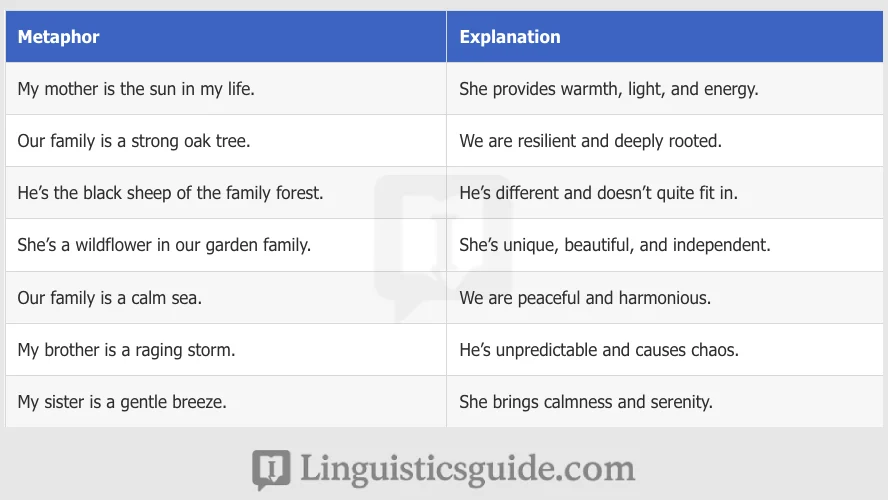
Nature metaphors are frequently used to describe the nurturing, growing, and sometimes wild aspects of family. They can depict the strength and resilience of family bonds, as well as the potential for both beauty and chaos, mirroring the unpredictability of the natural world.
The table below presents a variety of nature metaphors used to describe different aspects of family.
| Metaphor | Explanation |
|---|---|
| My mother is the sun in my life. | She provides warmth, light, and energy. |
| Our family is a strong oak tree. | We are resilient and deeply rooted. |
| He’s the black sheep of the family forest. | He’s different and doesn’t quite fit in. |
| She’s a wildflower in our garden family. | She’s unique, beautiful, and independent. |
| Our family is a calm sea. | We are peaceful and harmonious. |
| My brother is a raging storm. | He’s unpredictable and causes chaos. |
| My sister is a gentle breeze. | She brings calmness and serenity. |
| Our family is a fertile ground for growth. | We provide opportunities for everyone to thrive. |
| He’s the thorny rose of our family. | He’s beautiful but can be difficult to handle. |
| She’s the guiding star in our family constellation. | She provides direction and inspiration. |
| Our family is a flowing river. | We are constantly changing and evolving. |
| He’s the deep-rooted tree in our family. | He’s stable and provides a strong foundation. |
| She’s the bright sunflower in our family. | She’s cheerful and brings joy to everyone. |
| Our family is a blossoming garden. | We are growing and flourishing together. |
| He’s the silent mountain in our family. | He’s strong, stoic, and reliable. |
| She’s the sparkling waterfall in our family. | She’s energetic and refreshing. |
| Our family is a vibrant forest. | We are diverse and full of life. |
| He’s the wandering cloud in our family. | He’s free-spirited and unpredictable. |
| She’s the steady rain in our family. | She’s consistent and provides nourishment. |
| Our family is a warm spring. | We are welcoming and rejuvenating. |
| He’s the protective shield in our family. | He defends and safeguards us. |
| She’s the gentle wave in our family. | She brings comfort and tranquility. |
| Our family is a sunny meadow. | We are happy and carefree. |
| He’s the rocky path in our family. | He presents challenges and obstacles. |
| She’s the blossoming flower in our family. | She’s developing and reaching her full potential. |
Building Metaphor Examples
Building metaphors vividly illustrate the structural and supportive aspects of family. They emphasize the foundations, stability, and protective nature of familial relationships.
These metaphors can highlight both the strengths and vulnerabilities of the family unit, drawing parallels between construction and the creation and maintenance of a family.
| Metaphor | Explanation |
|---|---|
| Our family is built on trust. | Trust is the foundation of our relationships. |
| He’s the cornerstone of our family. | He’s essential and provides stability. |
| She’s the glue that holds our family together. | She keeps us connected and united. |
| Our family is a sturdy bridge. | We connect and support each other. |
| He’s the wall that protects our family. | He provides security and defense. |
| She is the architect of our family traditions. | She designs and maintains our cherished customs. |
| Our family is a well-constructed house. | We are strong, stable, and comfortable. |
| He’s the foundation upon which our family is built. | He provides the essential base for our growth. |
| She’s the roof over our heads. | She provides shelter and protection. |
| Our family is a towering skyscraper. | We are ambitious, strong, and reach for great heights. |
| He’s the scaffolding that supported us through tough times. | He provided temporary support until we could stand on our own. |
| She’s the blueprint for our family’s future. | She has a clear vision and plan for our family’s direction. |
| Our family is a solid fortress. | We are impenetrable and strong. |
| He’s the anchor that keeps our family grounded. | He provides stability and prevents us from drifting apart. |
| She’s the lighthouse guiding our family through storms. | She provides direction and safety during difficult times. |
| Our family is a mosaic of different personalities. | We are made up of diverse individuals who come together to create something beautiful. |
| He’s the bricklayer who builds our family’s legacy. | He works hard to create a lasting and meaningful heritage. |
| She’s the interior designer who makes our family feel like home. | She creates a warm and welcoming environment for everyone. |
| Our family is a monument to love and perseverance. | We stand as a testament to the power of enduring affection and resilience. |
| He’s the builder who constantly renovates and improves our family dynamic. | He actively works to make our family relationships stronger and healthier. |
| She’s the architect who designs our family’s future with care and precision. | She plans and shapes our family’s path with thoughtfulness and attention to detail. |
| Our family is a strong bridge connecting generations. | We link the past and the future, preserving traditions and values. |
| He’s the sturdy beam that supports our family’s structure. | He provides essential strength and stability to our family unit. |
| She’s the mortar that binds our family together in times of trouble. | She helps us stay connected and united during challenging periods. |
| Our family is a carefully crafted foundation for future generations. | We are building a lasting legacy of love, support, and values for those who come after us. |
Journey Metaphor Examples
Journey metaphors capture the shared experiences, challenges, and destinations that families encounter together. They highlight the progress, setbacks, and milestones that mark the family’s path.
These metaphors can also emphasize the individual journeys of family members and how they intertwine with the collective family narrative.
| Metaphor | Explanation |
|---|---|
| We’re all in the same boat. | We’re facing the same challenges together. |
| Our family is on a long and winding road. | We’ve experienced many ups and downs. |
| He’s forging his own path. | He’s creating his own unique journey. |
| She’s navigating uncharted territory. | She’s facing new and unfamiliar challenges. |
| Our family is climbing a mountain together. | We’re working towards a common goal. |
| He’s the trailblazer of our family. | He’s leading the way and setting new standards. |
| She’s the compass guiding our family’s journey. | She provides direction and helps us stay on course. |
| Our family is a ship sailing through life’s storms. | We face challenges together but remain resilient. |
| He’s the captain of our family ship. | He leads and guides us through difficult times. |
| She’s the map that helps us navigate our family’s journey. | She provides guidance and helps us make informed decisions. |
| Our family is a train moving forward on its tracks. | We are progressing towards our goals and dreams. |
| He’s the engineer who keeps our family on the right track. | He ensures that we stay focused and move in the right direction. |
| She’s the conductor who orchestrates our family’s journey. | She coordinates and manages our family’s activities and plans. |
| Our family is an airplane soaring through the sky. | We are reaching for new heights and exploring new opportunities. |
| He’s the pilot who guides our family through the air. | He leads us safely and confidently towards our destination. |
| She’s the flight attendant who ensures our family’s comfort and well-being. | She takes care of our needs and ensures that we are happy and healthy. |
| Our family is a marathon, not a sprint. | We are in it for the long haul and are prepared for challenges. |
| He’s the coach who motivates our family to keep going. | He encourages us and helps us overcome obstacles. |
| She’s the cheerleader who supports our family every step of the way. | She provides encouragement and celebrates our successes. |
| Our family is a road trip filled with unexpected adventures. | We embrace spontaneity and enjoy the journey together. |
| He’s the driver who takes us to new and exciting places. | He leads us on adventures and helps us explore the world. |
| She’s the navigator who ensures we don’t get lost along the way. | She provides direction and helps us stay on track. |
| Our family is a pilgrimage to discover our roots. | We are on a journey to understand our heritage and traditions. |
| He’s the historian who preserves our family’s stories and memories. | He keeps our history alive and shares it with future generations. |
| She’s the storyteller who brings our family’s past to life. | She captivates us with her tales of our ancestors and their experiences. |
Object Metaphor Examples
Object metaphors use inanimate objects to represent family members or the family as a whole, highlighting specific qualities or roles. These metaphors can provide concise and impactful descriptions of family dynamics, emphasizing the function, durability, or significance of each member within the family unit.
| Metaphor | Explanation |
|---|---|
| He’s the black sheep of the family. | He’s different and doesn’t conform to expectations. |
| She’s the heart of our family. | She’s loving, caring, and essential to our well-being. |
| Our family is a patchwork quilt. | We are made up of different pieces that come together to create something beautiful. |
| He’s the rock of our family. | He’s strong, reliable, and provides stability. |
| She’s the light of our family. | She brings joy, happiness, and optimism. |
| Our family is a treasure chest filled with memories. | We cherish our shared experiences and hold them dear. |
| He’s the key to our family’s happiness. | He brings joy and contentment to our lives. |
| She’s the compass that guides our family. | She provides direction and helps us stay on course. |
| Our family is a safety net. | We provide support and protection for each other. |
| He’s the shield that protects our family from harm. | He defends us from danger and adversity. |
| She’s the anchor that keeps our family grounded. | She provides stability and prevents us from drifting apart. |
| Our family is a puzzle where each piece fits perfectly. | We are all unique but essential to the completeness of our family. |
| He’s the backbone of our family. | He provides strength and support. |
| She’s the thread that weaves our family together. | She connects us and keeps us united. |
| Our family is a tapestry of different personalities and experiences. | We are made up of diverse individuals who create a rich and complex whole. |
| He’s the glue that holds our family together. | He keeps us connected and united. |
| She’s the mirror that reflects our family’s values. | She embodies our principles and beliefs. |
| Our family is a time capsule filled with cherished moments. | We preserve our memories and traditions for future generations. |
| He’s the battery that energizes our family. | He provides enthusiasm and motivation. |
| She’s the magnet that draws our family together. | She attracts us and keeps us close. |
| Our family is a book with many chapters yet to be written. | We continue to create new experiences and memories together. |
| He’s the remote control of our family. | He can change the mood or direct the activities. |
| She’s the charger in our family. | She re-energizes and uplifts everyone. |
| Our family is a compass guiding through life. | We provide direction and help navigate challenges. |
| He’s the sturdy table of our family gatherings. | He supports and brings everyone together. |
| She’s the favorite blanket of our family. | She provides comfort and warmth. |
Food Metaphor Examples
Food metaphors evoke feelings of nourishment, comfort, and shared experiences within a family. They often highlight the different flavors and ingredients that contribute to the overall family dynamic, showcasing how each member brings something unique to the table.
| Metaphor | Explanation |
|---|---|
| She’s the spice of our family. | She adds excitement and flavor to our lives. |
| Our family is a recipe for disaster. | We’re prone to conflict and chaos. |
| He’s the breadwinner of our family. | He provides financial support. |
| She’s the sugar in our family’s coffee. | She sweetens our lives and makes everything better. |
| Our family is a melting pot of cultures and traditions. | We are a diverse mix of backgrounds and beliefs. |
| He’s the salt of the earth in our family. | He’s genuine, honest, and reliable. |
| She’s the cream that rises to the top in our family. | She’s successful and stands out from the crowd. |
| Our family is a fruit salad of different personalities. | We are a mix of diverse and unique individuals. |
| He’s the apple of our family’s eye. | He’s cherished and loved by everyone. |
| She’s the icing on the cake in our family. | She adds the finishing touch and makes everything perfect. |
| Our family is a nourishing stew. | We provide comfort, warmth, and support for each other. |
| He’s the main course of our family gatherings. | He’s the center of attention and brings everyone together. |
| She’s the dessert that makes our family complete. | She brings joy and happiness to our lives. |
| Our family is a buffet of different talents and skills. | We are a diverse group with a wide range of abilities. |
| He’s the secret ingredient that makes our family special. | He brings a unique and valuable quality to our family. |
| She’s the gravy that brings our family together. | She connects us and makes us feel like a cohesive unit. |
| Our family is a well-balanced meal. | We provide each other with everything we need to thrive. |
| He is the yeast that makes our family rise. | He inspires growth and improvement. |
| She is the sugar that sweetens our family gatherings. | She brings joy and lightens the mood. |
| Our family is a warm cup of cocoa on a cold winter day. | We provide comfort and warmth during difficult times. |
| He is the chef who creates memorable family meals. | He brings us together and nourishes us. |
| She is the baker who sweetens our lives with love and care. | She adds joy and happiness to our family. |
| Our family is a potluck of different personalities and backgrounds. | We are a diverse group who come together to share our unique qualities. |
| He is the coffee that wakes our family up in the morning. | He provides energy and enthusiasm. |
| She is the tea that soothes our family in the evening. | She brings calmness and relaxation. |
Usage Rules for Family Metaphors
Using family metaphors effectively requires careful consideration of context, audience, and the intended meaning. Here are some key usage rules:
- Clarity: Choose metaphors that are easily understood by your audience. Avoid obscure or overly complex comparisons.
- Relevance: Ensure that the metaphor is relevant to the aspect of family you are describing. The qualities of the vehicle should align with the qualities of the tenor.
- Consistency: Maintain consistency in your use of metaphors. Avoid mixing metaphors in a way that creates confusion or contradiction.
- Appropriateness: Consider the emotional tone of the metaphor. Choose metaphors that are appropriate for the context and the message you are trying to convey.
- Originality: While common metaphors can be effective, try to create original metaphors that are fresh and engaging. This can make your communication more memorable and impactful.
It’s also important to be aware of cultural differences in the interpretation of metaphors. A metaphor that is effective in one culture may not be as effective in another.
Understanding your audience’s cultural background can help you choose metaphors that resonate with them.
Common Mistakes When Using Family Metaphors
Several common mistakes can undermine the effectiveness of family metaphors. Being aware of these pitfalls can help you avoid them.
| Mistake | Correct Example | Incorrect Example |
|---|---|---|
| Mixed Metaphors: Combining unrelated metaphors. | “Our family is a strong tree with deep roots.” | “Our family is a strong tree sailing on the ocean.” |
| Clichéd Metaphors: Using overused and predictable metaphors. | “Our family is a close-knit team.” | “Our family is as good as gold.” |
| Inappropriate Metaphors: Choosing metaphors that are offensive or insensitive. | “Our family is a supportive community.” | “Our family is a battlefield.” |
| Unclear Metaphors: Using metaphors that are difficult to understand. | “Our family is a well-tuned orchestra.” | “Our family is a quantum entanglement.” |
| Overextended Metaphors: Pushing a metaphor too far, leading to absurdity. | “Our family is a garden; we nurture each other.” | “Our family is a garden; we fertilize each other with gossip and prune each other’s ambitions.” |
Practice Exercises
Test your understanding of family metaphors with these exercises:
- Identify the Metaphor: In each sentence, identify the family metaphor.
- Explain the Meaning: Explain what the metaphor means in the context of the sentence.
- Create Your Own: Create your own family metaphor to describe a specific aspect of your family.
Exercise 1: Identify the Metaphor
| Question | Answer |
|---|---|
| 1. My mother is the anchor of our family. | Metaphor: anchor |
| 2. He’s the black sheep of the family. | Metaphor: black sheep |
| 3. Our family is a sturdy bridge. | Metaphor: bridge |
| 4. She’s the spice of our family. | Metaphor: spice |
| 5. Our family is a long and winding road. | Metaphor: long and winding road |
| 6. He’s the glue that holds our family together. | Metaphor: glue |
| 7. She is the sun in our family. | Metaphor: sun |
| 8. Our family is a treasure chest of memories. | Metaphor: treasure chest |
| 9. He is the rock of our family. | Metaphor: rock |
| 10. She is the light of our family. | Metaphor: light |
Exercise 2: Explain the Meaning
| Question | Answer |
|---|---|
| 1. My mother is the anchor of our family. | She provides stability and security. |
| 2. He’s the black sheep of the family. | He’s different and doesn’t conform. |
| 3. Our family is a sturdy bridge. | We connect and support each other. |
| 4. She’s the spice of our family. | She adds excitement and flavor. |
| 5. Our family is a long and winding road. | We’ve experienced many ups and downs. |
| 6. He’s the glue that holds our family together. | He keeps us connected and united. |
| 7. She is the sun in our family. | She provides warmth and happiness. |
| 8. Our family is a treasure chest of memories. | We cherish our shared experiences. |
| 9. He is the rock of our family. | He is strong and reliable. |
| 10. She is the light of our family. | She brings joy and happiness. |
Exercise 3: Create Your Own
(Answers will vary depending on individual experiences.)
- Describe your family using a nature metaphor.
- Describe a family member using a building metaphor.
- Describe your family’s journey using a journey metaphor.
- Describe a family member using an object metaphor.
- Describe your family using a food metaphor.
- Create a metaphor to explain a tradition in your family.
- Create a metaphor to describe the role of siblings in a family.
- Create a metaphor to describe the role of parents in a family.
- Create a metaphor to describe a challenging time your family faced.
- Create a metaphor to describe a joyful time your family shared.
Advanced Topics in Family Metaphors
For advanced learners, exploring the theoretical underpinnings of metaphor can provide a deeper understanding of their power and function. One key concept is Conceptual Metaphor Theory, which proposes
that metaphors are not just linguistic devices, but fundamental cognitive structures that shape our understanding of the world. According to this theory, we understand abstract concepts like “argument” or “time” in terms of more concrete concepts like “war” or “money.”
In the context of family metaphors, Conceptual Metaphor Theory suggests that our understanding of family is shaped by underlying metaphors that we may not even be aware of. For example, the metaphor “FAMILY IS A UNIT” might explain why we often talk about families as if they were single entities with shared goals and values.
Another advanced topic is the use of extended metaphors in literature and film. Authors and filmmakers often use extended metaphors to develop complex themes and characters. Analyzing these extended metaphors can provide valuable insights into the deeper meanings of the work.
For example, in some novels, a family might be consistently portrayed as a ship navigating treacherous waters. This extended metaphor could be used to explore themes of resilience, leadership, and the challenges of maintaining unity in the face of adversity.
Additionally, exploring the cultural and historical context of family metaphors can reveal how societal values and beliefs shape our understanding of family. Different cultures may use different metaphors to describe family, reflecting their unique perspectives and priorities.
By delving into these advanced topics, English language learners can gain a sophisticated understanding of the role of metaphor in shaping our perceptions of family and the world around us.
Frequently Asked Questions
Why are metaphors important in describing family relationships?
Metaphors provide a vivid and relatable way to understand the complex dynamics, emotions, and roles within a family. They allow us to express abstract ideas in concrete terms, making them easier to grasp and communicate.
How can I improve my understanding of family metaphors?
Practice identifying and analyzing metaphors in various contexts, such as literature, films, and everyday conversations. Pay attention to the qualities of the vehicle and how they relate to the tenor.
Also, explore different types of family metaphors and their common meanings.
Are there any metaphors I should avoid when talking about family?
Avoid metaphors that are clichéd, offensive, or insensitive. Be mindful of the emotional tone and ensure that the metaphor is appropriate for the context and audience.
Also, avoid mixing unrelated metaphors, as this can create confusion.
Can metaphors be used to create positive change in family relationships?
Yes, metaphors can be used to reframe perspectives and promote understanding. By choosing metaphors that emphasize positive qualities and shared goals, families can foster stronger connections and navigate challenges more effectively.
How do cultural differences affect the interpretation of family metaphors?
Different cultures may have different values and beliefs about family, which can influence the metaphors they use to describe it. A metaphor that is effective in one culture may not be as effective in another.
Understanding your audience’s cultural background is essential for effective communication.
Conclusion
Family metaphors are powerful tools for understanding and expressing the complex dynamics of familial relationships. By recognizing and analyzing these metaphors, we can gain deeper insights into our own families and the families of others.
Whether you are an English language learner seeking to expand your vocabulary or simply someone interested in exploring the nuances of language, mastering family metaphors can enrich your communication skills and enhance your understanding of human relationships. From nature-inspired comparisons to building-block analogies, the world of family metaphors offers a rich tapestry of figurative language waiting to be explored.
Embrace these metaphors, use them wisely, and watch as your understanding of family deepens and your ability to articulate its complexities flourishes.