
Understanding how we use metaphors to describe and compare cultures is crucial for effective communication and intercultural understanding. Metaphors shape our perceptions and can influence how we interact with people from different backgrounds.
In English grammar, these metaphorical usages often involve specific verb tenses, comparative adjectives, and idiomatic expressions. This article will explore various metaphors for culture, providing examples, usage rules, and practice exercises to help you master this fascinating aspect of language.
This guide is beneficial for English language learners, educators, and anyone interested in improving their intercultural communication skills.
Table of Contents
- Introduction
- Definition of Culture as Metaphor
- Structural Breakdown
- Types and Categories of Cultural Metaphors
- Examples of Cultural Metaphors
- Usage Rules for Cultural Metaphors
- Common Mistakes
- Practice Exercises
- Advanced Topics
- FAQ
- Conclusion
Definition of Culture as Metaphor
A metaphor is a figure of speech that directly compares two unlike things, suggesting a similarity between them without using “like” or “as.” When we talk about “culture as metaphor,” we’re using metaphorical language to understand and describe the complex and multifaceted nature of culture. Instead of defining culture literally, we use familiar concepts to represent its characteristics, values, and behaviors.
This metaphorical approach helps simplify complex ideas and makes them more relatable.
The function of using metaphors for culture is to provide a framework for understanding cultural differences and similarities. By comparing culture to something tangible and familiar, we can better grasp its abstract qualities.
Metaphors also influence our perceptions and attitudes towards different cultures. The context in which a cultural metaphor is used can significantly affect its interpretation.
For example, the “melting pot” metaphor, once seen as positive, is now often criticized for implying the loss of individual cultural identities.
Structural Breakdown
The structure of a cultural metaphor typically involves two main components: the tenor and the vehicle. The tenor is the subject being described (in this case, culture), and the vehicle is the object or concept used to represent it. Understanding how these components interact is essential for interpreting the meaning of a cultural metaphor.
Consider the metaphor “Culture is a garden.” Here, “culture” is the tenor, and “garden” is the vehicle. The metaphor suggests that culture, like a garden, requires cultivation, nurturing, and careful management to thrive.
It implies that different elements within a culture need to be tended to individually and that the overall health of the culture depends on the interaction and balance of these elements. The grammatical structure often involves a simple “A is B” construction, but more complex sentences can add layers of meaning.
The choice of verb tense is also important. Present tense (“Culture is…”) suggests a timeless, ongoing characteristic, while past tense (“Culture was…”) might imply a change or evolution. Adjectives and adverbs further refine the metaphor, adding nuances to the comparison. For instance, “Culture is a vibrant mosaic” conveys a sense of dynamism and diversity.
Types and Categories of Cultural Metaphors
Cultural metaphors are diverse, each offering a unique perspective on the nature of culture. Here are some common categories:
Culture as a Melting Pot
The “melting pot” metaphor suggests that different cultures blend together to create a homogenous whole. Immigrants assimilate into the dominant culture, losing their original customs and traditions.
This metaphor was popular in the United States during the early 20th century, reflecting the belief that immigrants should adopt American values and customs.
Culture as a Mosaic
In contrast to the “melting pot,” the “mosaic” metaphor emphasizes the preservation of individual cultural identities within a larger society. Each culture retains its unique characteristics, contributing to the overall beauty and complexity of the mosaic.
This metaphor celebrates diversity and multiculturalism.
Culture as a Tapestry
Similar to the “mosaic,” the “tapestry” metaphor highlights the interconnectedness of different cultures. Each thread represents a different culture, and together they create a rich and intricate fabric.
This metaphor emphasizes the interdependence of cultures and the importance of understanding their relationships.
Culture as a Garden
The “garden” metaphor suggests that culture is something that needs to be nurtured and cultivated. Different elements within a culture, like plants in a garden, require different types of care.
This metaphor emphasizes the role of education, leadership, and community in fostering a healthy and thriving culture.
Culture as an Iceberg
The “iceberg” metaphor illustrates that only a small part of culture is visible on the surface (e.g., food, clothing, language). The majority of culture lies beneath the surface (e.g., values, beliefs, assumptions), hidden from plain sight.
This metaphor underscores the importance of understanding the deeper, often unconscious, aspects of culture.
Culture as Software of the Mind
This metaphor, popularized by Geert Hofstede, compares culture to the software that programs our thinking and behavior. Culture provides us with a set of mental frameworks and scripts that guide our actions and interactions.
This metaphor highlights the pervasive influence of culture on our cognitive processes.
Examples of Cultural Metaphors
The following tables provide examples of cultural metaphors, categorized by type, with explanations of their intended meaning and potential implications.
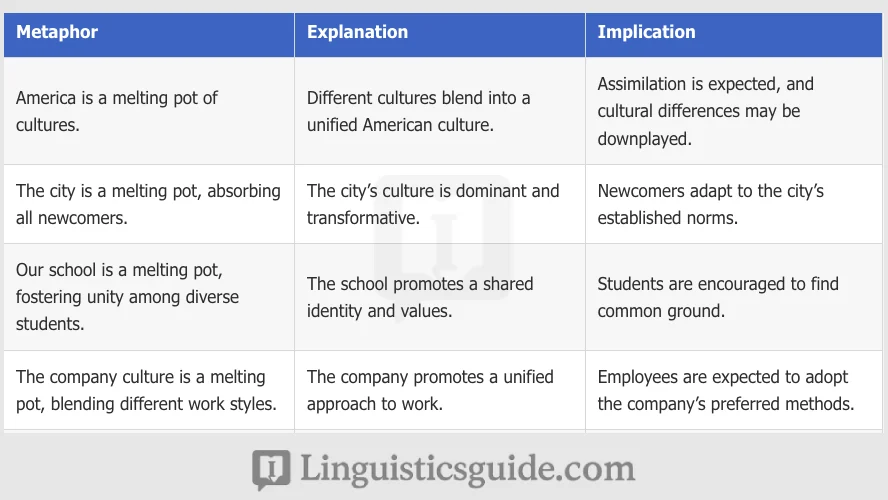
The table below shows examples of the “Culture as a Melting Pot” metaphor and its variations. It illustrates how this metaphor is used and understood in different contexts.
| Metaphor | Explanation | Implication |
|---|---|---|
| America is a melting pot of cultures. | Different cultures blend into a unified American culture. | Assimilation is expected, and cultural differences may be downplayed. |
| The city is a melting pot, absorbing all newcomers. | The city’s culture is dominant and transformative. | Newcomers adapt to the city’s established norms. |
| Our school is a melting pot, fostering unity among diverse students. | The school promotes a shared identity and values. | Students are encouraged to find common ground. |
| The company culture is a melting pot, blending different work styles. | The company promotes a unified approach to work. | Employees are expected to adopt the company’s preferred methods. |
| The neighborhood became a melting pot after the new development. | The influx of new residents led to cultural mixing. | Traditional neighborhood customs may be diluted. |
| Their marriage is a melting pot of traditions. | They blend their family customs to create new ones. | Compromise and adaptation are key to their relationship. |
| The music scene here is a melting pot of genres. | Different musical styles influence each other. | New and hybrid genres emerge from the blending. |
| The political arena is a melting pot of ideologies. | Different political views clash and sometimes merge. | Compromises and new political platforms may arise. |
| The art community is a melting pot of creative expression. | Artists from various backgrounds inspire each other. | Innovative and diverse art forms are produced. |
| The festival is a melting pot of food and culture. | Various cuisines and traditions are celebrated together. | Attendees can experience a wide range of cultural offerings. |
| The project team is a melting pot of skills and expertise. | Team members with different backgrounds collaborate. | The project benefits from a diverse set of perspectives. |
| The online community is a melting pot of ideas. | Users from around the world share their thoughts and opinions. | The community fosters a global exchange of information. |
| The conference is a melting pot of industry professionals. | Experts from different companies network and share insights. | The conference promotes innovation and collaboration. |
| The research lab is a melting pot of scientific disciplines. | Researchers from various fields work together. | The lab fosters interdisciplinary research. |
| The social media platform is a melting pot of opinions. | Users express a wide range of viewpoints. | The platform can be a source of both conflict and understanding. |
| The training program is a melting pot of learning styles. | Participants with different learning preferences are accommodated. | The program aims to cater to a diverse audience. |
| The international summit is a melting pot of diplomacy. | Leaders from different countries negotiate and collaborate. | The summit aims to promote global cooperation. |
| The think tank is a melting pot of intellectual thought. | Scholars from various backgrounds contribute their ideas. | The think tank fosters innovative solutions to complex problems. |
| The co-working space is a melting pot of entrepreneurs. | People from various backgrounds create their own ventures. | The space fosters innovation and collaboration. |
| The retreat is a melting pot of spiritual practices. | People from various backgrounds share their customs. | The retreat fosters understanding and collaboration. |
This table illustrates the “Culture as a Mosaic” metaphor, highlighting the preservation of individual identities within a collective.
| Metaphor | Explanation | Implication |
|---|---|---|
| The city is a mosaic of different cultures. | Each culture retains its distinct identity. | Diversity is celebrated, and cultural differences are valued. |
| Our organization is a mosaic of talents and backgrounds. | We value the unique perspectives each person brings. | Inclusion and respect are core principles. |
| The art exhibit is a mosaic of different styles. | Each artist’s work stands out individually. | Variety and individuality are emphasized. |
| The team is a mosaic of skills, each essential to success. | Different skills complement each other without blending. | Each team member’s expertise is recognized and utilized. |
| The community is a mosaic of traditions and customs. | Each group maintains its unique cultural practices. | Cultural heritage is preserved and respected. |
| The classroom is a mosaic of learning styles. | Students learn in different ways, each valid and valuable. | Teachers accommodate diverse learning preferences. |
| The neighborhood is a mosaic of architectural designs. | Each house has its unique style and character. | Variety and individuality are celebrated in the built environment. |
| The music festival is a mosaic of genres and artists. | Each performer brings their distinct musical style. | The festival offers a diverse and eclectic lineup. |
| The garden is a mosaic of flowers and plants. | Each species retains its unique characteristics. | Biodiversity and ecological balance are valued. |
| The quilt is a mosaic of fabrics and patterns. | Each piece contributes to the overall design. | Individuality and craftsmanship are emphasized. |
| The online platform is a mosaic of user-generated content. | Each user contributes their unique perspective and voice. | Diversity and inclusivity are promoted. |
| The conference is a mosaic of expert opinions. | Each speaker shares their unique insights and expertise. | A wide range of viewpoints is presented. |
| The research project is a mosaic of methodologies. | Researchers use different approaches to investigate the topic. | A multifaceted and comprehensive understanding is achieved. |
| The social media feed is a mosaic of personal stories. | Users share their experiences and perspectives. | A diverse and authentic portrayal of life is presented. |
| The training program is a mosaic of teaching techniques. | Instructors use different methods to engage participants. | A variety of learning styles are accommodated. |
| The international collaboration is a mosaic of partnerships. | Organizations from different countries work together. | Shared goals and mutual benefits are emphasized. |
| The think tank is a mosaic of intellectual disciplines. | Scholars from various fields contribute their expertise. | Interdisciplinary research is fostered. |
| The co-working space is a mosaic of startups and freelancers. | People from various backgrounds create their own ventures. | The space fosters innovation and collaboration. |
| The retreat is a mosaic of spiritual practices. | People from various backgrounds share their customs. | The retreat fosters understanding and collaboration. |
| The city council is a mosaic of political viewpoints. | Each member represents a different part of the city. | The council aims to represent the city’s diverse needs. |
This table shows examples of the “Culture as an Iceberg” metaphor, emphasizing the hidden aspects of culture.
| Metaphor | Explanation | Implication |
|---|---|---|
| Culture is like an iceberg; most of it is hidden beneath the surface. | Visible aspects (e.g., food, clothing) are only a small part of culture. | Understanding requires exploring deeper values and beliefs. |
| When interacting with a new culture, remember the iceberg. | Focus on understanding the underlying values, not just the surface behaviors. | Misunderstandings can arise if you only focus on the visible aspects. |
| The iceberg metaphor helps us appreciate cultural complexity. | There’s more to culture than meets the eye. | Patience and curiosity are essential for intercultural understanding. |
| Corporate culture is an iceberg; values are below the surface. | Visible practices are driven by hidden beliefs. | To change the culture, you must address the underlying values. |
| Personal relationships are like icebergs; emotions are hidden. | Visible actions are driven by hidden feelings. | Communication requires empathy and understanding. |
| The political climate is an iceberg; opinions are concealed. | Visible statements are driven by hidden agendas. | Analysis requires critical thinking and investigation. |
| The art world is an iceberg; meaning is often hidden. | Visible works are driven by complex concepts. | Appreciation requires knowledge and interpretation. |
| The scientific community is an iceberg; assumptions are unstated. | Visible research is driven by hidden hypotheses. | Progress requires questioning and challenging assumptions. |
| The educational system is an iceberg; values are implicit. | Visible curriculum is driven by hidden beliefs. | Reform requires examining and revising the underlying values. |
| The legal system is an iceberg; principles are often obscured. | Visible laws are driven by hidden philosophies. | Justice requires transparency and ethical considerations. |
| The medical profession is an iceberg; ethics are rarely visible. | Visible treatments are driven by hidden beliefs. | Care requires empathy and ethical considerations. |
| The economic system is an iceberg; motives are often concealed. | Visible transactions are driven by hidden incentives. | Understanding requires economic literacy and ethical awareness. |
| The religious institution is an iceberg; beliefs are deeply rooted. | Visible rituals are driven by hidden faith. | Respect requires understanding and tolerance. |
| The military organization is an iceberg; discipline is paramount. | Visible actions are driven by hidden principles. | Understanding requires respect and consideration. |
| The family dynamic is an iceberg; feelings are often unsaid. | Visible interactions are driven by hidden emotions. | Harmony requires empathy and understanding. |
| The environmental movement is an iceberg; values are profound. | Visible actions are driven by hidden beliefs. | Sustainability requires commitment and understanding. |
| The technological industry is an iceberg; innovation is key. | Visible advancements are driven by hidden research. | Progress requires commitment and investment. |
| The political campaign is an iceberg; strategy is crucial. | Visible actions are driven by hidden planning. | Success requires organization and execution. |
| The co-working space is an iceberg; values are often unstated. | Visible actions are driven by hidden beliefs. | Understanding requires respect and consideration. |
| The retreat is an iceberg; feelings are often unsaid. | Visible interactions are driven by hidden emotions. | Harmony requires empathy and understanding. |
Usage Rules for Cultural Metaphors
When using cultural metaphors, it’s important to be mindful of their potential impact. Here are some guidelines:
- Be aware of the connotations: Different metaphors carry different connotations. The “melting pot” can imply forced assimilation, while the “mosaic” suggests respect for diversity. Choose metaphors that accurately reflect your intended meaning.
- Consider your audience: Your audience’s cultural background and beliefs will influence how they interpret your metaphors. Be sensitive to potential misunderstandings.
- Provide context: Explain the intended meaning of your metaphor to avoid ambiguity. Don’t assume that everyone will interpret it the same way.
- Avoid stereotypes: Be careful not to reinforce harmful stereotypes through your use of metaphors. Choose metaphors that promote understanding and respect.
- Use metaphors sparingly: Overusing metaphors can make your language sound cliché or confusing. Use them strategically to enhance your message.
For example, saying “The cultural landscape is a battlefield” might unintentionally evoke negative emotions and reinforce conflict. A more neutral metaphor, such as “The cultural landscape is a garden,” could be more appropriate depending on the context and your intended message.
Remember that even seemingly innocuous metaphors can carry subtle biases, so it’s essential to reflect on their potential implications.
Common Mistakes
Here are some common mistakes to avoid when using metaphors for culture:
| Incorrect | Correct | Explanation |
|---|---|---|
| “All cultures should melt into one.” | “Cultures can coexist like pieces in a mosaic.” | The first statement suggests forced assimilation, while the second promotes diversity. |
| “That culture is a messy garden.” | “That culture is a garden that needs careful tending.” | The first statement is overly critical, while the second acknowledges potential and need for care. |
| “Culture is just the tip of the iceberg.” | “Culture is like an iceberg, with most of it hidden beneath the surface.” | The first statement is incomplete and lacks clarity. |
| “The world is becoming a bland melting pot.” | “The world is becoming increasingly interconnected, like threads in a tapestry.” | The first statement is negative and oversimplified, while the second is more nuanced and positive. |
| “Their culture is a software virus.” | “Their culture is a different operating system.” | The first statement is offensive, while the second promotes understanding. |
| “Our company is a melting pot, so everyone must conform.” | “Our company is a mosaic, where everyone’s unique contribution is valued.” | The first statement implies forced assimilation, while the second values diversity. |
Practice Exercises
Test your understanding of cultural metaphors with these exercises.
Exercise 1: Identify the Metaphor
Identify the cultural metaphor used in each sentence and explain its meaning.
| Question | Answer |
|---|---|
| 1. The city is a vibrant tapestry of cultures. | Metaphor: Tapestry. Meaning: The city’s cultures are interconnected and create a rich fabric. |
| 2. Our school is a melting pot of students from around the world. | Metaphor: Melting pot. Meaning: Students from different backgrounds blend together. |
| 3. Culture is like an iceberg; most of it is hidden. | Metaphor: Iceberg. Meaning: The visible aspects of culture are only a small part of the whole. |
| 4. The organization is a mosaic of diverse talents. | Metaphor: Mosaic. Meaning: The organization values the unique contributions of each individual. |
| 5. The community is a garden that needs careful tending. | Metaphor: Garden. Meaning: The community requires nurturing and care to thrive. |
| 6. The project was a cultural crossroads, where ideas converged. | Metaphor: Crossroads. Meaning: The project brought together diverse perspectives and approaches. |
| 7. The nation is a symphony, with each culture playing a unique instrument. | Metaphor: Symphony. Meaning: The nation is harmonious, with each culture playing a distinct role. |
| 8. The team was a cultural kaleidoscope, constantly shifting and changing. | Metaphor: Kaleidoscope. Meaning: The team was dynamic and diverse, with ever-changing perspectives. |
| 9. The city is a cultural patchwork, sewn together with shared values. | Metaphor: Patchwork. Meaning: The city is diverse, but united by common beliefs and principles. |
| 10. The company is a cultural constellation, with each employee a shining star. | Metaphor: Constellation. Meaning: The company values each employee’s unique talents and contributions. |
Exercise 2: Choose the Best Metaphor
Choose the best cultural metaphor to complete each sentence.
| Question | Options | Answer |
|---|---|---|
| 1. The city is a _____, with each neighborhood contributing its unique flavor. | a) melting pot b) mosaic c) garden | b) mosaic |
| 2. Our team is a _____, where everyone’s skills complement each other. | a) battlefield b) tapestry c) iceberg | b) tapestry |
| 3. Understanding a new culture is like exploring a _____. | a) melting pot b) iceberg c) garden | b) iceberg |
| 4. The company’s culture is a _____, needing constant care and attention. | a) garden b) mosaic c) melting pot | a) garden |
| 5. The global community is a _____, where different voices come together in harmony. | a) symphony b) battlefield c) iceberg | a) symphony |
| 6. The project was a cultural _____, bringing together diverse ideas and perspectives. | a) crossroads b) melting pot c) tapestry | a) crossroads |
| 7. The nation is a cultural _____, with each region contributing its unique traditions. | a) constellation b) patchwork c) iceberg | b) patchwork |
| 8. The team was a cultural _____, constantly evolving and adapting to new challenges. | a) kaleidoscope b) garden c) melting pot | a) kaleidoscope |
| 9. The organization is a cultural _____, where each member is a valuable asset. | a) constellation b) iceberg c) garden | a) constellation |
| 10. The festival was a cultural _____, celebrating diversity and unity. | a) mosaic b) melting pot c) symphony | a) mosaic |
Advanced Topics
For advanced learners, consider exploring the following topics:
- Critical analysis of cultural metaphors: Examine the biases and assumptions embedded in different metaphors.
- The role of metaphors in shaping cultural identity: Investigate how metaphors influence our understanding of ourselves and others.
- The use of metaphors in intercultural communication: Explore how metaphors can facilitate or hinder communication across cultures.
- The evolution of cultural metaphors over time: Trace how metaphors change and adapt to reflect shifting social and political contexts.
- The creation of new cultural metaphors: Develop innovative metaphors that capture the complexities of contemporary culture.
Delving into these areas will deepen your understanding of cultural metaphors and their impact on society.
FAQ
- What is a cultural metaphor?
A cultural metaphor is a figure of speech that uses an object, concept, or image to represent the characteristics, values, or behaviors of a culture. It helps simplify complex ideas and make them more relatable.
- Why are cultural metaphors important?
Cultural metaphors provide a framework for understanding cultural differences and similarities. They influence our perceptions and attitudes towards different cultures and can facilitate intercultural communication.
- What is the difference between the “melting pot” and “mosaic” metaphors?
The “melting pot” suggests that different cultures blend into a homogenous whole, while the “mosaic” emphasizes the preservation of individual cultural identities within a larger society.
- How can I avoid misusing cultural metaphors?
Be aware of the connotations of different metaphors, consider your audience, provide context, avoid stereotypes, and use metaphors sparingly.
- What is the “iceberg” metaphor for culture?
The “iceberg” metaphor illustrates that only a small part of culture is visible on the surface (e.g., food, clothing, language). The majority of culture lies beneath the surface (e.g., values, beliefs, assumptions).
- How do cultural metaphors influence our perceptions?
Cultural metaphors shape our perceptions by providing a lens through which we view different cultures. They can influence our attitudes, beliefs, and behaviors towards people from different backgrounds.
- Can cultural metaphors be harmful?
Yes, if they reinforce stereotypes, promote prejudice, or oversimplify complex cultural realities. It’s essential to use metaphors thoughtfully and critically.
- How can I learn more about cultural metaphors?
Read books and articles on intercultural communication, attend workshops and seminars, and engage in conversations with people from different cultures.
- What are some other common cultural metaphors?
Other common metaphors include culture as a tapestry, a garden, software of the mind, and a symphony. Each offers a unique perspective on the nature of culture.
- How do cultural metaphors evolve over time?
Cultural metaphors evolve to reflect shifting social, political, and economic contexts. They can also be influenced by new research and insights into cultural dynamics.
Conclusion
Understanding metaphors for culture is crucial for fostering intercultural understanding and effective communication. By recognizing the underlying assumptions and connotations of different metaphors, we can avoid misunderstandings and promote respect for cultural diversity.
Remember to be mindful of your audience, provide context, and avoid stereotypes when using cultural metaphors. As you continue your language learning journey, pay attention to how metaphors shape your perceptions and influence your interactions with people from different backgrounds.
By mastering the art of cultural metaphor, you’ll enhance your communication skills and deepen your appreciation for the richness and complexity of human culture.