
Understanding metaphors for the church is crucial for grasping the multifaceted nature of this institution. Metaphors serve as powerful tools in language, allowing us to understand abstract concepts by relating them to more concrete realities.
In the context of the church, metaphors provide insights into its purpose, structure, and relationship with its members and the wider world. This article explores various metaphors used to describe the church, their meanings, and their significance in shaping our understanding.
This guide is beneficial for students of theology, religious studies, English literature, and anyone interested in exploring the rich tapestry of figurative language used to describe the church.
Table of Contents
- Introduction
- Definition of Metaphor for Church
- Classification
- Function
- Context
- Structural Breakdown
- Types and Categories of Metaphors for Church
- The Church as the Body of Christ
- The Church as the Bride of Christ
- The Church as the Family of God
- The Church as the Flock of God
- The Church as the Temple of God
- The Church as the Vine and Branches
- The Church as the City of God
- Examples of Metaphors for Church
- Examples of “Body of Christ”
- Examples of “Bride of Christ”
- Examples of “Family of God”
- Examples of “Flock of God”
- Examples of “Temple of God”
- Usage Rules
- Contextual Appropriateness
- Cultural Sensitivity
- Theological Accuracy
- Common Mistakes
- Practice Exercises
- Exercise 1: Identifying Metaphors
- Exercise 2: Explaining Metaphors
- Exercise 3: Using Metaphors in Context
- Advanced Topics
- Extended Metaphors
- Mixed Metaphors
- Dead Metaphors
- FAQ
- Conclusion
Definition of Metaphor for Church
A metaphor for the church is a figure of speech that describes the church by comparing it to something else, without using “like” or “as.” It is a way of understanding the complex reality of the church through a more tangible or relatable concept. These metaphors are not merely decorative; they convey essential truths about the nature, purpose, and function of the church.
Classification
Metaphors for the church can be classified based on the aspect of the church they highlight. Some emphasize the church’s unity and interconnectedness, while others focus on its relationship with God, its mission in the world, or its internal structure.
They can also be classified based on their origin (e.g., biblical, historical, cultural). Biblical metaphors, for example, are rooted in the scriptures and provide foundational understandings of the church.
Function
The primary function of metaphors for the church is to illuminate its essence in a way that is accessible and meaningful. They help to convey abstract theological concepts in a concrete manner.
They also serve to inspire, motivate, and challenge members of the church to live out their calling. By using metaphors, we can gain a deeper appreciation for the church’s role in God’s plan and its impact on the world.
Context
The interpretation of metaphors for the church is highly dependent on context. The historical, cultural, and theological context in which a metaphor is used shapes its meaning and significance.
For instance, the metaphor of the “temple” carries different connotations depending on whether it is understood in the context of the Old Testament temple in Jerusalem or the New Testament concept of believers as living stones. Understanding the context is crucial for avoiding misinterpretations and appreciating the richness of the metaphor.
Structural Breakdown
The structure of a metaphor involves two key elements: the tenor and the vehicle. The tenor is the subject being described (in this case, the church), and the vehicle is the object or concept to which the church is being compared. The vehicle provides a new perspective on the tenor, highlighting certain qualities or characteristics. The relationship between the tenor and vehicle is not arbitrary; it is based on shared attributes or qualities that create a meaningful connection. For example, in the metaphor “the church is the body of Christ,” the church (tenor) is compared to a physical body (vehicle). This comparison emphasizes the unity, interdependence, and functionality of the church.
Understanding the underlying structure helps in deconstructing and interpreting the meaning of the metaphor. It allows us to identify the specific aspects of the church that are being emphasized and the implications of the comparison.
By analyzing the relationship between the tenor and vehicle, we can gain a deeper understanding of the church’s identity and purpose.
Types and Categories of Metaphors for Church
There are numerous metaphors used to describe the church, each offering a unique perspective. Here are some of the most prominent categories, often rooted in the Bible:
The Church as the Body of Christ
This metaphor, prominently featured in the writings of Paul, emphasizes the unity and interdependence of believers. Just as a physical body has many parts that work together, so too does the church consist of diverse members who contribute to the overall health and functioning of the body.
Each member has a unique role to play, and the body suffers when one part is not functioning properly. This metaphor also highlights the headship of Christ, who guides and directs the church.
The Church as the Bride of Christ
This metaphor depicts the intimate and loving relationship between Christ and the church. It emphasizes Christ’s sacrificial love for the church and the church’s devotion and faithfulness to Christ.
The image of the bride also suggests purity, beauty, and preparation for a future union with Christ. This metaphor often appears in the context of eschatology, referring to the ultimate union of Christ and the church in eternity.
The Church as the Family of God
This metaphor highlights the familial bonds that exist among believers. It emphasizes the love, support, and care that members of the church should provide for one another.
As members of God’s family, believers are adopted into a new relationship with God and with one another. This metaphor stresses the importance of community, fellowship, and mutual responsibility.
The Church as the Flock of God
This metaphor portrays Christ as the Good Shepherd who cares for and protects his flock (the church). It emphasizes Christ’s role as provider, protector, and guide.
The church, as the flock, is called to follow the Shepherd’s voice and trust in his care. This metaphor highlights the importance of leadership, guidance, and protection within the church.
The Church as the Temple of God
This metaphor depicts the church as the dwelling place of God’s Spirit. It emphasizes the holiness and sacredness of the church.
In the Old Testament, the temple was the place where God’s presence was manifested. In the New Testament, the church, composed of living stones (believers), becomes the new temple where God dwells.
This metaphor underscores the importance of worship, prayer, and spiritual growth within the church.
The Church as the Vine and Branches
This metaphor, used by Jesus in John 15, illustrates the vital connection between Christ and his followers. Jesus is the vine, and believers are the branches.
Just as branches depend on the vine for nourishment and life, so too do believers depend on Christ for spiritual sustenance. This metaphor emphasizes the importance of abiding in Christ and bearing fruit through his power.
The Church as the City of God
This metaphor portrays the church as a community set apart, a beacon of righteousness and justice in the world. It emphasizes the church’s role in transforming society and promoting God’s kingdom on earth.
The City of God is characterized by peace, justice, and love, and it serves as a model for human society. This metaphor highlights the church’s mission to be a witness to God’s grace and truth in the world.
Examples of Metaphors for Church
The following tables provide examples of how these metaphors are used in various contexts. Each table focuses on a specific metaphor and offers a range of examples to illustrate its application.
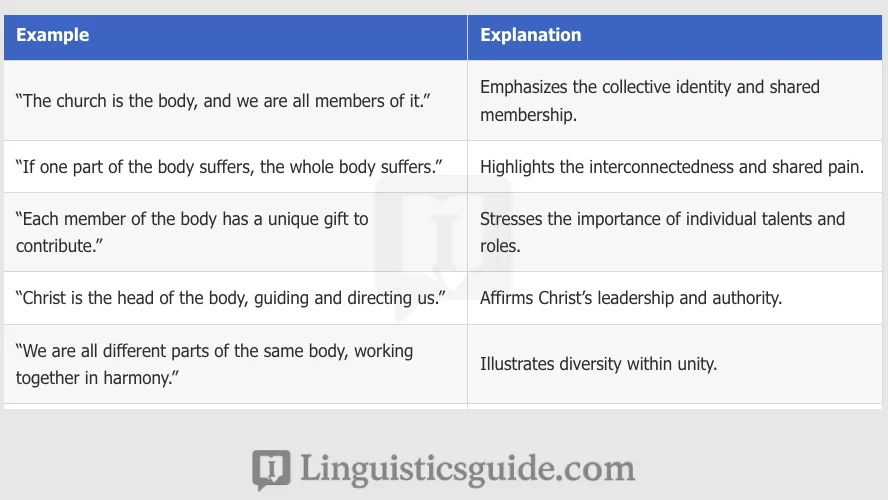
Examples of “Body of Christ”
This table provides examples illustrating the “Body of Christ” metaphor, emphasizing unity, interdependence, and the role of each member.
| Example | Explanation |
|---|---|
| “The church is the body, and we are all members of it.” | Emphasizes the collective identity and shared membership. |
| “If one part of the body suffers, the whole body suffers.” | Highlights the interconnectedness and shared pain. |
| “Each member of the body has a unique gift to contribute.” | Stresses the importance of individual talents and roles. |
| “Christ is the head of the body, guiding and directing us.” | Affirms Christ’s leadership and authority. |
| “We are all different parts of the same body, working together in harmony.” | Illustrates diversity within unity. |
| “A healthy church is like a healthy body, functioning smoothly.” | Compares church health to physical well-being. |
| “When we neglect one another, it’s like neglecting a part of our own body.” | Highlights the consequences of neglecting relationships. |
| “The body of Christ is called to serve the world with compassion.” | Emphasizes the church’s mission to serve others. |
| “We are all connected as members of the same body, sharing joys and sorrows.” | Illustrates shared experiences and empathy. |
| “The strength of the body depends on the health of each individual part.” | Stresses the importance of individual well-being. |
| “Like a body needs exercise, the church needs active participation.” | Compares church involvement to physical activity. |
| “The body of Christ is a living organism, constantly growing and adapting.” | Highlights the dynamic nature of the church. |
| “We are all essential parts of the body, each with a vital function.” | Affirms the importance of every member. |
| “The body of Christ is called to be a beacon of hope in a dark world.” | Emphasizes the church’s role as a source of light. |
| “Just as a body needs nourishment, the church needs spiritual feeding.” | Compares spiritual growth to physical nourishment. |
| “The body of Christ is a diverse community, united by love and faith.” | Illustrates the unity in diversity within the church. |
| “We are all called to play our part in building up the body of Christ.” | Stresses the importance of contributing to the church’s growth. |
| “The body of Christ is a powerful force for good in the world.” | Highlights the church’s potential for positive impact. |
| “Like a body needs rest, the church needs times of renewal and reflection.” | Compares spiritual renewal to physical rest. |
| “The body of Christ is a testament to God’s love and grace.” | Affirms the church’s role as a witness to God’s character. |
| “Each of us is a cell in the body of Christ, vital to its overall health.” | Illustrates the importance of individual contributions to the church’s well-being. |
| “The interconnectedness of the body of Christ means we celebrate each other’s successes.” | Emphasizes the joy of shared accomplishments within the church. |
| “As the body of Christ, we are called to extend compassion to those in need.” | Highlights the church’s responsibility to show mercy and kindness. |
Examples of “Bride of Christ”
This table illustrates the “Bride of Christ” metaphor, emphasizing love, purity, and the future union with Christ.
| Example | Explanation |
|---|---|
| “The church is the bride, and Christ is the bridegroom.” | Establishes the core relationship of the metaphor. |
| “The bride adorns herself in purity and righteousness.” | Highlights the church’s call to holiness. |
| “Christ loves the church as a bridegroom loves his bride.” | Emphasizes Christ’s deep and sacrificial love. |
| “The church eagerly awaits the return of her bridegroom.” | Illustrates the anticipation of Christ’s second coming. |
| “The bride is being prepared for a glorious wedding day.” | Highlights the church’s ongoing process of sanctification. |
| “The church is beautiful in the eyes of her bridegroom.” | Affirms the church’s inherent value and worth. |
| “The bride is faithful to her bridegroom, remaining true to him.” | Stresses the importance of loyalty and commitment. |
| “The church is adorned with the jewels of grace and mercy.” | Highlights the gifts that Christ bestows upon the church. |
| “The bride and bridegroom will one day be united in perfect love.” | Illustrates the ultimate fulfillment of the relationship. |
| “The church is called to reflect the beauty and love of her bridegroom.” | Emphasizes the church’s role as a witness to Christ. |
| “Like a bride preparing for her wedding, the church prepares for Christ’s return.” | Compares church preparation to bridal preparations. |
| “The bride of Christ is a symbol of hope and promise for the world.” | Highlights the church’s role as a source of hope. |
| “The church, as the bride, is called to be a beacon of light, reflecting Christ’s glory.” | Emphasizes the church’s responsibility to shine Christ’s light. |
| “In the union of the bride and bridegroom, we see a picture of perfect harmony and love.” | Illustrates the ideal relationship between Christ and the church. |
| “The bride of Christ is a community of believers, united by their love for the bridegroom.” | Highlights the communal aspect of the church’s relationship with Christ. |
| “The church, as the bride, is adorned with the gifts of the Spirit, making her radiant.” | Emphasizes the transformative power of the Holy Spirit in the church. |
| “The bride of Christ is a testament to God’s faithfulness and enduring love.” | Affirms the church’s role as a witness to God’s character. |
| “As the bride of Christ, the church is called to extend love and compassion to all.” | Highlights the church’s responsibility to show mercy and kindness. |
| “The church eagerly anticipates the day when she will be fully united with her bridegroom in eternal glory.” | Illustrates the ultimate hope of the church. |
| “The bride of Christ is a reminder of the profound love and sacrifice that Christ made for humanity.” | Emphasizes the sacrificial love of Christ. |
| “Like a bride carefully chooses her attire, the church cultivates righteousness and holiness.” | Compares the church’s pursuit of holiness to a bride’s careful preparation. |
| “The bride of Christ is constantly being refined and purified by the Word of God.” | Highlights the transformative power of Scripture in the church. |
| “As the bride of Christ, we are called to be a community of love, acceptance, and forgiveness.” | Emphasizes the importance of love and forgiveness within the church. |
Examples of “Family of God”
This table illustrates the “Family of God” metaphor, emphasizing love, support, and mutual responsibility among believers.
| Example | Explanation |
|---|---|
| “The church is the family of God, and we are all brothers and sisters.” | Establishes the familial relationship among believers. |
| “We are adopted into God’s family through faith in Christ.” | Highlights the process of becoming part of God’s family. |
| “Family members support and encourage one another through life’s challenges.” | Emphasizes the importance of mutual support. |
| “We share a common heritage as children of God.” | Illustrates the shared identity and inheritance. |
| “Family members forgive one another and show grace and mercy.” | Highlights the importance of forgiveness and grace. |
| “We are all loved and accepted unconditionally by our heavenly Father.” | Affirms God’s unconditional love for his children. |
| “Family members celebrate each other’s successes and comfort each other in times of sorrow.” | Illustrates shared experiences and empathy. |
| “We are all called to care for and protect one another as members of the same family.” | Emphasizes the importance of mutual care and protection. |
| “The family of God is a diverse community, united by love and faith.” | Illustrates the unity in diversity within the church. |
| “We are all learning and growing together as members of God’s family.” | Highlights the ongoing process of spiritual growth. |
| “Like a loving family, the church welcomes and embraces all who come.” | Compares the church’s welcome to that of a loving family. |
| “The family of God is a place of belonging and acceptance for all.” | Affirms the church’s role as a place of belonging. |
| “As the family of God, we are called to extend love and compassion to those in need.” | Highlights the church’s responsibility to show mercy and kindness. |
| “In the family of God, we find strength, encouragement, and support for our journey of faith.” | Illustrates the benefits of being part of God’s family. |
| “The family of God is a testament to God’s love and grace, transforming lives and communities.” | Affirms the church’s role as a witness to God’s character. |
| “As members of God’s family, we are called to reflect his love and character in all that we do.” | Emphasizes the church’s responsibility to reflect God’s love. |
| “The family of God is a place where we can be authentic and vulnerable, knowing that we are loved and accepted.” | Highlights the importance of authenticity and vulnerability. |
| “As the family of God, we are called to be a beacon of hope, offering love and support to a hurting world.” | Emphasizes the church’s role as a source of hope. |
| “In the family of God, we find a sense of purpose and belonging that transcends earthly relationships.” | Illustrates the unique benefits of being part of God’s family. |
| “The family of God is a reminder that we are never alone, but always connected to a community of faith.” | Affirms the importance of community and connection. |
| “Like a strong family, the church stands together in times of adversity, offering strength and support.” | Compares the church’s resilience to that of a strong family. |
| “The family of God celebrates milestones together, sharing in each other’s joys and accomplishments.” | Highlights the importance of shared celebrations within the church. |
| “As the family of God, we are committed to nurturing each other’s spiritual growth and well-being.” | Emphasizes the importance of spiritual nurture within the church. |
Examples of “Flock of God”
This table provides examples illustrating the “Flock of God” metaphor, emphasizing Christ’s role as the Good Shepherd and the church’s need for guidance and protection.
| Example | Explanation |
|---|---|
| “The church is the flock, and Christ is the Good Shepherd.” | Establishes the core relationship of the metaphor. |
| “The Good Shepherd leads his flock to green pastures and still waters.” | Highlights Christ’s provision and care. |
| “The flock follows the Shepherd’s voice and trusts in his guidance.” | Emphasizes the importance of obedience and trust. |
| “The Good Shepherd protects his flock from danger and harm.” | Illustrates Christ’s protective role. |
| “The flock is safe and secure in the Shepherd’s care.” | Affirms the security and peace found in Christ. |
| “The Good Shepherd knows each member of his flock by name.” | Highlights Christ’s personal knowledge and care. |
| “The flock is united by their common Shepherd and their shared pasture.” | Illustrates the unity and common bond among believers. |
| “The Good Shepherd lays down his life for his flock.” | Emphasizes Christ’s sacrificial love. |
| “The flock is called to follow the Shepherd’s example of love and service.” | Highlights the importance of imitating Christ’s character. |
| “The Good Shepherd seeks out the lost sheep and brings them back to the fold.” | Illustrates Christ’s compassion for the lost. |
| “Like a shepherd guiding his flock, Christ leads the church through life’s journey.” | Compares Christ’s guidance to a shepherd’s leadership. |
| “The flock of God is a symbol of peace, security, and belonging.” | Affirms the church’s role as a place of peace and belonging. |
| “As the flock of God, we are called to be a community of love, support, and encouragement.” | Highlights the importance of mutual support within the church. |
| “The Good Shepherd watches over his flock, protecting them from harm and danger.” | Emphasizes Christ’s protective presence. |
| “The flock of God is a testament to God’s faithfulness and enduring love.” | Affirms the church’s role as a witness to God’s character. |
| “As members of the flock, we are called to trust in the Shepherd’s guidance and care.” | Emphasizes the importance of trust and obedience. |
| “The flock of God is a place where we can find rest, renewal, and spiritual nourishment.” | Highlights the benefits of being part of the church. |
| “As the flock of God, we are called to be a beacon of hope, offering love and support to a hurting world.” | Emphasizes the church’s role as a source of hope. |
| “In the flock of God, we find a sense of purpose and belonging that transcends earthly relationships.” | Illustrates the unique benefits of being part of God’s flock. |
| “The flock of God is a reminder that we are never alone, but always under the watchful eye of the Good Shepherd.” | Affirms the importance of Christ’s constant presence. |
| “Like sheep following their shepherd, the church follows Christ’s teachings and example.” | Compares the church’s obedience to sheep following their shepherd. |
| “The Good Shepherd provides for his flock, ensuring they have everything they need.” | Highlights Christ’s provision for the church. |
| “As the flock of God, we are committed to caring for each other and extending God’s love to the world.” | Emphasizes the importance of mutual care and service. |
Examples of “Temple of God”
This table illustrates the “Temple of God” metaphor, emphasizing the church as the dwelling place of God’s Spirit and its holiness.
| Example | Explanation |
|---|---|
| “The church is the temple of God, and we are the living stones.” | Establishes the core relationship of the metaphor. |
| “God’s Spirit dwells within the temple, making it holy and sacred.” | Highlights the presence of God in the church. |
| “The temple is a place of worship, prayer, and spiritual encounter.” | Emphasizes the importance of spiritual practices. |
| “Each living stone is essential to the structure and integrity of the temple.” | Illustrates the importance of each member. |
| “The temple is built on the foundation of Jesus Christ.” | Affirms Christ as the foundation of the church. |
| “The temple is adorned with the beauty of holiness and the glory of God.” | Highlights the beauty and glory of the church. |
| “The temple is a place of refuge and sanctuary for those who seek God.” | Affirms the church’s role as a place of refuge. |
| “The temple is a beacon of light, shining forth God’s love and truth.” | Emphasizes the church’s role as a source of light. |
| “The temple is a community of believers, united by their shared faith and worship.” | Illustrates the unity and fellowship within the church. |
| “The temple is constantly being built and renewed by the power of the Holy Spirit.” | Highlights the ongoing process of spiritual growth. |
| “Like a sacred temple, the church is a place set apart for God’s purposes.” | Compares the church’s purpose to that of a sacred temple. |
| “The temple of God is a symbol of his presence, power, and glory in the world.” | Affirms the church’s role as a witness to God’s character. |
| “As the temple of God, we are called to be a community of love, acceptance, and forgiveness.” | Highlights the importance of love and forgiveness within the church. |
| “The Holy Spirit dwells within the temple, empowering us to live a life of holiness and service.” | Emphasizes the transformative power of the Holy Spirit. |
| “The temple of God is a testament to his faithfulness and enduring love.” | Affirms the church’s role as a witness to God’s character. |
| “As living stones, we are called to build each other up in faith and love.” | Emphasizes the importance of mutual encouragement. |
| “The temple of God is a place where we can encounter his presence and experience his grace and mercy.” | Highlights the benefits of being part of the church. |
| “As the temple of God, we are called to be a beacon of hope, offering love and support to a hurting world.” | Emphasizes the church’s role as a source of hope. |
| “In the temple of God, we find a sense of purpose and belonging that transcends earthly relationships.” | Illustrates the unique benefits of being part of God’s temple. |
| “The temple of God is a reminder that we are never alone, but always in the presence of the Holy Spirit.” | Affirms the importance of the Holy Spirit’s constant presence. |
| “Like a temple filled with reverence, the church is a place of deep respect and awe for God.” | Compares the church’s reverence to that of a sacred temple. |
| “The temple of God is a community where each member is valued and contributes to its spiritual strength.” | Highlights the importance of individual contributions to the church’s well-being. |
| “As the temple of God, we are committed to maintaining its purity and holiness through our actions and attitudes.” | Emphasizes the importance of maintaining purity within the church. |
Usage Rules
While metaphors can be powerful tools, it’s important to use them thoughtfully and appropriately. Here are some guidelines to consider:
Contextual Appropriateness
Choose metaphors that are relevant and meaningful to your audience. Consider their cultural background, level of understanding, and familiarity with the concepts being discussed.
A metaphor that resonates with one group may be confusing or offensive to another. Ensure the metaphor enhances understanding rather than creating confusion.
Cultural Sensitivity
Be mindful of cultural differences and avoid metaphors that may be offensive or insensitive. What seems like a harmless comparison in one culture may carry negative connotations in another.
Do your research and seek feedback from others to ensure your metaphors are culturally appropriate. Avoid using metaphors that perpetuate stereotypes or reinforce harmful biases.
Theological Accuracy
Ensure that your metaphors accurately reflect biblical teachings and theological principles. Avoid using metaphors that distort or contradict core doctrines.
Consult with theologians and biblical scholars to ensure your metaphors are theologically sound. The goal is to illuminate truth, not to create misleading or heretical interpretations.
Common Mistakes
Several common mistakes can undermine the effectiveness of metaphors. Here are a few to avoid:
- Mixed Metaphors: Combining two or more metaphors that create a nonsensical or contradictory image. Incorrect: “The church is a well-oiled machine navigating stormy seas.” Correct: “The church is a ship navigating stormy seas.”
- Overused Metaphors: Relying on clichés that have lost their impact. Instead of: “The church is a light in the darkness,” try a more original image.
- Inappropriate Metaphors: Using comparisons that are disrespectful or trivializing. Avoid: “The church is like a social club.”
- Misinterpreting Metaphors: Drawing incorrect or unintended conclusions from a metaphor. Carefully explain: the intended meaning and avoid stretching the comparison too far.
Understanding these common pitfalls can help you use metaphors more effectively and avoid miscommunication.
Practice Exercises
Test your understanding of metaphors for the church with these exercises.
Exercise 1: Identifying Metaphors
Identify the metaphor used in
Identify the metaphor used in each of the following statements:
- “The church is a hospital for sinners.”
- “Believers are branches connected to the vine, which is Christ.”
- “The church is a lighthouse, guiding people to safety.”
Answers:
- Hospital
- Vine and Branches
- Lighthouse
Exercise 2: Explaining Metaphors
Explain the meaning of the following metaphors for the church:
- The church as the body of Christ.
- The church as the family of God.
Answers:
- The church as the body of Christ emphasizes unity, interdependence, and the unique role of each member.
- The church as the family of God highlights love, support, and mutual responsibility among believers.
Exercise 3: Using Metaphors in Context
Write a short paragraph using one of the metaphors for the church discussed in this article. Explain how the metaphor applies to a real-life situation or experience.
Example:
Imagine the church as a garden. In this garden, each member is like a different plant, with unique needs and characteristics. Some plants require more sunlight, while others thrive in the shade. Some need constant watering, while others prefer drier conditions. As gardeners, we must tend to each plant with care, providing the specific nourishment and support it needs to flourish. When we do this, the garden becomes a beautiful and diverse ecosystem, where each plant contributes to the overall health and vibrancy of the whole.
Advanced Topics
For those interested in delving deeper into the study of metaphors, here are some advanced topics to explore:
Extended Metaphors
An extended metaphor is a metaphor that is developed over several lines or even throughout an entire work. It allows for a more detailed and nuanced exploration of the subject being compared.
In the context of the church, an extended metaphor might involve exploring various aspects of the “body of Christ” metaphor, such as the function of different organs, the importance of the nervous system, and the overall health and well-being of the body. By developing the metaphor over time, we can gain a richer and more comprehensive understanding of the church.
Mixed Metaphors
A mixed metaphor is the unintentional combining of two or more metaphors that are inconsistent or nonsensical. This can create confusion and undermine the effectiveness of the communication.
For example, “The church is a well-oiled machine navigating stormy seas” is a mixed metaphor because it combines the image of a machine with the image of a ship. It is important to avoid mixed metaphors and ensure that your comparisons are clear and consistent.
Dead Metaphors
A dead metaphor is a metaphor that has become so overused that it has lost its figurative meaning and is now used as a literal expression. For example, the phrase “the heart of the matter” was once a metaphor, but it is now used as a common expression to describe the central point of an issue.
While dead metaphors are not necessarily problematic, it is important to be aware of them and avoid relying on them too heavily. Using fresh and original metaphors can help to make your communication more engaging and impactful.
FAQ
Why are metaphors important for understanding the church?
Metaphors provide accessible and meaningful ways to understand complex concepts about the church’s nature, purpose, and function.
How do I choose the right metaphor for the church?
Consider your audience, the context, and the specific aspect of the church you want to emphasize. Ensure the metaphor is theologically accurate and culturally sensitive.
What should I avoid when using metaphors for the church?
Avoid mixed metaphors, overused clichés, inappropriate comparisons, and misinterpretations.
Can metaphors for the church change over time?
Yes, metaphors can evolve as cultural contexts and theological understandings shift.
Are some metaphors for the church better than others?
The effectiveness of a metaphor depends on its appropriateness for the specific context and audience. Some metaphors may be more helpful in certain situations than others.
Conclusion
Metaphors for the church provide a rich and diverse tapestry of images and ideas that help us understand this complex institution. By exploring these metaphors, we can gain a deeper appreciation for the church’s nature, purpose, and mission in the world.
As we use metaphors to communicate about the church, it is important to be mindful of contextual appropriateness, cultural sensitivity, and theological accuracy. By using metaphors thoughtfully and intentionally, we can illuminate truth, inspire faith, and build up the body of Christ.