
The English language, with its rich history and diverse influences, often presents subtle nuances that can be confusing for both native speakers and learners. One such area of confusion lies in the spelling of the word used to describe hair color: “blond” or “blonde.” Understanding the difference between these two spellings, which is rooted in gendered language, is crucial for accurate and effective communication.
This article aims to clarify the proper usage of “blond” and “blonde,” exploring their origins, grammatical rules, and common pitfalls. Whether you’re a student, writer, or simply someone looking to improve your English skills, this guide will provide you with the knowledge and confidence to use these terms correctly.
Table of Contents
- Introduction
- Definition: Blond vs. Blonde
- Structural Breakdown
- Types and Categories
- Examples of Usage
- Usage Rules
- Common Mistakes
- Practice Exercises
- Advanced Topics
- Frequently Asked Questions (FAQ)
- Conclusion
Definition: Blond vs. Blonde
Off to College Deals

Save up to 30% on everything you need for the semester.
Contains affiliate link
Writers frequently wonder, is blond or blonde correct, especially when polishing formal or academic work. The answer depends on grammar rather than taste. If you’re unsure is it spelled blond or blonde, remember that “blond” is traditionally masculine and gender-neutral, while “blonde” is feminine. Knowing how to spell blonde or blond means identifying the subject and choosing the form that matches its grammatical role. Following this distinction keeps your writing precise, professional, and stylistically consistent.
The words “blond” and “blonde” both refer to the same light, yellowish hair color. Choosing between blond hair or blonde hair often causes hesitation. In formal writing, “blond hair” is the safer gender-neutral option, particularly when the person’s gender is unknown. “Blonde hair” is traditionally used for female subjects, though modern style guides increasingly accept “blond hair” for everyone.
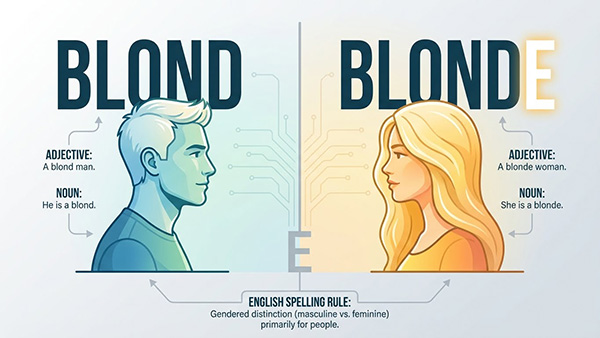
The distinction lies in their grammatical gender. “Blond” is traditionally used as a masculine noun or adjective, while “blonde” is used as a feminine noun or adjective. This distinction originates from French, where many words have gendered forms.
In essence, the difference is primarily one of grammatical gender agreement. This means that, depending on whether you are referring to a male or female, you would typically choose the corresponding form. However, it’s important to note that usage is evolving, and the lines are becoming increasingly blurred, especially in contemporary English.
Structural Breakdown
The structure of these words is quite simple. Both “blond” and “blonde” are derived from the Old French word “blond,” which itself comes from the Medieval Latin word “blondus,” meaning “yellow.” The addition of the final “e” in “blonde” is a common marker of feminine gender in French-derived words.
Young Adults & Students:
Get 6 Months of Prime for $0

Ages 18-24 unlock exclusive perks including:
Contains affiliate link
Here’s a breakdown:
- Root: blond (Old French/Medieval Latin – meaning yellow)
- Masculine Form: blond
- Feminine Form: blonde
The word can function as both a noun and an adjective:
- Noun: A person with blond/blonde hair.
- Adjective: Describing something as having a light, yellowish color.
Types and Categories
While the primary distinction is gender-based, let’s explore the different ways “blond” and “blonde” can be categorized based on their grammatical function:
Noun
As a noun, “blond” refers to a male with blond hair, and “blonde” refers to a female with blond hair. For example, “He is a natural blond” and “She is a stunning blonde.”
Adjective
As an adjective, “blond” describes a masculine noun, and “blonde” describes a feminine noun. For example, “a blond boy” and “a blonde girl.”
Evolving Usage
It’s crucial to acknowledge that language is dynamic. Modern usage often sees “blond” used as a gender-neutral term, particularly as an adjective. This is especially true in journalistic and general writing where gender neutrality is preferred. However, understanding the traditional distinction remains important for recognizing and appreciating the nuances of the English language.
Examples of Usage
To solidify your understanding, let’s examine a variety of examples demonstrating the correct usage of “blond” and “blonde” in different contexts.
Examples with “Blond” (Masculine)
The following table provides examples of “blond” used as a masculine noun and adjective. Note the context and the subject being described.
| Sentence | Part of Speech | Context |
|---|---|---|
| He was a tall, blond man with piercing blue eyes. | Adjective | Describing a male’s hair color. |
| The casting director needed a blond for the role of the Viking. | Noun | Referring to a male actor with blond hair. |
| My brother is a natural blond. | Noun | Stating that the speaker’s brother has blond hair naturally. |
| He admired the blond surfer riding the wave. | Noun | Referring to a male surfer with blond hair. |
| The blond knight charged into battle. | Adjective | Describing a male knight’s hair color. |
| That blond boy is always getting into trouble. | Adjective | Describing a male child’s hair color. |
| I saw a blond walking down the street. | Noun | Referring to a male with blond hair walking on the street. |
| The portrait depicted a handsome blond man. | Adjective | Describing the hair color of a male subject in a portrait. |
| He dreamed of being a famous blond actor. | Noun | Referring to a male actor with blond hair. |
| The blond dog ran through the park. | Adjective | Describing a male dog’s fur color. While technically applicable, this is less common and often uses “golden” or similar. |
| A blond student raised his hand in class. | Adjective | Describing a male student’s hair color. |
| The blond singer captivated the audience. | Noun | Referring to a male singer with blond hair. |
| He pointed to the blond in the photograph. | Noun | Identifying a male with blond hair in a photograph. |
| The blond superhero saved the day. | Adjective | Describing a male superhero’s hair color. |
| He is considered a classic blond. | Noun | Referring to a male with classic blond hair. |
| The blond athlete won the gold medal. | Noun | Referring to a male athlete with blond hair. |
| That blond character is the protagonist. | Adjective | Describing a male character in a story. |
| The blond musician played the guitar. | Noun | Referring to a male musician with blond hair. |
| He styled his blond hair carefully. | Adjective | Describing the hair color of a male. |
| The blond tourist took a picture of the Eiffel Tower. | Noun | Referring to a male tourist with blond hair. |
Examples with “Blonde” (Feminine)
The following table provides examples of “blonde” used as a feminine noun and adjective. Again, pay close attention to the context and subject.
| Sentence | Part of Speech | Context |
|---|---|---|
| She was a beautiful blonde with a dazzling smile. | Noun | Referring to a female with blond hair. |
| The movie starred a stunning blonde actress. | Adjective | Describing a female actress’s hair color. |
| My sister is a natural blonde. | Noun | Stating that the speaker’s sister has blond hair naturally. |
| He fell in love with a charming blonde. | Noun | Referring to a female with blond hair. |
| The blonde princess waved to the crowd. | Adjective | Describing a female princess’s hair color. |
| That blonde girl is incredibly talented. | Adjective | Describing a female child’s hair color. |
| I saw a blonde shopping at the mall. | Noun | Referring to a female with blond hair shopping at the mall. |
| The painting featured a graceful blonde woman. | Adjective | Describing the hair color of a female subject in a painting. |
| She aspired to be a famous blonde singer. | Noun | Referring to a female singer with blond hair. |
| The blonde cat purred contentedly. | Adjective | Describing a female cat’s fur color. While technically applicable, this is less common and often uses “golden” or similar. |
| A blonde student answered the question correctly. | Adjective | Describing a female student’s hair color. |
| The blonde dancer captivated the audience. | Noun | Referring to a female dancer with blond hair. |
| She pointed to the blonde in the group photo. | Noun | Identifying a female with blond hair in a group photograph. |
| The blonde superheroine saved the city. | Adjective | Describing a female superhero’s hair color. |
| She is considered a true blonde. | Noun | Referring to a female with true blond hair. |
| The blonde athlete broke the world record. | Noun | Referring to a female athlete with blond hair. |
| That blonde character is the protagonist. | Adjective | Describing a female character in a story. |
| The blonde musician played the violin. | Noun | Referring to a female musician with blond hair. |
| She styled her blonde hair elegantly. | Adjective | Describing the hair color of a female. |
| The blonde tourist admired the ancient ruins. | Noun | Referring to a female tourist with blond hair. |
Examples of Gender-Neutral or Evolving Usage
The following table illustrates instances where “blond” is used in a gender-neutral way, particularly as an adjective. This reflects the evolving nature of the English language.
| Sentence | Context |
|---|---|
| The child had blond hair and bright eyes. | Describing a child’s hair color without specifying gender. |
| The description mentioned a suspect with blond hair. | Describing a suspect’s hair color in a police report, where gender might be unknown or irrelevant. |
| “Blond” is sometimes used as a general term for light-colored hair. | Discussing the word “blond” itself, rather than describing a person. |
| The company sought models with blond hair for the advertisement. | Advertising for models with a specific hair color, potentially including both men and women. |
| The article discussed the science behind blond hair. | Focusing on the scientific aspect of blond hair color, irrespective of gender. |
| That doll has blond hair. | Describing a doll’s hair color; gender is often irrelevant for inanimate objects. |
| The witness described the person as having blond hair. | Witness statement where gender is not emphasized or is unknown. |
| He dyed his hair blond. | Describing a male dyeing his hair, where “blond” is used as the color itself. |
| She dyed her hair blond. | Describing a female dyeing her hair, where “blond” is used as the color itself. |
| The puppy had soft, blond fur. | Describing an animal’s fur color without gender specification (though “golden” is more common). |
| The team needed someone with blond hair for the play. | Casting call where the gender might be flexible. |
| The garden was filled with blond sunflowers. | Describing the color of sunflowers. |
| “Blond” can be used as a general adjective for light yellow. | Discussing the general usage of the word. |
| The house was painted a light blond color. | Describing the color of the house. |
| The sand on the beach was a pale blond. | Describing the color of the sand. |
| The light had a blond tint. | Describing the color of the light. |
| The room was decorated in shades of blond. | Describing interior design. |
| The fabric had a blond sheen. | Describing the fabric’s appearance. |
| The wood had a natural blond tone. | Describing the color of the wood. |
| The photograph was taken with a blond filter. | Describing a photographic filter. |
Usage Rules
Mastering blond vs blonde grammar prevents subtle but noticeable errors. The difference is not about meaning or pronunciation; it is about agreement. “Blond” serves as the masculine form and the modern gender-neutral adjective, while “blonde” marks the feminine form.
This pattern comes directly from French grammar. Writing “a blond man,” “a blonde woman,” and “blond hair” in neutral contexts keeps your usage accurate and polished.
Here’s a summary of the usage rules for “blond” and “blonde”:
- Traditional Rule: Use “blond” for males and “blonde” for females.
- Noun Usage: “He is a blond” (male), “She is a blonde” (female).
- Adjective Usage: “a blond man” (male), “a blonde woman” (female).
- Modern Trend: “Blond” is increasingly used as a gender-neutral adjective.
- Formal Writing: In formal contexts, it’s best to adhere to the traditional gendered distinction.
- Informal Writing: In informal contexts, “blond” as a gender-neutral adjective is generally acceptable.
Exceptions and Special Cases:
There aren’t strict exceptions, but the key consideration is context and audience. If you’re writing for a formal publication or audience that values traditional grammar, stick to the gendered distinction. If you’re writing informally or for a more modern audience, using “blond” as a gender-neutral adjective is usually fine.
Common Mistakes
One of the most common mistakes is using “blonde” to describe a male or using “blond” as an adjective to describe a female in formal writing. Here are some examples of common mistakes and their corrections:
| Incorrect | Correct | Explanation |
|---|---|---|
| He is a blonde. | He is a blond. | “Blonde” is the feminine form; use “blond” for males. |
| She is a blond. | She is a blonde. | “Blond” is the masculine form; use “blonde” for females. |
| a blonde man | a blond man | “Blonde” is the feminine adjective; use “blond” for masculine nouns. |
| a blond woman | a blonde woman | “Blond” is the masculine adjective; use “blonde” for feminine nouns. |
| The suspect was described as blonde. | The suspect was described as blond. | In a gender-neutral context, “blond” is increasingly accepted. However, rephrasing to avoid the issue is also an option (e.g., “The suspect had blond hair”). |
Practice Exercises
Test your understanding with these practice exercises. Choose the correct word (“blond” or “blonde”) to complete each sentence.
Exercise 1: Identifying Correct Usage
| Question | Answer |
|---|---|
| 1. She is a natural ______. | blonde |
| 2. He is known as the ______ surfer. | blond |
| 3. The ______ actress won an Oscar. | blonde |
| 4. The ______ boy played in the park. | blond |
| 5. They described the suspect as having ______ hair. | blond (gender-neutral usage) |
| 6. My father was a ______, when he was younger. | blond |
| 7. The ______ princess married the prince. | blonde |
| 8. A ______ hair was found at the crime scene. | blond (gender-neutral usage) |
| 9. She always wanted to be a famous ______. | blonde |
| 10. The ______ knight rode into the sunset. | blond |
Exercise 2: Correcting Mistakes
Identify and correct the mistakes in the following sentences.
| Question | Answer |
|---|---|
| 1. He is a stunning blonde. | He is a stunning blond. |
| 2. She is a handsome blond. | She is a handsome blonde. |
| 3. The blonde man walked into the bar. | The blond man walked into the bar. |
| 4. The blond woman smiled warmly. | The blonde woman smiled warmly. |
| 5. The child had blonde hair. | The child had blond hair. (gender-neutral usage) |
| 6. The suspect was a tall blonde. | The suspect was a tall blond. (gender-neutral usage) |
| 7. That is a blonde dog. | That is a blond dog. (though “golden” is more common) |
| 8. She dyed her hair a light blond shade, so she is now a blond. | She dyed her hair a light blond shade, so she is now a blonde. |
| 9. He is a fantastic blonde actor. | He is a fantastic blond actor. |
| 10. She is a blond singer. | She is a blonde singer. |
Exercise 3: Fill in the Blanks
Complete the following sentences with either “blond” or “blonde”, considering the context and subject gender.
| Question | Answer |
|---|---|
| 1. The detective was looking for a ______ male suspect. | blond |
| 2. She always admired ______ actresses from old Hollywood. | blonde |
| 3. He considered himself a ______ with a heart of gold. | blond |
| 4. The ______ girl danced gracefully on the stage. | blonde |
| 5. The police were searching for a ______ suspect in the robbery. | blond (gender-neutral usage) |
| 6. The ______ haired man was very charming. | blond |
| 7. My neighbor is a beautiful ______. | blonde |
| 8. He is a ______, and she is a brunette. | blond |
| 9. The ______ wizard cast a spell. | blond |
| 10. She dreamed of becoming a famous ______ model. | blonde |
Advanced Topics
For advanced learners, let’s delve into more complex aspects of “blond” and “blonde” usage:
Historical Context
Understanding the historical context of gendered language is crucial for appreciating the nuances of “blond” and “blonde.” The distinction originates from French, where grammatical gender is a fundamental aspect of the language. As English has evolved, it has retained some of these gendered distinctions, although they are becoming less rigid.
Cross-Cultural Considerations
Different cultures have varying attitudes towards gendered language. In some cultures, gender distinctions are strictly observed, while in others, they are more fluid. Understanding these cultural differences can help you navigate the use of “blond” and “blonde” in international contexts.
Literary and Artistic Usage
In literature and art, the choice between “blond” and “blonde” can be deliberate and symbolic. Authors and artists may use these words to convey specific meanings or to evoke certain associations. Analyzing these choices can provide deeper insights into the text or artwork.
Frequently Asked Questions
Is it ever correct to use “blonde” to describe a man?
Traditionally, no. “Blonde” is the feminine form and should be used to describe women. Using it to describe a man is grammatically incorrect in formal settings. However, language evolves, and you might encounter it in informal contexts, though it’s still generally avoided.
Is it offensive to use “blond” as a gender-neutral term?
Generally, no. Using “blond” as a gender-neutral adjective is becoming increasingly common and is not typically considered offensive. However, be mindful of your audience and the context. If you’re unsure, it’s always best to err on the side of caution and use the gendered forms or rephrase the sentence.
Why does the distinction between “blond” and “blonde” exist?
The distinction comes from French, where many words have gendered forms. English borrowed these words, and while gendered language is less prevalent in English, some distinctions, like “blond” and “blonde,” have persisted.
In what context should I always use “blond” and “blonde” correctly?
In formal writing, academic papers, professional settings, and any situation where grammatical accuracy is paramount, you should always use “blond” and “blonde” according to their traditional gendered forms.
Can I use “blond” for animals?While technically possible, it’s less common. For animals, terms like “golden,” “light-colored,” or specific breed descriptors are more frequently used to describe light fur or hair.
Is there a difference in pronunciation between “blond” and “blonde”?
No, there is no difference in pronunciation. Both words are pronounced the same way in English.
What if I don’t know the gender of the person I’m describing?
If you don’t know the gender, using “blond” as a gender-neutral adjective is generally acceptable. You can also rephrase the sentence to avoid using either word directly, such as “The person had light-colored hair.”
Is it okay to use just “blond” in all situations to simplify things?
While using “blond” as a gender-neutral adjective is becoming more common, especially in informal contexts, it’s not universally accepted. In formal writing or situations where grammatical correctness is important, it’s still best to differentiate between “blond” for males and “blonde” for females. Using “blond” exclusively might be seen as incorrect or less precise by some people.
Conclusion
Understanding the difference between “blond” and “blonde” is a subtle but important aspect of English grammar. While the traditional gendered distinction is rooted in French, its application in English is evolving. By mastering the usage rules and recognizing common mistakes, you can communicate more effectively and accurately.
Remember to consider your audience and the context when choosing between “blond” and “blonde,” and be aware of the growing trend towards gender-neutral usage. With practice and attention to detail, you can confidently navigate this linguistic nuance.

I’m James Terban, a teacher with a degree in Education and five years of experience working with students of all ages, from young kids learning their first grammar rules to adults picking up English as a second language. I started Linguistics Guide because I kept seeing good learners hit a wall due to explanations that were either too vague or too complicated. Every article here comes from a real question I have heard in a classroom or seen asked online.