
Expressing admiration for someone’s kindness or pleasant demeanor goes beyond simply using the word “nice.” English offers a rich tapestry of idioms that add color and nuance to your descriptions. Understanding these idioms not only enhances your vocabulary but also allows you to appreciate the subtle cultural contexts in which they are used.
This guide is designed for English language learners, teachers, and anyone looking to enrich their communicative abilities by mastering diverse ways to describe someone as “nice.”
This article will delve into various idioms that convey the essence of being nice, exploring their meanings, usage, and providing numerous examples to solidify your understanding. By the end of this guide, you’ll be equipped with a versatile range of expressions to accurately and vividly portray the qualities of kindness and pleasantness in different situations.
Table of Contents
- Definition of Idioms for “Nice”
- Structural Breakdown of Idioms
- Types and Categories of Idioms for “Nice”
- Examples of Idioms for “Nice”
- Usage Rules for Idioms for “Nice”
- Common Mistakes When Using Idioms for “Nice”
- Practice Exercises
- Advanced Topics
- Frequently Asked Questions
- Conclusion
Definition of Idioms for “Nice”
Idioms are phrases or expressions whose meanings cannot be understood from the ordinary meanings of the words within them. They are figurative language, often culturally specific, and add depth and color to communication.
Idioms for “nice” are phrases that describe someone as being kind, pleasant, agreeable, or generally good-natured, without explicitly using the word “nice.”
These idioms function as adjectives or adverbs, modifying nouns (people) or verbs (actions) to indicate the presence of agreeable qualities. The context in which they are used is crucial, as the same idiom can have slightly different connotations depending on the situation.
For example, “a heart of gold” implies deep-seated kindness, while “a ray of sunshine” suggests a cheerful and uplifting presence.
Understanding these idioms is essential for grasping the nuances of English conversation and literature. They provide a more vivid and engaging way to express admiration and appreciation for someone’s character or behavior.
They allow for a more colorful, and sometimes subtle, way of conveying that someone is pleasant to be around, helpful, or simply a good person.
Structural Breakdown of Idioms
Idioms, by nature, defy direct structural analysis because their meaning is not derived from the literal meanings of their components. However, we can examine the grammatical categories of the words used within the idioms to understand how they function within a sentence.
Many idioms for “nice” include nouns, verbs, and adjectives working together to create a figurative meaning. For example, in the idiom “a heart of gold,” “heart” is a noun, “of” is a preposition, and “gold” is another noun.
However, the meaning isn’t literally about a heart made of the metal gold; it symbolizes a kind and generous nature. Understanding the grammatical roles of the words helps in using the idiom correctly in a sentence.
Some idioms may follow a specific grammatical pattern, such as “as [adjective] as [noun],” as in “as good as gold.” Here, the adjective “good” modifies the abstract quality represented by the noun “gold.” Recognizing these patterns can aid in remembering and using the idioms correctly. The structure reinforces the intended meaning.
It’s important to note that altering the structure of an idiom, even slightly, can change or destroy its meaning. Idioms are fixed expressions, and their power lies in their established form.
For example, changing “a heart of gold” to “a golden heart” alters the meaning slightly and sounds less idiomatic.
Types and Categories of Idioms for “Nice”
Idioms for “nice” can be categorized based on the specific aspect of niceness they emphasize. Here are some categories:
1. Kindness and Generosity
These idioms highlight a person’s willingness to help others and their generous nature. They often imply selflessness and a genuine concern for the well-being of others.
Examples include “a heart of gold,” “wouldn’t hurt a fly,” and “a shoulder to cry on.”
2. Pleasantness and Agreeableness
These idioms describe someone who is easy to get along with, cheerful, and enjoyable to be around. They emphasize positive interactions and a generally agreeable disposition.
Examples include “a ray of sunshine,” “as nice as pie,” and “easy-going.”
3. Goodness and Virtue
These idioms suggest a person of high moral character and integrity. They imply honesty, trustworthiness, and a commitment to doing what is right.
Examples include “as good as gold,” “an angel,” and “salt of the earth.”
4. Helpfulness and Supportiveness
These idioms focus on someone’s willingness to provide assistance and support to others in need. They emphasize reliability and a dedication to helping others overcome challenges.
Examples include “a helping hand,” “always there for you,” and “goes the extra mile.”
5. Innocence and Harmlessness
These idioms describe someone who is gentle, innocent, and incapable of causing harm. They emphasize a lack of malice or harmful intentions.
Examples include “wouldn’t hurt a fly,” “pure as the driven snow,” and “harmless as a kitten.”
Examples of Idioms for “Nice”
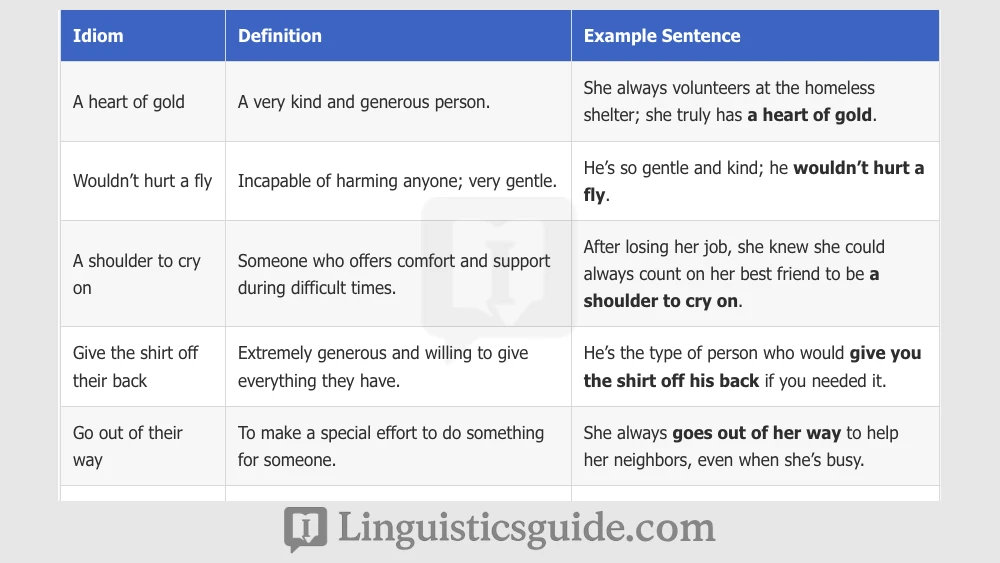
The following tables provide extensive examples of idioms for “nice,” categorized by the types discussed above. Each idiom is presented with a brief definition and an example sentence to illustrate its usage.
Examples of Idioms for Kindness and Generosity
This table contains idioms that signify kindness and generosity, showing how they are used in sentences to describe someone’s character.
| Idiom | Definition | Example Sentence |
|---|---|---|
| A heart of gold | A very kind and generous person. | She always volunteers at the homeless shelter; she truly has a heart of gold. |
| Wouldn’t hurt a fly | Incapable of harming anyone; very gentle. | He’s so gentle and kind; he wouldn’t hurt a fly. |
| A shoulder to cry on | Someone who offers comfort and support during difficult times. | After losing her job, she knew she could always count on her best friend to be a shoulder to cry on. |
| Give the shirt off their back | Extremely generous and willing to give everything they have. | He’s the type of person who would give you the shirt off his back if you needed it. |
| Go out of their way | To make a special effort to do something for someone. | She always goes out of her way to help her neighbors, even when she’s busy. |
| A soft touch | Someone easily persuaded to give money or help. | He’s a soft touch for anyone with a sad story. |
| Beneath the surface | Kind and generous person despite initial impressions. | Beneath his gruff exterior, he is a man with a heart of gold. |
| As big as all outdoors | A generous and kind soul. | Despite his humble beginnings, he has a heart as big as all outdoors. |
| As kind as they come | Extremely kind and generous. | She’s as kind as they come, always ready to lend a hand. |
| A ray of sunshine | Brings brightness and joy to others. | Her infectious laughter and positive attitude make her a true ray of sunshine. |
| A gentle giant | A person with a large physique but a kind and gentle nature. | Despite his imposing size, he’s a gentle giant who loves animals. |
| Open-hearted | Someone who is generous and compassionate. | Her open-hearted nature makes her a beloved member of the community. |
| Big-hearted | Kind, generous, and compassionate. | He’s a big-hearted man who always puts others first. |
| Freehanded | Generous; giving freely. | She’s always been a freehanded giver, supporting various charities. |
| Munificent | Extremely generous; lavish. | The munificent donor gave a large sum to the local hospital. |
| Philanthropic | Seeking to promote the welfare of others, especially by donating money to good causes. | His philanthropic efforts have helped countless people in need. |
| Magnanimous | Very generous or forgiving, especially toward a rival or someone less powerful than oneself. | The magnanimous leader offered amnesty to his former enemies. |
| Altruistic | Showing a selfless concern for the well-being of others; unselfish. | Her altruistic nature drives her to volunteer at the soup kitchen every week. |
| A Good Samaritan | A person who voluntarily offers help or sympathy to people in distress. | He acted as a Good Samaritan when he stopped to help the stranded motorist. |
| A man of his word | Reliable and keeps his promises. | He is a man of his word, always fulfilling his commitments. |
| A true friend | Loyal and supportive. | She’s a true friend, always there to lend an ear and offer advice. |
| Always ready to help | Willing to assist others. | He’s always ready to help, no matter the task. |
| Go above and beyond | Exceeds expectations in helping. | She always goes above and beyond to assist her colleagues. |
| A true gem | A person who is kind, valuable, and appreciated. | She’s a true gem, always bringing positivity to the team. |
Examples of Idioms for Pleasantness and Agreeableness
This table focuses on idioms that describe someone who is pleasant, agreeable, and enjoyable to be around.
| Idiom | Definition | Example Sentence |
|---|---|---|
| A ray of sunshine | Someone who brings happiness and positivity to others. | Her cheerful attitude makes her a ray of sunshine in the office. |
| As nice as pie | Extremely pleasant and agreeable. | The hostess was as nice as pie, making everyone feel welcome. |
| Easy-going | Relaxed and not easily worried about things. | He has an easy-going personality, which makes him great to work with. |
| A pleasure to be around | Someone whose company is enjoyable. | She’s a pleasure to be around, always making people laugh. |
| Good company | Enjoyable to spend time with. | He’s always good company at parties, telling interesting stories. |
| Likeable | Easy to like; pleasant and friendly. | She’s incredibly likeable, making friends wherever she goes. |
| A breath of fresh air | Someone or something that is new and refreshing. | After a series of difficult projects, her optimistic attitude was a breath of fresh air. |
| A bright spark | A lively and intelligent person. | Her enthusiasm and intelligence make her a bright spark in the team. |
| A charming individual | Someone who is very pleasant and attractive. | His charm and wit make him a charming individual to be around. |
| A delight to know | Someone who is enjoyable and wonderful to know. | She’s a delight to know, always bringing joy to those around her. |
| A good egg | A kind and reliable person. | He’s a good egg, always willing to lend a hand. |
| A sweetheart | A kind, considerate, and lovable person. | She’s a sweetheart, always thinking of others. |
| Affable | Friendly, good-natured, or easy to talk to. | His affable personality made him a popular figure in the office. |
| Amiable | Having or displaying a friendly and pleasant manner. | Her amiable nature made her a perfect fit for customer service. |
| Congenial | Pleasant because of a personality, qualities, or interests that are similar to one’s own. | The congenial atmosphere of the club made it a popular meeting place. |
| Gracious | Courteous, kind, and pleasant. | She was a gracious host, making sure everyone felt comfortable. |
| Genial | Friendly and cheerful. | The genial bartender always had a smile for his customers. |
| Agreeable | Pleasing or willing to agree. | She was an agreeable companion, always ready for an adventure. |
| Even-tempered | Not easily annoyed or angered. | His even-tempered nature made him a great mediator. |
| Jolly | Cheerful and full of joy. | The jolly Santa Claus brought smiles to all the children. |
| Merry | Cheerful and lively. | They had a merry time at the holiday party. |
| Upbeat | Optimistic and cheerful. | Her upbeat attitude always lifts my spirits. |
| Vivacious | Lively and animated. | Her vivacious personality made her the life of the party. |
| Jovial | Cheerful and friendly. | The jovial host greeted everyone with a warm welcome. |
Examples of Idioms for Goodness and Virtue
This table showcases idioms that depict a person of high moral character, integrity, and virtue.
| Idiom | Definition | Example Sentence |
|---|---|---|
| As good as gold | Well-behaved and obedient; extremely virtuous. | The children were as good as gold during the church service. |
| An angel | A very kind and virtuous person. | She’s an angel for taking care of her elderly mother. |
| Salt of the earth | A person of great integrity and honesty. | He’s salt of the earth, always honest and reliable. |
| A saint | An exceptionally virtuous or kind person. | She’s a saint for putting up with his constant complaining. |
| Above board | Honest and legitimate. | His business dealings are always above board, so you can trust him. |
| On the level | Honest and truthful. | He’s on the level, you can rely on what he says. |
| A pillar of society | A respected and important member of the community. | The doctor was a pillar of society, known for his integrity and service. |
| The cream of the crop | The best of the best; the most virtuous and talented. | She’s the cream of the crop when it comes to ethical leadership. |
| A paragon of virtue | A perfect example of goodness and moral excellence. | He’s a paragon of virtue, always upholding the highest ethical standards. |
| A model citizen | Someone who behaves in a way that is considered to be correct and polite, and who obeys the law. | She’s a model citizen, actively involved in community service. |
| A shining example | Someone who sets a good example for others. | He’s a shining example of honesty and integrity. |
| A beacon of hope | Someone who provides hope and inspiration to others. | She’s a beacon of hope for those struggling with addiction. |
| Exemplary | Serving as a desirable model; representing the best of its kind. | His exemplary behavior earned him the respect of his peers. |
| Impeccable | In accordance with the highest standards of propriety; faultless. | Her impeccable manners impressed everyone at the dinner party. |
| Unimpeachable | Not able to be doubted, questioned, or criticized; entirely trustworthy. | His unimpeachable integrity made him the perfect candidate for the job. |
| Upright | Strictly honorable or honest; adhering to moral principles. | The upright judge was known for his fairness and impartiality. |
| Veritable | Used as an intensifier, often to qualify a metaphor. | She is a veritable saint for all the good she does. |
| Honorable | Deserving of respect or high regard. | He is an honorable man who always keeps his word. |
| Righteous | Morally right or justifiable. | The righteous leader fought against corruption and injustice. |
| Virtuous | Having or showing high moral standards. | She led a virtuous life, dedicated to helping others. |
| Full of integrity | Possessing strong moral principles. | He is full of integrity, always doing what is right. |
| Morally sound | Having good moral principles. | She is a morally sound individual who always acts ethically. |
| Principled | Acting in accordance with morality and showing recognition of right and wrong. | He is a principled leader who stands up for what he believes in. |
| Ethical | Morally correct and honorable. | Her ethical approach to business earned her the trust of her clients. |
Examples of Idioms for Helpfulness and Supportiveness
This table showcases idioms that depict a person who is helpful and supportive of others in need. They are reliable and dedicated to assisting others in overcoming challenges.
| Idiom | Definition | Example Sentence |
|---|---|---|
| A helping hand | Someone who offers assistance. | She’s always willing to lend a helping hand to those in need. |
| Always there for you | Someone who is consistently supportive. | No matter what, he’s always there for you. |
| Goes the extra mile | To do more than what is expected. | She always goes the extra mile to ensure her clients are satisfied. |
| A shoulder to lean on | Someone who provides emotional support. | When things get tough, he’s a shoulder to lean on. |
| A support system | A network of people who provide assistance. | Her family is her support system, always encouraging her. |
| Lend an ear | To listen attentively and empathetically. | She’s always willing to lend an ear when you need to talk. |
| Go out of their way | Make an effort to help or assist. | He went out of his way to help me move. |
| Pitch in | Help out; contribute to a task. | Everyone pitched in to clean up after the party. |
| Back someone up | Support or defend someone. | She always backs me up in meetings. |
| In someone’s corner | Supporting or defending someone. | I’m always in your corner. |
| Stand by someone | Support or defend someone during a difficult time. | She stood by him throughout his illness. |
| A steadfast friend | A loyal and reliable friend. | He’s a steadfast friend who always has your back. |
| A rock | Someone who provides stability and support. | She’s been a rock for me through all my challenges. |
| A comfort | Someone who provides solace and support. | He’s a great comfort in times of need. |
| A moral compass | Someone who provides guidance and direction. | She’s my moral compass, helping me make the right decisions. |
| A guide | Someone who leads and assists others. | He’s been a guide to me in my career. |
| Mentor | A wise and trusted advisor. | She’s been my mentor, helping me grow professionally. |
| A confidante | Someone you can trust with secrets. | She’s my confidante, someone I can always confide in. |
| A true ally | Someone who provides support and assistance. | He’s a true ally in the fight for social justice. |
| On hand | Available to help. | He’s always on hand to assist with technical issues. |
| Ready to serve | Willing to help and assist. | She’s always ready to serve the community. |
| At your service | Willing to help and assist. | I’m at your service, ready to help in any way I can. |
| An advocate | Someone who supports and defends others. | She’s a passionate advocate for human rights. |
| A proponent | Someone who supports a cause or belief. | He’s a proponent of sustainable energy. |
Usage Rules for Idioms for “Nice”
Using idioms correctly requires understanding their specific context and connotations. Here are some important usage rules:
- Context Matters: Pay attention to the situation. Some idioms are more appropriate in formal settings, while others are better suited for casual conversations. For example, “as good as gold” is often used to describe children, while “salt of the earth” is used for adults with strong moral character.
- Word Order: Idioms are fixed expressions. Changing the word order can alter or destroy their meaning. Always use the idiom exactly as it is written.
- Tense and Number: Adjust the tense and number of the words within the idiom to fit the grammatical context of your sentence. For example, “He has a heart of gold” can be changed to “They have hearts of gold.”
- Don’t Overuse: While idioms can enrich your language, overuse can make your speech sound unnatural or forced. Use them sparingly and appropriately.
- Know Your Audience: Be mindful of your audience’s familiarity with idioms. If you’re speaking to non-native English speakers, it’s best to use idioms sparingly or explain their meanings.
Common Mistakes When Using Idioms for “Nice”
Here are some common mistakes to avoid when using idioms for “nice”:
| Incorrect | Correct | Explanation |
|---|---|---|
| She has a golden heart. | She has a heart of gold. | The correct idiom is “a heart of gold,” not “a golden heart.” |
| He wouldn’t harm a mosquito. | He wouldn’t hurt a fly. | The idiom is “wouldn’t hurt a fly,” which means being gentle and harmless. |
| She is as nice as cake. | She is as nice as pie. | The correct idiom is “as nice as pie,” not “as nice as cake.” |
| He’s a sunshine ray. | He’s a ray of sunshine. | The correct idiom is “a ray of sunshine,” not “a sunshine ray.” |
| She gave me a hand of help. | She gave me a helping hand. | The correct idiom is “a helping hand,” not “a hand of help.” |
Practice Exercises
Test your understanding of idioms for “nice” with these exercises.
Exercise 1: Fill in the Blanks
Complete the sentences using the appropriate idiom from the list below.
Idiom List: a heart of gold, wouldn’t hurt a fly, a ray of sunshine, as good as gold, salt of the earth
| Question | Answer |
|---|---|
| 1. She is always cheerful and brings joy to everyone; she’s truly __________. | a ray of sunshine |
| 2. He’s so gentle and kind; he __________. | wouldn’t hurt a fly |
| 3. The children were __________ during the entire trip. | as good as gold |
| 4. She has __________; she volunteers every weekend at the local soup kitchen. | a heart of gold |
| 5. He’s __________; you can always count on him to be honest and reliable. | salt of the earth |
| 6. Despite his rough exterior, he has __________. | a heart of gold |
| 7. Her positive attitude makes her __________. | a ray of sunshine |
| 8. The dog is so gentle it __________. | wouldn’t hurt a fly |
| 9. For being so well behaved the children were __________. | as good as gold |
| 10. He is a hard worker and honest man, truly __________. | salt of the earth |
Exercise 2: Matching
Match the idiom to its correct definition.
| Idiom | Definition |
|---|---|
| 1. A shoulder to cry on | a. Very kind and generous |
| 2. As nice as pie | b. Someone who offers comfort and support |
| 3. A helping hand | c. Extremely pleasant and agreeable |
| 4. A heart of gold | d. Someone who offers assistance |
Answers: 1-b, 2-c, 3-d, 4-a
Exercise 3: Sentence Completion
Complete the following sentences using the most appropriate idiom from the list.
Idioms: a ray of sunshine, goes the extra mile, a true gem, a pleasure to be around, an angel
| Question | Answer |
|---|---|
| 1. She always __________ to help her colleagues, even when she’s busy. | goes the extra mile |
| 2. Her positive attitude makes her __________ in the office. | a ray of sunshine |
| 3. She is __________ for taking care of her sick mother. | an angel |
| 4. He’s __________ always making people laugh and feel comfortable. | a pleasure to be around |
| 5. She is __________always bringing positivity to the team. | a true gem |
| 6. The teacher __________ for her students. | goes the extra mile |
| 7. The class loves how she is __________. | a ray of sunshine |
| 8. She is __________ for always helping others. | an angel |
| 9. He is __________ making friends wherever he goes. | a pleasure to be around |
| 10. The kind friend is __________. | a true gem |
Advanced Topics
For advanced learners, consider exploring the historical origins and cultural contexts of these idioms. Understanding where these expressions come from can provide deeper insights into their meanings and usage.
For example, researching the origin of “salt of the earth” reveals its biblical roots and its association with honest, hardworking people.
Another advanced topic is the use of idioms in literature and film. Analyze how authors and filmmakers use idioms to create vivid characters, enhance dialogue, and convey deeper themes.
Pay attention to how the context influences the interpretation of the idiom.
Finally, explore regional variations in idiom usage. While some idioms are widely understood, others may be more common in specific regions or dialects.
Understanding these regional differences can help you communicate more effectively with people from diverse backgrounds.
Frequently Asked Questions
- What is an idiom?
An idiom is a phrase or expression whose meaning cannot be understood from the ordinary meanings of the words within it. It’s a figurative expression that is specific to a language or culture.
- Why are idioms important?
Idioms add color and nuance to language, making it more expressive and engaging. Understanding idioms is essential for comprehending spoken and written English, as well as for communicating effectively with native speakers.
- How can I learn idioms effectively?
Learn idioms in context, using examples and practice exercises. Focus on understanding the meaning and usage of each idiom, rather than simply memorizing the words. Read widely and listen to native speakers to encounter idioms in natural contexts.
- Are idioms the same in all English-speaking countries?
No, idioms can vary significantly between different English-speaking countries and regions. Some idioms are widely understood, while others are specific to certain dialects or cultures.
- Can I create my own idioms?
While you can certainly be creative with language, idioms are generally established expressions that have gained widespread acceptance. Creating your own idioms may lead to confusion or misunderstanding.
- Is it okay to use idioms in formal writing?
It depends on the context and the specific idiom. Some idioms are appropriate for formal writing, while others are more suited for casual conversation. Use your judgment and consider your audience.
- How do I know when to use an idiom?
Use idioms when they fit naturally into the context of your conversation or writing and when you are confident that your audience will understand them. Avoid using idioms if you are unsure of their meaning or usage.
- Where can I find more examples of idioms?
There are many resources available
Conclusion
Mastering idioms for “nice” is a valuable step in enhancing your English language skills. By understanding the meanings, usage rules, and common mistakes associated with these expressions, you can communicate more effectively and vividly. Continue to practice and explore new idioms to enrich your vocabulary and deepen your appreciation for the nuances of the English language. Remember, the key to using idioms effectively is understanding their context and using them appropriately.