
Understanding and using idioms effectively is crucial for mastering the English language. Idioms add color, depth, and nuance to communication, making it more engaging and relatable.
Among the many categories of idioms, those expressing hope are particularly important. They allow us to convey optimism, encouragement, and positive expectations in a vivid and memorable way.
This article will delve into various idioms related to hope, exploring their meanings, usage, and providing numerous examples to enhance your understanding. This guide is beneficial for English language learners of all levels, from beginners to advanced speakers, as well as teachers looking for resources to enrich their lessons.
Table of Contents
- Introduction
- Definition of Idioms for Hope
- Structural Breakdown of Idioms
- Types and Categories of Hope Idioms
- Examples of Idioms for Hope
- Usage Rules for Idioms for Hope
- Common Mistakes When Using Hope Idioms
- Practice Exercises
- Advanced Topics in Hope Idioms
- Frequently Asked Questions
- Conclusion
Definition of Idioms for Hope
An idiom is a phrase or expression whose meaning cannot be understood from the literal meanings of its individual words. Instead, it carries a figurative meaning that is culturally specific.
Idioms for hope are a subset of idioms that specifically convey a sense of optimism, positive expectation, or the belief in a favorable outcome despite challenges. These idioms often use metaphorical language to express abstract concepts related to hope, such as light, growth, or overcoming obstacles.
Understanding these idioms requires familiarity with the underlying cultural context and the figurative associations they evoke.
The function of idioms for hope is to add emotional depth and persuasive power to communication. They can be used to encourage, reassure, or inspire others, as well as to express one’s own positive outlook.
These idioms are commonly found in everyday conversation, literature, speeches, and various forms of media. Their usage can significantly enhance the expressiveness and impact of language, making it more engaging and memorable for the audience.
Structural Breakdown of Idioms
Idioms, by nature, defy straightforward structural analysis because their meaning is not derived from the sum of their parts. However, we can examine common structural elements that frequently appear in idioms for hope.
These often include:
- Metaphors: Using concrete images to represent abstract concepts (e.g., “a light at the end of the tunnel” uses the image of light to symbolize hope after a difficult period).
- Similes: Comparing a situation to something positive to highlight hope (e.g., “as good as new” suggests a return to a hopeful state).
- Verbs of action or progress: Implying forward movement and improvement (e.g., “turn over a new leaf” suggests making positive changes).
- Figurative language: Employing non-literal expressions to convey a deeper meaning (e.g., “keep your chin up” encourages maintaining a positive attitude).
The structure of an idiom is fixed, meaning the words cannot be changed or rearranged without altering or losing the idiom’s meaning. For instance, saying “a lamp at the end of the tunnel” does not carry the same idiomatic weight as “a light at the end of the tunnel.” Therefore, it is essential to learn the exact wording of idioms to use them correctly.
Types and Categories of Hope Idioms
Idioms for hope can be categorized based on the specific aspect of hope they emphasize. Here are some common categories:
General Hope Idioms
These idioms express a general sense of optimism and a belief in a positive outcome.
Future-Oriented Hope Idioms
These idioms focus on expectations and possibilities for the future.
Perseverance and Resilience Idioms
These idioms emphasize the importance of maintaining hope and determination in the face of adversity.
Chance and Possibility Idioms
These idioms highlight the role of chance and the potential for unexpected positive outcomes.
Light and Positivity Idioms
These idioms use the metaphor of light to represent hope, guidance, and positive energy.
Examples of Idioms for Hope
The following sections provide a variety of idioms for hope, categorized by the aspects of hope that they express. Each idiom is accompanied by a definition and example sentences to illustrate its usage.
General Hope Idioms
These idioms convey a general sense of optimism and a belief in a positive outcome.
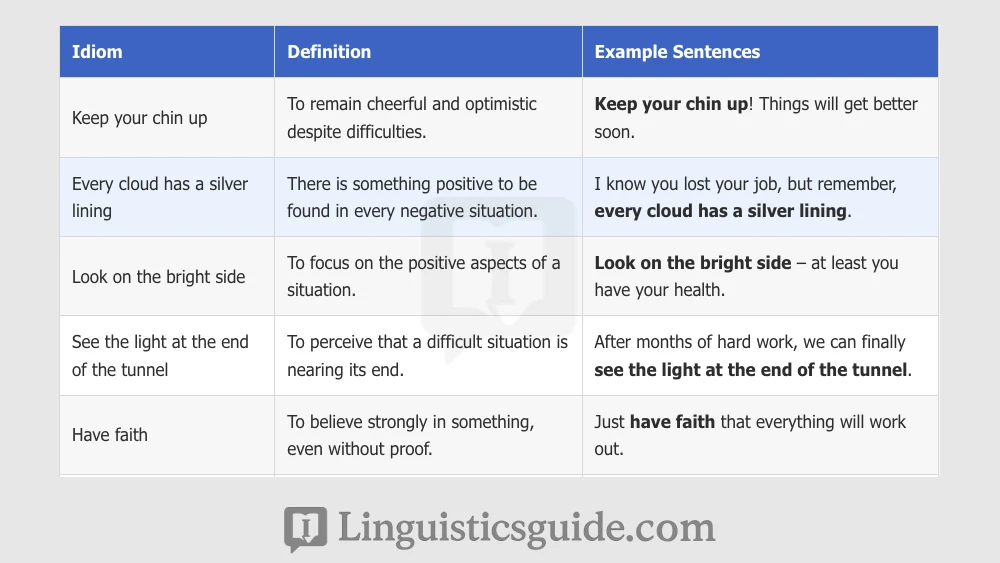
The table below showcases a variety of general hope idioms. Each idiom is defined and accompanied by example sentences to illustrate its usage in context.
| Idiom | Definition | Example Sentences |
|---|---|---|
| Keep your chin up | To remain cheerful and optimistic despite difficulties. | Keep your chin up! Things will get better soon. |
| Every cloud has a silver lining | There is something positive to be found in every negative situation. | I know you lost your job, but remember, every cloud has a silver lining. |
| Look on the bright side | To focus on the positive aspects of a situation. | Look on the bright side – at least you have your health. |
| See the light at the end of the tunnel | To perceive that a difficult situation is nearing its end. | After months of hard work, we can finally see the light at the end of the tunnel. |
| Have faith | To believe strongly in something, even without proof. | Just have faith that everything will work out. |
| Never say die | To refuse to give up, even when things are difficult. | Our team was losing, but we never say die and eventually won. |
| Hope springs eternal | Hope always exists, even in the face of adversity. | Even after so many setbacks, hope springs eternal in his heart. |
| Chin up, buttercup | A comforting phrase encouraging someone to stay positive. | Chin up, buttercup, it’s not the end of the world. |
| Brighten someone’s day | To make someone feel happier. | A simple smile can brighten someone’s day. |
| Think positive | To focus on positive thoughts and outcomes. | It’s important to think positive, even when things are tough. |
| A ray of hope | A small amount of optimism or possibility in a difficult situation. | The new medicine offered a ray of hope for patients with the disease. |
| Keep the faith | To continue to believe in something despite challenges. | Keep the faith; your efforts will be rewarded. |
| Things will look up | The situation will improve. | Don’t worry, things will look up soon. |
| Every day is a new day | Each day offers a fresh start and new opportunities. | Don’t dwell on the past; every day is a new day. |
| Tomorrow is another day | Similar to “every day is a new day,” emphasizing future possibilities. | If things don’t go well today, remember tomorrow is another day. |
| The sun will come out tomorrow | A hopeful expression suggesting better times are ahead. | Even though it’s raining now, the sun will come out tomorrow. |
| Look forward to | To anticipate something positive with pleasure. | I look forward to seeing you again soon. |
| Keep a stiff upper lip | To remain brave and not show emotions in a difficult situation. | He kept a stiff upper lip despite the bad news. |
| Find a silver lining | To discover something positive in a negative situation. | Even in this setback, we need to find a silver lining. |
| Make the best of it | To try to be positive and do what you can in a difficult situation. | We can’t change what happened, so we have to make the best of it. |
| Count your blessings | To be grateful for the good things in your life. | When you’re feeling down, count your blessings. |
| Take heart | To be encouraged; to feel hopeful. | Take heart! You’re doing a great job. |
| There’s always light at the end of the tunnel | There is hope even in the most difficult situations. | There’s always light at the end of the tunnel; just keep going. |
Future-Oriented Hope Idioms
These idioms focus on expectations and possibilities for the future.
This table provides idioms that specifically relate to future expectations and possibilities. Understanding these idioms can help convey optimism about what lies ahead.
| Idiom | Definition | Example Sentences |
|---|---|---|
| The sky’s the limit | There is no limit to what can be achieved. | With your talent and dedication, the sky’s the limit. |
| On the horizon | About to happen or appear. | There are new opportunities on the horizon. |
| A new chapter | A new beginning or phase in life. | Moving to a new city is like starting a new chapter. |
| Fresh start | An opportunity to begin again without being affected by past mistakes. | After the divorce, she decided to make a fresh start. |
| The best is yet to come | The most positive or exciting events are still in the future. | Don’t worry, the best is yet to come! |
| Reach for the stars | To aim for something very ambitious or difficult. | Reach for the stars, and you might just get there. |
| A promising future | A future that looks likely to be successful or happy. | She has a promising future in the field of medicine. |
| Full of promise | Likely to develop in a positive or successful way. | The project is full of promise and could revolutionize the industry. |
| Looking up | Improving or becoming more positive. | After a difficult period, things are finally looking up. |
| Around the corner | About to happen or appear very soon. | Spring is just around the corner. |
| A bright future | A future that is likely to be successful and happy. | He has a bright future ahead of him. |
| New horizons | New experiences or opportunities. | Traveling to different countries opens up new horizons. |
| Turn over a new leaf | To start behaving in a better way. | After his mistake, he decided to turn over a new leaf. |
| On the upswing | Improving or increasing. | The economy is on the upswing. |
| The future is bright | The future looks promising. | With these new developments, the future is bright. |
| A world of possibilities | Many different opportunities or chances. | Graduating from college opens up a world of possibilities. |
| Toward a better future | Moving in a direction that will lead to a more positive future. | We are working toward a better future for our children. |
| A silver lining in the future | A positive aspect to look forward to in the future. | Even though things are tough now, there’s a silver lining in the future. |
| The dawn of a new era | The beginning of a new period in history or development. | The invention of the internet marked the dawn of a new era. |
| A light on the horizon | A sign of hope or improvement in the future. | The peace talks are a light on the horizon. |
Perseverance and Resilience Idioms
These idioms emphasize the importance of maintaining hope and determination in the face of adversity.
The following table highlights idioms that underscore the significance of perseverance and resilience when facing challenges. These idioms encourage maintaining hope and determination even when things are difficult.
| Idiom | Definition | Example Sentences |
|---|---|---|
| Hang in there | To persevere or remain resolute during a difficult time. | Hang in there! You’re almost finished with the project. |
| Keep pushing | To continue trying despite difficulties. | Keep pushing, and you’ll eventually reach your goal. |
| When the going gets tough, the tough get going | Strong people rise to meet difficult challenges. | When the going gets tough, the tough get going, and that’s what we need to do now. |
| Hold on | To persevere or wait patiently. | Hold on; things will get better. |
| Never give up | To refuse to stop trying, even when things are difficult. | Never give up on your dreams. |
| Stay strong | To remain resilient and positive during a challenging time. | Stay strong, and you’ll get through this. |
| Keep fighting | To continue to struggle or compete despite difficulties. | Keep fighting for what you believe in. |
| Push through | To continue with determination despite obstacles. | We need to push through this difficult period. |
| Stand tall | To face challenges with courage and dignity. | Stand tall, even when things are tough. |
| Weather the storm | To survive a difficult situation. | We will weather the storm and come out stronger. |
| Dig deep | To make a great effort, especially when tired or discouraged. | We need to dig deep to finish this project on time. |
| Persevere through | To continue with effort despite difficulties. | We must persevere through these challenges. |
| Stay the course | To continue doing something until it is finished, even if it is difficult. | Stay the course, and you will succeed. |
| Rise above | To overcome difficulties or challenges. | We must rise above these obstacles. |
| Plod on | To continue working slowly and steadily, even when it is difficult. | Just plod on, and you’ll eventually get there. |
| Tough it out | To endure a difficult situation with determination. | We have to tough it out until things improve. |
| Keep at it | To continue working on something. | Keep at it, and you’ll eventually master the skill. |
| Don’t lose heart | To not become discouraged or lose hope. | Don’t lose heart; keep trying. |
| Get back on your feet | To recover from a setback or difficulty. | It takes time to get back on your feet after a loss. |
| Bounce back | To recover quickly from a setback. | She has the ability to bounce back from any challenge. |
| Take a beating | To experience hardship or difficulty. | The company took a beating during the recession. |
| Grit your teeth | To face a difficult situation with determination. | We have to grit our teeth and get through this. |
Chance and Possibility Idioms
These idioms highlight the role of chance and the potential for unexpected positive outcomes.
This table showcases idioms that emphasize the role of chance and the potential for unexpected positive events. These idioms often convey that even in uncertain situations, there is a possibility of a favorable outcome.
| Idiom | Definition | Example Sentences |
|---|---|---|
| Anything is possible | Everything is within the realm of possibility, no matter how unlikely it seems. | With hard work and determination, anything is possible. |
| Never say never | Do not say that something will not happen because it is possible. | I thought I would never like broccoli, but never say never. |
| A snowball’s chance in hell | Very little or no chance of success. | He has a snowball’s chance in hell of winning the election. |
| Strike gold | To discover or achieve something valuable or successful, often unexpectedly. | The company struck gold with its new product. |
| When pigs fly | Something that will never happen. | He’ll clean his room when pigs fly. |
| Chance of a lifetime | A rare and valuable opportunity. | This is a chance of a lifetime; don’t miss it. |
| A lucky break | A sudden and unexpected opportunity or piece of good fortune. | He got a lucky break when he met the right person. |
| In the cards | Likely to happen; destined. | Success is in the cards for you. |
| Roll the dice | To take a risk in the hope of a positive outcome. | We decided to roll the dice and invest in the new venture. |
| Pot of gold at the end of the rainbow | An illusionary reward that is difficult or impossible to find. | He was chasing a pot of gold at the end of the rainbow. |
| Fingers crossed | An expression used to wish for good luck. | I have an interview tomorrow; fingers crossed! |
| Knock on wood | An expression used to ward off bad luck. | I haven’t had any accidents yet, knock on wood. |
| Lady luck | Good fortune or chance. | Lady luck was on his side that day. |
| Leave it to chance | To allow something to happen randomly without any control. | We decided to leave it to chance and see what happens. |
| Take a gamble | To take a risk with the hope of a positive outcome. | We decided to take a gamble and invest in the stock market. |
| Win the lottery | To have an unexpected and significant stroke of good luck. | It felt like I had won the lottery when I got the job offer. |
| Good fortune smiles on you | To experience good luck or success. | Good fortune smiles on you when you work hard. |
| When your ship comes in | When you achieve wealth or success. | He’s waiting for his ship to come in. |
| Against all odds | Despite seeming impossible. | He succeeded against all odds. |
| Take a shot | To attempt something. | I’m going to take a shot at winning the competition. |
Light and Positivity Idioms
These idioms use the metaphor of light to represent hope, guidance, and positive energy.
The table below lists idioms that utilize the symbolism of light to signify hope, guidance, and positivity. These idioms often evoke a sense of clarity, inspiration, and optimism in challenging situations.
| Idiom | Definition | Example Sentences |
|---|---|---|
| Light at the end of the tunnel | A sign that a difficult period is coming to an end. | After months of hard work, we finally saw the light at the end of the tunnel. |
| A beacon of hope | Something that gives hope and encouragement in a difficult situation. | The charity is a beacon of hope for the homeless. |
| Shed light on | To provide clarity or understanding about something. | The investigation shed light on the cause of the accident. |
| Brighten up | To become more cheerful or positive. | His smile brightened up the room. |
| A ray of sunshine | A person or thing that brings happiness and positivity. | She is a ray of sunshine in my life. |
| In a good light | In a favorable or positive way. | The company wants to present itself in a good light. |
| See the light | To understand something clearly. | He finally saw the light and realized his mistake. |
| Bring to light | To reveal or make something known. | The investigation brought to light some serious issues. |
| A guiding light | Someone or something that provides direction or inspiration. | Her mentor was a guiding light in her career. |
| Lighten the mood | To make a situation or atmosphere more cheerful. | He told a joke to lighten the mood. |
| A spark of hope | A small amount of optimism or possibility. | There’s still a spark of hope that we can win. |
| Shine a light on | To focus attention on something to make it more visible or understandable. | The documentary shined a light on the issue of poverty. |
| The sun always shines after the rain | A reminder that difficult times are followed by better times. | Remember, the sun always shines after the rain. |
| A silver lining | A positive aspect of a negative situation. | The silver lining of losing his job was that he started his own business. |
| Turn on the light | To illuminate or make something clear. | Let’s turn on the light and find the answer. |
| See things in a new light | To understand something differently or from a new perspective. | After the discussion, I saw things in a new light. |
| The dawn of a new day | The beginning of a new and positive period. | This marks the dawn of a new day for our company. |
| A bright spot | A positive or encouraging aspect in a difficult situation. | The project was a bright spot in an otherwise challenging year. |
| A light in the darkness | A source of hope or guidance in a difficult time. | Her kindness was a light in the darkness during his illness. |
| Chase away the shadows | To eliminate doubts or fears. | Let’s chase away the shadows and embrace the future. |
Usage Rules for Idioms for Hope
Using idioms correctly requires attention to context and nuance. Here are some key rules to follow:
- Use idioms in appropriate contexts: Consider the audience and the formality of the situation. Some idioms are more suitable for casual conversation than formal writing.
- Maintain the correct wording: Idioms have fixed structures, so avoid altering the words or their order.
- Understand the figurative meaning: Ensure you grasp the underlying meaning of the idiom to use it accurately.
- Avoid overuse: While idioms can enrich your language, using too many can make your speech sound unnatural or contrived.
- Be aware of cultural differences: Idioms are often culturally specific, so be mindful of your audience’s background.
It’s also crucial to remember that idioms should complement your message, not obscure it. Clarity should always be the priority, and idioms should be used to enhance, not confuse, your communication.
Common Mistakes When Using Hope Idioms
Here are some common mistakes that learners make when using idioms for hope, along with corrections:
| Incorrect | Correct | Explanation |
|---|---|---|
| Keep your head up. | Keep your chin up. | The correct idiom is “chin up,” not “head up.” |
| Every rain has a silver lining. | Every cloud has a silver lining. | The idiom uses “cloud,” not “rain.” |
| Look at the shiny side. | Look on the bright side. | The correct phrase is “bright side,” not “shiny side.” |
| See the light in the end. | See the light at the end of the tunnel. | The complete idiom includes “at the end of the tunnel.” |
| Have belief. | Have faith. | The correct idiom is “have faith.” |
| Never say quit. | Never say die. | The correct idiom is “never say die.” |
| Chin up, flower. | Chin up, buttercup. | The correct idiom is “chin up, buttercup.” |
Practice Exercises
Test your understanding of idioms for hope with these exercises.
Exercise 1: Fill in the Blanks
Complete the following sentences with the appropriate idiom from the list provided.
- Never say die
- Keep your chin up
- Every cloud has a silver lining
- See the light at the end of the tunnel
- The sky’s the limit
| Question | Answer |
|---|---|
| 1. Even though you failed the exam, remember that __________. | Every cloud has a silver lining |
| 2. __________, things will get better soon. | Keep your chin up |
| 3. With your determination, __________. | The sky’s the limit |
| 4. After months of hard work, we can finally __________. | See the light at the end of the tunnel |
| 5. __________! You can achieve anything if you try. | Never say die |
| 6. Even though it’s tough, __________. | Keep your chin up |
| 7. After many setbacks, we could finally __________. | See the light at the end of the tunnel |
| 8. Remember, __________; there’s always something positive to find. | Every cloud has a silver lining |
| 9. With your talent and passion, __________. | The sky’s the limit |
| 10. __________, and keep striving for your goals. | Never say die |
Exercise 2: Matching
Match the idiom with its correct definition.
| Idiom | Definition | Answer |
|---|---|---|
| 1. Hang in there | a. There is no limit to what can be achieved. | 1. b |
| 2. The sky’s the limit | b. To persevere or remain resolute during a difficult time. | 2. a |
| 3. A fresh start | c. An opportunity to begin again without being affected by past mistakes. | 3. c |
| 4. Reach for the stars | d. To aim for something very ambitious or difficult. | 4. d |
| 5. The best is yet to come | e. The most positive or exciting events are still in the future. | 5. e |
Exercise 3: Multiple Choice
Choose the correct idiom to complete the sentence.
| Question | Options | Answer |
|---|---|---|
| 1. Despite the challenges, we must __________ and keep trying. | a) give up b) hang in there c) run away | 1. b |
| 2. He is __________ because he always sees the positive side of things. | a) a pessimist b) an optimist c) a ray of sunshine | 2. c |
| 3. After losing his job, he decided to __________ and pursue his passion. | a) turn over a new leaf b) stay the same c) give up | 3. a |
| 4. We are working __________ for our children. | a) toward a better future b) towards a bad future c) toward a similar future | 4. a |
| 5. She always __________ despite the difficulties she faces. | a) keeps her chin down b) keeps her chin up c) keeps her head down | 5. b |
Advanced Topics in Hope Idioms
For advanced learners, exploring the etymology and cultural context of hope idioms can provide a deeper understanding of their usage and impact. Additionally, analyzing how these idioms are used in literature, speeches, and media can offer insights into their rhetorical power.
Consider researching the origins of specific idioms and how their meanings have evolved over time. Also, pay attention to how different cultures express hope through their own unique idioms and expressions.
Another advanced topic is the creative adaptation of idioms. Skilled writers and speakers often modify idioms slightly to create novel expressions that resonate with their audience while still maintaining a connection to the original meaning.
This requires a sophisticated understanding of both the idiom and the context in which it is used.
Frequently Asked Questions
What is the difference between an idiom and a proverb?
An idiom is a phrase whose meaning is different from the literal meaning of its words, while a proverb is a short, well-known saying that expresses a general truth or piece of advice.
How can I improve my understanding of idioms?
Read widely, pay attention to how native speakers use idioms, and practice using them in your own speech and writing. Keep a notebook of new idioms and their meanings.
Are idioms universal?
No, idioms are often culturally specific and may not translate directly into other languages. Understanding the cultural context is crucial for accurate interpretation.
Can I create my own idioms?
While it’s possible to create new expressions, they only become idioms if they are widely adopted and understood by a community of speakers.
Why is it important to learn idioms?
Learning idioms enhances your understanding of a language and culture, allowing you to communicate more effectively and connect with native speakers on a deeper level.
How do I know when to use an idiom?
Consider the context, audience, and formality of the situation. Idioms are generally more appropriate in informal settings and when communicating with people who are familiar with the language and culture.
What should I do if I don’t understand an idiom?
Ask for clarification or look it up in a dictionary or online resource. Pay attention to the context to get clues about its meaning.
Are there any resources to help me learn idioms?
Yes, there are many dictionaries, websites, and language learning apps that provide explanations and examples of idioms. Additionally, reading books and watching movies in English can help you learn idioms in context.
Conclusion
Idioms for hope are powerful tools for expressing optimism, encouragement, and positive expectations. By understanding their meanings, usage rules, and cultural contexts, English language learners can significantly enhance their communication skills.
This guide has provided a comprehensive overview of various idioms related to hope, offering definitions, examples, and practice exercises to facilitate learning. As you continue your language journey, remember to embrace these colorful expressions and use them to inspire and uplift yourself and others.