
Understanding idioms is crucial for mastering the nuances of the English language. Idioms add color and depth to communication, allowing speakers to convey emotions and ideas in a vivid and relatable manner.
This is especially true when expressing strong feelings like hate. This article delves into common idioms used to express hate, providing definitions, examples, and usage rules.
This comprehensive guide is designed for English language learners of all levels, from beginners seeking to expand their vocabulary to advanced speakers aiming to refine their expressive abilities.
Off to College Deals

Save up to 30% on everything you need for the semester.
Contains affiliate link
By mastering these idioms, you’ll enhance your ability to understand and participate in conversations, literature, and media that employ figurative language. Furthermore, understanding the context and cultural background of these expressions will allow you to use them appropriately and effectively, avoiding misinterpretations and fostering clearer communication.
This article aims to equip you with the knowledge and skills necessary to confidently navigate the rich landscape of English idioms related to hate.
Table of Contents
- Definition of Idioms for Hate
- Structural Breakdown of Idioms
- Types and Categories of Hate Idioms
- Examples of Idioms for Hate
- Usage Rules for Hate Idioms
- Common Mistakes When Using Hate Idioms
- Practice Exercises
- Advanced Topics in Hate Idioms
- Frequently Asked Questions
- Conclusion
Definition of Idioms for Hate
An idiom is a phrase or expression whose meaning cannot be understood from the literal meanings of its individual words. Instead, it has a figurative meaning that is known through common usage.
Idioms for hate are expressions that convey a strong feeling of dislike, aversion, or animosity. These idioms are often more expressive and impactful than simply stating “I hate something.” They add color and intensity to the language, providing a more nuanced way to communicate negative emotions.
These idioms can be classified based on their intensity, ranging from mild dislike to intense loathing. They also vary in formality, with some being suitable for casual conversation and others being more appropriate for formal writing or speech.
Young Adults & Students:
Get 6 Months of Prime for $0

Ages 18-24 unlock exclusive perks including:
Contains affiliate link
Understanding the context in which an idiom is used is essential for interpreting its meaning correctly and using it appropriately.
The function of hate idioms is primarily to express negative feelings in a more vivid and engaging way. They can also be used to emphasize the speaker’s emotional state, to create a sense of drama, or to add humor to a situation.
The specific context in which an idiom is used will determine its precise meaning and impact.
Structural Breakdown of Idioms
Idioms, by their nature, defy simple grammatical rules. Their structure is fixed, meaning that the words cannot be changed or rearranged without altering the meaning or rendering the idiom nonsensical.
This fixed structure is one of the key characteristics that distinguishes idioms from ordinary phrases.
Most idioms consist of a combination of verbs, nouns, adjectives, and prepositions. The specific arrangement of these elements is what gives the idiom its unique meaning.
For example, the idiom “can’t stand” consists of the auxiliary verb “can’t” and the verb “stand,” but its meaning (to dislike intensely) is not directly related to the literal meaning of standing.
Understanding the structural elements of an idiom can help learners to recognize it and remember its meaning. However, it’s important to remember that the meaning of an idiom cannot be derived from its individual parts.
Instead, it must be learned as a whole unit.
One common pattern in idioms is the use of metaphorical language. Many idioms draw on images or concepts from everyday life to express abstract ideas.
For example, the idiom “to have it in for someone” uses the image of holding something against someone to convey the idea of harboring resentment.
Types and Categories of Hate Idioms
Hate idioms can be categorized based on several factors, including intensity, formality, and the specific emotion they express. Here are some common categories:
Intensity
This category classifies idioms based on the strength of the negative feeling they convey. Some idioms express mild dislike, while others express intense loathing.
Formality
This category classifies idioms based on their appropriateness for different contexts. Some idioms are suitable for casual conversation, while others are more appropriate for formal writing or speech.
Specific Emotion
This category classifies idioms based on the specific type of negative emotion they express. Some idioms express anger, while others express disgust or resentment.
Examples of Categories:
- Mild Dislike: “Not a fan,” “Couldn’t care less”
- Moderate Dislike: “Can’t stand,” “Don’t care for”
- Strong Dislike/Hate: “Loathe,” “Detest,” “Abhor”
- Informal: “Have it in for someone,” “Get on someone’s nerves”
- Formal: “Hold in contempt,” “View with disdain”
- Anger: “See red,” “Go ballistic”
- Disgust: “Turn one’s stomach,” “Make one’s skin crawl”
- Resentment: “Bear a grudge,” “Harbor ill feelings”
Examples of Idioms for Hate
This section provides a comprehensive list of idioms used to express hate, organized by categories of intensity and emotion. Each idiom is accompanied by a definition and example sentence to illustrate its usage.
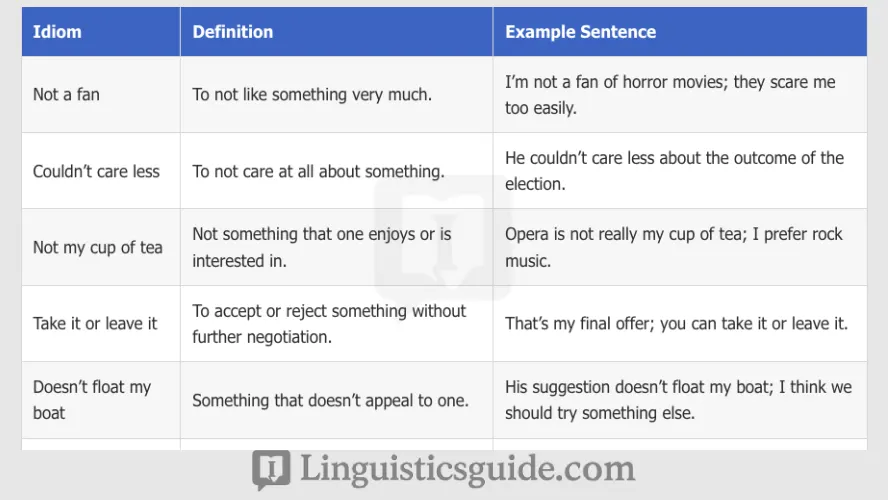
Table 1: Idioms Expressing Mild Dislike
The following table lists idioms that express a mild level of dislike or disinterest. These are generally suitable for everyday conversation and don’t convey strong negative emotions.
| Idiom | Definition | Example Sentence |
|---|---|---|
| Not a fan | To not like something very much. | I’m not a fan of horror movies; they scare me too easily. |
| Couldn’t care less | To not care at all about something. | He couldn’t care less about the outcome of the election. |
| Not my cup of tea | Not something that one enjoys or is interested in. | Opera is not really my cup of tea; I prefer rock music. |
| Take it or leave it | To accept or reject something without further negotiation. | That’s my final offer; you can take it or leave it. |
| Doesn’t float my boat | Something that doesn’t appeal to one. | His suggestion doesn’t float my boat; I think we should try something else. |
| Not wild about | To not be enthusiastic about something. | I’m not wild about the new design; it seems a bit bland. |
| Don’t care for | To not like something. | I don’t care for coffee; I prefer tea in the morning. |
| No love lost | To have a mutual dislike for someone. | There’s no love lost between them; they’ve been rivals for years. |
| Don’t think much of | To have a low opinion of someone or something. | I don’t think much of his leadership skills; he’s not very decisive. |
| Not big on | To not be very interested in something. | I’m not big on spicy food; I prefer milder flavors. |
| Leave me cold | To not excite or interest someone. | His performance left me cold; it lacked emotion. |
| Underwhelmed | To fail to impress or excite someone. | I was rather underwhelmed by the movie; I expected more. |
| Pass | To decline an offer or opportunity. | I’ll pass on the invitation; I’m not feeling well. |
| Not my thing | Something that is not to one’s taste or preference. | Camping is just not my thing; I prefer staying in hotels. |
| Meh | An expression of indifference or lack of enthusiasm. | “How was the party?” “Meh, it was okay.” |
| Indifferent | Having no particular interest or sympathy; unconcerned. | She seemed indifferent to the news of her promotion. |
| Don’t have a taste for | To not enjoy or appreciate something. | I don’t have a taste for modern art; I prefer classical paintings. |
| Could do without | To be able to manage or live comfortably without something. | I could do without the constant noise from the construction site. |
| Not keen on | To not be enthusiastic or fond of something. | I’m not keen on going to the beach today; it’s too crowded. |
| So-so | Neither very good nor very bad; passable. | The restaurant was so-so; the food was okay but nothing special. |
Table 2: Idioms Expressing Moderate Dislike
The following table lists idioms that express a moderate level of dislike. These idioms are stronger than those in the previous category and indicate a more significant aversion.
| Idiom | Definition | Example Sentence |
|---|---|---|
| Can’t stand | To dislike someone or something very much. | I can’t stand the sound of nails scratching on a chalkboard. |
| Get on someone’s nerves | To irritate or annoy someone. | His constant complaining really gets on my nerves. |
| Rub someone the wrong way | To irritate or annoy someone unintentionally. | She rubs me the wrong way; I can’t explain why. |
| Stick in one’s craw | To be difficult to accept or tolerate. | The injustice of the situation stuck in his craw. |
| Find something distasteful | To consider something unpleasant or offensive. | I find his behavior quite distasteful. |
| Have no patience for | To be unable to tolerate someone or something. | I have no patience for people who are always late. |
| Object to | To express disapproval or opposition to something. | I object to the way he spoke to her. |
| Take exception to | To object strongly to something. | I take exception to your accusations. |
| Not in favor of | To not support or approve of something. | I’m not in favor of the proposed changes. |
| Have a bone to pick with | To have a grievance or complaint to discuss with someone. | I have a bone to pick with you about the way you handled the project. |
| Irksome | Annoying; irritating. | His constant interruptions were quite irksome. |
| Grates on me | To irritate or annoy someone. | Her high-pitched voice really grates on me. |
| Aversion to | A strong dislike or disinclination. | I have an aversion to public speaking. |
| Resent | To feel bitterness or indignation at (a circumstance, action, or person). | I resent being treated like a child. |
| Dislike intensely | To have a strong feeling of aversion or disapproval. | I dislike intensely the way he always interrupts. |
| Can’t bear | Unable to endure someone or something. | I can’t bear the thought of him getting away with it. |
| Take a dim view of | To disapprove of something. | The manager takes a dim view of employees being late. |
| Have no stomach for | To not want to do or experience something unpleasant. | I have no stomach for conflict. |
| Bother | To take the trouble to do something. | Don’t bother me with trivial details. |
| Upsetting | Causing distress, worry, or unhappiness. | It’s upsetting to see animals being mistreated. |
Table 3: Idioms Expressing Strong Dislike/Hate
This table includes idioms that express a strong feeling of dislike or hate. These are the most intense expressions and should be used with caution, as they can be quite offensive.
| Idiom | Definition | Example Sentence |
|---|---|---|
| Loathe | To feel intense dislike or disgust for someone or something. | I loathe the smell of cigarette smoke. |
| Detest | To dislike intensely. | I detest dishonesty. |
| Abhor | To regard with disgust and hatred. | I abhor violence of any kind. |
| Despise | To feel contempt or deep repugnance for. | I despise people who take advantage of others. |
| Have it in for someone | To be determined to cause trouble for someone. | My boss has it in for me; he’s always criticizing my work. |
| Can’t stand the sight of | To strongly dislike someone’s appearance or presence. | I can’t stand the sight of him after what he did. |
| Hate someone’s guts | To intensely dislike someone. | I hate his guts; he’s a terrible person. |
| Wouldn’t touch something with a ten-foot pole | To refuse to have anything to do with something. | I wouldn’t touch that project with a ten-foot pole; it’s a disaster. |
| View with disdain | To regard someone or something as unworthy of respect. | She views his efforts with disdain. |
| Hold in contempt | To consider someone or something worthless or despicable. | He holds his former colleagues in contempt. |
| Abominate | To detest or loathe. | I abominate the way he treats his employees. |
| Execrate | To feel or express great loathing for. | I execrate the very idea of war. |
| Repugnant | Extremely distasteful; unacceptable. | His behavior was utterly repugnant. |
| Revolting | Causing intense disgust; disgusting. | The food was revolting. |
| Sick and tired of | Having had enough of; exasperated. | I’m sick and tired of his excuses. |
| Can’t abide | Unable to tolerate. | I can’t abide liars. |
| Object strongly | To express a very strong feeling of disapproval. | I object strongly to being spoken to in that tone. |
| Bitterly resent | To feel a strong and resentful dislike. | I bitterly resent being overlooked for the promotion. |
| Intense animosity | Strong hostility or dislike. | There’s intense animosity between the two rival companies. |
| Deep-seated hatred | A deeply ingrained and persistent feeling of hate. | The conflict stems from deep-seated hatred. |
Table 4: Idioms Expressing Anger
This table includes idioms that specifically express feelings of anger. These idioms often involve metaphors related to heat, explosions, or aggression.
| Idiom | Definition | Example Sentence |
|---|---|---|
| See red | To become very angry. | I saw red when he insulted my family. |
| Go ballistic | To become extremely angry and irrational. | My dad went ballistic when he saw the damage to the car. |
| Blow a fuse | To become very angry. | He blew a fuse when he realized he had been cheated. |
| Hit the roof | To become extremely angry. | She hit the roof when she found out what happened. |
| Fly off the handle | To lose one’s temper suddenly and violently. | He flew off the handle at the slightest provocation. |
| Foaming at the mouth | To be extremely angry. | He was foaming at the mouth when he heard the news. |
| Livid | Extremely angry. | She was livid when she found out she had been betrayed. |
| Incensed | Very angry; enraged. | He was incensed by the false accusations. |
| Furious | Extremely angry. | She was furious with him for lying. |
| Mad as a hornet | Extremely angry. | He was mad as a hornet when he discovered the mistake. |
| In a rage | In a state of uncontrolled anger. | He stormed out of the room in a rage. |
| Lose one’s cool | To become angry or lose one’s temper. | He lost his cool and started shouting. |
| Go off on someone | To suddenly become angry and start shouting at someone. | He went off on me for no reason. |
| Hot under the collar | Angry or agitated. | He got hot under the collar when I questioned his decisions. |
| Bristle at | To react defensively or angrily. | She bristled at the suggestion that she had made a mistake. |
| Seethe with anger | To be filled with intense but suppressed anger. | He was seething with anger but tried to remain calm. |
| Work oneself into a lather | To become very agitated or angry. | He worked himself into a lather over the smallest things. |
| Take umbrage | To feel offended or annoyed by something. | She took umbrage at his remarks. |
| Outraged | Extremely angry and shocked. | The public was outraged by the scandal. |
| Seething | Filled with intense but unexpressed anger. | Beneath his calm exterior, he was seething. |
Table 5: Idioms Expressing Disgust
The following table presents idioms that express a feeling of disgust. These idioms often use imagery related to unpleasant sensations or objects.
| Idiom | Definition | Example Sentence |
|---|---|---|
| Turn one’s stomach | To cause someone to feel disgusted. | The sight of the accident turned my stomach. |
| Make one’s skin crawl | To cause someone to feel disgusted or uneasy. | The thought of spiders makes my skin crawl. |
| Leave a bad taste in one’s mouth | To leave someone with an unpleasant memory or feeling. | The way the deal was handled left a bad taste in my mouth. |
| Repulse | To cause someone to feel intense disgust. | The smell of rotten food repulsed me. |
| Nauseate | To cause someone to feel sick or disgusted. | The graphic details of the crime nauseated me. |
| Distasteful | Unpleasant or offensive. | His comments were extremely distasteful. |
| Unpalatable | Difficult to accept or tolerate. | The truth was unpalatable to her. |
| Off-putting | Unpleasant or unattractive. | His arrogance was off-putting. |
| Revolting | Extremely unpleasant. | The conditions in the prison were revolting. |
| Abhorrent | Inspiring disgust and loathing. | Racism is abhorrent to me. |
| Vile | Extremely unpleasant; disgusting. | The food tasted vile. |
| Loathsome | Causing hatred or disgust; repulsive. | His behavior was loathsome. |
| Repugnant | Extremely distasteful; unacceptable. | His views are repugnant to me. |
| Make one’s hair stand on end | To frighten or disgust someone greatly. | The scary story made my hair stand on end. |
| Ugh | An expression of disgust or distaste. | “Ugh, this tastes awful!” |
| Yuk | An expression of disgust. | “Yuk, what is that smell?” |
| Yuck | An expression of disgust. | “Yuck, this milk is sour!” |
| Putrid | Decaying or rotting and emitting a fetid smell. | The putrid smell of garbage filled the air. |
| Foul | Offensive to the senses, especially through having an unpleasant smell or taste. | The foul odor made me gag. |
| Rank | Having a strong, unpleasant smell or taste. | The rank smell of sewage was overwhelming. |
Usage Rules for Hate Idioms
Using idioms correctly requires attention to context, formality, and the specific nuances of each expression. Here are some key rules to keep in mind:
- Context: Consider the situation and audience when choosing an idiom. Some idioms are too informal for professional settings, while others may be too strong for casual conversation.
- Formality: Be aware of the formality level of each idiom. Use formal idioms in formal writing and speech, and informal idioms in casual settings.
- Intensity: Choose idioms that accurately reflect the intensity of your feelings. Using an overly strong idiom can be perceived as dramatic or insincere, while using an overly weak idiom may not convey the strength of your emotions.
- Cultural Sensitivity: Be mindful of cultural differences and avoid using idioms that may be offensive or misunderstood in certain cultures.
- Accuracy: Ensure that you understand the meaning of an idiom before using it. Misusing an idiom can lead to confusion or miscommunication.
It’s also important to remember that idioms are fixed expressions. Do not alter the wording or grammar of an idiom, as this can change its meaning or render it nonsensical.
For example, instead of saying “I can’t standing him,” say “I can’t stand him.”
Common Mistakes When Using Hate Idioms
English language learners often make mistakes when using idioms, due to their figurative nature and fixed structure. Here are some common errors to avoid:
- Literal Interpretation: Interpreting idioms literally instead of understanding their figurative meaning.
- Incorrect Word Choice: Using the wrong words in an idiom.
- Grammatical Errors: Making grammatical errors within the idiom.
- Misunderstanding Context: Using an idiom in an inappropriate context.
- Overuse: Using idioms too frequently, which can make your speech sound unnatural.
Here are some examples of common mistakes and their corrections:
| Incorrect | Correct | Explanation |
|---|---|---|
| I am not having a fan of that. | I am not a fan of that. | Incorrect word choice within the idiom. |
| He couldn’t care less about it. | He couldn’t care less. | Unnecessary addition to the idiom. |
| She is getting on my nerves all the time. | She gets on my nerves. | Incorrect verb tense. |
| I have a bone to argue with you. | I have a bone to pick with you. | Incorrect word choice within the idiom. |
| He saw red color. | He saw red. | Unnecessary addition to the idiom. |
Practice Exercises
Test your understanding of idioms for hate with these practice exercises. Choose the correct idiom to complete each sentence.
Exercise 1: Fill in the blanks
Choose the correct idiom from the list to complete each sentence:
- can’t stand
- not my cup of tea
- couldn’t care less
- gets on my nerves
- loathe
- I _________ the way he chews with his mouth open.
- Classical music is _________, I prefer jazz.
- He _________ about what others think of him.
- Her constant complaining really _________.
- I _________ the smell of burnt toast.
Answer Key:
- can’t stand
- not my cup of tea
- couldn’t care less
- gets on my nerves
- loathe
Exercise 2: Multiple Choice
Choose the best idiom to replace the underlined phrase in each sentence.
- I really dislike his arrogant attitude.
- I am a fan of
- I can’t stand
- I am so-so with
- The thought of eating snails disgusts me.
- Turns my stomach
- Floats my boat
- Leave me cold
- He became very angry when he heard the news.
- Saw blue
- Saw red
- Saw green
- I don’t want anything to do with that project.
- Touch it with a ten-foot pole
- Touch it with a hand
- Touch it with my heart
- She is always trying to cause trouble for me.
- Has it in for me
- Has it out for me
- Has it up for me
- I strongly disapprove of his behavior.
- Take a bright view of
- Take a dim view of
- Take a clear view of
- I am extremely disgusted by the sight of blood.
- Makes my skin crawl
- Makes my heart sing
- Makes my eyes water
- I am tired of his constant excuses.
- Sick and tired of
- Well and rested with
- Happy and joyful for
- I cannot tolerate his lies.
- Can’t abide
- Can’t assist
- Can’t attend
- He is very annoying.
- A pleasure
- Irksome
- Delightful
Answer Key:
- b
- a
- b
- a
- a
- b
- a
- a
- a
- b
Exercise 3: Sentence Completion
Complete the following sentences with an appropriate idiom for hate.
- I _________ when people are rude to service staff.
- He _________ whenever someone questions his authority.
- I _________ having to wake up early on weekends.
- She _________ people who are dishonest.
- The thought of public speaking _________.
- I _________ his constant interruptions.
- She _________ the way he treats animals.
- I _________ being kept waiting.
- He _________ people who are late.
- She _________ his condescending attitude.
Answer Key (Example Answers):
- see red
- flies off the handle
- can’t stand
- despises
- makes my skin crawl
- can’t bear
- abhors
- resent
- has no patience for
- views with disdain
Advanced Topics in Hate Idioms
For advanced learners, exploring the etymology and historical context of idioms can provide a deeper understanding of their meaning and usage. Additionally, analyzing the use of idioms in literature and media can enhance your ability to interpret and appreciate complex texts.
Another advanced topic is the use of idioms in different dialects of English. Idioms can vary significantly between British English, American English, and other regional dialects.
Understanding these variations is essential for effective communication in diverse environments.
Furthermore, advanced learners can explore the use of idioms to create rhetorical effects, such as irony, sarcasm, and humor. Mastering the art of using idioms effectively can significantly enhance your communication skills.
Frequently Asked Questions
- What is the difference between an idiom and a proverb?
An idiom is a phrase whose meaning is not predictable from the usual meanings of its constituent elements. A proverb is a short, popular saying that embodies a general truth or advice. While both are figurative, proverbs offer wisdom, while idioms are primarily expressive.
- How can I learn new idioms effectively?
Immerse yourself in English language content, such as books, movies, and TV shows. Pay attention to how native speakers use idioms in conversation. Keep a notebook of new idioms and practice using them in your own speech and writing.
- Is it okay to use idioms in formal writing?
Generally, idioms should be used sparingly in formal writing, as they can make your writing sound less professional. However, some idioms are more formal than others and may be appropriate in certain contexts. Always consider your audience and the purpose of your writing when deciding whether to use an idiom.
- How do I know when an expression is an idiom?
If the meaning of a phrase cannot be understood from the literal meanings of its individual words, it is likely an idiom. You can also consult a dictionary of idioms or ask a native speaker for clarification.
- Are idioms the same in all English-speaking countries?
No, idioms can vary significantly between different English-speaking countries. For example, an idiom that is common in American English may not be used or understood in British English, and vice versa. Be aware of these variations when communicating with people from different regions.
- What should I do if I don’t understand an idiom?
Don’t be afraid to ask for clarification. You can ask the speaker to explain the meaning of the idiom or consult a dictionary or online resource. Understanding the context in which the idiom is used can also help you to infer its meaning.
- How can I avoid misusing idioms?
Practice using idioms in different contexts to get a feel for their nuances. Pay attention to how native speakers use idioms and ask for feedback on your own usage. Avoid using idioms that you are not completely familiar with.
- Are there any online resources for learning idioms?
Yes, there are many online resources for learning idioms, including dictionaries, websites, and language learning apps. Some popular resources include the Oxford Idioms Dictionary, Merriam-Webster’s Idiom Dictionary, and various online language learning platforms.
- Can I create my own idioms?
While it is possible to create new phrases, they are not considered idioms until they gain widespread usage and acceptance. Idioms are, by definition, established expressions with a recognized figurative meaning.
- How important is it to learn idioms for mastering English?
Learning idioms is crucial for mastering English, as they are an integral part of the language. Understanding idioms will significantly enhance your ability to comprehend and communicate effectively in English.
Conclusion
Mastering idioms for hate is an essential step in achieving fluency and expressiveness in English. By understanding the definitions, structures, and usage rules of these idioms, learners can enhance their ability to communicate negative emotions effectively and appropriately.
This guide has provided a comprehensive overview of common idioms for hate, along with practical exercises and tips for avoiding common mistakes. Continue to practice and explore these expressions to enrich your vocabulary and improve your overall command of the English language.
Embrace the challenge of learning idioms, and you’ll find your communication skills reaching new heights.

I’m James Terban, a teacher with a degree in Education and five years of experience working with students of all ages, from young kids learning their first grammar rules to adults picking up English as a second language. I started Linguistics Guide because I kept seeing good learners hit a wall due to explanations that were either too vague or too complicated. Every article here comes from a real question I have heard in a classroom or seen asked online.