
Understanding idioms is crucial for mastering English, especially when discussing sensitive topics like conflict. Idioms add color and nuance to communication, allowing us to express complex emotions and situations succinctly.
This article delves into common idioms used to describe conflict, disputes, and disagreements. Whether you’re an English language learner or a native speaker looking to expand your vocabulary, this guide provides comprehensive explanations, examples, and practice exercises to enhance your understanding and usage of these powerful expressions.
Table of Contents
- Introduction
- Definition of Idioms for Conflict
- Structural Breakdown of Conflict Idioms
- Types and Categories of Conflict Idioms
- Examples of Conflict Idioms
- Usage Rules for Conflict Idioms
- Common Mistakes with Conflict Idioms
- Practice Exercises
- Advanced Topics in Conflict Idioms
- Frequently Asked Questions
- Conclusion
Introduction
Expressing disagreement and conflict effectively is a vital communication skill. While direct language is important, idioms offer a nuanced and often more engaging way to convey the complexities of contentious situations.
These expressions, deeply rooted in culture and history, enrich our vocabulary and provide a deeper understanding of how conflict is perceived and managed in the English-speaking world. This article explores various idioms related to conflict, offering definitions, examples, and practical exercises to help you master their usage.
From heated arguments to subtle disagreements, we’ll explore the diverse range of idioms that capture the essence of conflict in its many forms.
Definition of Idioms for Conflict
Idioms for conflict are expressions or phrases whose overall meaning differs from the literal meaning of the individual words they contain. These idioms are specifically used to describe situations involving disagreement, arguments, disputes, or any form of opposition. They provide a colorful and often indirect way to talk about conflict, adding depth and emotional resonance to communication. Understanding these idioms can significantly improve your comprehension of spoken and written English, particularly in contexts where conflict is a central theme.
The classification of conflict idioms can be based on the type of conflict they describe (e.g., personal, professional, political), the intensity of the conflict (e.g., mild disagreement, heated argument, all-out war), or the stage of the conflict (e.g., initial disagreement, escalation, resolution). Their function is to provide a more expressive and engaging way to discuss conflict, often adding humor, sarcasm, or emphasis.
The context in which these idioms are used is crucial for understanding their intended meaning and impact.
Structural Breakdown of Conflict Idioms
The structure of conflict idioms can vary significantly. Some idioms are simple phrases consisting of a few words, while others are more complex sentences.
Many idioms rely on metaphorical language, using imagery and symbolism to represent conflict. For example, the idiom “to lock horns” uses the image of two animals fighting to describe a direct confrontation.
Understanding the structural elements of idioms can help you decipher their meaning and use them effectively.
Common patterns include:
- Verb + Preposition: “Fall out” (to have an argument)
- Noun + Verb: “A bone to pick” (a reason to argue)
- Adjective + Noun: “A sore point” (a sensitive issue that causes conflict)
- Phrasal Verbs: “Stir up trouble” (to provoke conflict)
The grammatical function of idioms can also vary. They can act as verbs, nouns, adjectives, or adverbs, depending on the specific idiom and its context.
For example, “at loggerheads” functions as an adjective, describing a state of disagreement, while “bury the hatchet” functions as a verb, describing the act of resolving a conflict.
Types and Categories of Conflict Idioms
Conflict idioms can be categorized based on various aspects of conflict, such as the level of intensity, the nature of the disagreement, or the desired outcome. Here are some common categories:
Idioms Describing the Start or Cause of Conflict
These idioms often refer to the initial spark that ignites a disagreement or dispute.
Idioms Describing Escalating Conflict
These idioms illustrate how a conflict can intensify and become more serious.
Idioms Describing De-escalating Conflict
These idioms refer to actions or situations that help to reduce the intensity of a conflict.
Idioms Describing Conflict Resolution
These idioms describe the process of resolving a conflict and reaching an agreement.
Idioms Describing Avoidance of Conflict
These idioms refer to strategies or behaviors used to prevent conflict from arising.
Examples of Conflict Idioms
This section provides a comprehensive list of conflict idioms, categorized by their meaning and usage. Each idiom is accompanied by a definition and example sentence to illustrate its proper use.
General Conflict Idioms
These idioms are commonly used to describe general situations of conflict or disagreement.
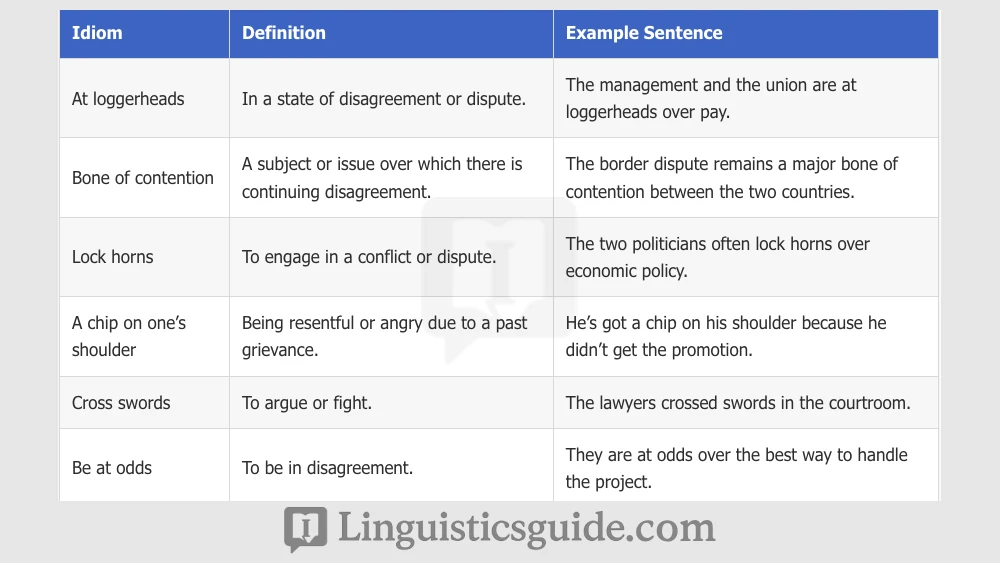
Table 1: General Conflict Idioms
| Idiom | Definition | Example Sentence |
|---|---|---|
| At loggerheads | In a state of disagreement or dispute. | The management and the union are at loggerheads over pay. |
| Bone of contention | A subject or issue over which there is continuing disagreement. | The border dispute remains a major bone of contention between the two countries. |
| Lock horns | To engage in a conflict or dispute. | The two politicians often lock horns over economic policy. |
| A chip on one’s shoulder | Being resentful or angry due to a past grievance. | He’s got a chip on his shoulder because he didn’t get the promotion. |
| Cross swords | To argue or fight. | The lawyers crossed swords in the courtroom. |
| Be at odds | To be in disagreement. | They are at odds over the best way to handle the project. |
| Take issue with | To disagree with something. | I must take issue with your statement about the company’s performance. |
| A clash of wills | A situation where two people strongly disagree and try to impose their will. | The project failed because of a clash of wills between the project manager and the team leader. |
| On a collision course | Heading towards a conflict. | The two companies are on a collision course over market share. |
| In the crossfire | Caught in the middle of a conflict. | The civilians were caught in the crossfire during the battle. |
| At each other’s throats | Arguing fiercely. | The siblings were at each other’s throats over who would inherit the house. |
| Draw a line in the sand | To set a limit that cannot be crossed. | The company drew a line in the sand regarding further budget cuts. |
| Fan the flames | To make a conflict worse. | His comments only fanned the flames of the argument. |
| Get someone’s back up | To annoy or irritate someone. | His arrogant attitude really gets my back up. |
| Have a beef with someone | To have a disagreement or complaint about someone. | I have a beef with the way he handled the situation. |
| Hit a nerve | To touch on a sensitive issue. | Her comment about his weight clearly hit a nerve. |
| Rub someone the wrong way | To irritate someone. | His constant complaining rubs me the wrong way. |
| Stir the pot | To intentionally cause trouble or conflict. | He’s always stirring the pot with his controversial opinions. |
| Walk on eggshells | To be very careful not to offend someone. | I have to walk on eggshells around my boss because he’s so sensitive. |
| A war of words | A verbal dispute. | The debate turned into a war of words between the two candidates. |
| Fight tooth and nail | To fight very fiercely. | They fought tooth and nail to win the contract. |
| Go for the jugular | To attack someone in their most vulnerable spot. | The politician went for the jugular during the debate, attacking his opponent’s personal life. |
| Beat around the bush | Avoiding the main issue. | Stop beating around the bush and tell me what the problem is. |
| Call a spade a spade | To speak frankly and directly. | Let’s call a spade a spade: this project is failing. |
Idioms for Escalating Conflict
These idioms describe how a conflict can intensify and become more serious.
Table 2: Escalating Conflict Idioms
| Idiom | Definition | Example Sentence |
|---|---|---|
| Add fuel to the fire | To make a conflict worse. | His comments only added fuel to the fire. |
| Boil over | To erupt in anger. | The tension between them finally boiled over during the meeting. |
| Come to a head | To reach a critical point. | The crisis came to a head when the company announced layoffs. |
| Escalate quickly | To increase rapidly in intensity. | What started as a minor disagreement escalated quickly into a full-blown argument. |
| Go from bad to worse | To deteriorate further. | The situation went from bad to worse when more people got involved. |
| Reach a boiling point | To reach a point where people can no longer control their anger. | The negotiations reached a boiling point when the union threatened to strike. |
| Fan the flames | To make something more intense. | The media coverage only fanned the flames of the controversy. |
| Stir up a hornet’s nest | To cause a lot of trouble. | By questioning the CEO’s decisions, she stirred up a hornet’s nest. |
| Open a can of worms | To create a new set of problems. | Investigating the old files opened a can of worms. |
| Take a turn for the worse | To become worse. | The argument took a turn for the worse when personal insults were exchanged. |
| Push someone’s buttons | To do something that annoys someone. | He knows exactly how to push my buttons. |
| Cross the line | To do something unacceptable. | He crossed the line when he started making personal attacks. |
Idioms for De-escalating Conflict
These idioms refer to actions or situations that help to reduce the intensity of a conflict.
Table 3: De-escalating Conflict Idioms
| Idiom | Definition | Example Sentence |
|---|---|---|
| Pour oil on troubled waters | To try to calm a conflict. | The mediator poured oil on troubled waters by suggesting a compromise. |
| Smooth things over | To resolve a conflict. | He tried to smooth things over by apologizing to her. |
| Take the heat out of | To reduce the intensity of a situation. | The company’s statement took the heat out of the controversy. |
| Let sleeping dogs lie | To avoid stirring up trouble. | It’s best to let sleeping dogs lie and not bring up the past. |
| Keep a lid on | To control a situation. | The manager tried to keep a lid on the rumors spreading through the office. |
| Back down | To give up a position in an argument. | Neither side was willing to back down from their demands. |
| Call a truce | To agree to stop fighting. | They called a truce to discuss the issue calmly. |
| Meet halfway | To compromise. | Both parties had to meet halfway to reach an agreement. |
| Take the high road | To act morally superior. | Despite the insults, she decided to take the high road and remain professional. |
| Turn the other cheek | To not retaliate when attacked. | He decided to turn the other cheek and not respond to the criticism. |
Idioms for Conflict Resolution
These idioms describe the process of resolving a conflict and reaching an agreement.
Table 4: Conflict Resolution Idioms
| Idiom | Definition | Example Sentence |
|---|---|---|
| Bury the hatchet | To make peace after a conflict. | They decided to bury the hatchet and start over. |
| Clear the air | To resolve misunderstandings. | We need to clear the air and discuss what happened. |
| Build bridges | To establish connections. | The company is trying to build bridges with the local community. |
| Turn over a new leaf | To start behaving in a better way. | He promised to turn over a new leaf and stop causing trouble. |
| Find common ground | To find areas of agreement. | The negotiators were able to find common ground on several key issues. |
| Kiss and make up | To reconcile after a fight. | After a heated argument, they kissed and made up. |
| Patch things up | To repair a relationship. | They tried to patch things up after the disagreement. |
| Settle the score | To get revenge. | He wanted to settle the score after being betrayed. |
| Call it quits | To end a relationship or agreement. | After years of struggling, they decided to call it quits. |
Idioms for Avoiding Conflict
These idioms refer to strategies or behaviors used to prevent conflict from arising.
Table 5: Conflict Avoidance Idioms
| Idiom | Definition | Example Sentence |
|---|---|---|
| Steer clear of | To avoid something or someone. | I try to steer clear of political discussions at family gatherings. |
| Turn a blind eye | To ignore something. | The manager turned a blind eye to the employee’s misconduct. |
| Sweep under the rug | To hide a problem. | The company tried to sweep the scandal under the rug. |
| Keep the peace | To maintain order. | He tried to keep the peace between his feuding siblings. |
| Sit on the fence | To remain neutral. | She decided to sit on the fence and not take sides in the argument. |
| Duck the issue | To avoid dealing with a problem. | The politician ducked the issue by changing the subject. |
| Look the other way | To ignore something. | He chose to look the other way rather than confront the problem. |
| Play it safe | To avoid risks. | She decided to play it safe and not voice her opinion. |
| Take a rain check | To postpone something. | Let’s take a rain check on this discussion and revisit it later. |
Usage Rules for Conflict Idioms
Using idioms correctly requires understanding their specific meanings and contexts. Here are some key rules to keep in mind:
- Context is crucial: The meaning of an idiom can change depending on the context in which it is used.
- Don’t take them literally: Idioms are not meant to be interpreted literally. Focus on the overall meaning of the phrase.
- Consider your audience: Some idioms may be unfamiliar to non-native speakers or people from different cultural backgrounds.
- Pay attention to grammar: While idioms are fixed expressions, they still need to be used grammatically correct in a sentence.
For example, the idiom “to beat around the bush” means to avoid talking directly about a subject. You wouldn’t use this idiom in a situation where directness is valued or expected.
Common Mistakes with Conflict Idioms
Using idioms incorrectly can lead to misunderstandings and confusion. Here are some common mistakes to avoid:
Table 6: Common Mistakes with Conflict Idioms
| Incorrect | Correct | Explanation |
|---|---|---|
| He added gas to the fire. | He added fuel to the fire. | The correct idiom is “add fuel to the fire,” not “gas.” |
| They buried the axe. | They buried the hatchet. | The correct idiom is “bury the hatchet,” not “axe.” |
| She poured water on the oil. | She poured oil on troubled waters. | The correct idiom is “pour oil on troubled waters,” not “water on the oil.” |
| He was walking on eggs. | He was walking on eggshells. | The correct idiom is “walking on eggshells,” which implies being cautious. |
| They are in one’s throats. | They are at each other’s throats. | The correct idiom is “at each other’s throats,” meaning they are arguing fiercely. |
Practice Exercises
Test your understanding of conflict idioms with these practice exercises. Choose the correct idiom to complete each sentence.
Exercise 1: Multiple Choice
Table 7: Practice Exercise 1
| Question | Options | Answer |
|---|---|---|
| The two companies are _________ over market share. | a) at loggerheads b) under the weather c) on cloud nine | a) at loggerheads |
| He always tries to _________ by making jokes. | a) bury the hatchet b) clear the air c) add fuel to the fire | b) clear the air |
| The argument _________ when personal insults were exchanged. | a) added fuel to the fire b) took a turn for the worse c) buried the hatchet | b) took a turn for the worse |
| She decided to _________ and not respond to his criticism. | a) turn the other cheek b) call it quits c) stir the pot | a) turn the other cheek |
| They had to _________ to reach an agreement. | a) meet halfway b) stir the pot c) add fuel to the fire | a) meet halfway |
| He’s always _________ with his controversial opinions. | a) smoothing things over b) stirring the pot c) burying the hatchet | b) stirring the pot |
| The border dispute remains a major _________ between the two countries. | a) bone of contention b) piece of cake c) walk in the park | a) bone of contention |
| The negotiations _________ when the union threatened to strike. | a) reached a boiling point b) added fuel to the fire c) buried the hatchet | a) reached a boiling point |
| Let’s _________ and not bring up the past. | a) let sleeping dogs lie b) add fuel to the fire c) bury the hatchet | a) let sleeping dogs lie |
| They decided to _________ and start over. | a) bury the hatchet b) add fuel to the fire c) stir the pot | a) bury the hatchet |
Exercise 2: Fill in the Blanks
Complete the following sentences using appropriate conflict idioms.
- After the heated debate, they decided to __________ and move forward. bury the hatchet
- The two politicians often __________ over economic policy. lock horns
- His comments only __________ of the argument. fanned the flames
- I have to __________ around my boss because he’s so sensitive. walk on eggshells
- The company is trying to __________ with the local community. build bridges
- The situation __________ when more people got involved. went from bad to worse
- The manager tried to __________ the rumors spreading through the office. keep a lid on
- Both parties had to __________ to reach an agreement. meet halfway
- I try to __________ political discussions at family gatherings. steer clear of
- Let’s __________ on this discussion and revisit it later. take a rain check
Advanced Topics in Conflict Idioms
For advanced learners, exploring the etymology and cultural context of conflict idioms can provide a deeper understanding of their usage and meaning. Many idioms have historical roots that shed light on their metaphorical significance.
For example, the idiom “bury the hatchet” comes from a Native American tradition of burying a hatchet or tomahawk to symbolize the end of hostilities and the beginning of peace. Understanding this cultural context enriches the meaning of the idiom and its implications for conflict resolution.
Additionally, analyzing how conflict idioms are used in literature, film, and other forms of media can provide valuable insights into their expressive power and emotional impact. Observing how skilled writers and speakers use these idioms can inspire you to incorporate them more effectively into your own communication.
Frequently Asked Questions
Why is it important to learn idioms for conflict?
Learning idioms for conflict enhances your ability to understand and express nuanced opinions and situations effectively. It also improves your comprehension of spoken and written English, particularly in contexts where conflict is a central theme.
Are conflict idioms universal across different English-speaking countries?
While many conflict idioms are widely understood, some may be more common in certain regions or countries. It’s important to be aware of these regional variations and consider your audience when using idioms.
How can I improve my understanding of conflict idioms?
To improve your understanding of conflict idioms, practice using them in context, read widely, and pay attention to how native speakers use them in conversation and writing. Additionally, studying the etymology and cultural context of idioms can deepen your understanding of their meaning and usage.
Can I use conflict idioms in formal writing?
While idioms can add color and expressiveness to your writing, it’s important to use them judiciously in formal contexts. Overusing idioms can make your writing sound informal or unprofessional.
Consider your audience and the purpose of your writing when deciding whether to use idioms.
What are some resources for learning more about conflict idioms?
There are many resources available for learning more about conflict idioms, including dictionaries of idioms, online language learning platforms, and books on English vocabulary and usage. Additionally, reading widely and listening to native speakers can expose you to a wide range of idioms in context.
Conclusion
Mastering idioms for conflict is essential for effective communication in English. By understanding the meanings, usage rules, and common mistakes associated with these expressions, you can enhance your ability to navigate contentious situations with grace and skill.
This article has provided a comprehensive guide to conflict idioms, offering definitions, examples, practice exercises, and advanced topics to help you deepen your understanding and usage. Whether you’re an English language learner or a native speaker, incorporating these idioms into your vocabulary will enrich your communication and empower you to express yourself more effectively in a wide range of contexts.
Remember, practice makes perfect, so continue to explore and use these idioms in your daily interactions to master their nuances and become a more confident and articulate communicator.