

Understanding abbreviations and Latin terms is crucial for clear and concise writing, especially in academic, legal, and technical contexts. “E.g.,” short for the Latin phrase exempli gratia, is a common abbreviation used to introduce examples that clarify a point. Mastering its correct usage ensures that your writing is not only grammatically sound but also conveys your intended meaning accurately.
This article provides a comprehensive guide to “e.g.,” covering its definition, proper usage, common mistakes, and practical exercises to help you confidently incorporate it into your writing. This guide will benefit students, writers, and professionals looking to enhance their communication skills and improve the clarity of their written work.
This article is a comprehensive guide to mastering the correct usage of “e.g.” in writing. By understanding its definition, structural elements, and usage rules, you can enhance the clarity and precision of your written communication. From common mistakes to advanced topics, this article covers everything you need to know to use “e.g.” effectively.
Off to College Deals

Save up to 30% on everything you need for the semester.
Contains affiliate link
Table of Contents
- Definition of E.g.
- Structural Breakdown
- Types or Categories of Examples
- Examples of E.g. in Sentences
- Usage Rules for E.g.
- Common Mistakes When Using E.g.
- Practice Exercises
- Advanced Topics
- Frequently Asked Questions (FAQ)
- Conclusion
Definition of E.g.
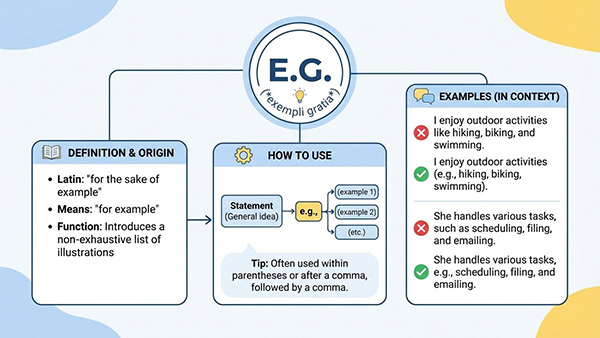
The abbreviation “e.g.” stands for the Latin phrase exempli gratia, which translates to “for example” or “for instance.” It is used to introduce one or more examples that illustrate a point, concept, or idea that has already been stated. Unlike “i.e.” (id est, meaning “that is”), which clarifies or specifies a statement, “e.g.” provides examples to help the reader understand the preceding statement better. Therefore, “e.g.” is used to give a non-exhaustive list of examples.
In academic writing, “e.g.” is frequently employed to support arguments, provide evidence, or clarify complex concepts. In legal documents, it helps to illustrate specific clauses or provisions with concrete instances. In technical manuals, “e.g.” can demonstrate how a particular function or feature works in practice. In each of these contexts, its role remains the same: to provide examples that enhance understanding and clarify meaning.
Understanding e.g meaning is essential for using it correctly in any written context. Knowing what does e.g. stand for—the Latin phrase exempli gratia—clarifies that it is used to introduce examples rather than to define or specify a statement.
Additionally, understanding what does e.g. mean in writing helps ensure that sentences remain concise and avoid redundancy. For instance, writing “for example, e.g., oranges and apples” is incorrect because e.g. already conveys “for example.” Incorporating these distinctions improves clarity and makes your writing more professional.
Young Adults & Students:
Get 6 Months of Prime for $0

Ages 18-24 unlock exclusive perks including:
Contains affiliate link
Structural Breakdown
The structure of “e.g.” in a sentence is relatively straightforward. It typically appears within parentheses or is set off by commas, followed by one or more examples. A comma should always follow “e.g.” itself before listing the examples. The examples provided should be relevant to the preceding statement and should help to clarify its meaning.
Here’s a breakdown of the structural elements:
- E.g.: The abbreviation itself, always written in lowercase with periods after each letter.
- Comma: A comma must follow “e.g.” to separate it from the examples.
- Examples: One or more examples that illustrate the preceding statement. If multiple examples are given, they should be separated by commas.
- Parentheses or Commas: The entire phrase, including “e.g.” and the examples, is usually enclosed in parentheses or set off by commas.
Understanding this structure is essential for using “e.g.” correctly and ensuring that your writing is clear and concise. Here’s an example illustrating the structure: “Many fruits are rich in vitamins (e.g., oranges, bananas, and apples).”
To learn how to use e.g. in a sentence, place it directly before the examples and follow it with a comma, as in: “Many fruits are rich in vitamins (e.g., oranges, bananas, and apples).” When considering how to read e.g. in a sentence, it is typically spoken as “for example,” making the illustrative purpose clear to the listener.
In academic or research contexts, you can also give example of using e.g. in citation, such as: “Several studies focus on renewable energy (e.g., Smith, 2020; Lee, 2019), demonstrating practical applications.” Mastery of these rules ensures precise and professional writing.
Types or Categories of Examples
While the function of “e.g.” remains consistent, the types of examples it introduces can vary depending on the context. Here are some categories of examples you might encounter:
Specific Instances
These are concrete examples of a general category or concept. For example, “Several types of renewable energy are gaining popularity (e.g., solar, wind, and hydro power).”
Illustrative Cases
These examples serve to illustrate a particular situation or scenario. For example, “Certain medical conditions require immediate attention (e.g., severe chest pain, difficulty breathing, or sudden loss of vision).”
Practical Applications
These examples demonstrate how a concept or theory can be applied in real-world situations. For example, “Various programming languages are used in web development (e.g., HTML, CSS, and JavaScript).”
Exemplary Models
These examples represent ideal or typical instances of a particular category. For example, “Several famous Impressionist painters captured the beauty of landscapes (e.g., Claude Monet, Edgar Degas, and Pierre-Auguste Renoir).”
Hypothetical Scenarios
These examples are used to illustrate potential outcomes or possibilities. For example, “Different risk management strategies can be employed to mitigate potential losses (e.g., diversification, hedging, or insurance).”
Examples of E.g. in Sentences
The following tables provide a variety of examples illustrating the correct usage of “e.g.” in different contexts. These examples are designed to help you understand how to incorporate “e.g.” effectively into your writing.
Table 1: General Examples
This table provides general examples of how “e.g.” is used to introduce examples in various sentences.
| Sentence |
|---|
| Many countries in Europe are popular tourist destinations (e.g., France, Italy, and Spain). |
| Several types of musical instruments are commonly used in orchestras (e.g., violins, flutes, and trumpets). |
| Various kinds of desserts are often served at parties (e.g., cakes, pies, and cookies). |
| Certain sports require a high level of physical endurance (e.g., marathon running, swimming, and cycling). |
| Many fruits are rich in vitamins (e.g., oranges, bananas, and apples). |
| Several types of transportation are available in big cities (e.g., buses, trains, and taxis). |
| Various hobbies can help reduce stress (e.g., reading, gardening, and painting). |
| Some animals are known for their intelligence (e.g., dolphins, chimpanzees, and elephants). |
| Many languages are spoken around the world (e.g., English, Spanish, and Mandarin). |
| Certain types of flowers are commonly used in bouquets (e.g., roses, lilies, and tulips). |
| Several planets in our solar system have moons (e.g., Earth, Mars, and Jupiter). |
| Various forms of art can be found in museums (e.g., paintings, sculptures, and photographs). |
| Some countries are famous for their cuisine (e.g., Italy, Japan, and Mexico). |
| Many types of renewable energy sources are being developed (e.g., solar, wind, and geothermal). |
| Certain historical figures are known for their leadership (e.g., Abraham Lincoln, Mahatma Gandhi, and Nelson Mandela). |
| Various social media platforms are popular among teenagers (e.g., Instagram, TikTok, and Snapchat). |
| Some programming languages are widely used in software development (e.g., Java, Python, and C++). |
| Many types of exercises can improve cardiovascular health (e.g., running, swimming, and cycling). |
| Certain spices are commonly used in Indian cuisine (e.g., turmeric, cumin, and coriander). |
| Various breeds of dogs are popular as pets (e.g., Labrador Retrievers, German Shepherds, and Golden Retrievers). |
Table 2: Academic Writing Examples
This table illustrates how “e.g.” is used in academic writing to provide examples that support arguments or clarify concepts.
| Sentence |
|---|
| Researchers have identified several factors that contribute to academic success (e.g., consistent study habits, effective time management, and strong motivation). |
| Various theoretical frameworks are used in sociological research (e.g., functionalism, conflict theory, and symbolic interactionism). |
| Different types of research methods are employed in psychological studies (e.g., surveys, experiments, and case studies). |
| Several statistical techniques are used to analyze data in scientific research (e.g., t-tests, ANOVA, and regression analysis). |
| Various literary devices are used by authors to enhance their writing (e.g., metaphors, similes, and alliteration). |
| Different economic indicators are used to measure the health of a country’s economy (e.g., GDP, inflation rate, and unemployment rate). |
| Several historical events have had a significant impact on the course of human history (e.g., the French Revolution, the Industrial Revolution, and World War II). |
| Different types of political systems exist around the world (e.g., democracy, monarchy, and dictatorship). |
| Various environmental issues are threatening the planet’s ecosystems (e.g., deforestation, pollution, and climate change). |
| Several ethical considerations are important in medical research (e.g., informed consent, confidentiality, and beneficence). |
| Different types of learning styles can influence a student’s academic performance (e.g., visual, auditory, and kinesthetic). |
| Various cognitive biases can affect decision-making processes (e.g., confirmation bias, anchoring bias, and availability heuristic). |
| Several factors contribute to the development of mental health disorders (e.g., genetics, environmental stressors, and trauma). |
| Different types of leadership styles can be effective in organizational settings (e.g., transformational, transactional, and servant leadership). |
| Various marketing strategies are used to promote products and services (e.g., advertising, public relations, and social media marketing). |
| Several types of financial investments can help individuals achieve their financial goals (e.g., stocks, bonds, and real estate). |
| Different types of energy sources are used to power homes and businesses (e.g., electricity, natural gas, and solar power). |
| Various communication technologies have transformed the way people interact (e.g., email, social media, and video conferencing). |
| Several types of transportation systems are used to move people and goods (e.g., roads, railways, and airports). |
| Different types of educational institutions provide learning opportunities for students (e.g., schools, colleges, and universities). |
Table 3: Technical Writing Examples
This table demonstrates the use of “e.g.” in technical writing, where it is used to provide examples of how a function or feature works.
| Sentence |
|---|
| Several programming languages are used for data analysis (e.g., Python, R, and MATLAB). |
| Various types of sensors are used in robotics (e.g., ultrasonic sensors, infrared sensors, and tactile sensors). |
| Different types of databases are used to store and manage data (e.g., MySQL, PostgreSQL, and MongoDB). |
| Several types of algorithms are used in machine learning (e.g., linear regression, decision trees, and neural networks). |
| Various networking protocols are used for communication between devices (e.g., TCP/IP, HTTP, and FTP). |
| Different types of data structures are used in computer programming (e.g., arrays, linked lists, and trees). |
| Several types of operating systems are used on computers and mobile devices (e.g., Windows, macOS, and Android). |
| Various types of file formats are used to store digital information (e.g., PDF, JPEG, and MP3). |
| Different types of software licenses are used to protect intellectual property (e.g., GPL, MIT, and Apache). |
| Several types of security measures are used to protect computer systems from cyber threats (e.g., firewalls, antivirus software, and intrusion detection systems). |
| Various types of cloud computing services are offered by different providers (e.g., IaaS, PaaS, and SaaS). |
| Different types of data visualization tools are used to represent data graphically (e.g., bar charts, pie charts, and scatter plots). |
| Several types of programming paradigms are used in software development (e.g., object-oriented programming, functional programming, and procedural programming). |
| Various types of hardware components are used in computer systems (e.g., CPU, RAM, and hard drive). |
| Different types of network topologies are used to connect devices in a network (e.g., star, bus, and ring). |
| Several types of web development frameworks are used to build web applications (e.g., React, Angular, and Vue.js). |
| Various types of mobile app development platforms are used to create mobile applications (e.g., iOS, Android, and React Native). |
| Different types of version control systems are used to manage changes to source code (e.g., Git, SVN, and Mercurial). |
| Several types of testing methodologies are used in software testing (e.g., unit testing, integration testing, and system testing). |
| Various types of database management systems are used to manage and organize data (e.g., relational databases, NoSQL databases, and object-oriented databases). |
Table 4: Legal Writing Examples
This table showcases the use of “e.g.” in legal writing, where it helps in illustrating specific clauses or provisions with concrete instances.
| Sentence |
|---|
| Certain types of contracts must be in writing to be enforceable (e.g., contracts for the sale of land, contracts that cannot be performed within one year, and contracts for the sale of goods worth over a certain amount). |
| Various types of intellectual property are protected by law (e.g., patents, trademarks, and copyrights). |
| Different types of legal remedies are available to parties who have been harmed by a breach of contract (e.g., monetary damages, specific performance, and rescission). |
| Several types of criminal offenses are punishable by imprisonment (e.g., murder, robbery, and assault). |
| Various types of evidence are admissible in court (e.g., testimony, documents, and physical evidence). |
| Different types of legal entities can be formed to conduct business (e.g., sole proprietorships, partnerships, and corporations). |
| Several types of constitutional rights are protected by the Bill of Rights (e.g., freedom of speech, freedom of religion, and the right to bear arms). |
| Various types of torts can give rise to civil lawsuits (e.g., negligence, defamation, and trespass). |
| Different types of legal defenses can be raised by defendants in criminal cases (e.g., self-defense, insanity, and alibi). |
| Several types of administrative agencies have the power to regulate various industries and activities (e.g., the Environmental Protection Agency, the Food and Drug Administration, and the Federal Communications Commission). |
| Various types of property can be owned by individuals and businesses (e.g., real estate, personal property, and intellectual property). |
| Different types of legal proceedings are used to resolve disputes (e.g., litigation, arbitration, and mediation). |
| Several types of government regulations are designed to protect consumers (e.g., product safety standards, truth-in-advertising laws, and data privacy regulations). |
| Various types of international agreements govern relations between countries (e.g., treaties, trade agreements, and human rights conventions). |
| Different types of legal doctrines are used to interpret and apply the law (e.g., stare decisis, res judicata, and collateral estoppel). |
| Several types of legal ethics rules govern the conduct of attorneys (e.g., confidentiality, conflicts of interest, and competence). |
| Various types of legal research tools are used by attorneys and legal scholars (e.g., legal databases, law reviews, and court opinions). |
| Different types of legal writing are used in the legal profession (e.g., briefs, memos, and contracts). |
| Several types of legal careers are available to law school graduates (e.g., practicing attorney, judge, and legal scholar). |
| Various types of laws govern different aspects of society (e.g., criminal law, civil law, and constitutional law). |
Usage Rules for E.g.
To ensure correct usage, consider these rules:
- Lowercase and Periods: Always write “e.g.” in lowercase with periods after each letter.
- Comma After E.g.: Always place a comma after “e.g.” to separate it from the examples that follow.
- Parentheses or Commas: Enclose the entire phrase (e.g., and the examples) in parentheses or set it off with commas.
- Non-Exhaustive List: Use “e.g.” to provide a non-exhaustive list of examples. If you want to provide a complete list, use “i.e.” instead.
- Relevance: Make sure the examples you provide are relevant to the preceding statement and help to clarify its meaning.
- Consistency: Be consistent in your usage throughout your document. If you use parentheses in one instance, use them in all instances.
Following these rules will help you use “e.g.” correctly and effectively in your writing.
Common Mistakes When Using E.g.
Several common mistakes can occur when using “e.g.” Here are some examples of incorrect and correct usage:
| Incorrect | Correct | Explanation |
|---|---|---|
| Eg: apples, bananas, oranges | E.g., apples, bananas, oranges | “E.g.” must be in lowercase with periods and followed by a comma. |
| For example, e.g., apples, bananas, oranges | E.g., apples, bananas, oranges | “E.g.” already means “for example,” so it is redundant to include both. |
| I.e., apples, bananas, oranges (e.g., fruits) | E.g., apples, bananas, oranges (fruits) | “I.e.” is used for clarification, not to provide examples. |
| Such as, e.g., apples, bananas, oranges | E.g., apples, bananas, oranges | Using “such as” with “e.g.” is redundant. |
| E.g: apples, bananas and oranges. | E.g., apples, bananas, and oranges. | A comma must follow “e.g.” and a serial comma (Oxford comma) should be used for clarity. |
| E.g., apples, bananas etc. | E.g., apples, bananas. | Avoid using “etc.” after “e.g.” because “e.g.” already implies that the list is not exhaustive. |
Avoiding these common mistakes will improve the clarity and accuracy of your writing.
Practice Exercises
Test your understanding of “e.g.” with the following exercises. Fill in the blanks with appropriate examples, using “e.g.” correctly.
Exercise 1
Complete the following sentences using “e.g.” and appropriate examples.
| Question | Answer |
|---|---|
| Many countries have beautiful landscapes (_____, mountains, forests, and deserts). | E.g., Switzerland, Canada, and New Zealand have diverse landscapes, including mountains, forests, and deserts. |
| Several types of pets are popular among families (_____, dogs, cats, and birds). | E.g., dogs, cats, and birds are popular pets among families. |
| Various forms of exercise can improve physical fitness (_____, running, swimming, and yoga). | E.g., running, swimming, and yoga are effective forms of exercise for improving physical fitness. |
| Some fruits are excellent sources of vitamin C (_____, oranges, strawberries, and kiwis). | E.g., oranges, strawberries, and kiwis are excellent sources of vitamin C. |
| Many cities are known for their historical landmarks (_____, Rome, Athens, and Cairo). | E.g., Rome, Athens, and Cairo are known for their historical landmarks and cultural heritage. |
| Several types of electronic devices are commonly used in daily life (_____, smartphones, laptops, and tablets). | E.g., smartphones, laptops, and tablets are essential electronic devices in modern daily life. |
| Various forms of entertainment are available in urban areas (_____, concerts, theaters, and museums). | E.g., concerts, theaters, and museums offer diverse forms of entertainment in urban areas. |
| Some languages are widely spoken across the globe (_____, English, Spanish, and Mandarin). | E.g., English, Spanish, and Mandarin are widely spoken languages across the globe. |
| Many types of renewable energy are being developed (_____, solar, wind, and geothermal). | E.g., solar, wind, and geothermal energy are being developed as renewable alternatives. |
| Certain types of vegetables are rich in vitamins and minerals (_____, spinach, broccoli, and carrots). | E.g., spinach, broccoli, and carrots are nutrient-rich vegetables that provide essential vitamins and minerals. |
Exercise 2
Correct the following sentences, which contain errors in the use of “e.g.”
| Question | Answer |
|---|---|
| For example, e.g., apples, bananas, and oranges are fruits. | E.g., apples, bananas, and oranges are fruits. |
| Eg: cats, dogs, and birds are common pets. | E.g., cats, dogs, and birds are common pets. |
| Several countries, e.g: France, Italy, and Spain, are popular tourist destinations. | Several countries, e.g., France, Italy, and Spain, are popular tourist destinations. |
| E.g., running, swimming etc. are good for health. | E.g., running and swimming are good for health. |
| I.e., apples, bananas, oranges (e.g., fruits). | E.g., apples, bananas, oranges (fruits). |
| Such as, e.g., books, magazines, and newspapers. | E.g., books, magazines, and newspapers. |
| E.g: coffee, tea and juice. | E.g., coffee, tea, and juice. |
| E.g., pens, pencils etc. are stationery items. | E.g., pens and pencils are stationery items. |
| E.g., apples, bananas, and oranges etc. are fruits. | E.g., apples, bananas, and oranges are fruits. |
| Several activities, e.g: hiking, camping, and fishing, are great for outdoor adventures. | Several activities, e.g., hiking, camping, and fishing, are great for outdoor adventures. |
Advanced Topics
For advanced learners, it’s important to understand the nuances of using “e.g.” in complex sentences and formal writing. Here are some advanced considerations:
Combining with Other Abbreviations
In some cases, you might need to use “e.g.” in conjunction with other abbreviations like “i.e.” or “cf.” (confer, meaning “compare”). Ensure that each abbreviation is used correctly and that their meanings do not overlap. For example, “Different approaches to data analysis exist (e.g., regression analysis; cf. i.e., descriptive statistics).”
Contextual Appropriateness
While “e.g.” is widely accepted, it might not be appropriate for all types of writing. In very formal or literary contexts, it may be preferable to use the full phrase “for example” instead. Consider your audience and the overall tone of your writing when deciding whether to use “e.g.”
Placement within Sentences
The placement of “e.g.” within a sentence can affect its readability. Generally, it should be placed as close as possible to the term or concept it is illustrating. Avoid placing it at the beginning of a sentence or in a way that disrupts the flow of the text.
Frequently Asked Questions (FAQ)
Here are some frequently asked questions about using “e.g.”
What does “e.g.” stand for?
“E.g.” stands for the Latin phrase exempli gratia, which means “for example” or “for instance.”
How is “e.g.” different from “i.e.”?
“E.g.” provides examples to illustrate a point, while “i.e.” (id est) clarifies or specifies a statement. “E.g.” introduces a non-exhaustive list of examples, whereas “i.e.” provides a restatement or definition of the preceding term. For example, “Bring your favorite fruit (e.g., apples, bananas, oranges)” versus “Bring a tropical fruit (i.e., a fruit that grows in the tropics).”
Is it necessary to use parentheses with “e.g.”?
While parentheses are commonly used, it is also acceptable to set off the phrase with commas. The choice depends on the context and the surrounding sentence structure. Consistency is key; choose one method and stick to it throughout your document.
Can I use “etc.” after “e.g.”?
It is generally not recommended to use “etc.” after “e.g.” because “e.g.” already implies that the list is not exhaustive. Adding “etc.” is redundant.
Should I capitalize “e.g.” at the beginning of a sentence?
No, “e.g.” should always be written in lowercase, even when it appears at the beginning of a sentence. However, it’s best to avoid starting a sentence with “e.g.” altogether. Rephrase the sentence to include the examples within the sentence structure.
Is it okay to use “e.g.” in formal writing?
Yes, “e.g.” is acceptable in formal writing, including academic papers and professional documents. However, consider your audience and the overall tone of your writing. In very formal contexts, it may be preferable to use “for example” instead.
What is the correct punctuation for “e.g.”?
The correct punctuation for “e.g.” is to write it in lowercase with periods after each letter (e.g.) and to follow it with a comma. The entire phrase, including the examples, should be enclosed in parentheses or set off by commas.
How many examples should I include after “e.g.”?
There is no strict rule for the number of examples to include after “e.g.” However, it is generally best to provide a few relevant examples that effectively illustrate your point. Avoid providing too many examples, as this can make your writing cumbersome.
Conclusion
Mastering the use of “e.g.” is essential for clear and effective communication in various contexts, from academic writing to technical documentation. By understanding its definition, structural elements, and usage rules, you can confidently incorporate it into your writing. Avoid common mistakes and practice regularly to enhance your proficiency. Remember that “e.g.” is a valuable tool for providing examples and clarifying complex ideas, making your writing more accessible and understandable.
By consistently applying the guidelines and practicing the exercises provided in this article, you will be well-equipped to use “e.g.” correctly and effectively. This will not only improve the clarity of your writing but also enhance your credibility as a writer or professional. Continue to refine your skills and pay attention to context to ensure that your usage of “e.g.” is always appropriate and effective.

I’m James Terban, a teacher with a degree in Education and five years of experience working with students of all ages, from young kids learning their first grammar rules to adults picking up English as a second language. I started Linguistics Guide because I kept seeing good learners hit a wall due to explanations that were either too vague or too complicated. Every article here comes from a real question I have heard in a classroom or seen asked online.