
Understanding the difference between “continually” and “continuously” is crucial for precise and effective communication in English. While both words describe actions that happen over a period of time, they convey distinct meanings. Confusing them can lead to ambiguity or misinterpretation.
This article provides a comprehensive guide to differentiating between these two adverbs, offering clear definitions, usage examples, and practical exercises to help you master their correct application. This guide will benefit English language learners, writers, and anyone seeking to enhance their grammatical accuracy.
This article explores the nuances of “continually” and “continuously,” clarifying their meanings through detailed explanations and numerous examples.
Off to College Deals

Save up to 30% on everything you need for the semester.
Contains affiliate link
We’ll delve into the structural elements of each word, examine various usage scenarios, and address common mistakes. By the end of this guide, you’ll be equipped with the knowledge and skills to confidently use these adverbs in your writing and speaking.
Table of Contents
- 1. Definition of Continually and Continuously
- 2. Structural Breakdown
- 3. Types or Categories of Usage
- 4. Examples of Continually and Continuously
- 5. Usage Rules
- 6. Common Mistakes
- 7. Practice Exercises
- 8. Advanced Topics
- 9. Frequently Asked Questions (FAQ)
- 10. Conclusion
1. Definition of Continually and Continuously
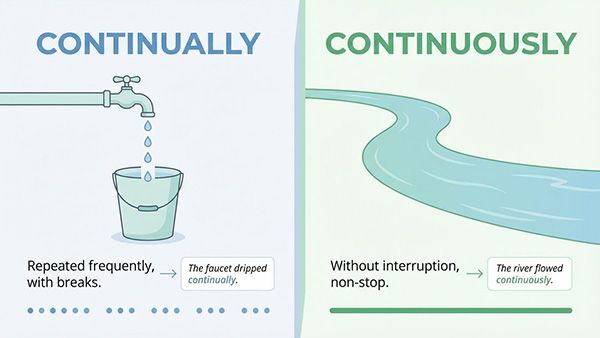
Both “continually” and “continuously” are adverbs that describe actions occurring over a period of time. However, they differ significantly in their nuance and application.
1.1 Continually
“Continually” implies that an action or event happens repeatedly with intervals or breaks. It suggests a recurring pattern with pauses in between each instance of the action. Think of it as something that happens again and again.
For example: “The phone continually rang throughout the meeting.” This suggests the phone rang multiple times, with pauses between each ring.
Young Adults & Students:
Get 6 Months of Prime for $0

Ages 18-24 unlock exclusive perks including:
Contains affiliate link
1.2 Continuously
“Continuously” indicates that an action or event happens without interruption or cessation. It suggests an unbroken sequence or a constant state. Think of it as something that never stops.
For example: “The machine ran continuously for 24 hours.” This means the machine operated without stopping for the entire duration.
1.3 Summary Table: Continually vs. Continuously
The following table summarizes the key differences between “continually” and “continuously”:
| Feature | Continually | Continuously |
|---|---|---|
| Meaning | Repeatedly with intervals | Without interruption |
| Nature of Action | Recurring, intermittent | Uninterrupted, constant |
| Example | The student continually asked questions. | The heart beats continuously. |
2. Structural Breakdown
Understanding the structure of these words can further clarify their meanings.
2.1 Continually Structure
“Continually” is formed from the word “continual” and the suffix “-ly,” which transforms it into an adverb. “Continual” itself comes from “continue,” meaning to persist or keep going. The “-al” suffix indicates a quality or state, so “continual” describes something that happens repeatedly.
2.2 Continuously Structure
“Continuously” is derived from the word “continuous” with the addition of the “-ly” suffix. “Continuous” also originates from “continue,” but the “-ous” suffix signifies a state or quality of being unbroken or uninterrupted.
2.3 Etymological Roots
Both words share the root “continue,” but the different suffixes, “-al” and “-ous,” dramatically change their meaning. Recognizing these suffixes and their significance can aid in remembering the distinction between “continually” and “continuously.”
3. Types or Categories of Usage
The usage of “continually” and “continuously” can be categorized based on the type of action or event being described.
3.1 Recurring Actions (Continually)
“Continually” is often used to describe actions that occur regularly but with pauses or breaks. These actions are not constant but happen at intervals.
Example: “The software continually prompts me to update.”
3.2 Uninterrupted Processes (Continuously)
“Continuously” is used to describe processes or actions that happen without stopping. These are ongoing and unbroken activities.
Example: “The factory operates continuously, 24 hours a day.”
3.3 Annoying Habits (Continually)
“Continually” can be used to describe habits or behaviors that are irritating due to their repetitive nature.
Example: “He continually interrupts me when I’m speaking.”
3.4 Constant States (Continuously)
“Continuously” can describe a state that persists without change or cessation.
Example: “The temperature remained continuously below freezing.”
4. Examples of Continually and Continuously
The following sections provide extensive examples to illustrate the proper use of “continually” and “continuously.”
4.1 Continually Examples
Here are several examples of “continually” used in sentences. Notice that the actions are repeated with intervals.
| Sentence | Explanation |
|---|---|
| The baby continually woke up during the night. | The baby woke up multiple times with periods of sleep in between. |
| The dog continually barked at the mailman. | The dog barked repeatedly each time the mailman approached. |
| The website continually displays pop-up ads. | Pop-up ads appear on the website multiple times during a session. |
| The politician continually changed his stance on the issue. | The politician altered his position several times. |
| The student continually asked for help. | The student requested assistance multiple times. |
| The alarm clock continually went off until I woke up. | The alarm sounded repeatedly with short breaks. |
| The leaky faucet continually dripped. | The faucet dripped many times, not just a single continuous stream. |
| The children continually argued during the car ride. | The children had multiple arguments with pauses in between. |
| The company continually releases new versions of its software. | New versions are released regularly, but not without interruption. |
| The phone continually vibrates with notifications. | The phone vibrates repeatedly as new notifications arrive. |
| The news channel continually reports on the latest developments. | The news channel gives updates at various times, not in a single unbroken broadcast. |
| The artist continually experimented with new techniques. | The artist tried different methods at various points in time. |
| The athlete continually trained to improve their performance. | The athlete engaged in repeated training sessions. |
| The teacher continually reminded the students about the deadline. | The teacher gave reminders on multiple occasions. |
| The wind continually howled throughout the storm. | The wind made howling sounds repeatedly. |
| The printer continually jammed. | The printer encountered multiple instances of jamming. |
| The actor continually forgot his lines. | The actor stumbled over his dialogue multiple times during rehearsals. |
| The manager continually checked on the progress of the project. | The manager made repeated checks on the project’s status. |
| The patient continually complained about the pain. | The patient voiced complaints about the pain at various times. |
| The machine continually malfunctioned. | The machine experienced repeated failures. |
| The bird continually chirped outside my window. | The bird chirped at intervals throughout the morning. |
| The dog continually begged for food at the dinner table. | The dog begged multiple times during the meal. |
| The construction crew continually worked to finish the project on time. | The crew worked repeatedly, with breaks, to meet the deadline. |
4.2 Continuously Examples
Here are several examples of “continuously” used in sentences. Note that the actions or states are uninterrupted.
| Sentence | Explanation |
|---|---|
| The heart beats continuously throughout life. | The heart never stops beating. |
| The rain fell continuously for three days. | The rain did not stop at any point during the three days. |
| The company continuously strives for improvement. | The company’s effort to improve is ongoing and never ceases. |
| The stream flowed continuously down the mountain. | The water flowed without interruption. |
| The light shone continuously throughout the night. | The light remained on without being turned off. |
| The factory operated continuously to meet the demand. | The factory ran without stopping to fulfill orders. |
| The nurse continuously monitored the patient’s vital signs. | The nurse kept a constant watch on the patient’s vital signs. |
| The software continuously updates in the background. | The software updates without any interruption to its process. |
| The engine ran continuously for hours. | The engine didn’t stop at any point during those hours. |
| The website is continuously updated with new content. | The website content is refreshed without pause. |
| The security camera continuously records footage. | The camera never stops recording. |
| The machine continuously produces widgets. | The machine’s production of widgets is uninterrupted. |
| The company continuously invests in research and development. | The company’s investment in R&D is ongoing. |
| The music played continuously at the party. | The music didn’t stop playing at any point during the party. |
| The support team continuously works to resolve customer issues. | The team’s effort to solve problems is constant. |
| The athlete continuously trained for the upcoming competition. | The athlete’s training regime was relentless. |
| The sensor continuously monitors the air quality. | The sensor’s monitoring process is unbroken. |
| The government continuously works to improve the infrastructure. | The government’s infrastructure projects are ongoing. |
| The artist continuously painted for hours. | The artist painted without taking a break. |
| The system continuously backs up data to prevent data loss. | The system’s backup process is uninterrupted. |
| The lava flowed continuously from the volcano. | The lava’s flow was constant and unbroken. |
| The project manager continuously monitored team progress. | The manager oversaw the project without breaks. |
| The company is continuously seeking innovative solutions. | The search for solutions is always in progress. |
4.3 Comparison Examples: Continually vs. Continuously
This table provides direct comparisons to highlight the nuanced differences.
| Sentence | Explanation |
|---|---|
| The student continually asked questions. | The student asked questions repeatedly, with pauses in between. |
| The student continuously asked questions. | The student kept asking questions without stopping. (This might sound unnatural; “repeatedly” is often a better choice here). |
| The machine continually broke down. | The machine broke down multiple times. |
| The machine ran continuously. | The machine ran without stopping. |
| He continually checked his phone. | He checked his phone repeatedly throughout the day. |
| He continuously checked his phone. | He was constantly looking at his phone without looking away (less common usage). |
| The waves continually crashed on the shore. | The waves crashed repeatedly. |
| The water flowed continuously. | The water never stopped flowing. |
| The company continually advertises its products. | The company advertises regularly at various times. |
| The company continuously monitors its network for security threats. | The company’s network monitoring is uninterrupted. |
5. Usage Rules
Understanding the following rules will help you use “continually” and “continuously” correctly.
5.1 Rule 1: Interruption vs. No Interruption
If the action is repeated with interruptions, use “continually.” If the action is uninterrupted, use “continuously.”
5.2 Rule 2: Context Matters
Consider the context of the sentence. Ask yourself whether the action is happening without breaks or if it is recurring.
5.3 Rule 3: Choose the Best Word
Sometimes, even if an action is technically uninterrupted, “continually” might be a better choice if you want to emphasize repetition or frequency. For example, “He continually breathed” is technically correct (we hope!), but “He breathed continuously” sounds more natural unless you’re emphasizing the repeated act of breathing (e.g., in a yoga exercise).
5.4 Rule 4: Intentional vs. Unintentional Actions
“Continually” is often used to describe intentional, repeated actions, while “continuously” is often used for processes or states that happen without conscious control.
6. Common Mistakes
Avoid these common errors when using “continually” and “continuously.”
6.1 Mistake 1: Using “continuously” When “Continually” is Needed
Incorrect: The child continuously asked for candy.
Correct: The child continually asked for candy.
Explanation: The child asked for candy multiple times, not in one unbroken stream of requests.
6.2 Mistake 2: Using “continually” When “Continuously” is Needed
Incorrect: The machine continually ran for 24 hours.
Correct: The machine ran continuously for 24 hours.
Explanation: The machine ran without stopping for the entire duration.
6.3 Mistake 3: Overusing “Continuously”
Sometimes, “repeatedly” or “frequently” is a better alternative to “continually” or “continuously” for clarity and style.
Less Clear: He continuously made mistakes.
Better: He repeatedly made mistakes.
6.4 Mistake 4: Confusing the Adjectives
Remember that “continual” and “continuous” are adjectives, while “continually” and “continuously” are adverbs. Make sure you are using the correct form based on the part of speech required in the sentence.
7. Practice Exercises
Test your understanding with these exercises.
7.1 Exercise 1: Fill in the Blanks
Choose either “continually” or “continuously” to fill in the blanks in the following sentences.
| Question | Answer |
|---|---|
| 1. The rain fell ______ throughout the afternoon. | continuously |
| 2. The child ______ interrupted the adult conversation. | continually |
| 3. The factory operated ______ to meet the high demand. | continuously |
| 4. The website ______ updates its content. | continually |
| 5. The heart beats ______ throughout a person’s life. | continuously |
| 6. The dog ______ barked at the passing cars. | continually |
| 7. The company ______ strives to improve its products. | continuously |
| 8. The leaky faucet ______ dripped. | continually |
| 9. The software ______ monitors the system for errors. | continuously |
| 10. The politician ______ changed their opinion on the matter. | continually |
7.2 Exercise 2: Correct the Errors
Identify and correct any errors in the use of “continually” and “continuously” in the following sentences.
| Question | Answer |
|---|---|
| 1. The machine continually ran without stopping. | The machine continuously ran without stopping. |
| 2. The student continuously asked for help throughout the class. | The student continually asked for help throughout the class. |
| 3. The river flowed continually to the ocean. | The river flowed continuously to the ocean. |
| 4. The bird sang continuously in the morning. | The bird sang continually in the morning. |
| 5. The company continually strives for perfection without stopping. | The company continuously strives for perfection. |
| 6. The light shone continually throughout the night. | The light shone continuously throughout the night. |
| 7. The child continually cried without stopping. | The child cried continuously. |
| 8. The alarm went off continuously until I woke up. | The alarm went off continually until I woke up. |
| 9. The website is continuously updated at regular intervals. | The website is continually updated at regular intervals. |
| 10. He continuously interrupted the speaker. | He continually interrupted the speaker. |
7.3 Exercise 3: Sentence Completion
Complete the following sentences using either “continually” or “continuously” in a way that makes sense.
| Question | Answer (Example) |
|---|---|
| 1. The project manager ______ monitored the progress. | The project manager continuously monitored the progress. |
| 2. The toddler ______ reached for the cookie jar. | The toddler continually reached for the cookie jar. |
| 3. The software ______ scans for viruses. | The software continuously scans for viruses. |
| 4. The wind ______ blew through the trees. | The wind continually blew through the trees. |
| 5. The company ______ seeks feedback from its customers. | The company continually seeks feedback from its customers. |
| 6. The athlete ______ trained for the marathon. | The athlete continuously trained for the marathon. |
| 7. The student ______ asked challenging questions. | The student continually asked challenging questions. |
| 8. The machine ______ produced identical components. | The machine continuously produced identical components. |
| 9. The website ______ adds new features. | The website continually adds new features. |
| 10. The musician ______ practiced their instrument. | The musician continually practiced their instrument. |
8. Advanced Topics
For advanced learners, here are some more complex aspects to consider.
8.1 Formal vs. Informal Usage
In very formal writing, consider whether a synonym might be even more precise and elegant than “continually” or “continuously.” For instance, instead of “The government continuously works to improve infrastructure,” you might write “The government is dedicated to the ongoing improvement of infrastructure.”
8.2 Subjective Interpretation
The distinction between “continually” and “continuously” can sometimes be subjective and depend on the speaker’s perspective. What one person perceives as a continuous action, another might see as a series of repeated actions.
8.3 Literary Usage
In literature, authors may intentionally blur the lines between “continually” and “continuously” for stylistic effect or to create a specific mood or tone. Analyzing such instances can provide a deeper appreciation of the nuances of language.
For learners seeking clarity, it’s helpful to address the difference between continually and continuously directly. When exploring continually vs continuously grammar, remember that continually refers to actions repeated at intervals, while continuously describes actions without interruption.
Understanding this distinction also clarifies searches like continuously versus continually or continuously vs continually meaning, highlighting that the choice depends on whether the action pauses or remains unbroken. Keeping these nuances in mind ensures precise and accurate usage in both writing and speech.
Frequently Asked Questions
Here are some common questions about “continually” and “continuously.”
Q1: Is it always wrong to use “continuously” when I mean “continually”?
A: Not always, but it can be misleading. While some instances may be understandable, using “continuously” when you mean “continually” can create ambiguity. It’s essential to choose the word that accurately reflects the intended meaning to avoid confusion.
Q2: Can “repeatedly” always replace “continually”?
A: “Repeatedly” is often a good substitute for “continually,” but not always. “Repeatedly” simply emphasizes the act of repetition, while “continually” also implies a certain regularity or pattern to the repetitions. Consider the specific context to determine the best word.
Q3: Are there any regional differences in the usage of these words?
A: Generally, the distinction between “continually” and “continuously” is consistent across different English-speaking regions. However, subtle variations in colloquial usage may exist. It’s always best to adhere to standard grammatical rules in formal writing and speech.
Q4: How can I improve my understanding of these words?
A: Practice is key! Pay attention to how these words are used in written and spoken English. Try creating your own sentences using “continually” and “continuously” and ask a native speaker to review them. The more you practice, the better you’ll become at distinguishing between them.
Q5: Is it better to avoid using these words altogether?
A: No, these words are valuable tools in the English language. They allow you to express nuanced meanings about the duration and frequency of actions. Instead of avoiding them, focus on understanding their proper usage and practicing their application.
Q6: What’s the difference between “constant” and “continuous”?
A: “Constant” describes something that remains the same over time, while “continuous” describes something that happens without interruption. A constant speed is one that doesn’t change; continuous rain is rain that doesn’t stop.
Q7: Does the internet make it easier or harder to learn the correct usage of continually and continuously?
A: The internet can be both a blessing and a curse. It provides access to countless examples of English usage, but it also contains a significant amount of incorrect or poorly edited content. Rely on reputable sources like grammar guides, dictionaries, and well-edited publications to ensure you’re learning accurate information.
Q8: How can I teach this concept to others effectively?
A: Use clear and simple definitions, provide plenty of examples, and focus on the core difference: interruption vs. no interruption. Use visual aids like tables and diagrams to illustrate the concepts. Encourage active practice through exercises and real-world examples.
10. Conclusion
Mastering the distinction between “continually” and “continuously” enhances the precision and clarity of your communication. “Continually” describes actions that repeat with intervals, while “continuously” describes actions that occur without interruption. By understanding their definitions, structural elements, and usage rules, you can confidently employ these adverbs in your writing and speaking.
Remember to consider the context of your sentences and choose the word that accurately reflects your intended meaning. Practice the exercises provided in this guide, and pay attention to how these words are used in various texts. With dedication and attention to detail, you’ll master the correct usage of “continually” and “continuously” and elevate your English language proficiency.

I’m James Terban, a teacher with a degree in Education and five years of experience working with students of all ages, from young kids learning their first grammar rules to adults picking up English as a second language. I started Linguistics Guide because I kept seeing good learners hit a wall due to explanations that were either too vague or too complicated. Every article here comes from a real question I have heard in a classroom or seen asked online.