
Understanding the nuances of English grammar can significantly enhance your communication skills, both in writing and speaking. One common point of confusion is the proper use of “anyway” and “anyways.” While both words exist, only one is generally considered grammatically correct in standard English.
This article will delve into the definitions, usage rules, common mistakes, and everything else you need to know to confidently use “anyway” and avoid the pitfall of “anyways.” Whether you are an ESL learner, a student, or someone who simply wants to refine their grasp of English, this guide will provide clarity and practical examples to master this subtle but important distinction.
Table of Contents
- Introduction
- Definition of Anyway and Anyways
- Structural Breakdown
- Usage Rules of Anyway
- Examples of Anyway in Use
- When is Anyways Acceptable?
- Common Mistakes
- Practice Exercises
- Advanced Topics
- FAQ
- Conclusion
Definition of Anyway and Anyways
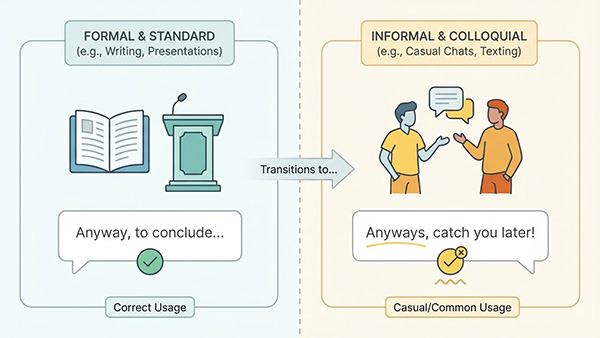
Many learners often ask questions like “is it anyway or anyways” or “anyway or anyways which is correct.” The general rule is that “anyway” is the standard, grammatically correct form in both formal and informal English. Questions such as “anyways vs anyway”, “is anyways a word”, “is anyways grammatically correct”, and “is anyways proper english” confirm that “anyways” is mostly used in informal speech or regional dialects. While it exists, it is discouraged in professional writing. Sticking with “anyway” ensures clarity and correctness in all formal communication.
Let’s start by defining each term to understand their distinct roles in the English language. Understanding the precise meaning and context is crucial for proper usage.
Anyway
Anyway is an adverb that serves multiple functions in a sentence. It is used to indicate a transition to a new topic, to dismiss a previous statement, to reintroduce a topic after a digression, or to soften the impact of a statement. It is generally considered the standard and grammatically correct form in both formal and informal contexts. Anyway is versatile and can be used in a wide range of situations.
Anyways
The anyways meaning is similar to “anyway,” often signaling a transition, dismissal, or return to a previous topic. Its tone, however, is casual and informal, making it suitable for conversational English but not for formal writing.
Anyways, while commonly heard in informal speech, is generally considered non-standard English. It is often used in the same contexts as “anyway,” but its usage is typically discouraged in formal writing and academic settings. Some dialects may accept “anyways” as a colloquialism, but it’s best to stick with “anyway” to ensure grammatical correctness in most situations. The addition of the ‘s’ is seen as redundant and unnecessary by most grammarians.
Structural Breakdown
Both “anyway” and “anyways” are derived from the word “way,” with the prefix “any-” indicating indefiniteness or generality. The addition of “-s” to form “anyways” is a common feature in some adverbs (e.g., “towards,” “backwards”). However, in the case of “anyway,” the “-s” is generally considered superfluous in standard English. The proper structure to use to ensure grammatical correctness is using “anyway” in all contexts.
The structure of “anyway” allows it to function as a conjunctive adverb, connecting ideas and providing a sense of flow in the discourse. It can appear at the beginning, middle, or end of a sentence, depending on the intended emphasis and context. Its flexibility and adaptability make it a valuable tool for effective communication.
Usage Rules of Anyway
Understanding the different ways “anyway” can be used will help you employ it effectively in your writing and speech. It is a versatile word that serves several distinct functions.
As a Transition Word
Anyway can be used to smoothly transition to a new topic or to steer the conversation in a different direction. It signals a shift in focus and indicates that the speaker or writer is moving on to something else. This usage helps maintain coherence and prevents abrupt changes in the flow of discussion.
Reintroducing a Topic
After a digression or a temporary departure from the main subject, anyway can be used to bring the conversation back to the original topic. It serves as a reminder of the initial focus and helps to re-establish the continuity of the discussion. This is particularly useful in conversations where tangents are common.
Dismissing a Previous Statement
Anyway can also be used to downplay or dismiss a previous statement, often implying that it is not important or relevant to the current discussion. This usage can convey a sense of moving past a point that is no longer considered significant. It can be a subtle way to change the subject or to indicate that a particular issue is resolved.
Softening a Statement
Anyway can be employed to soften the impact of a statement that might be perceived as harsh or direct. It can make the statement sound less assertive or more casual, reducing the potential for offense or misunderstanding. This is particularly useful in situations where tact and diplomacy are important.
Examples of Anyway in Use
The following examples illustrate the various ways “anyway” can be used in different contexts. These examples will help you understand the versatility and nuances of this word.
Anyway as a Transition Word Examples
This table provides examples of “anyway” used to transition to a new topic. Notice how it signals a shift in focus.
| Sentence | Explanation |
|---|---|
| We were talking about the weather, but anyway, let’s discuss the project deadlines. | Signals a shift from discussing the weather to discussing project deadlines. |
| I didn’t really enjoy the movie. Anyway, what did you think of the restaurant? | Transitions from a discussion of the movie to a discussion of the restaurant. |
| That meeting was a complete waste of time. Anyway, I wanted to ask you about your weekend plans. | Moves the conversation from a frustrating meeting to weekend plans. |
| I’m not sure about the details. Anyway, the main point is that we need to act quickly. | Shifts focus from specific details to the urgency of the situation. |
| She seemed a bit upset, but anyway, I need to finish this report. | Transitions from observing someone’s emotional state to a pressing task. |
| The traffic was terrible this morning. Anyway, did you hear about the new company policy? | Moves from a complaint about traffic to a discussion of company policy. |
| I couldn’t find my keys. Anyway, I managed to get here on time. | Transitions from a personal inconvenience to a successful outcome. |
| The presentation wasn’t as good as I hoped. Anyway, we still got positive feedback. | Shifts focus from the presentation’s quality to the positive feedback received. |
| He didn’t seem interested in my idea. Anyway, I’m going to proceed with it. | Moves from someone’s lack of interest to the speaker’s determination. |
| I’m not sure if that’s the right approach. Anyway, let’s try it and see what happens. | Transitions from uncertainty to a willingness to experiment. |
| That’s enough about my problems, anyway, how are you doing? | Shifts the focus of the conversation from the speaker’s problems to the listener’s well-being. |
| I don’t want to dwell on the past. Anyway, we need to focus on the future. | Transitions from a focus on the past to a focus on the future. |
| I’m not going to complain about it. Anyway, it’s time to move on. | Signals a shift from complaining to acceptance and moving forward. |
| Let’s not get sidetracked. Anyway, back to the topic at hand. | Transitions back to the main topic after a digression. |
| I had a hard time finding the place, but anyway, I’m here now. | Transitions from a past difficulty to the present situation. |
| We can argue about it later, anyway, the decision has been made. | Transitions from a potential argument to the finality of a decision. |
| I didn’t get the job, but anyway, I learned a lot from the interview. | Shifts focus from a negative outcome to a positive learning experience. |
| It was a long and tiring day, but anyway, I’m glad we accomplished so much. | Transitions from acknowledging fatigue to appreciating accomplishments. |
| I’m not sure about the answer, anyway, that’s not the right question. | Transitions from uncertainty about an answer, to the question being wrong. |
| It was a bit of a mess, anyway, it turned out ok. | Transitions from mess to acceptable outcome. |
Anyway Reintroducing a Topic Examples
The table below illustrates how “anyway” is used to bring the conversation back to the original topic after a digression.
| Sentence | Explanation |
|---|---|
| We got sidetracked talking about movies, but anyway, as I was saying about the budget… | Brings the conversation back to the original topic of the budget after a movie discussion. |
| Sorry, I went off on a tangent. Anyway, where were we with the marketing strategy? | Returns the conversation to the marketing strategy after a tangent. |
| That’s an interesting story, but anyway, let’s get back to the main point of the meeting. | Reintroduces the main point of the meeting after an interesting story. |
| We were discussing the new software. Anyway, to reiterate its benefits… | Returns the focus to the benefits of the new software after a digression. |
| I got distracted talking about my vacation. Anyway, back to the presentation… | Reintroduces the presentation after a discussion about a vacation. |
| That’s a funny anecdote, but anyway, what’s the next item on the agenda? | Brings the meeting back to the agenda after a funny anecdote. |
| Sorry for the interruption. Anyway, as I was explaining the process… | Returns the conversation to explaining the process after an interruption. |
| We spent too much time on that detail. Anyway, let’s focus on the overall plan. | Reintroduces the overall plan after dwelling on a specific detail. |
| I didn’t mean to interrupt, anyway, where were we in the discussion? | Returns the conversation to the point before the interruption. |
| That was interesting, anyway, we need to get on with finishing the project on time. | Reintroduces urgency to the project. |
| Sorry about the long story, anyway, what were you planning to do this weekend? | Return to the original question after telling a long story. |
| I got a little off-topic, anyway, did you finish reading the assigned chapter? | Brings the conversation back to the assigned reading. |
| I didn’t mean to change the subject, anyway, what did you think about the presentation? | Returns the focus to the speaker’s thoughts about the presentation. |
| I got a little distracted, anyway, what do we need to clarify? | Reintroduces a need for clarity. |
| Sorry, that was beside the point, anyway, what’s our next goal? | Returns to the topic of the next goal. |
| That was a different discussion, anyway, what do you think about this problem? | Reintroduces the problem they are discussing. |
| I didn’t mean to get off-topic, anyway, what is your opinion about this idea? | Returns their focus to the idea. |
| I didn’t mean to change the subject, anyway, do you think we should have the event? | Returns the focus to having the event, with the speaker asking for their opinion. |
| That was an interesting distraction, anyway, do you have any questions? | Returns the focus to the discussion, asking if there are any questions. |
| That was an interesting point, anyway, what is our next plan of action? | Returns to the discussion, asking about the next plan of action. |
Anyway Dismissing a Statement Examples
This table shows examples of “anyway” being used to dismiss or downplay a previous statement.
| Sentence | Explanation |
|---|---|
| I was worried about the presentation, but anyway, it went well in the end. | Dismisses the initial worry because the presentation was ultimately successful. |
| He was a bit rude, but anyway, it doesn’t matter now. | Downplays the rudeness, suggesting it’s no longer relevant. |
| I don’t think they liked the idea, but anyway, we’re going ahead with it. | Dismisses their potential disapproval as the decision has been made. |
| It was a difficult situation, but anyway, we managed to resolve it. | Downplays the difficulty because it was successfully resolved. |
| I was a little disappointed, but anyway, it’s not the end of the world. | Dismisses the disappointment as not being a significant issue. |
| The weather was terrible, but anyway, we still had a good time. | Downplays the bad weather as not ruining the overall experience. |
| I made a mistake, but anyway, I learned from it. | Dismisses the mistake by focusing on the positive learning outcome. |
| The project was delayed, but anyway, we delivered it successfully. | Downplays the delay as the project was ultimately delivered successfully. |
| I was nervous, but anyway, I got through it. | Dismisses the nervousness as overcome by successfully completing the task. |
| He wasn’t very helpful, but anyway, I figured it out myself. | Downplays his lack of helpfulness as the speaker found a solution independently. |
| It was a long shot, but anyway, it worked. | Downplays the unlikelihood of the success, since it worked. |
| That wasn’t the plan, but anyway, it’s all going according to plan. | Dismisses the broken plan, and focuses on the new plan. |
| Our initial plan was unsuccessful, but anyway, we are on the right track. | Dismisses the initial plan, since they are on the right track. |
| I had a bad day, but anyway, it can only get better. | Dismisses the bad day, and focuses on the future. |
| I lost the game, but anyway, I had fun. | Dismisses the loss, and focuses on having fun. |
| I forgot my textbook, but anyway, it won’t be necessary. | Dismisses the textbook being forgotten, since it won’t be necessary. |
| I don’t like the food, but anyway, I will still eat it. | Dismisses the speaker not liking the food, since they will still eat it. |
| I don’t agree with the decision, but anyway, I respect it. | Dismisses the speaker not agreeing with the decision, but they respect it anyway. |
| I thought it would be hard, but anyway, it was easy. | Dismisses the thought that it would be hard, since it was easy. |
| I thought I would fail, but anyway, I got an A. | Dismisses the thought that the speaker would fail, since they got an A. |
Anyway Softening a Statement Examples
The following table demonstrates how “anyway” can be used to soften a potentially harsh or direct statement.
| Sentence | Explanation |
|---|---|
| I don’t think that’s a good idea, anyway, just my opinion. | Softens the disagreement by adding “just my opinion.” |
| I’m not sure about that, anyway, we can discuss it later. | Softens the uncertainty by suggesting a future discussion. |
| That might not work, anyway, let’s explore other options. | Softens the criticism by proposing alternative solutions. |
| I’m not really interested, anyway, thanks for the offer. | Softens the rejection by expressing gratitude. |
| That’s not quite right, anyway, we’re all learning. | Softens the correction by acknowledging that learning is a process. |
| I’m not convinced, anyway, let’s hear other perspectives. | Softens the skepticism by inviting other opinions. |
| That’s not my favorite, anyway, I appreciate the thought. | Softens the dislike by expressing appreciation. |
| I’m not sure that’s feasible, anyway, we can look into it. | Softens the doubt by suggesting further investigation. |
| That’s not really my style, anyway, thanks for considering me. | Softens the disinterest by thanking the person for considering the speaker. |
| I don’t think that will work, anyway, but give it a shot. | Softens the expression that something won’t work by suggesting they try anyway. |
| I don’t think it’s that important, anyway, it’s just an opinion. | Softens the statement by saying it’s just an opinion. |
| I think it’s a bad idea, anyway, do what you want. | Softens the speakers bad opinion, by saying that the listener can do what they want. |
| I don’t think that’s correct, anyway, I don’t really know. | Softens the the statement of not being correct, by the speaker saying they don’t really know. |
| I don’t like it, anyway, you can like it if you want. | Softens the statement of not liking it, by saying the listener can like it if they want. |
| I hate the idea, anyway, it doesn’t matter. | Softens the hate of the idea, by saying that it doesn’t matter. |
| I am not excited, anyway, thanks for inviting me. | Softens the lack of excitement, by thanking the person for inviting them. |
| I am not sad, anyway, I need to focus on my work. | Softens the lack of sadness, by the speaker saying they need to focus on their work. |
| I am not mad, anyway, you are fine. | Softens the lack of being mad, by saying the listener is fine. |
| I don’t know the answer, anyway, I can look it up. | Softens the lack of knowing the answer, by saying they can look it up. |
| I don’t have the time, anyway, good luck. | Softens the lack of time, by wishing good luck. |
When is Anyways Acceptable?
If you are learning how to use anyways in a sentence, here are a few examples: “I didn’t enjoy the movie, anyways, it was worth watching,” or “He forgot the keys, anyways, we managed to get inside.” These sentences show casual spoken usage but are best avoided in formal writing.
While “anyway” is generally preferred in standard English, “anyways” is not considered grammatically correct in formal settings. However, “anyways” might be acceptable in very informal contexts, such as casual conversations among friends, or in certain regional dialects where it is commonly used. It is also somtimes used to add emphasis.
However, it’s crucial to be aware of your audience and the context to ensure that your language is appropriate. In most writing situations, stick with “anyway” to avoid any potential criticism or confusion.
Understanding the difference in anyway vs anyways grammar is essential. “Anyway” follows standard grammar rules and can appear at the start, middle, or end of a sentence. “Anyways”, on the other hand, is often treated as non-standard and may be flagged as incorrect in grammar checks or formal editing. Using “anyway” consistently avoids confusion and ensures proper sentence structure.
Common Mistakes
One of the most common mistakes is using “anyways” in formal writing or speech. This can make your communication appear less polished and professional. Another common mistake is using “anyway” incorrectly in a sentence, such as placing it in an awkward position that disrupts the flow of the sentence. Understanding the correct usage rules and practicing regularly can help you avoid these errors.
| Incorrect | Correct | Explanation |
|---|---|---|
| Anyways, I think we should go. | Anyway, I think we should go. | “Anyways” is non-standard; “anyway” is the correct form. |
| I’m not sure, anyways, let’s try it. | I’m not sure, but anyway, let’s try it. | Using “anyway” to transition to a suggestion. |
| Anyway, to be honest, I didn’t like it anyway. | To be honest, I didn’t like it anyway. | Redundant use of “anyway” at the beginning and end. |
| He said anyways, that he was coming. | He said anyway that he was coming. | Incorrect placement of anyway |
| I was thinking anyways, it doesn’t matter. | I was thinking, but anyway, it doesn’t matter. | Correct use of anyway to dismiss the previous thought. |
Practice Exercises
These exercises will help you reinforce your understanding of “anyway” and “anyways.” Practice is essential for mastering any grammar concept.
Exercise 1: Fill in the Blanks
Fill in the blanks with the appropriate word: “anyway” or “anyways.”
| Question | Answer |
|---|---|
| 1. ________, I wanted to ask you about your vacation. | Anyway |
| 2. ________, I don’t think it’s a good idea. | Anyway |
| 3. ________, let’s get back to the main topic. | Anyway |
| 4. ________, thanks for the offer, but I’m busy. | Anyway |
| 5. ________, I managed to finish the project on time. | Anyway |
| 6. ________, what did you think of the movie? | Anyway |
| 7. ________, it doesn’t really matter now. | Anyway |
| 8. ________, I’m going to proceed with my plan. | Anyway |
| 9. ________, let’s try it and see what happens. | Anyway |
| 10. ________, thanks for considering my suggestion. | Anyway |
Exercise 2: Correct the Sentences
Correct the following sentences if they contain an error in the use of “anyway” or “anyways.” If the sentence is correct, write “Correct.”
| Question | Answer |
|---|---|
| 1. Anyways, I decided to go to the party. | Anyway, I decided to go to the party. |
| 2. I didn’t like the food, anyways. | I didn’t like the food, anyway. |
| 3. Anyway, I think we should leave now. | Correct |
| 4. Anyways, let’s get started with the meeting. | Anyway, let’s get started with the meeting. |
| 5. He said anyways that he would be late. | He said anyway that he would be late. |
| 6. Anyway, thanks for your help. | Correct |
| 7. The weather was bad, anyways, we had fun. | The weather was bad, but anyway, we had fun. |
| 8. Anyways, I don’t care what they think. | Anyway, I don’t care what they think. |
| 9. Anyway, I’m glad it’s over. | Correct |
| 10. I was nervous, but anyways, I did it. | I was nervous, but anyway, I did it. |
Advanced Topics
For advanced learners, it’s worth noting the stylistic nuances of using “anyway.” While grammatically correct, overuse of “anyway” can make your writing or speech sound repetitive or unfocused. Consider using synonyms or alternative phrasing to add variety and clarity to your communication. For example, you could use “regardless,” “nevertheless,” “in any case,” or “at any rate” to convey similar meanings.
Additionally, understanding the subtle emotional undertones that “anyway” can convey is crucial for effective communication. It can sometimes imply a sense of resignation, dismissal, or reluctance. Be mindful of these connotations and choose your words carefully to avoid unintended meanings.
FAQ
Here are some frequently asked questions about the use of “anyway” and “anyways.” These questions address common points of confusion and provide clear, concise answers.
Is “anyways” ever correct?
While “anyways” is commonly heard in informal speech, it is generally considered non-standard English. It may be acceptable in very casual conversations or in certain regional dialects, but it is best to avoid it in formal writing and professional settings. Stick with “anyway” to ensure grammatical correctness.
What is the difference between “anyway” and “in any case”?
“Anyway” and “in any case” are often used interchangeably, but “in any case” tends to be more formal and emphatic. “In any case” often signals a conclusion or a summary of previous points, while “anyway” can be used more broadly to transition, dismiss, or soften a statement.
Can “anyway” be used at the end of a sentence?
Yes, “anyway” can be used at the end of a sentence, often to add a casual or dismissive tone. For example, “I didn’t want to go anyway.” In this context, it reinforces the speaker’s lack of interest or regret.
How can I avoid overusing “anyway” in my writing?
To avoid overuse, try to identify the specific function of “anyway” in each sentence and consider alternative phrasing. Use synonyms such as “regardless,” “nevertheless,” “in any case,” “still,” or “despite that.” Varying your vocabulary will make your writing more engaging and clear.
Is it okay to use “anyway” in academic writing?
While “anyway” is grammatically correct, it is generally best to avoid it in formal academic writing. Academic writing typically requires a more formal and precise tone. Consider using more formal transition words or phrases to maintain a professional and scholarly voice.
What is the origin of the word “anyway”?
“Anyway” is derived from the Middle English “any wey,” meaning “in any direction” or “in any manner.” Over time, its meaning evolved to encompass its current usage as a transition word, a dismissive term, and a softener.
Can “anyway” change the meaning of a sentence?
Yes, “anyway” can significantly alter the meaning of a sentence depending on its context. It can indicate a change of topic, a dismissal of a previous point, or a softening of a statement. Understanding its nuances is crucial for accurate interpretation.
Is “anyway” considered informal language?
While “anyway” is acceptable in both formal and informal settings, it is generally considered to be more casual than some of its synonyms. In highly formal contexts, it may be preferable to use alternatives like “nevertheless” or “in any case” to maintain a more professional tone.
Conclusion
Mastering the correct usage of “anyway” is a subtle but important aspect of English grammar. While “anyways” is generally considered non-standard, “anyway” is a versatile adverb that can be used to transition, dismiss, reintroduce, or soften statements. By understanding the rules and practicing with examples, you can confidently use “anyway” in your writing and speech. Remember to be mindful of your audience and the context to ensure that your language is appropriate and effective. With consistent practice, you’ll be able to wield “anyway” with precision and finesse.