
The English language, with its nuances and subtleties, can sometimes be a minefield of confusion, even for native speakers. One common point of uncertainty revolves around the terms “anytime” and “any time.” While they might seem interchangeable at first glance, understanding their distinct meanings and correct usage is crucial for clear and effective communication.
This article aims to demystify these terms, providing a comprehensive guide to their definitions, structural differences, and practical applications. Whether you’re an English language learner, a seasoned writer, or simply someone looking to refine their grammar skills, this guide will equip you with the knowledge and confidence to use “anytime” and “any time” correctly in any context.
By mastering the subtle differences between “anytime” and “any time,” you’ll not only enhance the clarity of your writing but also demonstrate a greater command of the English language. This understanding is particularly important in professional settings, academic writing, and any situation where precise communication is paramount. Let’s embark on a journey to unravel the intricacies of these two terms and unlock the secrets to their proper usage.
Table of Contents
- Definition: Anytime vs. Any Time
- Structural Breakdown
- Usage of ‘Anytime’
- Usage of ‘Any Time’
- Examples of ‘Anytime’ in Sentences
- Examples of ‘Any Time’ in Sentences
- Usage Rules: Anytime vs. Any Time
- Common Mistakes
- Practice Exercises
- Advanced Topics
- Frequently Asked Questions (FAQ)
- Conclusion
Definition: Anytime vs. Any Time
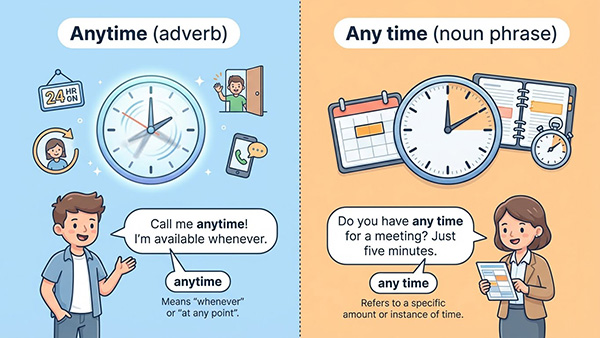
When comparing anytime vs any time, many writers wonder is it any time or anytime. The key difference between anytime and any time is that anytime is an adverb used to indicate a flexible moment, while any time refers to a specific amount or period of time. Keeping this distinction in mind ensures precise and clear writing, whether in casual or formal contexts.
Understanding the fundamental difference between “anytime” and “any time” is the first step towards mastering their correct usage. Let’s break down the definitions of each term:
The anytime meaning is simple: it denotes “at any time” or “whenever.” Many learners ask, is anytime one word or anytime one word or two? Remember, in all contexts where it functions as an adverb, anytime should always be written as a single word. Using it as two words is grammatically incorrect unless you actually mean any time as a noun phrase.
Anytime: “Anytime” is an adverb that means “at any time” or “whenever.” It functions as a single word and is used to indicate that something can occur at any unspecified point in time. It often implies flexibility or lack of a specific schedule.
Any Time: “Any time” is a two-word phrase consisting of the adjective “any” and the noun “time.” It refers to an unspecified amount of time or a point in time that is not fixed. The phrase emphasizes the duration or availability of time.
In essence, “anytime” is an adverb of time, while “any time” is an adjective-noun combination referring to an unspecified duration or instance of time.
Structural Breakdown
The structural differences between “anytime” and “any time” are key to understanding their proper usage. Let’s examine each term in more detail:
Anytime: A Single-Word Adverb
“Anytime” functions as an adverb, modifying a verb, adjective, or another adverb. As a single word, it acts as a unit within the sentence, indicating when an action can occur. It does not require any additional words to complete its meaning in most contexts.
Any Time: An Adjective-Noun Phrase
“Any time,” on the other hand, is a phrase composed of the adjective “any” and the noun “time.” The adjective “any” modifies the noun “time,” indicating an unspecified or non-specific duration or instance. This phrase often requires additional context or words to clarify its meaning within a sentence.
Consider the following examples to illustrate the structural differences:
Anytime: “You can call me anytime.” (Here, “anytime” modifies the verb “call.”)
Any Time: “Do you have any time to help me?” (Here, “any” modifies “time,” and the phrase functions as the object of the verb “have.”)
Usage of ‘Anytime’
The adverb “anytime” is typically used in situations where you want to express that something can happen at any unspecified moment. It conveys a sense of openness and flexibility regarding timing. Here are some common scenarios where “anytime” is appropriate:
- Invitations or Offers: When inviting someone to do something without specifying a particular time.
- Availability: Indicating that you are available or accessible at any moment.
- Flexibility: Expressing that there are no time constraints or limitations.
Usage of ‘Any Time’
The phrase “any time” is used when you are referring to an unspecified amount of time or a point in time that is not fixed. It often involves questions about availability or the duration of an activity. Here are some typical contexts for using “any time”:
- Asking About Availability: Inquiring whether someone has time available.
- Referring to a Duration: Describing an unspecified period of time.
- Expressing Uncertainty: Indicating that the exact timing is unknown or irrelevant.
Examples of ‘Anytime’ in Sentences
To further clarify the usage of “anytime,” let’s examine a variety of examples in different contexts. The following table presents a collection of sentences using “anytime” correctly, illustrating its versatility as an adverb of time.
The table below provides examples of using the word “anytime” in different contexts. Notice how it typically functions as an adverb, modifying a verb or expressing general availability.
| Category | Example Sentence |
|---|---|
| Invitations | Feel free to visit us anytime you’re in town. |
| Availability | You can reach me anytime if you need assistance. |
| Offers | Call anytime you have questions about the project. |
| Flexibility | We’re open anytime during the week. |
| General | Anytime is a good time for ice cream. |
| Requests | Stop by anytime you are free. |
| Greetings | Anytime! I’m always here to help. |
| Invitations | Come over anytime for a chat. |
| Availability | I’m available anytime to discuss this further. |
| Offers | Ask for help anytime you get stuck. |
| Flexibility | The gym is open anytime from 6 AM to 10 PM. |
| General | Anytime is a good time to learn something new. |
| Requests | Let me know anytime you change your mind. |
| Greetings | Anytime, glad I could assist you. |
| Invitations | Drop me a line anytime. |
| Availability | Our support team is available anytime. |
| Offers | Feel free to reach out anytime. |
| Flexibility | You can start the course anytime. |
| General | Anytime is a good time to relax. |
| Requests | Contact me anytime you need anything. |
| Greetings | Anytime! I’m happy to help. |
| Invitations | Visit our website anytime. |
| Availability | The library is open anytime during opening hours. |
Examples of ‘Any Time’ in Sentences
Now, let’s explore the usage of “any time” with a series of examples. Remember that “any time” functions as an adjective-noun phrase, referring to an unspecified duration or instance of time.
The table below provides examples of using the phrase “any time” in different contexts. Notice how it is used to refer to an unspecified amount of time or a non-specific point in time.
| Category | Example Sentence |
|---|---|
| Availability | Do you have any time to talk about the proposal? |
| Duration | It will take any time between one and two hours to complete the task. |
| Uncertainty | I don’t have any time to waste on unproductive meetings. |
| Requests | Is there any time that works best for you? |
| General | He didn’t spend any time preparing for the presentation. |
| Availability | Is there any time this week that you are free? |
| Duration | It won’t take any time at all to fix. |
| Uncertainty | I don’t have any time for games. |
| Requests | Do you need any time to think about it? |
| General | She didn’t waste any time getting started. |
| Availability | Do you have any time to spare? |
| Duration | It won’t take any time to learn the basics. |
| Uncertainty | I don’t have any time to argue. |
| Requests | Can you give me any time to review the document? |
| General | We didn’t spend any time on that topic. |
| Availability | Is there any time that suits your schedule? |
| Duration | It will be completed in almost any time. |
| Uncertainty | I don’t have any time to deal with that. |
| Requests | Will you require any time off. |
| General | There is no any time left to prepare for it. |
Usage Rules: Anytime vs. Any Time
To ensure correct usage, it’s essential to follow specific guidelines for “anytime” and “any time.” Here’s a breakdown of the key rules:
- Use “anytime” as a single word when you mean “at any time” or “whenever.” It functions as an adverb and does not require additional words to complete its meaning.
- Use “any time” as two words when you are referring to an unspecified amount of time or a non-specific point in time. The phrase consists of the adjective “any” modifying the noun “time.”
- Pay attention to the context of the sentence. Determine whether you are expressing general availability or referring to a specific duration or instance of time.
Here’s a table summarizing the key differences and usage rules:
| Term | Part of Speech | Meaning | Usage | Example |
|---|---|---|---|---|
| Anytime | Adverb | At any time; whenever | Expressing general availability or lack of time constraints | You can call me anytime. |
| Any Time | Adjective-Noun | An unspecified amount of time | Referring to a duration or instance of time that is not fixed | Do you have any time to help me? |
Common Mistakes
One of the most common mistakes is using “anytime” when “any time” is required, and vice versa. Let’s address some frequent errors and provide corrected examples:
Mistake 1: Using “anytime” when referring to a duration of time.
Incorrect: “Do you have anytime to spare?”
Correct: “Do you have any time to spare?”
Mistake 2: Using “any time” when expressing general availability.
Incorrect: “Feel free to contact me any time.”
Correct: “Feel free to contact me anytime.”
Mistake 3: Confusing the two in questions about scheduling.
Incorrect: “Is anytime good for you to meet?”
Correct: “Is there any time good for you to meet?”
The table below illustrates common mistakes and the corrected versions:
| Incorrect Sentence | Correct Sentence | Explanation |
|---|---|---|
| I don’t have anytime to waste. | I don’t have any time to waste. | “Any time” is needed to refer to an unspecified amount of time. |
| Visit us any time you’re in the area. | Visit us anytime you’re in the area. | “Anytime” is used to mean “at any time.” |
| Do you need anytime to think about it? | Do you need any time to think about it? | “Any time” is required to ask about needing a duration of time. |
| Call me any time you need help. | Call me anytime you need help. | “Anytime” is used to express that you can call at any moment. |
| It won’t take anytime at all. | It won’t take any time at all. | “Any time” is needed to refer to the duration of the task. |
Practice Exercises
To solidify your understanding of “anytime” and “any time,” complete the following practice exercises. Choose the correct word or phrase to fill in the blank in each sentence.
Exercise 1: Choose the correct word:
| Question | Options | Answer |
|---|---|---|
| 1. You can come over ________ you like. | a) anytime b) any time | a) anytime |
| 2. Do you have ________ to help me with this project? | a) anytime b) any time | b) any time |
| 3. Feel free to call ________. | a) anytime b) any time | a) anytime |
| 4. I don’t have ________ to argue with you. | a) anytime b) any time | b) any time |
| 5. The store is open ________ during the week. | a) anytime b) any time | a) anytime |
| 6. Is there ________ that works for you to meet? | a) anytime b) any time | b) any time |
| 7. Please contact me ________ if you have any questions. | a) anytime b) any time | a) anytime |
| 8. We don’t have ________ to waste on this issue. | a) anytime b) any time | b) any time |
| 9. You can submit your assignment ________ before the deadline. | a) anytime b) any time | a) anytime |
| 10. Do you need ________ to review the proposal? | a) anytime b) any time | b) any time |
Exercise 2: Rewrite the sentences using the correct form:
| Question | Answer |
|---|---|
| 1. Is any time a good moment to call? | Is anytime a good moment to call? |
| 2. I can do you this favor anytime. | I can do you this favor any time. |
| 3. You may visit the museum any time you wish. | You may visit the museum anytime you wish. |
| 4. I don’t want anytime off. | I don’t want any time off. |
| 5. I am ready anytime. | I am ready at any time. |
| 6. I will be available any time. | I will be available anytime. |
| 7. Is there anytime you can come in? | Is there any time you can come in? |
| 8. Please call me any time. | Please call me anytime. |
| 9. I am free any time. | I am free anytime. |
| 10. There isn’t anytime left. | There isn’t any time left. |
Advanced Topics
A common point of confusion involves phrases like anytime soon or any time soon. Use any time soon when referring to a specific anticipated event or duration that is not immediate. For example, “I don’t expect the results any time soon.” Using anytime soon in casual speech may be heard, but it is technically incorrect, since anytime as an adverb does not pair with “soon” in standard grammar. Always choose the two-word form when indicating a future point that is not fixed.
For advanced learners, it’s helpful to understand more nuanced aspects of “anytime” and “any time.” These include idiomatic expressions and subtle contextual variations.
- Idiomatic Expressions: Be aware of idiomatic expressions that use “any time,” such as “not any time soon,” which means “not in the near future.”
- Contextual Variations: In some cases, the choice between “anytime” and “any time” can depend on the formality of the context. “Anytime” is generally considered more informal.
According to style guides like the Canadian Press, the distinction between anytime versus any time canadian press is strictly maintained. The adverb anytime should only be used for general availability or flexibility, while any time refers to a measurable or unspecified duration. Writers following Canadian editorial standards must avoid using anytime when the context clearly demands a noun phrase. This guideline helps maintain consistency in professional and journalistic writing across Canada.
Further exploration into these advanced topics can provide a deeper understanding of the English language and enhance your ability to communicate effectively in a variety of situations.
Frequently Asked Questions (FAQ)
Here are some frequently asked questions about “anytime” and “any time,” along with detailed answers to address common points of confusion:
Q: Is “anytime” ever correct as two words?
A: No, “anytime” is always written as one word when used as an adverb meaning “at any time” or “whenever.” If you find yourself writing it as two words, it’s likely that you need to re-evaluate the sentence and use “any time” instead.
Q: Can I use “anytime” at the beginning of a sentence?
A: While grammatically possible, it’s not common to start a sentence with “anytime.” It’s more natural to use it within the sentence to modify a verb or express general availability. For example, instead of “Anytime is a good time to start,” you might say, “It’s a good time to start anytime.”
Q: How can I easily remember the difference between “anytime” and “any time”?
A: A helpful trick is to think of “anytime” as a single concept – “at any time.” If you can replace it with “whenever” and the sentence still makes sense, then “anytime” is the correct choice. If you’re referring to a duration or instance of time, “any time” is more appropriate.
Q: Is “anytime” considered informal?
A: While “anytime” is generally acceptable in most contexts, it can be perceived as slightly more informal than phrases like “at any time.” In formal writing, you might prefer to use the longer phrase for a more professional tone.
Q: What’s the difference between “anytime” and “at any time”?
A: “Anytime” is a single-word adverb that means “at any time.” The phrase “at any time” is more formal and explicit. In many cases, they are interchangeable, but “at any time” might be preferred in formal writing.
Q: Can you give me an example where both “anytime” and “any time” could be used, but with different meanings?
A: Consider the sentence: “You can come visit.” If you add “anytime,” it becomes “You can come visit anytime,” meaning you are welcome to visit at any time. If you add “any time,” it becomes “You can come visit if you have any time,” meaning you are welcome to visit if you have some time available.
Q: How does context influence the choice between “anytime” and “any time”?
A: Context is crucial. If you’re offering general availability or flexibility, “anytime” is likely correct. If you’re asking about someone’s schedule or referring to a specific duration, “any time” is more appropriate. Consider the overall meaning you want to convey.
Q: Are there any regional differences in the usage of “anytime” and “any time”?
A: While the basic rules apply universally, there might be slight regional preferences or variations in colloquial usage. However, adhering to the standard grammatical rules will ensure clear communication regardless of region.
Conclusion
Mastering the correct usage of “anytime” and “any time” is a valuable skill for anyone seeking to improve their English proficiency. By understanding their definitions, structural differences, and the contexts in which they are used, you can avoid common mistakes and communicate more effectively. Remember that “anytime” functions as an adverb, meaning “at any time,” while “any time” is a phrase referring to an unspecified amount of time. Pay attention to the context of your sentences and apply the usage rules to ensure accuracy.
With practice and attention to detail, you’ll become more confident in your ability to choose the correct form. Review the examples and practice exercises provided in this guide. By consistently applying these principles, you’ll refine your grammar skills and elevate the clarity of your writing. Continue to explore the nuances of the English language, and you’ll find yourself communicating with greater precision and confidence. Keep practicing, and soon you’ll be using “anytime” and “any time” with ease and accuracy!