
Understanding the difference between “analyze” and “analyse” is crucial for effective communication in English. While both words share the same core meaning – to examine something methodically and in detail – their usage varies based on regional preferences.
This article provides a comprehensive guide to using “analyze” and “analyse” correctly, exploring their definitions, structural differences, usage rules, and common mistakes. Whether you’re a student, a professional writer, or simply someone looking to improve your English, this guide will equip you with the knowledge and practice needed to confidently use these words.
This article is designed to benefit learners of all levels, from beginners to advanced speakers. By understanding the nuances of these words, you can enhance your writing and speaking skills.
This comprehensive guide provides clear explanations, numerous examples, and practical exercises to ensure a thorough understanding of the topic. Let’s dive in and master the art of analyzing!
Table of Contents
- Definition of Analyze and Analyse
- Structural Breakdown
- Types of Analysis
- Examples of Analyze and Analyse
- Usage Rules
- Common Mistakes
- Practice Exercises
- Advanced Topics
- FAQ
- Conclusion
Definition of Analyze and Analyse
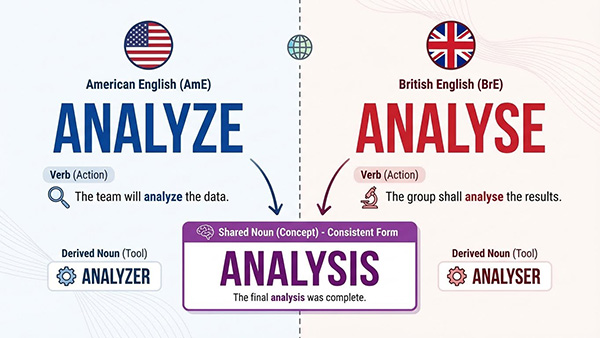
The words “analyze” and “analyse” are variants of the same verb, meaning to examine something carefully and methodically to understand its nature or structure. Both words derive from the Greek word analyein, which means “to break up” or “to dissolve.”
Analyze: This is the spelling predominantly used in American English. It is the standard form in the United States and is widely accepted in other English-speaking countries as well. The Oxford English Dictionary lists “analyze” as the preferred spelling.
Analyse: This is the spelling commonly used in British English, as well as in other Commonwealth countries such as Canada, Australia, and New Zealand. It maintains the “-se” ending, which is characteristic of many verbs derived from Greek.
In essence, both words have the same meaning and function identically as verbs. The only difference lies in their spelling, which is dictated by regional preferences.
Structural Breakdown
Both “analyze” and “analyse” function as transitive verbs, meaning they require a direct object to complete their meaning. The basic structure is:
Subject + Verb (analyze/analyse) + Object
For example:
- The scientist analyzed the data.
- The researcher analysed the results.
The verb can be conjugated into different tenses, such as:
- Present tense: analyze/analyse
- Past tense: analyzed/analysed
- Future tense: will analyze/will analyse
- Present participle: analyzing/analysing
- Past participle: analyzed/analysed
The structural components remain consistent regardless of the spelling variation.
Many learners often wonder “analyze or analyse which is correct.” The answer is straightforward: both spellings are correct, but their usage depends on the variety of English you are following.
In American English, “analyze” is standard, while British English uses “analyse.” Paying attention to “analyse spelling” throughout your writing ensures consistency and professionalism. For longer documents or academic papers, it is helpful to decide early whether you will “to analyse or to analyze” and then stick with that choice to avoid mixing forms.
Types of Analysis
Analysis can be broadly categorized into various types depending on the field and purpose. Here are some common types:
1. Data Analysis
Data analysis involves examining raw data to draw conclusions about the information. This is widely used in fields like statistics, economics, and market research.
2. Literary Analysis
Literary analysis involves examining a piece of literature, such as a novel or poem, to understand its themes, symbols, and meaning.
3. Chemical Analysis
Chemical analysis involves identifying and quantifying the components of a substance, often used in chemistry and related fields.
4. Financial Analysis
Financial analysis involves evaluating financial statements and other data to assess the performance and stability of a company or investment.
5. SWOT Analysis
SWOT (Strengths, Weaknesses, Opportunities, Threats) analysis is a strategic planning tool used to evaluate the internal and external factors affecting a project or business venture.
6. Root Cause Analysis
Root cause analysis is a method of problem-solving used to identify the underlying causes of a problem or event.
7. Content Analysis
Content analysis is a research technique used to make replicable and valid inferences by interpreting and coding textual material.
Understanding the difference between “to analyze or study” can clarify your writing. “To analyze” refers to examining something carefully to identify patterns, causes, or relationships, often using critical thinking or data. In comparison, “to study” generally involves observing, learning, or reviewing a subject without necessarily breaking it down in detail.
For example, a scientist analyzes experimental results to draw conclusions, whereas a student might study a textbook to understand key concepts. Choosing between “to analyze or study” depends on the level of scrutiny required, ensuring your writing communicates the intended depth of examination accurately.
Examples of Analyze and Analyse
The following tables provide examples of “analyze” and “analyse” used in various contexts. Note the spelling differences based on regional preferences.
Table 1: General Examples
This table showcases the use of ‘analyze’ and ‘analyse’ in everyday sentences, highlighting their interchangeable nature depending on the English dialect used.
| Sentence (American English) | Sentence (British English) |
|---|---|
| The scientist will analyze the samples. | The scientist will analyse the samples. |
| We need to analyze the situation carefully. | We need to analyse the situation carefully. |
| The software helps to analyze data quickly. | The software helps to analyse data quickly. |
| She wants to analyze her dreams. | She wants to analyse her dreams. |
| The detective tried to analyze the clues. | The detective tried to analyse the clues. |
| The economist will analyze the market trends. | The economist will analyse the market trends. |
| The students were asked to analyze the poem. | The students were asked to analyse the poem. |
| The doctor needs to analyze the test results. | The doctor needs to analyse the test results. |
| The manager decided to analyze the sales figures. | The manager decided to analyse the sales figures. |
| The committee will analyze the proposal. | The committee will analyse the proposal. |
| I need to analyze my spending habits. | I need to analyse my spending habits. |
| They will analyze the impact of the new policy. | They will analyse the impact of the new policy. |
| Let’s analyze the problem from a different angle. | Let’s analyse the problem from a different angle. |
| The team will analyze the competitor’s strategy. | The team will analyse the competitor’s strategy. |
| We have to analyze the risks involved. | We have to analyse the risks involved. |
| The program is designed to analyze complex systems. | The program is designed to analyse complex systems. |
| She is going to analyze the survey responses. | She is going to analyse the survey responses. |
| The analysts will analyze the current situation. | The analysts will analyse the current situation. |
| He wants to analyze the historical data. | He wants to analyse the historical data. |
| The purpose is to analyze the effectiveness of the treatment. | The purpose is to analyse the effectiveness of the treatment. |
Table 2: Examples in Academic Contexts
This table presents examples of how ‘analyze’ and ‘analyse’ are used within academic settings, such as research papers, essays, and scholarly articles.
| Sentence (American English) | Sentence (British English) |
|---|---|
| The paper aims to analyze the effects of globalization. | The paper aims to analyse the effects of globalisation. |
| Researchers analyzed the data collected from the experiment. | Researchers analysed the data collected from the experiment. |
| Students must analyze the text for its underlying themes. | Students must analyse the text for its underlying themes. |
| The study will analyze the impact of social media on society. | The study will analyse the impact of social media on society. |
| The professor asked us to analyze the historical context. | The professor asked us to analyse the historical context. |
| The thesis will analyze the economic policies of the government. | The thesis will analyse the economic policies of the government. |
| The article analyzes the causes of the financial crisis. | The article analyses the causes of the financial crisis. |
| We need to analyze the statistical significance of the results. | We need to analyse the statistical significance of the results. |
| The research will analyze the relationship between education and income. | The research will analyse the relationship between education and income. |
| The dissertation analyzed the philosophical implications of the theory. | The dissertation analysed the philosophical implications of the theory. |
| The team is working to analyze the genetic code. | The team is working to analyse the genetic code. |
| The experiment was designed to analyze the chemical reactions. | The experiment was designed to analyse the chemical reactions. |
| The scientists analyzed the samples under a microscope. | The scientists analysed the samples under a microscope. |
| The study will analyze the behavior of the participants. | The study will analyse the behavior of the participants. |
| The report aims to analyze the current market conditions. | The report aims to analyse the current market conditions. |
| The students were required to analyze the data sets. | The students were required to analyse the data sets. |
| The methodology involved analyzing large amounts of information. | The methodology involved analysing large amounts of information. |
| The findings will be analyzed in the next chapter. | The findings will be analysed in the next chapter. |
| The purpose of the research is to analyze the long-term effects. | The purpose of the research is to analyse the long-term effects. |
| The researchers will analyze the patterns in the data. | The researchers will analyse the patterns in the data. |
Table 3: Examples in Business and Professional Contexts
This table illustrates the use of ‘analyze’ and ‘analyse’ in business settings, reports, and professional communications, maintaining relevance across dialects.
| Sentence (American English) | Sentence (British English) |
|---|---|
| The consultant will analyze the company’s performance. | The consultant will analyse the company’s performance. |
| We need to analyze the market trends before launching the product. | We need to analyse the market trends before launching the product. |
| The manager asked the team to analyze the sales data. | The manager asked the team to analyse the sales data. |
| The report will analyze the risks and benefits of the project. | The report will analyse the risks and benefits of the project. |
| The analysts are working to analyze the financial statements. | The analysts are working to analyse the financial statements. |
| The company needs to analyze its customer feedback. | The company needs to analyse its customer feedback. |
| The software helps us to analyze the data more efficiently. | The software helps us to analyse the data more efficiently. |
| The marketing team will analyze the effectiveness of the campaign. | The marketing team will analyse the effectiveness of the campaign. |
| The HR department is analyzing employee satisfaction levels. | The HR department is analysing employee satisfaction levels. |
| The board of directors will analyze the strategic plan. | The board of directors will analyse the strategic plan. |
| We must analyze the competition’s moves carefully. | We must analyse the competition’s moves carefully. |
| The executive will analyze the quarterly reports. | The executive will analyse the quarterly reports. |
| They are going to analyze the impact of the new regulations. | They are going to analyse the impact of the new regulations. |
| The goal is to analyze the potential for growth. | The goal is to analyse the potential for growth. |
| We plan to analyze the feasibility of the project. | We plan to analyse the feasibility of the project. |
| The system is designed to analyze complex data sets. | The system is designed to analyse complex data sets. |
| The team will analyze the results of the survey. | The team will analyse the results of the survey. |
| Our task is to analyze the current economic climate. | Our task is to analyse the current economic climate. |
| The committee will analyze the proposed changes. | The committee will analyse the proposed changes. |
| She will analyze the trends in consumer behavior. | She will analyse the trends in consumer behavior. |
Table 4: Examples in Scientific Research
In this table, the focus is on the scientific application of ‘analyze’ and ‘analyse’, particularly within research and experimentation contexts, showcasing their usage in data interpretation and hypothesis testing.
| Sentence (American English) | Sentence (British English) |
|---|---|
| The scientists analyzed the chemical composition of the sample. | The scientists analysed the chemical composition of the sample. |
| Researchers use advanced techniques to analyze DNA sequences. | Researchers use advanced techniques to analyse DNA sequences. |
| The study will analyze the effects of pollution on the environment. | The study will analyse the effects of pollution on the environment. |
| The team is working to analyze the data from the climate models. | The team is working to analyse the data from the climate models. |
| The experiment was designed to analyze the behavior of particles. | The experiment was designed to analyse the behavior of particles. |
| They need to analyze the impact of different variables. | They need to analyse the impact of different variables. |
| We plan to analyze the physiological responses of the subjects. | We plan to analyse the physiological responses of the subjects. |
| The task is to analyze the seismic activity in the region. | The task is to analyse the seismic activity in the region. |
| The goal is to analyze the genetic markers of the disease. | The goal is to analyse the genetic markers of the disease. |
| She will analyze the spectral data from the telescope. | She will analyse the spectral data from the telescope. |
| The analysts will analyze the data gathered during the storm. | The analysts will analyse the data gathered during the storm. |
| He wants to analyze the molecular structure of the compound. | He wants to analyse the molecular structure of the compound. |
| The purpose is to analyze the effectiveness of the vaccine. | The purpose is to analyse the effectiveness of the vaccine. |
| The researchers will analyze the distribution of plant species. | The researchers will analyse the distribution of plant species. |
| I need to analyze the results from the latest clinical trials. | I need to analyse the results from the latest clinical trials. |
| Let’s analyze the effects of radiation on different materials. | Let’s analyse the effects of radiation on different materials. |
| The program is designed to analyze complex biological systems. | The program is designed to analyse complex biological systems. |
| She is going to analyze the soil samples for contaminants. | She is going to analyse the soil samples for contaminants. |
| The committee will analyze the research methodology. | The committee will analyse the research methodology. |
| The new tool helps to analyze data more accurately. | The new tool helps to analyse data more accurately. |
Usage Rules
The primary rule to remember is to use “analyze” in American English and “analyse” in British English. Consistency is key within a document or piece of writing.
1. Consistency
Maintain consistency throughout your writing. If you start with “analyze,” stick with it for the entire document if you are writing for an American audience. Similarly, use “analyse” consistently if you are writing for a British audience.
2. Audience Awareness
Consider your target audience. If you are writing for an international audience, it may be best to use the spelling preferred by the majority of your readers or to choose one spelling and clearly indicate your choice at the beginning of the document.
3. Context Matters
In certain formal or academic contexts, it’s crucial to adhere to the style guide specified by the institution or publication. These guides often dictate specific spelling preferences.
4. Related Words
Be aware of the spelling of related words. For example, the noun form “analysis” is spelled the same in both American and British English. However, the adjective form follows the same pattern as the verb: “analyzable” (American) and “analysable” (British).
5. Software Settings
Utilize the spelling and grammar check features in your word processing software. Set the language settings appropriately to ensure that the software flags any inconsistencies in spelling.
Common Mistakes
Here are some common mistakes to avoid when using “analyze” and “analyse”:
1. Mixing Spellings
Incorrect: The scientist will analyze the data, and then analyse the results.
Correct: The scientist will analyze the data, and then analyze the results. (American English)
Correct: The scientist will analyse the data, and then analyse the results. (British English)
2. Using the Wrong Spelling for the Audience
Incorrect (for American audience): We need to analyse the situation carefully.
Correct (for American audience): We need to analyze the situation carefully.
Incorrect (for British audience): The software helps to analyze data quickly.
Correct (for British audience): The software helps to analyse data quickly.
3. Misspelling Related Words
Incorrect: The analysation was thorough.
Correct: The analysis was thorough.
4. Ignoring Software Suggestions
Pay attention to the spelling and grammar check in your word processor. Ignoring these suggestions can lead to inconsistencies and errors.
5. Overlooking Consistency
Failing to maintain consistent spelling throughout a document can make your writing appear unprofessional and careless.
Practice Exercises
Test your understanding of “analyze” and “analyse” with the following exercises. Choose the correct spelling based on the context provided.
Exercise 1: Fill in the Blanks (Choose analyze or analyse)
Fill in the blanks with the correct form of the verb, either “analyze” or “analyse,” depending on whether the sentence is meant for an American or British audience.
| Question | Answer |
|---|---|
| 1. The report will _______ the impact of the new policy. (American English) | analyze |
| 2. We need to _______ the situation carefully. (British English) | analyse |
| 3. The software helps to _______ data quickly. (American English) | analyze |
| 4. She wants to _______ her dreams. (British English) | analyse |
| 5. The detective tried to _______ the clues. (American English) | analyze |
| 6. The economist will _______ the market trends. (British English) | analyse |
| 7. The students were asked to _______ the poem. (American English) | analyze |
| 8. The doctor needs to _______ the test results. (British English) | analyse |
| 9. The manager decided to _______ the sales figures. (American English) | analyze |
| 10. The committee will _______ the proposal. (British English) | analyse |
Exercise 2: Correct the Spelling (Identify and correct errors)
Identify and correct the spelling errors in the following sentences. Assume a British English context.
| Question | Answer |
|---|---|
| 1. We need to analyze the data thoroughly. | We need to analyse the data thoroughly. |
| 2. The report will analyze the economic impact. | The report will analyse the economic impact. |
| 3. The team is working to analyze the results. | The team is working to analyse the results. |
| 4. She wants to analyze the problem from a new perspective. | She wants to analyse the problem from a new perspective. |
| 5. They will analyze the survey responses. | They will analyse the survey responses. |
| 6. Let’s analyze the potential risks. | Let’s analyse the potential risks. |
| 7. The program is designed to analyze complex systems. | The program is designed to analyse complex systems. |
| 8. He is going to analyze the historical documents. | He is going to analyse the historical documents. |
| 9. The analysts will analyze the current situation. | The analysts will analyse the current situation. |
| 10. The purpose is to analyze the effectiveness of the treatment. | The purpose is to analyse the effectiveness of the treatment. |
Exercise 3: Rewrite Sentences (Convert between American and British English)
Rewrite the following sentences, converting them from American English to British English or vice versa.
| Question (American English) | Answer (British English) |
|---|---|
| 1. The scientist will analyze the samples in the lab. | The scientist will analyse the samples in the lab. |
| 2. We need to analyze the market trends carefully. | We need to analyse the market trends carefully. |
| Question (British English) | Answer (American English) |
| 3. The software helps to analyse data efficiently. | The software helps to analyze data efficiently. |
| 4. She wants to analyse her spending habits. | She wants to analyze her spending habits. |
Advanced Topics
For advanced learners, understanding the etymology and historical context of “analyze” and “analyse” can provide deeper insight. The “-yze” ending in “analyze” is a result of American English’s simplification of spellings, influenced by Noah Webster’s dictionaries. British English retained the “-yse” ending, preserving the original Greek root more closely.
Furthermore, the use of computational tools for text analysis involves sophisticated algorithms and techniques. Natural Language Processing (NLP) methods are employed to automatically analyze large volumes of text data, extracting meaningful information and patterns. This field requires a strong understanding of both linguistics and computer science.
Another advanced topic is the critical analysis of texts and data. This involves not only understanding the content but also evaluating its credibility, biases, and underlying assumptions. Critical analysis is essential in academic research, journalism, and policy-making.
Frequently Asked Questions
Here are some frequently asked questions about “analyze” and “analyse”:
Is there any difference in meaning between “analyze” and “analyse”?
No, there is absolutely no difference in meaning. Both words mean to examine something methodically and in detail. The difference is purely in spelling, based on regional preferences (American vs. British English).
Which spelling should I use if I’m writing for an international audience?
If you’re writing for an international audience, consider the primary region of your readers. If there’s no clear majority, you might opt for “analyze” as it is widely understood, or explicitly state your spelling preference at the beginning of your document.
Is it ever acceptable to mix “analyze” and “analyse” in the same document?
No, it is generally not acceptable to mix the spellings within the same document. Consistency is crucial for maintaining a professional and coherent writing style. Choose one spelling and stick with it.
How can I ensure I’m using the correct spelling?
Set the language settings in your word processing software to either American English or British English. This will help the software identify and flag any inconsistencies in spelling.
What about related words like “analysis”? Do they also have different spellings?
No, words like “analysis” are spelled the same in both American and British English. However, be mindful of other related words like “analyzable” (American) and “analysable” (British), which follow the same spelling pattern as the verb.
Are there any exceptions to the “analyze” vs. “analyse” rule?
While the general rule holds true, some style guides or publications may have specific preferences that override the standard regional usage. Always consult the style guide if one is provided.
What is the origin of the different spellings?
The “-yze” ending in “analyze” is largely due to the influence of Noah Webster’s dictionaries, which aimed to simplify American English spellings. British English retained the “-yse” ending, which is closer to the word’s Greek origin.
Is one spelling considered more correct than the other?
Neither spelling is inherently “more correct.” The appropriate spelling depends entirely on the intended audience and the conventions of the English dialect you are using.
Conclusion
Mastering the distinction between “analyze” and “analyse” is a matter of understanding regional spelling preferences. While both words share the same meaning, using the correct spelling demonstrates attention to detail and respect for your audience. Remember to choose the spelling appropriate for your target audience – “analyze” for American English and “analyse” for British English – and maintain consistency throughout your writing.
By following the guidelines and examples provided in this article, you can confidently use “analyze” and “analyse” in your writing and speaking. Continued practice and awareness of your audience will further solidify your understanding and prevent common mistakes. Embrace the nuances of English grammar, and your communication will become more precise and effective.