

Choosing between “align to” and “align with” can be tricky, as both phrases are commonly used in English. Understanding the subtle differences in their meanings and appropriate contexts is crucial for clear and effective communication.
This article provides a comprehensive guide to mastering the usage of “align to” and “align with,” exploring their definitions, structural nuances, and practical applications.
Whether you’re an English language learner, a professional seeking to refine your writing, or simply someone interested in grammar, this guide will equip you with the knowledge and skills to confidently navigate these phrases.
Off to College Deals

Save up to 30% on everything you need for the semester.
Contains affiliate link
We’ll delve into the specific contexts where each phrase is most appropriate, providing numerous examples and practice exercises to solidify your understanding. By the end of this article, you’ll be able to differentiate between “align to” and “align with” with ease, ensuring your writing is precise and grammatically sound.
Table of Contents
- Definition: Align To vs. Align With
- Structural Breakdown
- Types and Categories of Alignment
- Examples: Align To and Align With in Context
- Usage Rules: When to Use Each Phrase
- Common Mistakes to Avoid
- Practice Exercises
- Advanced Topics: Nuances and Subtleties
- Frequently Asked Questions
- Conclusion
Definition: Align To vs. Align With
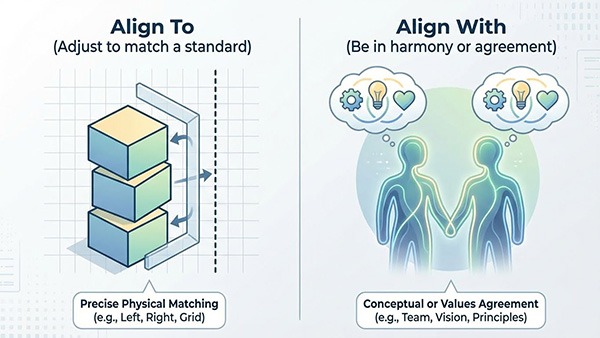
The phrases “align to” and “align with” both involve the concept of bringing something into agreement or correspondence with something else. However, they carry slightly different connotations and are used in distinct contexts. Let’s break down their definitions to understand the nuances.
Align To
“Align to” generally implies a closer, more direct conformity or adherence to a specific standard, rule, or objective. It suggests a deliberate effort to match something precisely to a predefined target. The focus is often on achieving a specific, measurable outcome.
Common usages of “align to” include:
Young Adults & Students:
Get 6 Months of Prime for $0

Ages 18-24 unlock exclusive perks including:
Contains affiliate link
- Conforming to a standard or regulation
- Matching data or information to a specific format
- Adjusting actions to meet a specific goal
Align With
“Align with,” on the other hand, suggests a broader agreement or compatibility with a general principle, value, or direction. It implies a sense of harmony or shared purpose, without necessarily requiring exact conformity. The emphasis is on overall consistency and support.
Common usages of “align with” include:
- Agreeing with a philosophy or belief
- Supporting a cause or movement
- Being consistent with a set of values
Structural Breakdown
Both “align to” and “align with” follow a similar grammatical structure: “align” (verb) + preposition (“to” or “with”) + object (noun or pronoun). Understanding this structure helps to clarify the relationship between the elements being aligned.
The basic structure is:
[Subject] + align + [to/with] + [Object]
Let’s examine the components:
- Subject: The entity that is doing the aligning (e.g., “The company,” “My goals,” “The software”).
- Align: The verb indicates the action of bringing something into agreement or correspondence.
- To/With: These prepositions are the key differentiators, indicating the type of alignment.
- Object: The entity that the subject is being aligned with (e.g., “the regulations,” “my values,” “the market trends”).
Consider these examples:
- “The company aligns its policies to the new regulations.” Here, “the company” is the subject, “aligns” is the verb, “to” is the preposition, and “the new regulations” is the object.
- “My goals align with my values.” In this sentence, “my goals” is the subject, “align” is the verb, “with” is the preposition, and “my values” is the object.
Types and Categories of Alignment
The concept of alignment can be categorized based on the context in which it is used. Recognizing these categories can further clarify the appropriate use of “align to” and “align with.”
Alignment to Standards or Regulations
This type of alignment involves conforming to specific rules, guidelines, or benchmarks. “Align to” is typically used in this context.
Alignment to Goals or Objectives
This involves adjusting actions or strategies to achieve a desired outcome. Again, “align to” is generally the preferred choice.
Alignment with Values or Principles
This type of alignment focuses on consistency with beliefs, ethics, or moral codes. “Align with” is more appropriate in this scenario.
Alignment with Trends or Market Conditions
This involves adapting to current market trends or consumer preferences. “Align with” is commonly used, suggesting a broader compatibility.
Alignment in Design or Layout
This refers to the arrangement of elements in a visually harmonious manner. “Align to” can be used when referring to a specific grid or baseline, while “align with” can be used more generally to suggest visual coherence.
Examples: Align To and Align With in Context
To illustrate the differences between “align to” and “align with,” let’s examine various examples in different contexts. The following tables present examples that highlight the nuances of each phrase.
Examples of “Align To”
This table provides examples of sentences using “align to,” focusing on adherence to standards, regulations, and specific goals.
| Sentence | Context |
|---|---|
| The software aligns to the industry standard for data encryption. | Technical compliance |
| The company must align its practices to the new environmental regulations. | Regulatory compliance |
| We need to align our marketing strategy to the target demographic’s preferences. | Strategic planning |
| The project budget must align to the financial constraints. | Financial planning |
| The curriculum is aligned to the state’s educational standards. | Educational standards |
| The research findings align to the initial hypothesis. | Scientific validation |
| The assembly line is aligned to maximize production efficiency. | Operational efficiency |
| The telescope was carefully aligned to the North Star. | Precise positioning |
| The organization aligned its resources to support the disaster relief efforts. | Resource allocation |
| The new policies are aligned to promote employee well-being. | Policy implementation |
| The car’s wheels need to be aligned to prevent uneven tire wear. | Mechanical adjustment |
| The decorations were aligned to create a symmetrical display. | Aesthetic arrangement |
| The components must be aligned to ensure proper functionality. | Technical specification |
| The text is aligned to the left margin for easy reading. | Formatting |
| The company aligned its goals to the shareholders’ expectations. | Stakeholder alignment |
| The project timeline is aligned to the critical milestones. | Project management |
| The sales targets are aligned to the company’s revenue projections. | Financial targets |
| The security measures are aligned to protect sensitive data. | Data protection |
| The training program is aligned to develop specific skills. | Skill development |
| The voting machines were aligned to ensure accurate vote counting. | Electoral integrity |
| The company aligned its products to the needs of its customers. | Customer service |
| The military aligned its forces to defend the border. | National security |
| The scientist aligned the experiment to test her theory. | Scientific method |
| The chef aligned his recipes to use only local ingredients. | Culinary practice |
| The city aligned its infrastructure to handle future growth. | Urban planning |
Examples of “Align With”
This table provides examples of sentences using “align with,” focusing on agreement with values, principles, and general trends.
| Sentence | Context |
|---|---|
| Her actions align with her stated values of integrity and honesty. | Ethical consistency |
| The company’s mission aligns with its commitment to social responsibility. | Corporate values |
| His political views align with the principles of liberalism. | Political ideology |
| The research findings align with previous studies in the field. | Scientific consensus |
| The project’s goals align with the organization’s long-term vision. | Strategic alignment |
| The new marketing campaign aligns with current consumer trends. | Market relevance |
| The proposed solution aligns with the client’s needs and expectations. | Client satisfaction |
| The artist’s style aligns with the principles of modernism. | Artistic movement |
| The author’s writing aligns with her personal experiences. | Authenticity |
| The organization’s policies align with the principles of human rights. | Ethical standards |
| The teacher’s methods align with the best practices in education. | Educational methodology |
| The coach’s training aligns with the athlete’s capabilities. | Personalized development |
| The government’s policies align with the needs of its citizens. | Public service |
| The doctor’s advice aligns with the patient’s overall health goals. | Medical care |
| The lawyer’s arguments align with the principles of justice. | Legal practice |
| The engineer’s designs align with the principles of sustainability. | Environmental responsibility |
| The architect’s vision aligns with the client’s lifestyle. | Design philosophy |
| The musician’s compositions align with the emotions she wants to convey. | Artistic expression |
| The programmer’s code aligns with the project’s requirements. | Software development |
| The investor’s strategy aligns with his risk tolerance. | Financial planning |
| The chef’s menu aligns with the restaurant’s theme. | Culinary concept |
| The gardener’s planting aligns with the local climate. | Environmental awareness |
| The dancer’s movements align with the rhythm of the music. | Artistic performance |
| The speaker’s words align with her body language. | Effective communication |
| The writer’s story aligns with the reader’s expectations. | Narrative structure |
Comparison Table: Align To vs. Align With
This table summarizes the key differences between “align to” and “align with” to provide a quick reference.
| Feature | Align To | Align With |
|---|---|---|
| Meaning | Conform to a specific standard or goal | Agree with a general principle or value |
| Emphasis | Precise conformity | Overall consistency |
| Context | Standards, regulations, objectives | Values, principles, trends |
| Example | “The company aligned its practices to the new regulations.” | “Her actions align with her stated values.” |
It’s also important to recognize situations where something is aligned to or aligned with a specific goal or principle. In many professional contexts, you may need to determine whether strategies align with or align to organizational standards, ensuring that actions are both consistent and precise.
Usage Rules: When to Use Each Phrase
To ensure correct usage, consider the following guidelines when choosing between “align to” and “align with.”
- Use “align to” when: You want to emphasize adherence to a specific, measurable standard, rule, or objective. The goal is to achieve precise conformity.
- Use “align with” when: You want to emphasize agreement or compatibility with a general principle, value, or direction. The focus is on overall consistency and support.
When crafting professional or academic writing, it’s essential to align with meaning so that every sentence clearly conveys its intended message. Ensuring that ideas are in align with meaning helps readers interpret the content correctly and reduces confusion.
Writers should strive to align with meaning by checking that examples, arguments, and explanations are consistent with the main point. Similarly, your statements should be aligned with the overall purpose or guiding principle of your text, which enhances clarity, coherence, and effectiveness. Paying attention to meaning ensures communication is precise and persuasive.
Consider the intended meaning and the context of the sentence. If you are referring to a specific target or benchmark, “align to” is likely the better choice. If you are referring to a broader concept or belief, “align with” is more appropriate.
Common Mistakes to Avoid
One common mistake is using “align to” when “align with” is more appropriate, and vice versa. This often occurs when the speaker or writer is not clear about the specific meaning they intend to convey.
Here are some examples of common mistakes and their corrections:
| Incorrect | Correct | Explanation |
|---|---|---|
| Her actions align to her values. | Her actions align with her values. | “With” is used because it refers to consistency with general values, not a specific target. |
| The company’s policies align with the regulations. | The company’s policies align to the regulations. | “To” is used because it refers to conforming to specific rules. |
| We need to align our strategy with the sales targets. | We need to align our strategy to the sales targets. | “To” is used because it refers to achieving specific, measurable objectives. |
Another common mistake is using the wrong preposition altogether. For example, using “align on” or “align in” instead of “align to” or “align with.” These alternatives are generally incorrect.
Practice Exercises
Test your understanding of “align to” and “align with” with the following exercises. Choose the correct phrase to complete each sentence.
Exercise 1: Fill in the Blanks
Complete the following sentences with either “align to” or “align with.”
| Question | Answer |
|---|---|
| 1. The company needs to ______ the new safety standards. | align to |
| 2. His beliefs ______ the principles of democracy. | align with |
| 3. The project plan must ______ the available resources. | align to |
| 4. The organization’s mission ______ its core values. | align with |
| 5. We need to ______ our marketing efforts the target audience. | align to |
| 6. Her lifestyle choices ______ her environmental concerns. | align with |
| 7. The software is designed to ______ the latest security protocols. | align to |
| 8. The proposed solution ______ the client’s requirements. | align with |
| 9. The budget needs to ______ the project’s objectives. | align to |
| 10. The team’s goals ______ the company’s overall strategy. | align with |
Exercise 2: Multiple Choice
Choose the correct phrase from the options provided.
| Question | Options | Answer |
|---|---|---|
| 1. The curriculum is designed to ______ the national standards. | a) align to b) align with | a) align to |
| 2. His actions do not ______ his words. | a) align to b) align with | b) align with |
| 3. We need to ______ our resources the project’s needs. | a) align to b) align with | a) align to |
| 4. The company’s values ______ the principles of sustainability. | a) align to b) align with | b) align with |
| 5. The new policies are intended to ______ the best practices in the industry. | a) align to b) align with | a) align to |
| 6. Her personal beliefs ______ her professional conduct. | a) align to b) align with | b) align with |
| 7. The system is configured to ______ the data format requirements. | a) align to b) align with | a) align to |
| 8. The proposed changes ______ the user’s feedback. | a) align to b) align with | b) align with |
| 9. The project timeline must ______ the critical milestones. | a) align to b) align with | a) align to |
| 10. The team’s objectives ______ the organization’s strategic goals. | a) align to b) align with | b) align with |
Exercise 3: Sentence Correction
Identify and correct the errors in the following sentences.
| Incorrect Sentence | Correct Sentence |
|---|---|
| 1. The company’s practices align with the new regulations. | The company’s practices align to the new regulations. |
| 2. His actions align to his stated values. | His actions align with his stated values. |
| 3. We need to align our strategy with the specific targets. | We need to align our strategy to the specific targets. |
| 4. The organization’s mission aligns to its core values. | The organization’s mission aligns with its core values. |
| 5. The software aligns with the industry standard. | The software aligns to the industry standard. |
| 6. Her lifestyle choices align to her environmental concerns. | Her lifestyle choices align with her environmental concerns. |
| 7. The proposed solution aligns to the client’s requirements. | The proposed solution aligns with the client’s requirements. |
| 8. The budget needs to align with the project’s objectives. | The budget needs to align to the project’s objectives. |
| 9. The team’s goals align to the company’s overall strategy. | The team’s goals align with the company’s overall strategy. |
| 10. The curriculum is designed to align with the national standards. | The curriculum is designed to align to the national standards. |
Advanced Topics: Nuances and Subtleties
While the basic distinction between “align to” and “align with” is relatively straightforward, there are some advanced nuances to consider. In certain contexts, the choice between the two phrases can be subtle and depend on the specific intention.
For instance, in a highly technical field, “align to” might be used even when referring to general principles if the emphasis is on precise application of those principles. Conversely, in a more philosophical context, “align with” might be used even when referring to specific goals if the emphasis is on the underlying values that drive those goals.
Furthermore, the choice between “align to” and “align with” can sometimes be influenced by regional variations in language use. While the general rules outlined in this article apply broadly, certain dialects or professional jargons may favor one phrase over the other in specific situations.
Frequently Asked Questions
Here are some frequently asked questions about the usage of “align to” and “align with.”
Is there a hard and fast rule for when to use “align to” versus “align with”?
While there are general guidelines, the best choice depends on the specific context and intended meaning. “Align to” emphasizes conformity to a specific standard or goal, while “align with” emphasizes agreement with a general principle or value.
Can I use “align on” instead of “align to” or “align with”?
Generally, no. “Align on” is not a standard or widely accepted alternative to “align to” or “align with.” It’s best to stick to the established phrases.
Is it ever acceptable to use “align with” when referring to a specific regulation?
While “align to” is generally preferred when referring to regulations, “align with” might be acceptable if the focus is on the overall spirit or intent of the regulation, rather than strict adherence to every detail. However, “align to” is still the safer and more precise choice.
What if I’m unsure which phrase to use?
If you’re unsure, consider the context carefully. Ask yourself whether you’re emphasizing precise conformity to a specific target (“align to”) or broader agreement with a general principle (“align with”). If possible, rephrase the sentence to avoid the issue altogether.
Are there any regional differences in usage?
While the general rules apply broadly, there may be slight regional variations in preference. However, using the guidelines outlined in this article will ensure your writing is grammatically correct and clear in most contexts.
Does the tone of the writing affect the choice between “align to” and “align with”?
The tone can subtly influence the choice. More formal or technical writing often favors “align to” for its precision, while more informal or philosophical writing might lean towards “align with” for its emphasis on broader agreement.
Can I use “align” without any preposition?
Yes, but the meaning changes. “Align” without a preposition typically means to arrange things in a straight line or to bring things into a proper relative position. For example, “Please align the chairs along the wall.” This is different from the meaning of “align to” or “align with,” which refers to agreement or conformity.
How important is it to get this right?
While the difference between “align to” and “align with” may seem subtle, using the correct phrase can significantly improve the clarity and precision of your writing. In professional or academic contexts, choosing the right phrase can enhance your credibility and ensure your message is accurately conveyed.
Conclusion
Mastering the nuances of “align to” and “align with” is essential for clear and effective communication. By understanding the subtle differences in their meanings and appropriate contexts, you can ensure your writing is precise and grammatically sound. Remember that “align to” emphasizes conformity to a specific standard or goal, while “align with” emphasizes agreement with a general principle or value.
Continue to practice using these phrases in different contexts to solidify your understanding. Pay attention to how they are used in professional writing, academic texts, and everyday conversations. With consistent practice, you’ll be able to confidently navigate the choice between “align to” and “align with,” enhancing your overall communication skills.
By internalizing the guidelines and examples provided in this article, you’ll be well-equipped to use “align to” and “align with” correctly, ensuring your message is always clear, concise, and grammatically accurate.

I’m James Terban, a teacher with a degree in Education and five years of experience working with students of all ages, from young kids learning their first grammar rules to adults picking up English as a second language. I started Linguistics Guide because I kept seeing good learners hit a wall due to explanations that were either too vague or too complicated. Every article here comes from a real question I have heard in a classroom or seen asked online.